Jazz Instruments: The Complete Guide to Every Instrument in Jazz
Jazz instruments are the specific acoustic and electro-acoustic instruments, including trumpet, saxophone, double bass, piano, drums, trombone, guitar, clarinet, flute, vibraphone, and organ, that form the core vocabulary of jazz music. Each is selected for its capacity for improvisation, expressive pitch manipulation, and rhythmic conversation within an ensemble. No other musical tradition places quite the same demands on its instruments: they must whisper, shout, bend, growl, and hold a conversation simultaneously with five other musicians, all without a conductor telling them when to move.
This guide covers every major jazz instrument by family, explains what separates jazz technique from classical or pop playing on the same instrument, and gives you a practical starting point if you’re choosing your first instrument. According to All About Jazz, the instrument roster in jazz ranges from the core ensemble lineup to occasionally featured voices like violin and cello, and in contemporary settings even includes synthesizers and wind controllers. We’ll cover all of that here.
What You’ll Learn in This Guide
- How jazz instruments are organized into families: brass, woodwinds, keyboards, strings, and percussion
- The specific role each instrument plays inside an ensemble, from walking bass lines to comping chords
- Famous players and essential recordings for every instrument covered
- What separates jazz technique from classical or pop technique on the same instrument
- How to pick the right instrument if you’re a beginner, including approximate costs
- Unusual instruments that have reshaped what jazz music instruments can mean: theremin, sitar, turntables, and more
Whether you’re a first-time listener trying to identify that warm low voice in a trio, or a student figuring out what instruments are used in jazz before you commit to lessons, you’re in the right place.
What Makes an Instrument a “Jazz Instrument”?
Let’s be honest: technically, any instrument can play jazz. People have recorded jazz on harp, sousaphone, and marimba. But certain instruments dominate jazz history for specific, acoustic and expressive reasons that go beyond tradition or accident.
The Three Qualities Every Jazz Instrument Shares
Tonal flexibility comes first. Jazz musicians bend pitches, shade timbres, and apply vibrato in ways that classical training actively discourages. An instrument that locks you into a fixed, precise tone is a harder sell in jazz. The saxophone’s key system, the trumpet’s valve technique, and the upright bass’s open strings all allow continuous pitch manipulation that puts the player, not the instrument, in control of the sound.
Dynamic range matters just as much. A jazz musician needs to drop to a near-whisper during a ballad and then build to a roar inside eight bars. The trumpet covers this spectrum without electronic amplification. So does the saxophone. The drum kit can brush-whisper or crash-thunder depending on what the moment demands.
Conversational responsiveness is the hardest quality to quantify but the most essential. Jazz is, at its core, a musical conversation. Every instrument must be able to “respond” to what it hears in real time, whether that means a bassist shortening a note to match a drummer’s accent or a pianist dropping out entirely to let a trumpet breathe. This quality rules out most instruments that require long physical setup to produce a single sound.
Why Not Every Instrument Is Equally Suited to Jazz
Instruments with fixed pitches, slow response times, or extremely limited dynamic range face real challenges in jazz settings. The pipe organ, for example, doesn’t bend notes. The orchestral oboe’s bright, penetrating tone sits awkwardly in a swing ensemble. That said, jazz has never fully respected these boundaries. Violins appeared in early string-band jazz; accordion underpins Astor Piazzolla’s nuevo tango; cello shows up in Fred Katz’s work with the Chico Hamilton Quintet. We cover these unusual voices later in this guide (see the Unusual Instruments section below).
Jazz prioritizes expression over precision. Classical performance culture prizes a clean, accurate tone above all else. Jazz culture prizes a personal, identifiable voice above all else, even if it’s a little rough around the edges.
The Rhythm Section, The Foundation of Every Jazz Band
The rhythm section is the engine room of any jazz band. It typically consists of drums, double bass, piano, and guitar, though trios often drop guitar and some groups omit piano entirely.
Two concepts define rhythm section playing. Comping (short for “accompanying”) means providing rhythmic and harmonic support behind a soloist without overwhelming them. Soloing is when a rhythm player steps forward to take an improvised lead. Most jazz rhythm musicians alternate between both roles within a single performance. Some jazz trios omit guitar entirely (Bill Evans, Oscar Peterson); some quartets drop piano to create space for the horn players. The configurations are flexible, but the rhythm section concept stays constant.
Double Bass
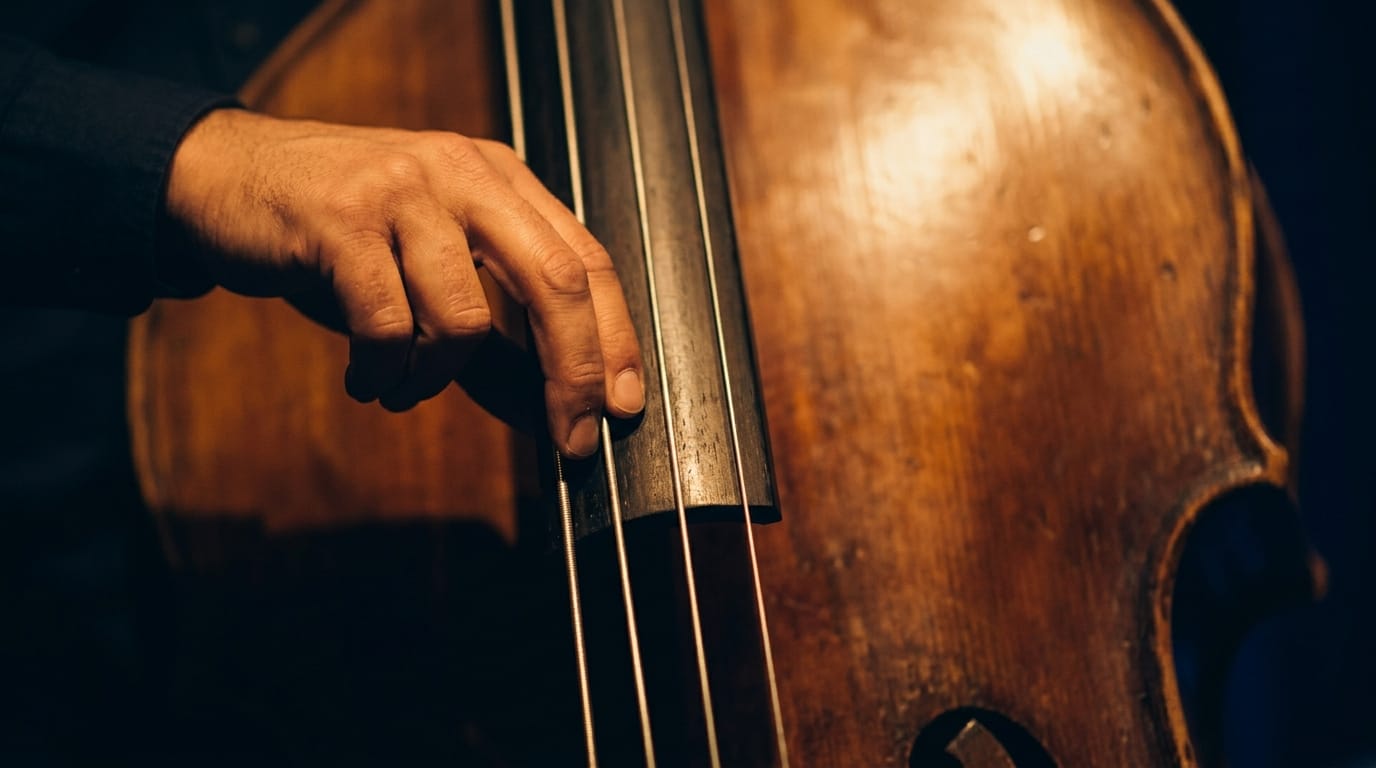
The double bass (also called the upright bass or contrabass) serves as the harmonic and rhythmic anchor of the jazz ensemble. Its primary jazz technique is the walking bass line: a steady, four-to-the-bar pattern that outlines chord changes while propelling the forward momentum of the music. A great walking line does more than mark time. It breathes with the ensemble, simultaneously grounding the harmony and pushing the rhythm forward. Paul Chambers’s bass on Miles Davis’s Kind of Blue (Columbia, 1959) is one of the most studied examples of this balance in recorded jazz.
Jazz bass differs from classical double bass in two key ways. First, jazz bassists primarily use pizzicato (plucking the strings with fingers) rather than arco (bowing), though arco appears in ballads and avant-garde contexts. Second, jazz bassists improvise solos and actively shape the harmonic direction of a performance. Classical bass players read parts. Jazz bassists negotiate in real time.
Standard jazz upright basses are typically 3/4 size, and players use either steel or gut strings depending on the tonal character they want. Gut strings produce a warmer, darker sound; steel strings project more clearly in loud settings.
Essential players: Paul Chambers, Ron Carter, Charles Mingus, Ray Brown, Scott LaFaro.
Key recordings:
- Kind of Blue, Miles Davis (Paul Chambers, Columbia, 1959)
- The Complete Village Vanguard Recordings, 1961, Bill Evans Trio (Scott LaFaro, Riverside)
- Bass on Top, Paul Chambers (Blue Note, 1957)
Drum Kit
Jazz drums don’t just keep time. They have a conversation. Art Blakey once said that the drummer sets the temperature of the room, and anyone who’s heard Blakey’s press roll on A Night in Tunisia (Blue Note, 1954) knows exactly what that means. Jazz drumming uses the swing feel, a specific approach to subdividing beats that creates the distinctive forward lean of jazz time.
Jazz kit setup differs from rock setups in concrete, measurable ways. Jazz drummers favor thin ride cymbals (not heavy crash cymbals) as the primary timekeeping surface. The hi-hat, which drives rock music, plays a supporting role in jazz. Bass drums in jazz are typically 18 to 20 inches in diameter, compared to 22 to 26 inches in rock. Wire brushes replace sticks for quiet settings. These are not stylistic preferences. They’re physical tools that produce a different, softer, more responsive sound.
Essential players: Art Blakey, Max Roach, Elvin Jones, Tony Williams, Jack DeJohnette.
Key recordings:
- A Night in Tunisia, Art Blakey & the Jazz Messengers (Blue Note, 1954)
- We Insist! Freedom Now Suite, Max Roach (Candid, 1960)
- My Favorite Things, John Coltrane (Elvin Jones, Atlantic, 1961)
Piano
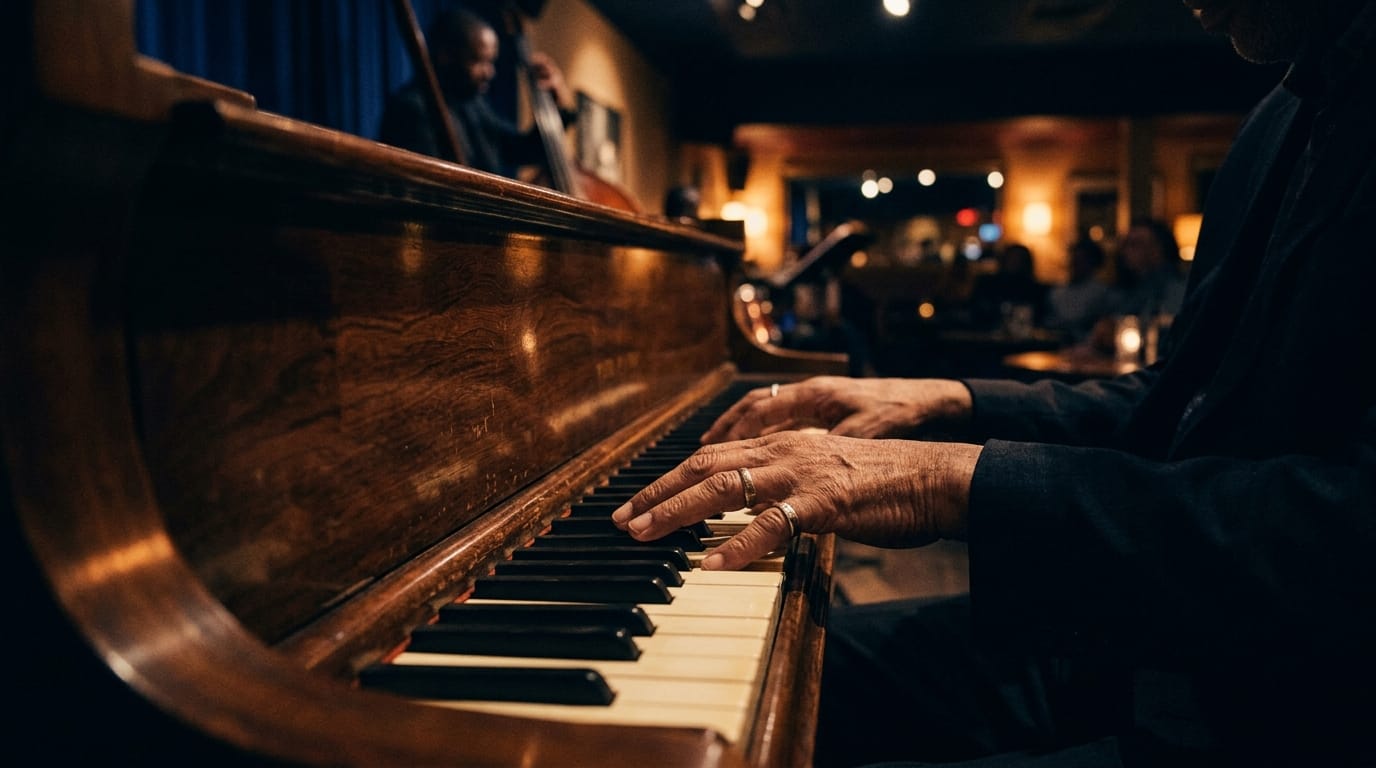
The piano occupies a unique dual role in jazz. It’s the only common jazz instrument that can simultaneously cover harmony, melody, rhythm, and bass register. Jazz pianists exploit this fully: they comp rhythmic chord voicings with the left hand, improvise melodic lines with the right, and shift between support and soloist roles without missing a beat.
Jazz piano technique diverges sharply from classical training in several areas. Jazz pianists use shell voicings (playing only the root, third, and seventh of a chord, omitting the fifth) and rootless voicings (dropping the root entirely and leaving it to the bassist). Both techniques create space and harmonic ambiguity that classical training typically avoids. Then there’s the concept of laying out: a jazz pianist deliberately stops playing to give a soloist room to breathe. You’ll rarely hear a classical pianist go silent in the middle of an accompaniment. In jazz, knowing when to stop is as important as knowing what to play.
Two recordings illustrate how differently the piano can function in jazz. Thelonious Monk’s angular, space-filled voicings on Thelonious Monk with John Coltrane (Riverside, 1957) sit in stark contrast to the lush, interconnected approach Bill Evans took on Waltz for Debby (Riverside, 1961). Both records are worth close study, and both remain foundational references for jazz piano students.
Essential players: Thelonious Monk, Bill Evans, Oscar Peterson, McCoy Tyner, Herbie Hancock.
Key recordings:
- Thelonious Monk with John Coltrane (Riverside, 1957)
- Waltz for Debby, Bill Evans (Riverside, 1961)
- Head Hunters, Herbie Hancock (Columbia, 1973)
Guitar
The jazz guitar has a specific physical identity: the hollow-body archtop. Instruments like the Gibson ES-175 and the Gibson L-5 CES produce a warm, rounded tone with minimal sustain and virtually no distortion. That sound sits perfectly under a saxophone without competing for the same frequencies. Solid-body electric guitars, which dominate rock and blues, push a brighter, more cutting tone that can clash with brass instruments.
Jazz guitar functions in two distinct modes. In the rhythm section, the guitarist comps chords behind soloists, using single-note or chord stabs to punctuate the harmonic rhythm. As a lead voice, the guitarist takes improvised solos that can rival a horn player’s melodic inventiveness. Joe Pass made the case for solo jazz guitar with his Virtuoso album (Pablo, 1974) and its companion Solo Concerts: Bremen & Lausanne (Pablo, 1975), performing unaccompanied arrangements that covered melody, harmony, and bass line simultaneously.
Charlie Christian’s work with Benny Goodman’s sextet between 1939 and 1941 essentially established the amplified jazz guitar as a front-line solo instrument, and those recordings still hold up as a masterclass in melodic invention.
Essential players: Charlie Christian, Wes Montgomery, Joe Pass, Pat Metheny, Jim Hall.
Key recordings:
- The Incredible Jazz Guitar of Wes Montgomery (Riverside, 1960)
- Virtuoso, Joe Pass (Pablo, 1974)
- Solo Concerts: Bremen & Lausanne, Joe Pass (Pablo, 1975)
Brass Instruments in Jazz
The frontline in jazz refers to the brass and woodwind instruments that carry the melody and improvise over the rhythm section. In a standard quartet, there’s one frontline horn; in a big band, the frontline expands to three or four independent sections. Brass instruments specifically dominate jazz history because of their power, expressive range, and technical capacity for pitch manipulation through mutes and embouchure (the way a player shapes their lips and facial muscles against the mouthpiece).
Trumpet
The trumpet is the lead voice of jazz history. From Louis Armstrong’s revolutionary recordings in the late 1920s through Miles Davis’s modal experiments in the late 1950s and Freddie Hubbard’s hard-bop virtuosity in the 1960s, the trumpet has sat at the front of nearly every jazz movement. No other single instrument spans jazz history so continuously.
Jazz-specific trumpet technique centers heavily on mutes, physical devices inserted into or placed over the bell to alter tone color. The straight mute creates a bright, nasal tone. The cup mute softens and darkens the sound. The Harmon mute (sometimes called the wah-wah mute) produces a thin, intimate, almost electronic timbre. Miles Davis’s use of the Harmon mute on “Blue in Green” from Kind of Blue (Columbia, 1959) created a sonic identity so distinctive that it remains one of the most referenced trumpet sounds in recorded jazz. Jazz players also use half-valving (partially depressing a valve to produce blue-note microtones) and growl technique (vocalizing into the horn while playing).
Here’s the physics: the trumpet’s fundamental frequencies sit in the 200Hz to 1kHz range, placing its core voice in exactly the midrange band where human ears are most sensitive. It cuts through an ensemble naturally, without amplification, which explains why it emerged as jazz’s primary lead voice in the pre-microphone era of the 1920s and 1930s.
Jazz trumpet contrasts with classical playing in one key way. Classical players prize a consistent, clear, warm tone throughout the register. Jazz players deliberately alter tone color within a single phrase, using the same note played loudly, softly, muted, or half-valved to communicate different emotional states.
Essential players: Louis Armstrong, Miles Davis, Dizzy Gillespie, Clifford Brown, Freddie Hubbard.
Key recordings:
- West End Blues, Louis Armstrong (OKeh, 1928)
- Kind of Blue, Miles Davis (Columbia, 1959)
- Clifford Brown and Max Roach (EmArcy, 1954)
Trombone
The trombone’s slide is jazz’s original pitch-bending tool. Before electronic pitch effects, before the whammy bar, before any studio processing, the trombone could glide between pitches in a single continuous motion. This glissando technique, sliding smoothly between notes, became a defining sound of New Orleans jazz and remained expressive throughout the bebop and hard-bop eras.
Jazz trombone stands apart from classical playing primarily in how aggressively it uses glissando. Classical trombone technique employs slides sparingly and precisely. Jazz trombone treats the slide as an expressive voice in its own right. J.J. Johnson, who proved definitively that bebop’s fast tempos were achievable on trombone, recorded The Eminent Jay Jay Johnson, Vol. 1 for Blue Note in 1953. That record changed what people thought the instrument could do.
Big band configurations use both tenor trombone (the most common, pitched in B-flat) and bass trombone (a deeper-voiced instrument that anchors the low end of the trombone section). A standard big band trombone section runs three or four players.
Essential players: J.J. Johnson, Kid Ory, Jack Teagarden, Curtis Fuller, Bob Brookmeyer.
Key recordings:
- The Eminent Jay Jay Johnson, Vol. 1 (Blue Note, 1953)
- Blues on the Corner, Curtis Fuller (Blue Note, 1961)
Flugelhorn
Most jazz instrument guides skip the flugelhorn. That’s a mistake. The flugelhorn produces one of the warmest, darkest tones in the brass family, and for ballads and intimate recording settings, it’s genuinely irreplaceable.
The physical difference from trumpet is measurable. The flugelhorn uses a conical bore (the tubing expands gradually from mouthpiece to bell). The trumpet uses a cylindrical bore (mostly consistent diameter until it flares at the bell). That difference in tubing shape produces a rounder, less penetrating tone. Miles Davis used flugelhorn extensively on Sketches of Spain (Columbia, 1960), where its mellow character suited Gil Evans’s orchestrations perfectly. Art Farmer eventually switched from trumpet to flugelhorn almost entirely, arguing that its sound better suited the introspective music he wanted to make. His album Something to Live For (Contemporary, 1987) with the String Ensemble makes the case convincingly.
Flugelhorn isn’t typically a first instrument. Most players come to it from trumpet. But if you’re serious about jazz ballads or chamber jazz, it’s worth exploring early.
Essential players: Miles Davis, Art Farmer, Clark Terry.
Woodwind Instruments in Jazz
Woodwinds cover an enormous range of tonal territory in jazz, from the bright, altissimo shriek of a soprano saxophone to the breathy warmth of a jazz flute to the low-register growl of a baritone saxophone. The saxophone family alone accounts for more recorded jazz solos than any other instrument family. The clarinet, dominant before 1945, never fully disappeared. The flute arrived as a significant voice in hard bop and gained steady ground from the 1960s onward.
Saxophone, The Voice of Jazz
The saxophone is the instrument most associated with jazz worldwide, and it earned that association through pure expressive range. Invented by Adolphe Sax in 1846 (making it the only major orchestral instrument invented by a single identifiable person), the saxophone was initially designed for military bands. Jazz musicians discovered that its combination of a brass body, woodwind fingering system, and single-reed mouthpiece created something extraordinarily flexible for improvisation.
Four saxophone voices dominate jazz:
- Alto saxophone: Brighter, higher voice in the saxophone family. Most closely associated with bebop (Charlie Parker recorded “Ko-Ko” on alto for Savoy Records in 1945, establishing the vocabulary of the entire modern era). The alto is the most common starting saxophone for beginners because the pedagogy is well-documented and the instrument is physically accessible.
- Tenor saxophone: The workhorse of jazz. Its rich, full tone sits perfectly in the midrange for melodic improvisation. John Coltrane, Sonny Rollins, Wayne Shorter, and Coleman Hawkins all built careers around it. Saxophone Colossus (Prestige, 1956) remains one of Rollins’s defining statements on the instrument.
- Soprano saxophone: Straight or curved body; nasal and penetrating in tone. Coltrane introduced it to a mass jazz audience on My Favorite Things (Atlantic, 1961), and the sound still defines the soprano’s jazz identity.
- Baritone saxophone: Deep and powerful. Gerry Mulligan pioneered the bari as a solo voice in jazz rather than just a section instrument. His California-based pianoless quartet recordings from 1952 on Pacific Jazz proved the baritone could carry a frontline.
Jazz saxophone technique goes well beyond standard fingering. Altissimo register playing (producing notes above the standard written range through embouchure pressure and fingering combinations), subtone technique (relaxing embouchure pressure to produce a hushed, airy sound at the bottom of the range), and extreme vibrato control all separate jazz saxophone from classical or orchestral playing. Coltrane’s late-period work introduced multiphonics: producing two or more simultaneous pitches on a single saxophone. It’s an advanced technique, but it illustrates how far jazz players push the instrument’s physical limits.
| Type | Pitch Range | Jazz Role | Famous Player | Key Album |
|---|---|---|---|---|
| Alto | D♭3–A♭5 | Bebop lead voice, melody | Charlie Parker | Jazz at Massey Hall (Debut, 1953) |
| Tenor | A♭2–E♭5 | Workhorse solo instrument | John Coltrane | A Love Supreme (Impulse!, 1965) |
| Soprano | A♭3–E♭6 | Distinctive lead, modal contexts | Wayne Shorter | Speak No Evil (Blue Note, 1966) |
| Baritone | C2–A♭4 | Low anchor, solo voice | Gerry Mulligan | California Concerts (Pacific Jazz, 1954) |
Essential players: Charlie Parker (alto), John Coltrane (tenor/soprano), Sonny Rollins (tenor), Gerry Mulligan (baritone), Wayne Shorter (tenor/soprano).
Clarinet
Here’s the thing about the clarinet: it was the dominant jazz woodwind before 1940. The saxophone largely replaced it during the bebop era, but the clarinet never disappeared from jazz. It’s more accurate to say it changed roles.
In New Orleans jazz and swing, the clarinet occupied the high melodic voice of the front line, weaving around the trumpet’s lead and the trombone’s counter-melody. Benny Goodman’s 1938 Carnegie Hall concert (recorded live and released on Columbia in 1950) remains one of the most documented jazz performances in history, with Goodman’s clarinet defining the swing era to a popular audience of millions. That concert reportedly drew the largest live jazz audience to that point.
Jazz clarinet technique uses the instrument’s full altissimo register and embraces “dirty” tonal inflections that classical players are specifically trained to eliminate. Pee Wee Russell’s intentionally rough tone, for example, would be considered a fault in a classical audition. In jazz, it was his voice.
Essential players: Sidney Bechet, Benny Goodman, Artie Shaw, Pee Wee Russell.
Key recordings:
- Sing, Sing, Sing, Benny Goodman (1938 Carnegie Hall Concert, Columbia)
- Blue Light, Duke Ellington feat. Barney Bigard (Victor, 1938)
Flute
The flute entered jazz as a secondary voice, primarily as a doubling instrument for saxophone players. It gained real prominence during the hard bop era of the late 1950s and early 1960s, and by the 1970s, jazz flute had its own distinct identity.
The flute’s main challenge in jazz is volume. It’s a quieter instrument than saxophone or trumpet, and in live settings it often requires amplification, which changes its tone character. But in the recording studio, its limitations become assets. A jazz flute solo on a ballad can carry an intimacy that nothing else matches.
Jazz flute uses a technique you won’t find in classical playing: singing into the flute while playing. The player vocalizes a pitch through the instrument simultaneously, producing a rough, doubled tone or a specific kind of harmonic distortion. Herbie Mann and Hubert Laws built their entire jazz identities around these techniques.
Essential players: Hubert Laws, Eric Dolphy (who also played alto saxophone and bass clarinet), Yusef Lateef, Herbie Mann.
Key recordings:
- Flute Talk, Hubert Laws (CBS, 1989)
- Out to Lunch!, Eric Dolphy (Blue Note, 1964)
Keyboard Instruments in Jazz (Beyond Piano)
The piano is the foundational keyboard instrument in jazz and appears in the Rhythm Section section above. But two other keyboard-family instruments have carved out distinct identities in jazz history, each with its own unique technical approach and ensemble role. The Hammond organ redefined the jazz trio format. The vibraphone brought something no other instrument offers: a warm, singing sustain built from steel bars and spinning motor discs.
Hammond Organ
The Hammond B-3 organ is the defining jazz organ, introduced into jazz contexts prominently in the mid-1950s. Jimmy Smith’s Blue Note recordings beginning with A New Sound, A New Star (1956) established the B-3 as a frontline jazz voice rather than a background texture instrument.
The organ trio format (organ, guitar, drums) became a defining jazz configuration because of one specific physical fact: the organist covers bass lines with the organ’s bass pedals while simultaneously comping chords with both hands. This eliminates the need for a separate bassist, creating a leaner, groovier ensemble where all three players operate at full intensity throughout. Back at the Chicken Shack (Blue Note, 1960) is the essential organ trio document.
Jazz organ tone depends on the Leslie speaker, a rotating speaker cabinet that creates a distinctive tremolo and Doppler effect. Jazz organists adjust the Leslie’s rotation speed to shift between a fast “chorus” effect and a slower, warmer rotary sound. This real-time tonal control is central to jazz organ expression and is absent in most digital organ simulations.
Essential players: Jimmy Smith, Jack McDuff, Larry Young, Joey DeFrancesco.
Key recordings:
- Back at the Chicken Shack, Jimmy Smith (Blue Note, 1960)
- Unity, Larry Young (Blue Note, 1965)
Vibraphone
The vibraphone (commonly called “vibes”) is a keyboard percussion instrument, not a brass or woodwind instrument, though its position in jazz often resembles a horn player’s role. Metal bars arranged in keyboard order produce pitched notes when struck with mallets. Motor-driven rotating discs inside the resonators create the instrument’s characteristic warm, pulsing sustain. The player controls vibrato depth by adjusting motor speed.
Vibraphone technique in jazz uses four-mallet technique: holding two mallets in each hand to play full chord voicings, similar in concept to piano comping. Gary Burton pioneered and refined four-mallet jazz vibraphone to a level that DownBeat critics have consistently recognized as one of jazz’s most technically demanding instrumental approaches.
Our editorial team at eJazzNews considers vibraphone one of the most underrepresented instruments in jazz education resources. Milt Jackson’s work with the Modern Jazz Quartet across the 1950s and 1960s, and Bobby Hutcherson’s Blue Note recordings from the mid-1960s, represent some of the most harmonically sophisticated playing the instrument has produced. Interestingly, our own coverage of Karl Berger’s Stone Workshop Orchestra highlights vibraphone as a central voice in contemporary jazz ensemble contexts.
Essential players: Lionel Hampton, Milt Jackson, Gary Burton, Bobby Hutcherson.
Key recordings:
- Bags Groove, Milt Jackson with Miles Davis (Prestige, 1954)
- Alone Together, Gary Burton & Ralph Towner (ECM, 1974)
Percussion Instruments in Jazz (Beyond the Drum Kit)
The drum kit, covered in the Rhythm Section above, is only one dimension of jazz percussion. Latin jazz, which absorbed Afro-Cuban and Afro-Brazilian rhythmic traditions, brought an entirely different family of percussion instruments into jazz contexts starting in the 1940s. These instruments don’t replace the drum kit. They layer additional rhythmic voices on top of it, creating the dense, interlocking rhythmic conversation that defines Latin jazz.
This tradition connects directly to contemporary artists working at the intersection of Cuban jazz and American jazz. For deeper context on how Cuban rhythmic traditions shape modern jazz, our profile of Dayramir Gonzalez traces how Afro-Cuban rhythmic language informs contemporary jazz composition and performance.
Congas and Bongos
The Afro-Cuban jazz movement (often called cubop) began in the mid-1940s, primarily through Dizzy Gillespie’s collaboration with Cuban percussionist Chano Pozo. Their 1947 recording of “Manteca” (Victor) was among the first commercially successful fusions of bebop jazz and Afro-Cuban rhythm. It introduced conga drums to a mainstream jazz audience and established the template for Latin jazz that dozens of musicians would develop over the following decades.
Congas are tall, single-headed drums played with bare hands. They provide the clave-based rhythmic foundation in Latin jazz. The clave is a two-bar rhythmic pattern (existing in 2-3 or 3-2 configurations) that underlies all Afro-Cuban music. Every other instrument in a Latin jazz ensemble orients its phrasing relative to the clave, whether or not it’s explicitly stated. Bongos are smaller, higher-pitched paired drums, typically used for accent figures and melodic rhythmic patterns above the conga foundation.
Essential players: Chano Pozo, Giovanni Hidalgo, Mongo Santamaría.
Key recordings:
- Manteca, Dizzy Gillespie & Chano Pozo (Victor, 1947)
- Afro Roots, Mongo Santamaría (Prestige, 1972)
Unusual Instruments in Jazz, Beyond the Standard Lineup
Jazz has always absorbed outside influences. Its history is, in part, a history of musicians picking up instruments nobody expected in a jazz setting and finding something essential in them. These unusual voices appear rarely, but when they appear, they often redirect the art form.
Theremin in Jazz
The theremin, invented by Léon Theremin in 1928, is one of the earliest electronic instruments. Played without physical contact (the performer moves their hands near two antennas to control pitch and volume), it produces an eerie, continuous pitch glide that sits at the extreme end of tonal flexibility. Sun Ra incorporated the theremin into his Arkestra performances from the 1950s onward, using its otherworldly quality to push jazz into science-fiction sonic territory that no acoustic instrument could reach. Its microtonal capabilities align naturally with jazz’s interest in notes between the notes.
Sitar in Jazz
The sitar entered jazz consciousness through the modal jazz era and John Coltrane’s documented interest in Indian classical music during the early 1960s. A real landmark recording: Joe Harriott and John Mayer’s Indo-Jazz Fusions (Columbia, 1966) placed the sitar directly alongside jazz horns and rhythm section in a composed but improvisational context. The sitar’s drone strings and microtonal capabilities, the ability to produce pitches that fall outside Western equal temperament, aligned naturally with jazz’s post-bop modal experimentation. Ravi Shankar’s collaborations with jazz musicians in this period further deepened the cross-cultural conversation.
Turntables in Jazz
DJ turntables entered jazz through the hip-hop/jazz crossover of the 1990s. Medeski Martin & Wood collaborated with DJ Logic, using turntable scratching as a percussive improvised voice inside jazz ensemble contexts. The turntable as a jazz instrument operates through real-time pitch manipulation, rhythmic scratching as percussion, and sampling as a form of live composition. It’s a legitimate improvising instrument when handled by a skilled player, and its presence in jazz reflects exactly the same absorptive quality that brought the saxophone into swing bands and the electric guitar into bebop combos.
Other Notable Unusual Instruments
Accordion: Astor Piazzolla’s nuevo tango movement built an entire aesthetic around the accordion (specifically the bandoneon) as an expressive jazz-adjacent solo instrument. Banjo: Essential in early New Orleans jazz before the guitar replaced it in the late 1920s. Cello: Fred Katz played cello as a primary voice in the Chico Hamilton Quintet in the mid-1950s, proving it could function as a jazz lead instrument. Contemporary cellist Erik Friedlander has developed the instrument’s jazz vocabulary considerably further. These instruments don’t appear at every jazz gig, but they have real histories in the music.
How to Choose Your First Jazz Instrument, A Practical Guide
Choosing your first jazz instrument is a practical decision, not a philosophical one. The right instrument depends on your budget, your physical characteristics, and the ensemble context you’re walking into. Here’s how to think through it.
Questions to Ask Before You Choose
Start with budget. Entry-level alto saxophones run approximately $300 to $600 from reputable manufacturers (Yamaha, Jupiter, Conn-Selmer). Entry-level trumpets range from $200 to $500. A usable upright bass, including a bow and case, will cost $800 to $2,000 or more for a student-quality instrument. A serviceable acoustic drum kit with cymbals runs $400 to $800.
Physical considerations matter more than most beginner guides admit. Brass and woodwind instruments require lung capacity and embouchure control that develop over months. Unfretted instruments (upright bass, violin) require a strong ear for pitch because there are no frets to guide your fingers. Hand size affects guitar and bass playability. None of these are permanent limitations, but they affect how quickly you’ll progress.
Finally: what does your local scene need? If your school jazz band has five saxophone players and no trumpet, trumpet gets you into the ensemble faster. If your neighborhood jazz jam session has no bass player, bass makes you immediately welcome.
Best First Instruments by Goal
| Goal | Recommended Instrument | Why | Approx. Entry Cost |
|---|---|---|---|
| Solo/melody focus | Alto Saxophone | Most common starter sax; well-documented pedagogy; versatile in combo and big band | $300–$600 |
| Harmony and theory | Piano/Keyboard | Teaches harmony and theory simultaneously; visual layout aids understanding | $200+ (keyboard) |
| Front line | Trumpet | Widest jazz repertoire; affordable at entry level; strong pedagogical tradition | $200–$500 |
| Ensemble anchor | Double Bass | High demand in jazz combos; harder to learn but immediately valuable | $800–$2,000 |
| Groove/rhythm | Drum Kit | Immediate ensemble utility; no pitch reading required initially | $400–$800 |
Resources for Getting Started
The Jamey Aebersold Jazz Play-Along series (Jamey Aebersold Jazz, Inc.) is the most widely used self-teaching resource in jazz education, covering everything from basic blues to advanced standards across more than 130 volumes. DownBeat’s annual Student Music Awards provide a useful benchmark for identifying strong jazz education programs across the United States. For structured online learning, JazzAdvice offers theory and improv resources specifically designed for self-directed jazz students.
Explore our full jazz education section for guides on jazz theory, ear training, and choosing jazz teachers, all built with the same practical focus this article applies to instrument selection.
Jazz Instruments Quick-Reference Table
Use this table for a fast overview of every major jazz instrument family, role, difficulty level, and a key player to start your listening with.
| Family | Instrument | Role in Jazz | Difficulty | Famous Player |
|---|---|---|---|---|
| Brass | Trumpet | Lead melody, improvisation | Intermediate | Miles Davis |
| Brass | Trombone | Harmonic middle voice, glissando | Intermediate | J.J. Johnson |
| Brass | Flugelhorn | Warm lead, ballads | Intermediate | Art Farmer |
| Woodwind | Alto Saxophone | Melody, bebop voice | Beginner-friendly | Charlie Parker |
| Woodwind | Tenor Saxophone | Workhorse solo voice | Beginner-friendly | John Coltrane |
| Woodwind | Soprano Saxophone | Distinctive lead, modal contexts | Intermediate | Wayne Shorter |
| Woodwind | Baritone Saxophone | Low anchor, section foundation | Intermediate | Gerry Mulligan |
| Woodwind | Clarinet | Historical lead, swing era | Intermediate | Benny Goodman |
| Woodwind | Flute | Color, Latin jazz, ballads | Intermediate | Hubert Laws |
| Keyboard | Piano | Harmony, melody, comping | Intermediate | Bill Evans |
| Keyboard | Hammond Organ | Chords + bass lines combined | Intermediate | Jimmy Smith |
| Keyboard | Vibraphone | Melodic color, chord voicings | Advanced | Milt Jackson |
| Strings | Double Bass | Walking bass, harmonic anchor | Advanced | Ron Carter |
| Strings | Guitar | Rhythm comping and lead melody | Intermediate | Wes Montgomery |
| Percussion | Drum Kit | Swing feel, time, conversation | Intermediate | Art Blakey |
| Percussion | Congas/Bongos | Latin rhythm, clave foundation | Intermediate | Mongo Santamaría |
Frequently Asked Questions About Jazz Instruments
What instruments are used in jazz?
The core jazz instruments include trumpet, saxophone (alto, tenor, soprano, and baritone), trombone, clarinet, flute, piano, Hammond organ, vibraphone, double bass, guitar, and drum kit. Percussion instruments like congas and bongos are central to Latin jazz. While technically any instrument can play jazz, these instruments dominate because of their tonal flexibility and capacity for expressive improvisation.
What instruments are in a jazz band?
A standard jazz combo typically includes 4 to 6 instruments: a rhythm section (piano, double bass, drums, and often guitar) plus one or two horn players (trumpet, saxophone, or trombone). A big band expands this to 15 to 25 musicians arranged in trumpet, trombone, and saxophone sections plus a full rhythm section. The exact configuration varies widely. Bill Evans’s trio used piano, bass, and drums with no horn. Miles Davis’s Kind of Blue sextet added two horns and two saxophones to the rhythm section.
What is the most important instrument in jazz?
There is no single most important instrument, but the rhythm section (drums, bass, piano) is consistently called the engine of jazz because it provides the harmonic and rhythmic foundation that every other instrument plays over. Among solo voices, the saxophone is the most historically associated with jazz across all eras, appearing prominently in every major stylistic period from swing through free jazz and contemporary jazz.
Is the guitar a jazz instrument?
Yes. Guitar has been central to jazz since Charlie Christian pioneered amplified jazz guitar in the late 1930s with Benny Goodman’s sextet. In jazz, the hollow-body archtop guitar is preferred for its warm, rounded tone. The guitar functions as both a rhythm section instrument (comping chords) and a lead solo voice. By 1960, Wes Montgomery’s The Incredible Jazz Guitar (Riverside) had established the guitar as fully capable of matching any horn player in melodic invention.
What jazz instruments are good for beginners?
The alto saxophone, trumpet, and piano are the most beginner-friendly jazz instruments. Alto saxophone is particularly popular because the fingering system is well-documented in jazz method books and the instrument is immediately useful in both combo and big band settings. Piano is valuable because it teaches harmony and music theory simultaneously. Trumpet offers the widest jazz repertoire at the most affordable entry cost. See the comparison table in the “How to Choose” section above for approximate costs and specifics.
The Jazz Instrument Family, A Final Word
Jazz instruments weren’t chosen arbitrarily. Each one earned its place in the music because of specific acoustic and expressive qualities that serve jazz’s core values: improvisation, conversation, swing, and individual voice. The trumpet cuts through with its midrange frequencies and mutable tone. The saxophone bends and shades pitch in a way that mirrors human speech. The upright bass walks and propels simultaneously. The drum kit swings rather than simply marks time. Every instrument in this guide brings something to the conversation that no other instrument can replace.
But here’s the thing: the instrument is only the beginning. Jazz technique, harmonic knowledge, and hundreds of hours of listening are what transform a player into a jazz musician. The best next step is to start listening with intention. Pick one instrument from this guide, find the key recordings listed, and spend time with them before you spend money on gear. For that, our jazz education hub and our broader jazz history coverage give you the context to hear what you’re listening to. The instruments open the door. The music itself is what pulls you through.