What Instruments Are Used in Jazz? The Main Jazz Instruments and What They Do
The main instruments used in jazz are the saxophone, trumpet and trombone, which play the melodies and most of the solos, and the piano, double bass, drums and guitar of the rhythm section, which supply the beat and the chords underneath. Clarinet, flute, vibraphone, Hammond organ and Latin percussion such as congas and bongos are standard in particular styles. The wind instrument most closely tied to jazz is the saxophone.
Table of Contents
- How a Jazz Band Is Put Together
- The Rhythm Section
- Double Bass
- Drums
- Piano
- Guitar
- Brass Instruments
- Trumpet
- Trombone
- Woodwinds: Saxophone, Clarinet and Flute
- Saxophone
- Clarinet
- Flute
- Vibraphone and Hammond Organ
- Vibraphone
- Hammond Organ
- Latin Percussion
- Less Common Instruments in Jazz
- Which Jazz Instrument Should You Learn?
- Frequently Asked Questions
- What instruments are used in jazz?
- What wind instrument is most commonly used in jazz?
- What instruments are in a jazz band?
- What percussion instruments are used in jazz?
How a Jazz Band Is Put Together
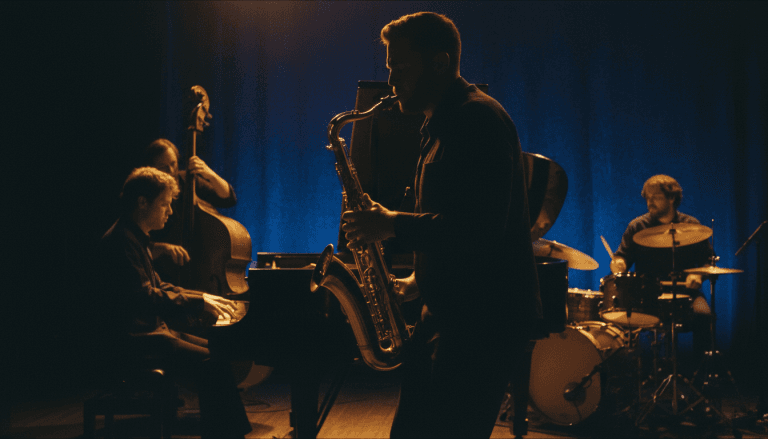
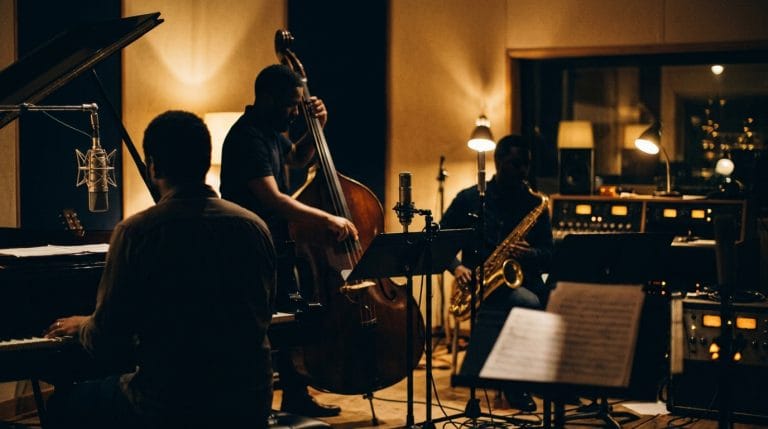
Almost every jazz group has two halves. The rhythm section keeps the time and lays out the harmony; the horns in front of it, often called the front line, state the tune and take most of the solos. Small groups, or combos, usually have three to seven players: a piano trio has no horns at all, while Miles Davis made Kind of Blue (Columbia, 1959) with a sextet of trumpet, alto and tenor saxophone, piano, bass and drums. A big band groups its horns into sections of trumpets, trombones and saxophones, the saxophones typically two altos, two tenors and a baritone, and a common modern format has 17 players. In the earliest jazz bands, banjo and tuba often did the jobs of guitar and bass.
The Rhythm Section
Double Bass
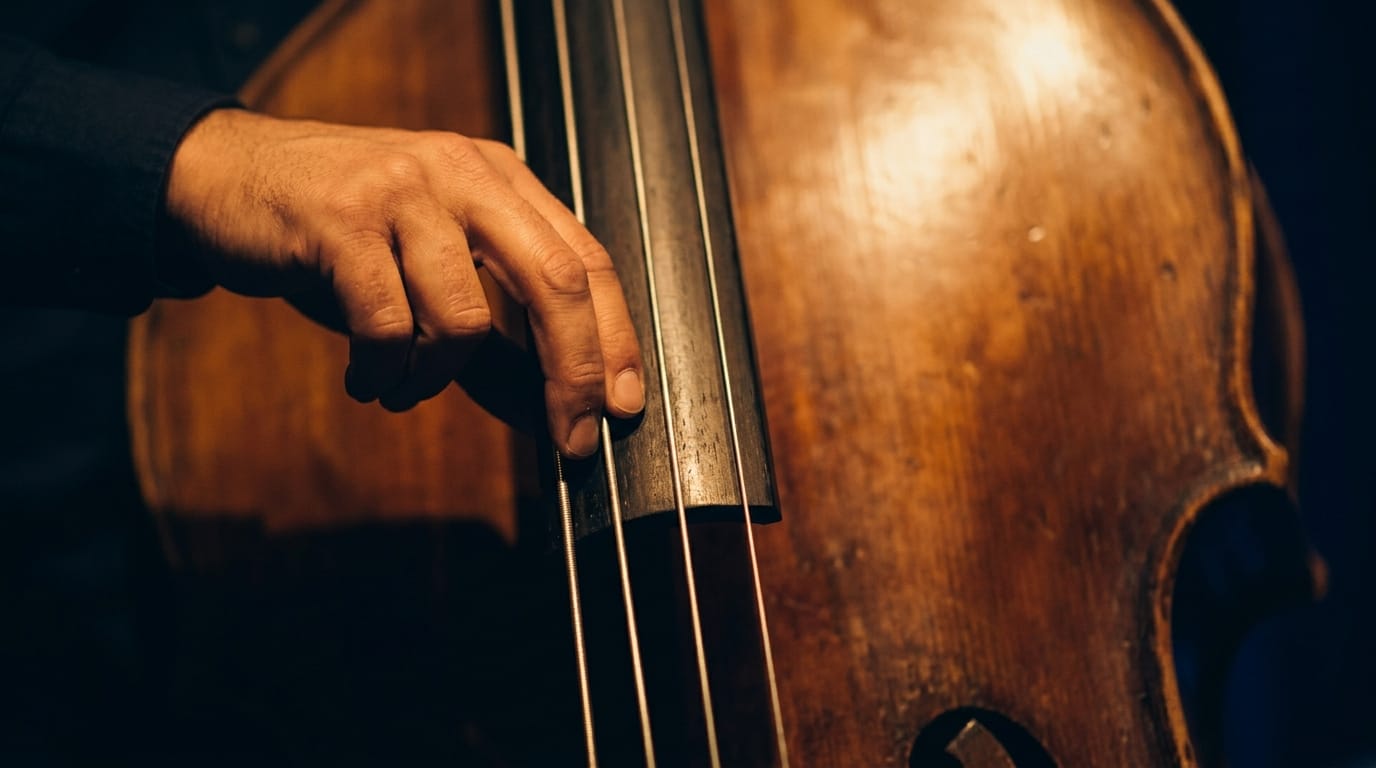
The double bass, or upright bass, holds the band together. Its basic job is the walking bass line: one note on each beat that spells out the chord progression and pushes the tempo forward. Jazz bassists pluck the strings (pizzicato) nearly all the time and use the bow mainly for the occasional solo. Jimmy Blanton, Oscar Pettiford, Ray Brown, Charles Mingus, Paul Chambers and Scott LaFaro shaped how the instrument is played.
Hear it on: Paul Chambers on Kind of Blue and on his own Bass on Top (Blue Note, 1957); Scott LaFaro with the Bill Evans Trio on Sunday at the Village Vanguard (Riverside, 1961).
Drums
A jazz drummer keeps time mainly on the ride cymbal, playing a swung pattern, while the hi-hat closes on beats two and four. That division goes back to bebop, when Kenny Clarke moved the steady four-beat pulse from the bass drum to the ride cymbal, freeing the bass drum and snare for accents. For ballads and quiet passages, drummers switch to brushes, fans of metal or nylon bristles swept across the snare. Art Blakey, Max Roach, Elvin Jones, Tony Williams and Jack DeJohnette are among the drummers who defined jazz time.
Hear it on: Art Blakey on A Night in Tunisia (Blue Note, 1961); Elvin Jones on John Coltrane’s My Favorite Things (Atlantic, 1961).
Piano
The piano is the only common jazz instrument that can play bass notes, chords and melody at the same time, so a pianist moves constantly between accompanying and soloing. Accompanying is called comping: short, rhythmic chords placed around the soloist’s phrases. Jazz pianists often leave notes out, using shell voicings (root, third and seventh) or rootless voicings that leave the root to the bassist; our guide to jazz piano chords and voicings explains both.
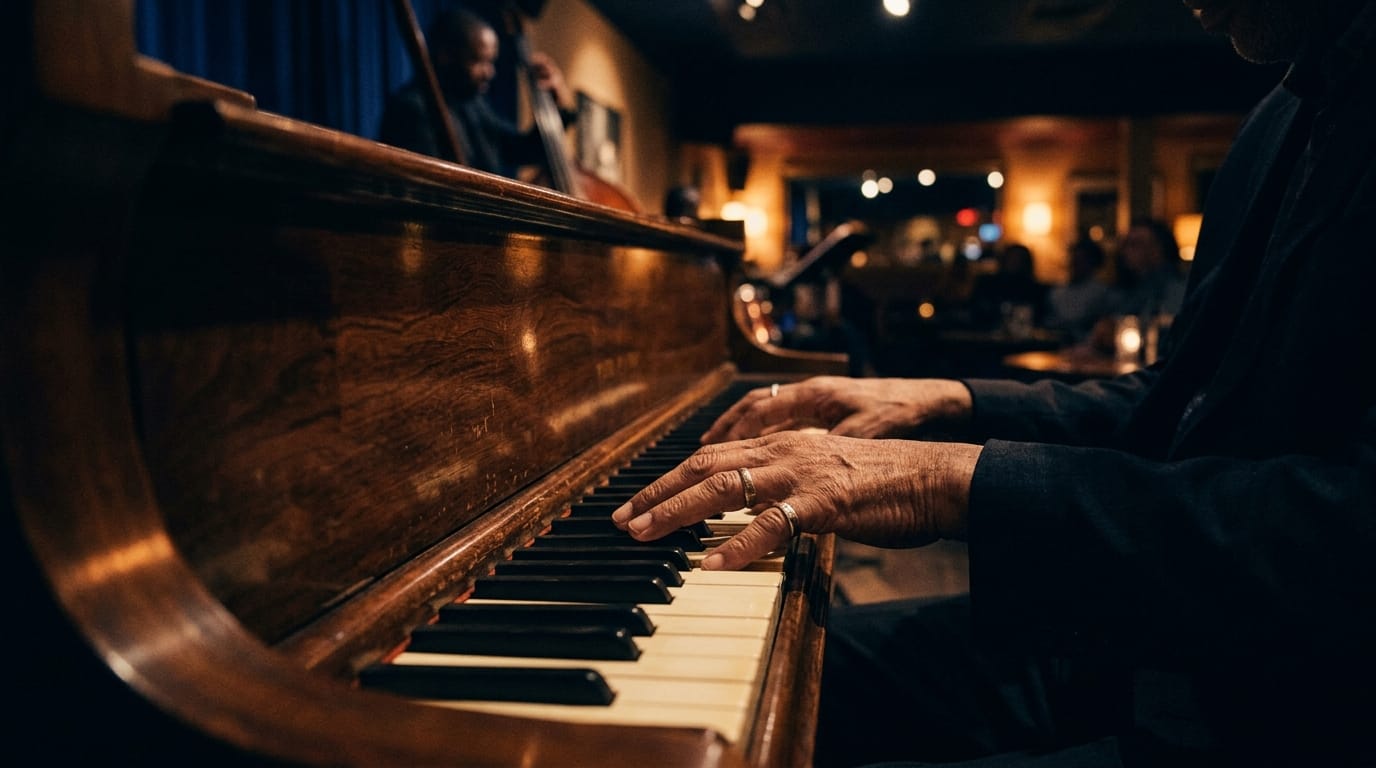
Approaches range from Thelonious Monk’s angular, percussive chords to Bill Evans’s dense harmony; see our list of the greatest jazz pianists.
Hear it on: Thelonious Monk with John Coltrane (Jazzland, 1961, recorded in 1957); Head Hunters, Herbie Hancock (Columbia, 1973), on which he played Fender Rhodes electric piano, clavinet and ARP synthesizers.
Guitar
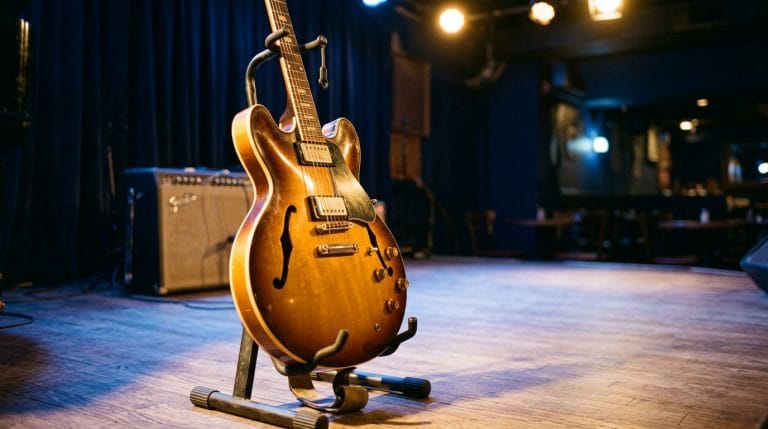
Jazz guitarists traditionally play hollow-body archtop guitars such as the Gibson L-5 or the semi-acoustic ES-175, usually with heavy flatwound strings for a warm, round tone. In early jazz the guitar, and before it the banjo, strummed chords in the rhythm section. Charlie Christian changed that: with Benny Goodman’s sextet and orchestra from 1939 to 1941 he played single-note lines on an amplified guitar and moved the instrument into the solo spotlight. Our jazz guitar guide goes deeper.
Hear it on: The Incredible Jazz Guitar of Wes Montgomery (Riverside, 1960), built on his thumb picking and octave lines; Joe Pass’s unaccompanied Virtuoso (Pablo, 1973).
Brass Instruments
Trumpet
The trumpet, with its close relative the cornet, has led jazz bands since New Orleans. Louis Armstrong turned it into a solo instrument on his Hot Five and Hot Seven records of the 1920s, and the unaccompanied cadenza that opens “West End Blues” (1928) is one of the defining moments of early jazz. Dizzy Gillespie took the trumpet into bebop, Clifford Brown and Freddie Hubbard into hard bop, and Miles Davis through cool jazz, modal jazz and fusion; see our profiles of the great jazz trumpet players.
Mutes are a big part of jazz trumpet. The straight mute gives a piercing tone, the cup mute a darker and softer one, and the Harmon mute (also called the wah-wah mute) a subdued, distant sound when its stem is removed. Miles Davis began playing it that way in 1946, and the sound became his trademark. Many trumpeters also double on flugelhorn, whose wider, conical bore gives a softer, rounder tone; Art Farmer switched to it in the early 1960s because it gave him a warmer sound without a mute.
Hear it on: “West End Blues,” Louis Armstrong and His Hot Five (1928); Clifford Brown and Max Roach (EmArcy, 1954); Kind of Blue, Miles Davis.
Trombone
The slide lets the trombone glide and smear between notes in ways valved instruments cannot. In New Orleans bands, Kid Ory developed the “tailgate” style, a rhythmic line played underneath the trumpets and cornets, and he was in the original lineup of Armstrong’s Hot Five in 1925. Bebop musicians had largely written the trombone off as too limited until J.J. Johnson, one of the earliest trombonists to embrace the style, showed it could keep up; his Blue Note sessions from 1953 to 1955 are collected as The Eminent Jay Jay Johnson.
Woodwinds: Saxophone, Clarinet and Flute
Saxophone
The saxophone is the wind instrument most commonly associated with jazz. Adolphe Sax invented it in the early 1840s and patented it in 1846; it counts as a woodwind because it uses a single reed, although its body is usually brass. It entered jazz through the dance bands of the early 1920s and became as central to the music as the trumpet. Four sizes are standard:
- Alto saxophone: higher and brighter, the main horn of bebop. Charlie Parker played alto on “Ko-Ko,” recorded for Savoy in November 1945. Cannonball Adderley is the alto player on Kind of Blue.
- Tenor saxophone: lower and fuller. Coleman Hawkins was one of the first to make it an accepted jazz horn, and his “Body and Soul” (Bluebird, 1939) entered the Library of Congress’s National Recording Registry in 2004. Sonny Rollins (Saxophone Colossus, Prestige, 1957), John Coltrane and Wayne Shorter followed.
- Soprano saxophone: straight or curved, with a piercing tone. Sidney Bechet discovered the straight soprano in London in 1919 and became its first influential player. It had become rare by the 1950s, until Steve Lacy and then John Coltrane, on My Favorite Things, his first album on the instrument, brought it back.
- Baritone saxophone: the low end of the section. Gerry Mulligan made it a lead voice, with a light, airy tone, in his pianoless quartet with Chet Baker, formed in 1952 and recorded for Pacific Jazz.
Our list of the most influential jazz saxophonists has listening suggestions for each.
Clarinet
The clarinet was a central jazz instrument from the 1910s. In New Orleans ensembles it played fast, high lines around the trumpet melody, with players such as Sidney Bechet and Johnny Dodds; in the swing era Benny Goodman and Artie Shaw became stars on it, and Columbia released Goodman’s January 1938 Carnegie Hall concert in 1950. From the 1940s the saxophone, louder and easier to finger, took over most of its role. The clarinet never disappeared: Eric Dolphy played bass clarinet as a lead voice on Out to Lunch! (Blue Note, 1964).
Flute
The flute arrived in jazz relatively late. Chick Webb’s band was among the first to use it, in the late 1930s, and Frank Wess was one of the first noteworthy jazz flutists in the 1940s. Because its fingering is close to the saxophone’s, many saxophonists double on it. Herbie Mann, Yusef Lateef, Bud Shank, Rahsaan Roland Kirk and Hubert Laws later made it a lead instrument; hear Mann’s Memphis Underground (Atlantic, 1969) or Dolphy’s “Gazzelloni” on Out to Lunch!.
Vibraphone and Hammond Organ
Vibraphone
The vibraphone is a mallet instrument with tuned aluminum bars. Motor-driven discs in the resonator tubes beneath the bars add a pulsing vibrato, and a foot pedal lets notes ring or damps them. Lionel Hampton popularized it in jazz after Louis Armstrong hired him in 1930; their recording that year is often considered the first improvised vibraphone solo. Milt Jackson played vibes in the Modern Jazz Quartet from 1952, Bobby Hutcherson took the instrument into the avant-garde on Out to Lunch!, and Gary Burton developed a four-mallet technique that lets one player voice full chords like a pianist. Vibraphonist Karl Berger played with Don Cherry and co-founded the Creative Music Studio in 1972.
Hammond Organ
The Hammond organ, above all the B-3 model introduced in 1954, became a jazz instrument through Jimmy Smith, who switched to organ permanently that year and began recording for Blue Note in 1956. Smith usually led a trio of organ, guitar and drums with no bassist: he played walking bass lines on the pedals for ballads and on the lower keyboard at faster tempos. The sound runs through a Leslie speaker, whose rotors switch between a slow (chorale) and a fast (tremolo) speed. Jack McDuff, Larry Young and Joey DeFrancesco are other organists worth hearing.
Hear it on: Back at the Chicken Shack, Jimmy Smith with Stanley Turrentine and Kenny Burrell (Blue Note, recorded 1960, released 1963).
Latin Percussion
Latin jazz adds hand percussion to the drum kit. Congas are tall, single-headed drums played with the hands; bongos are a smaller, higher-pitched pair used for fills and accents; timbales are shallow metal-shelled drums played with sticks. Everything is organized around the clave, a two-bar rhythmic pattern (played as 3-2 or 2-3) that the rest of the band phrases against.
“Tanga” (1943), composed by Mario Bauzá and recorded by Machito and his Afro-Cubans, is generally considered the first jazz piece built on the clave. Bauzá introduced Dizzy Gillespie to the Cuban conga player Chano Pozo, and their “Manteca,” recorded by Gillespie’s big band in December 1947, became the first clave-based tune to turn into a jazz standard. Mongo Santamaría, who played congas for Tito Puente and Cal Tjader, wrote “Afro Blue” in 1959. See also our profile of Cuban pianist Dayramir González.
Less Common Instruments in Jazz
Almost any instrument has been used in jazz. Violinist Stéphane Grappelli founded the Quintette du Hot Club de France with guitarist Django Reinhardt in 1934. Fred Katz played cello in the Chico Hamilton Quintet in the 1950s, one of the first to make it an improvising solo instrument. All About Jazz’s survey of rare instruments in jazz adds Dorothy Ashby on harp (Afro-Harping, Cadet, 1968), Toots Thielemans on harmonica (Man Bites Harmonica, Riverside, 1958), Julius Watkins on French horn and Rufus Harley on bagpipes.
Even the theremin, the electronic instrument Leon Theremin invented in 1920, has a small jazz history. Electronic-music historian Thom Holmes points to tracks by Yusef Lateef (1966) and Dorothy Ashby (1968), and to trumpeter Youseff Yancy, who played theremin on drummer Sunny Murray’s Apple Cores (1978). Pamelia Kurstin (now Pamelia Stickney), who came to it from jazz upright bass, developed a way of playing walking bass lines on it.
Electric instruments are the other big addition. From the late 1960s, jazz fusion bands tended to swap the acoustic piano and double bass for electric pianos, organs, synthesizers, electric guitars and bass guitar; Miles Davis’s In a Silent Way (1969) is considered his first fusion album.
Which Jazz Instrument Should You Learn?
Start with the sound you want to make. For melodies and solos, the alto saxophone and the trumpet are the usual entry points, and both fit in a combo or a school big band. To understand harmony, the piano shows every chord in front of you. Every combo needs a bassist and a drummer, so either is a reliable route into playing with other people. For practice, Jamey Aebersold’s play-along series, started in 1967 and now over 130 volumes, lets you improvise over a recorded rhythm section.
Frequently Asked Questions
What instruments are used in jazz?
The core jazz instruments are the trumpet, trombone and saxophone (alto, tenor, soprano and baritone) in front, and the piano, double bass, drums and guitar in the rhythm section. Clarinet, flute, vibraphone, Hammond organ and Latin percussion such as congas, bongos and timbales are common in particular styles, and fusion adds electric piano, synthesizers and bass guitar.
What wind instrument is most commonly used in jazz?
The saxophone. It entered jazz through the dance bands of the early 1920s and became as central as the trumpet, with the alto and tenor the most widely played sizes. The trumpet is the other wind instrument heard in almost every era of jazz.
What instruments are in a jazz band?
A small jazz group (combo) usually has three to seven players: a rhythm section of piano, bass and drums, sometimes guitar, plus one or more horns such as trumpet or saxophone. A big band has sections of trumpets, trombones and saxophones over a rhythm section, and a common modern format has 17 players.
What percussion instruments are used in jazz?
The drum kit is the main one: bass drum, snare, tom-toms, hi-hat and a ride cymbal that carries the time, played with sticks or brushes. The vibraphone is a pitched mallet instrument used as a solo voice. Latin jazz adds congas, bongos and timbales, organized around the clave rhythm.