How to Play Jazz Guitar: A Step-by-Step Guide for Beginners
What You’ll Learn in This Guide
- The realistic timeline to sound like a jazz guitarist, not just a rock player using 7th chords
- Which skills from folk, rock, or classical guitar transfer directly, and which habits to unlearn
- Essential chord voicings, scales, and the exact order to learn them
- 8 beginner-friendly jazz standards suited specifically to guitar
- How to transcribe a solo without losing your mind
- Practice routines for 30, 60, and 90 minutes per day
- Where to find the best jazz guitar lessons, courses, and resources online
Jazz guitar is a style of guitar playing rooted in jazz harmony, chromaticism, and improvisation, typically performed on hollow-body or semi-hollow electric guitars, and requires a fundamentally different approach to melody, rhythm, and chord voicing than rock or pop guitar. If you want to know how to play jazz guitar and actually sound like a jazz musician (not a rock guitarist who discovered 7th chords), expect a 1-3 year arc of deliberate, structured practice before the idiom feels natural.
Table of Contents
- Is Jazz Guitar Hard to Learn? Setting Honest Expectations
- How Jazz Guitar Differs From Rock, Blues, and Classical
- The 1-3 Year Honest Timeline
- Is Jazz Harder Than Blues?
- Prerequisites: What You Need Before You Start
- Prior Guitar Skills That Transfer
- Prior Skills That Don’t Transfer (and Can Hinder)
- Recommended Starting Equipment
- Step 1: Build Your Vocabulary, Scales and Modes
- Why Scales Come Before Licks
- The Major Scale Across All 12 Keys: The Non-Negotiable Foundation
- The Bebop Dominant Scale: Your First Jazz-Specific Scale
- The Bebop Major Scale
- Dorian Mode: The Minor ii Chord Sound
- Suggested Scale Practice Sequence (Weeks 1-12)
- Step 2: Master Essential Jazz Chord Voicings
- Why Jazz Guitar Voicings Look Different
- The 6 Essential Shell Voicings Every Beginner Must Know
- Drop 2 Voicings: The Next Level
- The ii-V-I Chord Progression in Practice
- Step 3: Learn Your First Jazz Standards
- Why Standards Are the Curriculum
- How to Choose a Starting Standard
- 8 Beginner Jazz Standards Suited Specifically to Guitar
- How to Learn a Standard (Process)
- Step 4: Transcribe, Learn Directly From the Source
- Why Transcription Is Non-Negotiable
- The 8-Bar Transcription Method for Beginners
- Recommended First Transcriptions for Guitar Specifically
- Step 5: Apply It, Playing With Others and Backing Tracks
- iReal Pro: The Essential Practice Tool
- Backing Track Alternatives (Free)
- Jam Session Etiquette for Beginners
- Common Mistakes Beginners Make (And How to Fix Them)
- Mistake 1: Defaulting to Pentatonic Scales When Improvising
- Mistake 2: Learning Chords Without Understanding Their Function
- Mistake 3: Practicing at Too High a Tempo
- Mistake 4: Ignoring Rhythmic Feel in Favor of Note Choice
- Mistake 5: Skipping Ear Training
- Practice Routine Templates
- 30-Minute Daily Routine (Absolute Beginner)
- 60-Minute Daily Routine (Early Intermediate)
- 90-Minute Daily Routine (Committed Beginner / Early Intermediate)
- Recommended Resources for Learning Jazz Guitar
- Books (Verifiable, Widely Cited)
- Online Courses and Lesson Platforms
- Apps
- YouTube Channels (Verified, Active)
- Frequently Asked Questions
- How Long Does It Take to Learn Jazz Guitar?
- Can I Learn Jazz Guitar Without a Teacher?
- What Is the Easiest Jazz Song to Learn on Guitar?
- How Is Jazz Guitar Played Differently From Rock Guitar?
- Do I Need to Learn to Read Music to Play Jazz Guitar?
- Start Here: Your First Week on Jazz Guitar
That timeline isn’t meant to discourage you. It’s meant to set you free from the frustration of expecting jazz to click in a weekend. Beginner jazz guitar is genuinely learnable, but it demands a different kind of study than most guitarists have done before. This guide walks you through every step: scales, voicings, standards, transcription, and real-world application. No shortcuts, no vague advice. A clear process from jazz guitar basics to your first jam session.
Is Jazz Guitar Hard to Learn? Setting Honest Expectations
Jazz guitar is harder to learn than blues or rock, but the difficulty is specific and manageable once you understand where it comes from. The challenge isn’t physical dexterity, it’s harmonic and rhythmic complexity that requires rewiring how you think about the guitar.
How Jazz Guitar Differs From Rock, Blues, and Classical
Rock and blues guitar rely heavily on pentatonic scales, power chords, and a relatively stable tonal center. Jazz routinely moves through multiple key centers in a single chorus, using harmonic devices like ii-V-I progressions (the most common movement in jazz: minor 7th chord to dominant 7th chord to major 7th chord), tritone substitutions, and altered dominants. These aren’t decorative additions, they’re the grammar of the language.
Rhythmically, jazz uses swing eighth notes: pairs of eighth notes where the first note is held slightly longer than the second, creating a loping, forward-leaning feel. Straight eighth notes (as in rock) sound immediately wrong in a jazz context. And improvisation in jazz means generating original melodic lines over moving chord changes in real time, not soloing over a static groove with one scale. The industry standard for reading music in jazz is the lead sheet: a single-staff melody with chord symbols above it, not tablature.
The 1-3 Year Honest Timeline
Here’s a realistic breakdown of what progress looks like:
- Months 1-3: Shell voicings, basic ii-V-I in a few keys, one or two simple standards at slow tempos
- Months 4-12: Diatonic chord vocabulary, introduction to bebop scales, 10-15 standards in your repertoire
- Years 2-3: Fluent comping behind other musicians, single-note lines over changes, jam session readiness
Measurable progress appears within 8-12 weeks when you follow a structured routine. The goal for year one isn’t to sound like Wes Montgomery, it’s to sound recognizably jazz at a slow tempo on a handful of tunes.
Is Jazz Harder Than Blues?
Yes, in most respects. Blues guitar centers on one scale (the minor pentatonic plus the “blue note,” a flatted fifth) over a simple I-IV-V chord form. A 12-bar blues stays in one key. A 32-bar AABA jazz standard (the most common form) moves through multiple key areas, often requiring a different scale or arpeggio approach for each chord. That said, the blues feel embedded in jazz, especially in hard bop, means your blues vocabulary isn’t wasted. It just needs to be expanded significantly.
Prerequisites: What You Need Before You Start
You don’t need to be an advanced guitarist to begin jazz on guitar for beginners, but some prior experience makes the process considerably smoother. Knowing what transfers and what doesn’t saves months of frustration.

Prior Guitar Skills That Transfer
Barre chord shapes, specifically the CAGED system (a method of mapping the guitar neck using five chord shapes: C, A, G, E, and D), transfer directly to moveable jazz voicings. If you can play a barre chord cleanly anywhere on the neck, you already understand the concept of moveable shapes. Fingerpicking and fingerstyle technique transfer well to chord-melody playing, where you play the melody and harmony simultaneously on the guitar. Reading rhythmic notation is highly useful; full staff notation is a plus but not mandatory for beginning jazz guitar.
Your blues or rock soloing experience gives you a working melodic ear, you already know what it feels like to phrase over a chord. That ear-to-finger connection is real and valuable. The problem is the specific scale habits that come with it, which leads to the next point.
Prior Skills That Don’t Transfer (and Can Hinder)
Pentatonic box patterns are the single biggest obstacle for rock and blues players entering jazz. The pentatonic scale is so deeply ingrained that it becomes the default response to any improvisation prompt, and it sounds immediately wrong over jazz changes. Tab dependency is another issue: jazz is transmitted through lead sheets and recordings, not tablature. If you’ve never read a chord symbol in your life, that’s the first literacy skill to develop. String bending as a primary expressive tool also needs to be set aside; jazz uses half-step bends sparingly and in specific stylistic contexts.
Recommended Starting Equipment
| Equipment | Entry-Level Option | Notes |
|---|---|---|
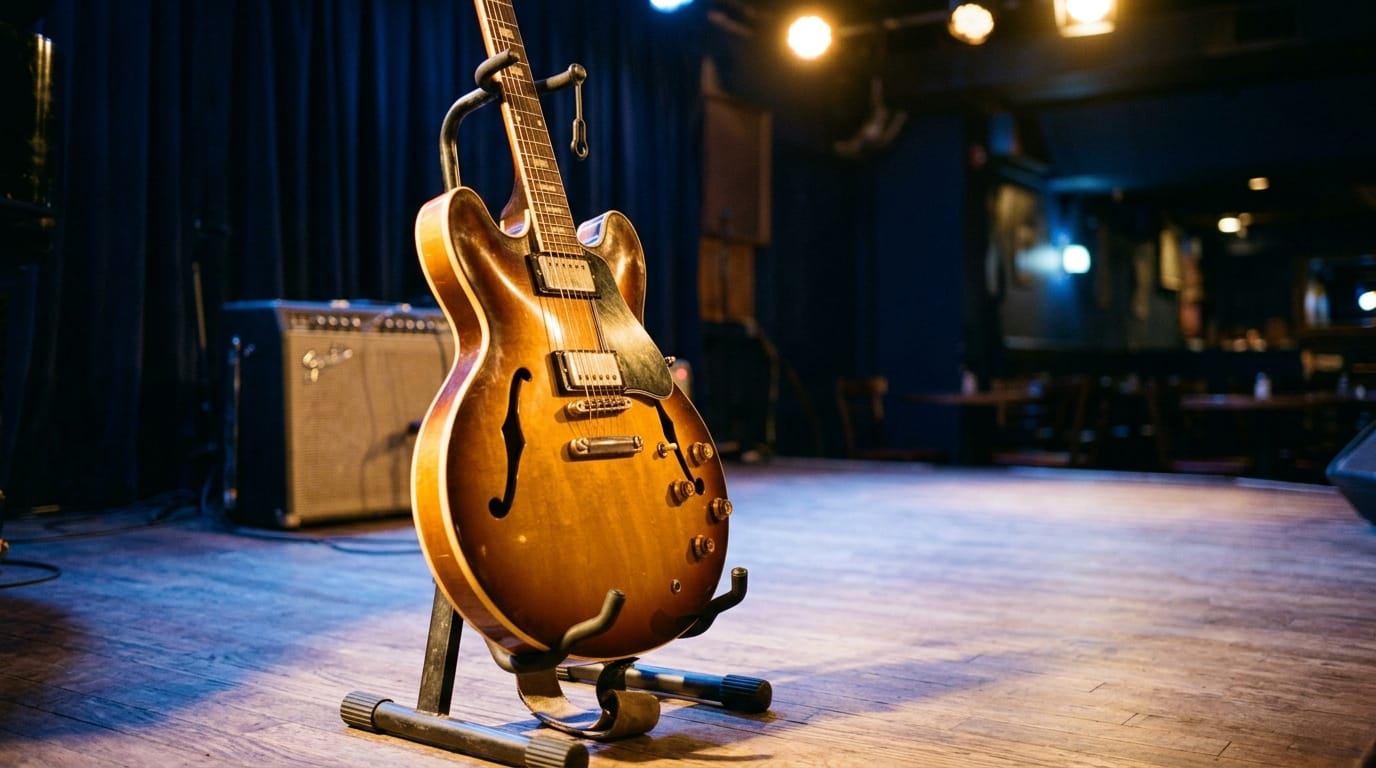
| Guitar | Epiphone ES-335, Ibanez AS73 | Semi-hollow body; avoid solid-body Strats to start |
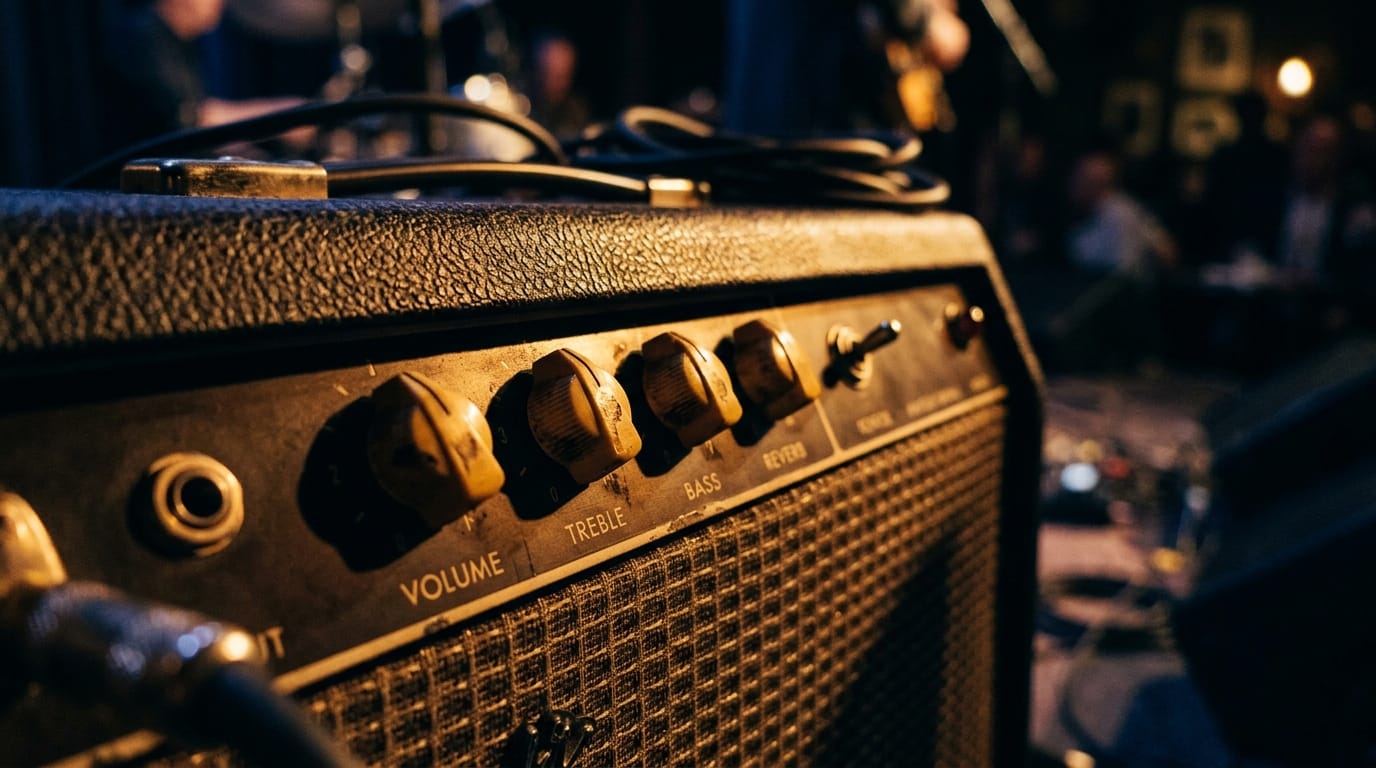
| Amplifier | Fender Blues Junior, Roland Jazz Chorus 40 | Clean tone only, no distortion |
| Pick | Medium gauge, rounded tip | Reduces overly bright attack |
| Strings | Flatwound 11-49 or roundwound 11-49 | Flatwounds give a more traditional jazz tone |
| Metronome / App | iReal Pro ($14.99), free metronome app | Essential from day one |
You don’t need to spend $2,000 on a vintage archtop. Instruments in the $400-$700 range are fully functional for learning. An acoustic guitar is possible, but a semi-hollow electric better replicates the tone and feel that defines jazz guitar. Roll the tone knob down slightly on your amp and guitar, that warm, slightly rounded sound is the target.
Step 1: Build Your Vocabulary, Scales and Modes
Scales are the alphabet of jazz improvisation. Licks (short, memorized melodic phrases) are words. Standards are sentences. The most common beginner mistake is memorizing licks without understanding their harmonic context, which produces phrases that don’t connect to the underlying chords. Start with the alphabet.
Why Scales Come Before Licks
When you understand why a note works over a chord, you can generate your own lines rather than recycling borrowed phrases. That’s the difference between speaking a language and reading from a phrasebook. Jazz guitar basics begin with the major scale, not because it’s the most exciting scale, but because every other scale and mode in jazz is defined in relation to it.
The Major Scale Across All 12 Keys: The Non-Negotiable Foundation
Learn the major scale in one position first, then expand across the entire neck using the CAGED system. Target: all 12 keys in a single position within the first 8 weeks. A specific exercise to start: play the major scale starting on the low E string, placing the root on each fret in turn, ascending and descending with a metronome at 60 BPM. This builds both the scale pattern and the habit of thinking in terms of root position rather than fixed shapes.
The Bebop Dominant Scale: Your First Jazz-Specific Scale
The bebop dominant scale is the most important jazz-specific scale for beginners. Its formula: Root-2-3-4-5-6-b7-7. That’s a Mixolydian mode (the scale built on the fifth degree of the major scale, with a flatted seventh) with one added note: the major 7th, which acts as a passing tone between the b7 and the root. Why does this matter? In an 8th-note line, the added note keeps chord tones landing on the strong beats (1, 2, 3, 4), which is the defining sound of bebop guitar phrasing.
Exercise: play the G bebop dominant scale descending from G on the high E string. Notice how the chord tones (G, B, D, F) align with the downbeats. That alignment is what makes bebop lines sound intentional rather than random. Practice this scale over a G7 chord in iReal Pro before moving to anything else.
The Bebop Major Scale
Formula: Root-2-3-4-5-#5-6-7. The added note here is the #5 (augmented fifth), which acts as a passing tone between the 5th and the 6th. Use this scale over major 7 and major 6 chords. It’s the companion to the bebop dominant, together, they cover the two most common chord types in a ii-V-I progression’s resolution.
Dorian Mode: The Minor ii Chord Sound
Dorian mode is a minor scale with a raised 6th. Formula: Root-2-b3-4-5-6-b7. In a ii-V-I in C major (Dm7-G7-Cmaj7), D Dorian is the appropriate scale over the Dm7 chord. Exercise: alternate between D Dorian (over Dm7) and G bebop dominant (over G7), four bars each, over a backing track. This two-scale exercise covers the first two-thirds of the most common harmonic movement in all of jazz.
Suggested Scale Practice Sequence (Weeks 1-12)
| Week | Scale Focus | BPM Target |
|---|---|---|
| 1-2 | Major scale (C, G, F keys) | 60 BPM |
| 3-4 | Major scale (all 12 keys, one position) | 70 BPM |
| 5-6 | Bebop dominant (G, C, F) | 60 BPM |
| 7-8 | Dorian mode (D, A, G) | 60 BPM |
| 9-10 | Bebop major | 65 BPM |
| 11-12 | Modes over ii-V-I: Dorian → Mixolydian → Ionian | 70 BPM |
Mick Goodrick’s book The Advancing Guitarist addresses the connection between scalar thinking and harmonic application in verifiable depth, it’s worth adding to your shelf once you’ve completed this 12-week sequence and want to push further into how scales relate to the full neck.

Step 2: Master Essential Jazz Chord Voicings
Jazz guitar chord voicings look and feel different from anything in rock or folk because they’re built for a specific sonic role: supporting a melody or soloist without cluttering the low register. Learning easy jazz guitar chords starts with understanding why jazz voicings are constructed the way they are. For a deeper dive into every voicing type, see our complete guide to jazz guitar chords and voicings.
Why Jazz Guitar Voicings Look Different
Full 6-string open chords are mostly avoided in jazz. The low strings create muddy, indistinct sound when you stack thirds in the bass register, especially in a band context where a double bass or electric bass is already covering the root. Standard jazz voicings use 3-4 strings, typically omitting the root entirely when a bassist is present. Most jazz comping happens on strings 2-5 or 3-6.
The 6 Essential Shell Voicings Every Beginner Must Know
A shell voicing contains only the root, 3rd, and 7th of a chord, the 5th is omitted because it adds little harmonic information. These three notes define the chord’s quality (major, minor, or dominant) with maximum clarity and minimum clutter. Shell voicings are the foundation of beginner jazz guitar chords and the fastest path to playing real changes.
| Chord Type | Notes Included | String Set | Function in ii-V-I |
|---|---|---|---|
| Major 7 | Root, major 3rd, major 7th | 6-4 or 5-3 | I chord (tonic) |
| Dominant 7 | Root, major 3rd, minor 7th | 6-4 or 5-3 | V chord (dominant) |
| Minor 7 | Root, minor 3rd, minor 7th | 6-4 or 5-3 | ii chord (supertonic) |
| Minor 7b5 | Root, minor 3rd, diminished 5th, minor 7th | 5-3 | ii chord in minor keys |
Learn these shapes with the root on the 6th string first, then the 5th string. Three moveable shapes, m7 (root 6), dom7 (root 6), maj7 (root 6), cover the changes to multiple standards. That’s your quick-start for simple jazz guitar chords.
Drop 2 Voicings: The Next Level
Once shell voicings feel automatic, move to drop 2 voicings. The concept: take a four-note close-position chord (all notes within one octave), then drop the second-highest note down one octave. The result is a wider, more resonant voicing that sits beautifully on strings 4-1 or 5-2. Drop 2 voicings are the workhorse of jazz guitar comping, most of what you hear on classic recordings from Jim Hall, Joe Pass, and Wes Montgomery uses this construction. Exercise: move a Dm7 drop 2 voicing through all four inversions on strings 4-1, keeping the tempo slow and the changes clean.
The ii-V-I Chord Progression in Practice
The ii-V-I (two-five-one) is the single most common harmonic movement in jazz. In C major: Dm7-G7-Cmaj7. Practice this progression in C, F, Bb, and Eb using shell voicings, these four keys cover the majority of jazz standards you’ll encounter at a jam session. Once shell voicings are clean, substitute drop 2 voicings for the same progression. The difference in sound is immediate and instructive.
Step 3: Learn Your First Jazz Standards
Jazz is an oral and aural tradition transmitted through shared repertoire. Standards, compositions that have become part of the common jazz vocabulary, are the language every musician at a jam session speaks. Knowing 10 standards fluently is worth more than knowing 50 partially. For a broader look at the repertoire, the 50 essential jazz standards every listener should know covers the full canon.
Why Standards Are the Curriculum
When you show up to a jam session, the bandleader calls a tune. Everyone is expected to know the melody, the chord changes, and the form, without sheet music. That shared knowledge is what makes spontaneous jazz performance possible. Standards are the curriculum because they’re the test. Learn them deeply, not broadly.
How to Choose a Starting Standard
Look for tunes with limited chord movement per bar (one chord per bar, or two at most), a singable melody, a common key, and wide use at jam sessions. Avoid tunes with rapid chord changes every two beats until your voicing changes are automatic.
8 Beginner Jazz Standards Suited Specifically to Guitar
| Standard | Key | Why It Works for Guitar | Tempo Range |
|---|---|---|---|
| “Autumn Leaves” | G minor / Bb major | Contains nearly every ii-V-I variation; manageable chord rate | 100-140 BPM |
| “All of Me” | C major | Slow harmonic rhythm; singable melody | 120-160 BPM |
| “Summertime” | A minor | Sparse changes; blues-influenced feel suits guitar tone | 60-90 BPM |
| “Fly Me to the Moon” | C major | Clear AABA form; one or two chords per bar | 140-180 BPM |
| “There Will Never Be Another You” | Eb major | Widely played at jam sessions; strong melodic arc | 120-180 BPM |
| “Blue Bossa” | C minor / Db major | Bossa nova feel suits guitar; comp pattern is teachable early | 100-130 BPM |
| “Misty” | Eb major | Slow ballad; ideal for chord-melody beginners | 60-80 BPM |
| “So What” | D Dorian / Eb Dorian | Modal; minimal changes; perfect for scale application | 130-160 BPM |
A few notes on these choices. “Autumn Leaves”, composed by Joseph Kosma in 1945, has been recorded roughly 1,400 times by jazz musicians alone, it’s the most important non-American standard in the repertoire and the single best first tune for a jazz guitarist because it contains both major and minor ii-V-I progressions. “Summertime”, composed by George Gershwin in 1934 for the opera Porgy and Bess, has accumulated well over 25,000 recorded versions, some fan-run tallies put the number above 60,000, its sparse harmonic movement makes it forgiving for beginners. “Blue Bossa”, written by trumpeter Kenny Dorham and introduced on Joe Henderson’s 1963 album Page One, is widely regarded as an ideal entry-level standard precisely because its bossa nova feel sits naturally on guitar. “So What” is the opening track on Miles Davis‘s Kind of Blue (1959) and one of the best-known examples of modal jazz, two chord voicings, one scale per section, and a groove that guitar handles beautifully.
How to Learn a Standard (Process)
- Listen to at least three different recordings before picking up the guitar
- Sing the melody out loud without the guitar
- Learn the melody on guitar, single notes only
- Add shell voicing chords beneath the melody (your first chord-melody arrangement)
- Practice comping alone with an iReal Pro backing track at a slow tempo
Step 4: Transcribe, Learn Directly From the Source
Transcription, the process of learning music by ear directly from a recording, is non-negotiable in jazz education. Joe Pass, Pat Martino, and Wes Montgomery all learned primarily by ear from recordings, and that oral tradition is documented throughout jazz history. No exercise book replicates what happens when your ear and your fingers have to solve the same problem simultaneously.
Why Transcription Is Non-Negotiable
Transcription develops the ear-to-finger connection that separates jazz musicians from guitarists who know jazz theory. When you can hear a note and find it on the guitar without thinking, you’re improvising. When you can’t, you’re executing patterns. The gap between those two states is closed by transcription, not by learning more scales. Start small, 8 bars is enough to produce real results.
The 8-Bar Transcription Method for Beginners
- Choose a solo recording at a slow-to-medium tempo
- Isolate 8 bars using software: Transcribe! (desktop, $39), Amazing Slow Downer (mobile), or YouTube’s speed reduction feature
- Listen to those 8 bars at least 20 times before picking up the guitar
- Find the first note by ear, match it on the guitar
- Write it down in standard notation or your own shorthand
- Learn the phrase at 50% of the original tempo with a metronome
- Memorize it, play it without looking at notes
Recommended First Transcriptions for Guitar Specifically
| Recording | Soloist | Why Suitable for Beginners |
|---|---|---|
| “Misty”, Wes Montgomery (Full House, 1962) | Wes Montgomery | Slow ballad; clear note choices; signature octave technique audible |
| “Autumn Leaves”, Jim Hall (Undercurrent, 1962) | Jim Hall | Sparse, lyrical lines; not speed-dependent; models space and phrasing |
| “All the Things You Are”, Joe Pass (Virtuoso, 1973) | Joe Pass | Chord-melody approach; shows how melody and harmony integrate |
| “So What”, Kind of Blue (1959) | Comping study | Listen to Bill Evans’ piano voicings and apply the concept to guitar |
Jim Hall (1930-2013) earned multiple Grammy nominations throughout his career and is widely regarded as one of the most lyrical guitarists in jazz history, his lines on Undercurrent are slow enough to hear every note choice clearly. Joe Pass, born Joseph Anthony Passalaqua in New Jersey in 1929, built his Virtuoso album (released on Pablo Records in 1973) as an unaccompanied solo guitar record, every note he plays is both melody and harmony, making it an ideal model for chord-melody study. Avoid Charlie Parker or John Coltrane solos as first transcriptions. They’re too fast and too chromatic for a beginner guitarist to extract useful vocabulary from.
Step 5: Apply It, Playing With Others and Backing Tracks
Scales and voicings practiced in isolation don’t automatically transfer to real musical situations. You need to apply what you’ve learned against a moving harmonic backdrop, and eventually, against other musicians. This is where jazz guitar online tools and live playing intersect.
iReal Pro: The Essential Practice Tool
IReal Pro ($14.99 on iOS and Android) is the most widely used practice tool in jazz education. It contains over 1,300 jazz standard chord charts with adjustable tempo, transposition, and multiple style feels including swing, bossa nova, and ballad. A specific beginner workflow: set “Autumn Leaves” to 80 BPM swing, play through the chord melody for the first chorus, then improvise using shell voicings and the bebop dominant scale for two more choruses. Do this for 10 minutes daily. The consistency matters more than the duration.
Backing Track Alternatives (Free)
- YouTube: search “[standard name] backing track jazz”, most major standards have multiple options
- SmartChord app (free tier): chord charts and basic playback
- Bandcamp: some jazz educators release free practice tracks
Jam Session Etiquette for Beginners
Arrive early and stay for the full session before signing up to play. Bring a Real Book (the Hal Leonard 6th Edition in C instruments is the standard reference). Call a tune you know thoroughly, not one you’ve “been working on.” The comping rule at any jam session is simple: less is more. Listen to the soloist, leave space, and don’t strum loudly while someone else is playing a line. Eye contact signals matter: a nod toward a soloist typically means you’re inviting them to trade fours (alternating 4-bar phrases between soloist and rhythm section) or take another chorus.
The most common beginner error at jam sessions isn’t wrong notes, it’s strumming too loudly while others solo. Jazz guitar comping is a conversation, not a monologue.
Common Mistakes Beginners Make (And How to Fix Them)
The best way to learn jazz guitar faster is to identify the specific errors that slow most beginners down and address them directly. These five mistakes appear consistently across players coming from rock, blues, and classical backgrounds.
Mistake 1: Defaulting to Pentatonic Scales When Improvising
Why it happens: The pentatonic scale is deeply ingrained from rock and blues training, it’s the first scale most guitarists learn, and it works over almost everything in those genres. Fix: Remove the pentatonic scale from your practice entirely for 90 days. Replace it exclusively with the bebop dominant scale over dominant chords. This forces your fingers to build new pathways rather than falling back on familiar patterns.
Mistake 2: Learning Chords Without Understanding Their Function
Why it happens: Chord diagrams are easier to find than theory explanations. You can learn a Dm7 shape in 30 seconds without knowing what it does harmonically. Fix: For every chord you learn, identify its function: Is it a I, ii, IV, V, or vi chord? What key is it in? This takes 60 extra seconds per chord and transforms isolated shapes into a connected harmonic system.
Mistake 3: Practicing at Too High a Tempo
Why it happens: Impatience. You want to sound like the recordings immediately. Fix: Use the “80% rule”, if you make more than one error per 8 bars, drop the BPM by 10. A clean “Autumn Leaves” at 80 BPM outperforms a sloppy version at 160 BPM in every meaningful way. Clean slow playing builds the muscle memory that eventually produces clean fast playing. Sloppy fast playing just reinforces errors.
Mistake 4: Ignoring Rhythmic Feel in Favor of Note Choice
Why it happens: Theory resources emphasize what notes to play over when to play them. Beginners focus on scale selection and ignore phrasing. Fix: Sing lines before playing them. The voice defaults to better rhythmic phrasing than fingers trained on rock patterns. If you can’t sing it, you can’t play it with conviction.
Mistake 5: Skipping Ear Training
Why it happens: Ear training feels abstract compared to learning a chord shape you can see and touch. Fix: Use the Functional Ear Trainer app (free on iOS and Android). Ten minutes daily for 60 days produces measurable improvement in interval recognition, the ability to hear a note and identify its relationship to the tonic. That skill is the foundation of transcription and real-time improvisation.
Practice Routine Templates
Structured practice time produces faster results than open-ended noodling. These three templates cover the most common time budgets for beginner jazz guitar lessons, pick the one that fits your schedule and follow it consistently for at least 30 days before evaluating progress.
30-Minute Daily Routine (Absolute Beginner)
| Time Block | Activity | Focus |
|---|---|---|
| 0:00-5:00 | Warm-up: chromatic exercises, slow | Finger independence |
| 5:00-12:00 | Shell voicings: ii-V-I in 3 keys | Chord muscle memory |
| 12:00-20:00 | Melody of one standard (no chords) | Melodic internalization |
| 20:00-30:00 | Play along to iReal Pro at slow tempo | Real-time application |
60-Minute Daily Routine (Early Intermediate)
| Time Block | Activity | Focus |
|---|---|---|
| 0:00-8:00 | Scale practice (bebop dominant, 4 keys) | Vocabulary |
| 8:00-18:00 | Drop 2 voicing inversions (one chord type) | Harmony |
| 18:00-30:00 | Transcription work (8-bar segment) | Ear development |
| 30:00-45:00 | Standard: full melody plus comping | Repertoire |
| 45:00-60:00 | Free improvisation over iReal Pro | Creativity |
90-Minute Daily Routine (Committed Beginner / Early Intermediate)
| Time Block | Activity | Focus |
|---|---|---|
| 0:00-10:00 | Technical warm-up plus chromatics | Technique |
| 10:00-25:00 | Scale practice across all 12 keys | Vocabulary |
| 25:00-40:00 | Chord voicing study (drop 2 or shell) | Harmony |
| 40:00-55:00 | Transcription (new 4-bar phrase or review) | Ear and vocabulary |
| 55:00-70:00 | Standard #1: melody, comping, and improvisation | Repertoire |
| 70:00-80:00 | Standard #2: comping only | Repertoire |
| 80:00-90:00 | Free play and creative application | Musicality |
One scheduling note: six days per week with one full rest day produces better retention than seven consecutive days for most beginners. The rest day isn’t wasted time, it’s when the brain consolidates what the fingers practiced.
Recommended Resources for Learning Jazz Guitar
The best jazz guitar course for you depends on your learning style, some players thrive with structured video lessons, others with books and transcription. Here are the most reliable options across every format, covering online jazz guitar lessons, courses, apps, and essential reading.
Books (Verifiable, Widely Cited)
| Book | Author | Best For |
|---|---|---|
| Jazz Guitar Method | Mickey Baker | Beginner chord and single-note foundations |
| The Advancing Guitarist | Mick Goodrick | Intermediate concepts; scalar thinking across the neck |
| Chord Chemistry | Ted Greene | Deep chord voicing study; one of the most thorough harmony books for guitar |
| The Real Book, 6th Edition | Hal Leonard | Essential lead sheet reference; C instruments version for guitar |
Mickey Baker’s Jazz Guitar Method remains one of the most practical entry points for beginning jazz guitar, it gets you playing usable chord shapes and single-note lines quickly, without overwhelming theory. Ted Greene’s Chord Chemistry is dense and demanding, but it’s the most thorough study of chord harmony ever published specifically for guitar.
Online Courses and Lesson Platforms
| Platform | Type | Notable For |
|---|---|---|
| TrueFire | Video course library | Hundreds of jazz guitar-specific courses across all levels |
| JamPlay (now merged with TrueFire) | Subscription lessons | Structured beginner-to-intermediate jazz paths |
| Learn Jazz Standards (learnJazzstandards.com) | Lessons plus podcast | Strong on jazz theory applied directly to guitar |
| JazzGuitarLessons.net | Free and paid content | Frank Vignola curriculum; clear beginner instruction |
Frank Vignola, born December 30, 1965, is an American jazz guitarist whose work spans swing, gypsy jazz, and mainstream jazz, his instructional approach at JazzGuitarLessons.net is practical and immediately applicable for beginners. For jazz guitar lessons online, TrueFire offers the widest catalog of jazz-specific content, with courses covering everything from shell voicings to bebop vocabulary.
Apps
- iReal Pro ($14.99): chord charts plus backing tracks for over 1,300 standards, the single most useful app for jazz guitar practice
- Transcribe! ($39 desktop): slows down recordings without changing pitch, essential for transcription work
- Amazing Slow Downer (mobile): same core function as Transcribe!, available on iOS and Android
- Functional Ear Trainer (free): interval recognition training based on Alain Benbassat’s functional ear training method
YouTube Channels (Verified, Active)
- Paul Davids: jazz guitar concepts explained clearly for intermediate players; Dutch guitarist and educator with a strong track record of accessible theory content
- Bruce Arnold Music: theory-heavy content with direct jazz application; Arnold is an American jazz guitarist and educator who taught for three decades
- JazzGuitarLessons.net channel: Marc-Andre Seguin’s channel, active since 2009, covering voicings, standards, and improvisation
For a broader look at how jazz guitar fits into the full history of the instrument, the complete guide to jazz guitar, players, instruments, and history covers the lineage from Charlie Christian to the present day.
Frequently Asked Questions
How Long Does It Take to Learn Jazz Guitar?
Most players with prior guitar experience reach a functional beginner level, able to play a handful of standards and comp at a slow jam session, within 6-12 months of consistent daily practice (30-60 minutes per day). Sounding fluently and idiomatically jazz typically requires 2-3 years. The timeline compresses significantly with regular playing alongside other musicians. Self-guided learners using structured resources like iReal Pro, transcription, and a solid method book can reach that functional level without a teacher, though progress is faster with periodic instruction.
Can I Learn Jazz Guitar Without a Teacher?
It’s possible, particularly with structured resources like TrueFire courses, Mickey Baker’s Jazz Guitar Method, and daily transcription work. However, a teacher, even one lesson per month, provides error correction that self-guided practice often misses. Bad habits in technique and harmony are significantly harder to unlearn after 12 months than to correct early. If budget is a constraint, consider one lesson every 4-6 weeks specifically for feedback rather than instruction.
What Is the Easiest Jazz Song to Learn on Guitar?
“Summertime” (Gershwin) and “So What” (Miles Davis) are among the most accessible for beginners. “Summertime” has slow harmonic movement and a blues-adjacent feel that sits naturally on guitar. “So What” uses only two chord voicings and a modal scale, D Dorian for the first section, Eb Dorian for the bridge, making it ideal for applying scale practice without navigating complex changes. Both tunes are widely played at jam sessions, so learning them has immediate practical value.
How Is Jazz Guitar Played Differently From Rock Guitar?
Jazz guitar emphasizes clean tone (no distortion), swing-feel eighth notes, chord voicings that omit the 5th and often the root, and improvisation over rapidly changing harmony. The dynamic approach is conversational rather than sustained, jazz guitarists respond to other musicians in real time, leaving space rather than filling every bar. The right-hand attack is typically lighter and more controlled than in rock, and the tone knob is rolled back to produce a warmer, rounder sound.
Do I Need to Learn to Read Music to Play Jazz Guitar?
Reading standard notation is valuable for accessing method books and written transcriptions, but most working jazz guitarists read chord symbols on lead sheets as their primary notation system. Tab is rarely used in professional jazz contexts. The minimum literacy for jazz guitar is the ability to read chord symbols (Dm7, G7, Cmaj7) and a basic lead sheet. Full staff notation is a genuine advantage but not a prerequisite for beginning jazz guitar.
Start Here: Your First Week on Jazz Guitar
The five-step path in this guide, scales, voicings, standards, transcription, and real-world application, is a complete system for learning jazz guitar from the ground up. Measurable progress appears within 8-12 weeks when you follow a structured routine consistently. Don’t try to do everything at once. Start with one standard (“Autumn Leaves”), one scale (the G bebop dominant over G7), and 30 minutes per day. That’s enough to build real momentum. When you’re ready to go deeper on harmony, the complete jazz guitar chords reference covers every voicing type you’ll need from beginner to advanced. And if you want to understand the players whose recordings you’ll be transcribing, the greatest jazz guitarists of all time profiles the musicians who built this tradition. Learn jazz guitar the right way, through the music itself, and the idiom will open up faster than you expect.