
How to Play Jazz Piano: A Step-by-Step Guide for Beginners
- What jazz piano actually requires, and how it differs from classical or pop technique
- The essential scales and modes every jazz pianist builds on, from major scales to bebop vocabulary
- The six chord voicings that unlock the jazz sound immediately
- A verified 10-tune starter repertoire of beginner jazz piano songs, with notes on why each one works
- How to transcribe a jazz solo, the single most effective self-teaching method in the music
- Practice routine templates for 30, 60, and 90 minutes daily, plus realistic progress milestones
Jazz piano is a style of keyboard performance built on jazz harmony, improvisation, and syncopated rhythm, requiring mastery of chord voicings, scale vocabulary, and ear training that distinguishes it fundamentally from classical or pop piano technique. If you want to learn jazz piano, not just play pop songs with 7th chords added, expect a realistic arc of one to three years of consistent daily practice before you sound recognizably jazz. That’s not discouraging; it’s honest, and it’s the timeline that published methods from Mark Levine to Jamey Aebersold consistently describe. Adult beginners are welcome at every stage of this process. There is no minimum age, no maximum age, and no prerequisite that says you must have studied classical piano first.
Table of Contents
- Do You Need Prior Piano Experience to Learn Jazz Piano?
- What Classical and Pop Training Transfers
- What Doesn’t Transfer, and Must Be Unlearned
- Adult Learners: A Note on Timeline
- Step 1, Build Your Jazz Vocabulary: Scales and Modes
- Start With Major and Minor Scales in All 12 Keys
- The Bebop Scales, Why They Exist
- Modes and Their Function on Jazz Chord Changes
- Step 2, Master Jazz Piano Chord Voicings
- The Essential Voicings Every Beginner Must Know
- Guide Tones, The Fastest Path to Jazz Sound
- Step 3, Learn Jazz Standards: Your First 10 Tunes
- Why Standards Form the Core Curriculum
- The Recommended 10-Tune Starter List
- How to Learn a Standard, The 4-Stage Method
- Step 4, Transcription: The Practice That Separates Jazz Players from Piano Players
- Four Recommended Starting Transcriptions
- Step-by-Step: How to Transcribe 8 Bars
- Step 5, Comping and Soloing: Putting Both Hands to Work
- Comping, What It Means and Why Rhythm Beats Harmony
- Introduction to Walking Bass Lines (Left Hand)
- Soloing Over Changes, First Principles
- Common Mistakes Beginners Make Learning Jazz Piano
- Mistake 1, Playing Too Many Notes
- Mistake 2, Ignoring Time and Practicing Without a Metronome
- Mistake 3, Over-Relying on Patterns and Licks
- Mistake 4, Skipping the Standards Repertoire
- Practice Routine Templates for Jazz Piano Beginners
- The 30-Minute Daily Practice Plan
- The 60-Minute Daily Practice Plan
- The 90-Minute Daily Practice Plan
- Recommended Resources: Courses, Books, and Teachers
- Essential Jazz Piano Books (Verified, In-Print)
- Online Jazz Piano Courses Worth Considering
- Finding a Jazz Piano Teacher
- How Long Does It Really Take? A Realistic Progress Timeline
- The 3-Stage Benchmark Timeline
- Learning Jazz Piano as an Adult: What’s Different
- FAQ, Your Jazz Piano Questions Answered
- Is it hard to play jazz piano?
- What is the best method to learn jazz piano?
- What is the 80/20 rule in piano?
- Is jazz piano harder than classical piano?
- Can I learn jazz piano without a teacher?
- Start With One Tune, One Voicing, One Week
Do You Need Prior Piano Experience to Learn Jazz Piano?
The short answer is no, but prior experience changes the shape of your learning, not the destination. What you bring to the piano determines which skills you build first and which habits you need to break. Understanding this distinction early saves months of frustration.
What Classical and Pop Training Transfers
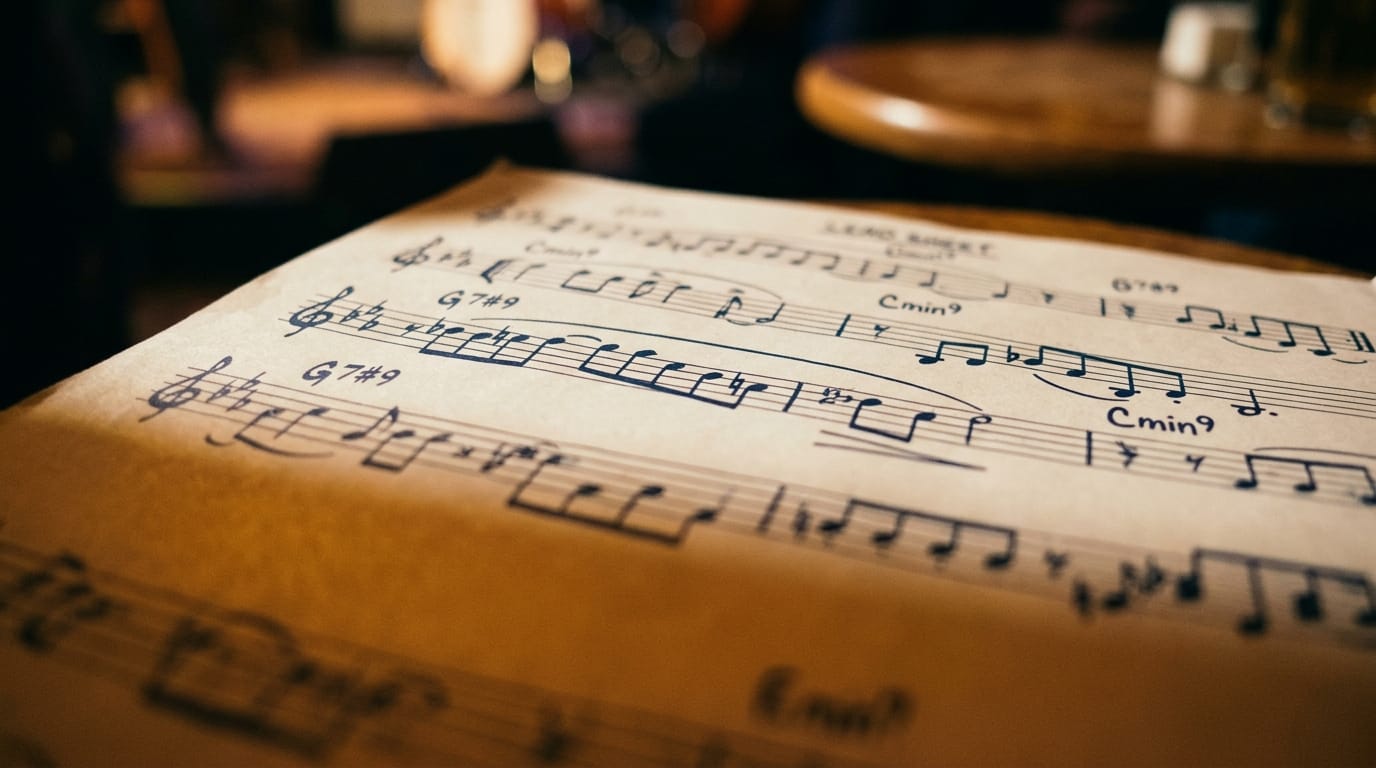
Reading treble and bass clef fluently transfers directly to jazz. Hand independence exercises, scales, arpeggios, and basic finger technique all carry over as a useful foundation. The Jazz Piano Book by Mark Levine (Sher Music, 1989) explicitly addresses students arriving from classical backgrounds, acknowledging that their theoretical grounding accelerates the harmony sections considerably. If you can read a lead sheet, a melody line in treble clef with chord symbols above it, you have enough notation literacy to begin jazz piano for beginners right now.
What Doesn’t Transfer, and Must Be Unlearned
Here’s the thing: classical voicing habits actively work against jazz. Root-position chords, which classical training drills into your hands, sound clunky in a jazz context where shell voicings and rootless voicings are the standard. Strict metric subdivision fights the swing feel, which lives in the space between the beat. Reading-only dependency is another trap, jazz demands ear-led learning from the start. You don’t need to read a full grand staff to begin, but you do need to start training your ear alongside your eyes.
Adult Learners: A Note on Timeline
Adults learning jazz piano bring real advantages: deeper harmonic understanding, stronger patience, and a richer listening history. Research in music psychology confirms that adults learn musical concepts faster than children but require more repetitions for motor encoding, the physical habit of playing a voicing without thinking about it takes longer to form after early childhood. That trade-off is manageable. Beginning jazz piano as an adult simply means prioritizing conceptual understanding early and trusting that the physical fluency follows with consistent repetition. The complete guide to jazz piano on eJazzNews covers the broader history and player lineage if you want context alongside your practice.
Step 1, Build Your Jazz Vocabulary: Scales and Modes
Before jazz harmony makes sense, your fingers need a physical map of the keyboard. Scales are that map. This isn’t a jazz piano tutorial that skips the fundamentals, the basics are where the jazz sound actually lives.
Start With Major and Minor Scales in All 12 Keys
Set a concrete benchmark before moving to jazz harmony: all 12 major scales, hands together, two octaves, at a metronome marking of quarter note = 80 BPM. That’s the floor, not the ceiling. Natural minor, harmonic minor, and melodic minor all appear in jazz contexts, natural minor in modal tunes, harmonic minor when a dominant chord resolves to a minor tonic, melodic minor in more advanced applications. Learn them in all 12 keys from the start. Transposing everything you learn into all 12 keys is one of the jazz piano basics that separates players who can only play in C from players who can sit in anywhere.
The Bebop Scales, Why They Exist
The bebop dominant scale adds a chromatic passing tone between the flatted 7th and the root of a dominant chord. The bebop major scale adds a chromatic passing tone between the 5th and 6th scale degrees. These additions aren’t decorative, they solve a rhythmic problem. When you play continuous eighth notes over a chord, the chromatic passing tone ensures that chord tones land on strong beats (1, 2, 3, 4) rather than weak eighth-note subdivisions. David Baker, whose How to Play Bebop series (Alfred Publishing) remains one of the most thorough treatments of this vocabulary, documented more than 70 books and 400 articles on jazz education during his career, his bebop scale exercises are worth the investment.
Modes and Their Function on Jazz Chord Changes
Modes assign a specific scale to each chord in a progression. On a ii-V-I in C major, the assignments work like this: D Dorian (D-E-F-G-A-B-C) over the Dm7 chord, G Mixolydian (G-A-B-C-D-E-F) over the G7 chord, and C Ionian (the plain C major scale) over the Cmaj7 chord. Lydian mode, which raises the 4th scale degree, appears frequently on major 7th chords in jazz arrangements. Locrian mode covers the m7♭5 chord (also called half-diminished), which appears as the ii chord in minor-key ii-V-i progressions. Keep this practical: the goal isn’t to memorize mode names but to hear which scale color fits which chord. The dedicated article on jazz scales and how they function over chord changes goes deeper on each mode with exercises.
Step 2, Master Jazz Piano Chord Voicings
Chord voicings are the specific arrangement of notes you choose to play a given chord. In jazz, the voicing you choose matters as much as the chord itself, the same Cmaj7 chord can sound lush, sparse, modern, or dated depending on which notes you stack and in which order. Mastering six core voicing types gives you the tools to sound like a jazz pianist immediately.
The Essential Voicings Every Beginner Must Know
| Voicing Type | Notes Used (C root example) | Hand | First Appears On |
|---|---|---|---|
| Shell Voicing (Root + 3rd + 7th) | C – E – B♭ | Left hand | Any ii-V-I |
| Four-Note Closed Voicing | C – E – G – B♭ | Right hand | C7 chord |
| Rootless Voicing (3rd + 7th guide tones) | E – B♭ (no root) | Left hand | Intermediate comping |
| Drop-2 Voicing | C – G – B♭ – E | Both hands | Chord melody arrangements |
| Sus4 / Quartal Voicing | C – F – B♭ | Left hand | Modal jazz tunes |
| Upper Structure Triad | D triad over G7 | Right hand | Advanced (listed for orientation only) |
The Jazz Piano Book by Mark Levine dedicates three full chapters to these voicings with progressive exercises. It’s the most thorough single-volume treatment of jazz voicings available, and it’s been the standard reference since its 1989 publication.
Guide Tones, The Fastest Path to Jazz Sound
The 3rd and 7th of any chord define its quality, major, minor, dominant, half-diminished. The root is optional in jazz because the bass player handles it. This means your left hand can play just two notes (the 3rd and 7th) and still communicate the full harmonic meaning of the chord. Practice voice-leading guide tones across a ii-V-I: on Dm7, play F and C; on G7, move to F and B; on Cmaj7, resolve to E and B. That smooth stepwise motion between guide tones is the foundation of jazz piano comping. For a complete breakdown of every voicing type with diagrams and exercises, the jazz piano chords guide covers the full progression from shell voicings to upper structures.
Step 3, Learn Jazz Standards: Your First 10 Tunes
Jazz standards are the shared language of the music. Every jazz musician in every city knows these tunes, they’re the sentences you need before you can have a conversation. Learning easy jazz piano songs from the standard repertoire isn’t a shortcut; it’s the curriculum. The Hal Leonard Real Book (6th Edition) is the legal, widely available reference for this repertoire. Note: searches for “jazz piano for beginners PDF” frequently lead to pirated copies of copyrighted books. Use the legal Hal Leonard edition, which is widely available from music retailers.
Why Standards Form the Core Curriculum
“Autumn Leaves” has been recorded approximately 1,400 times by mainstream and modern jazz musicians alone, according to published analysis of the standard’s history. That ubiquity isn’t an accident, the tune contains a clean ii-V-I in two related keys, making it a perfect harmonic laboratory. Standards give your scales and voicings a context to live in. Without tunes, you’re practicing vocabulary without sentences. The 50 best jazz standards article on eJazzNews gives you the broader repertoire picture once you’ve built your foundation.
The Recommended 10-Tune Starter List
| Tune | Composer | Key Center | Why It Works for Beginners | Primary Challenge |
|---|---|---|---|---|
| Autumn Leaves | Joseph Kosma | G minor / B♭ major | Clean ii-V-I in two related keys | Modulation between relative keys |
| Blue Bossa | Kenny Dorham | C minor / D♭ major | Accessible melody; clear bossa nova rhythm | Modulation down a half step |
| All of Me | Gerald Marks & Seymour Simons | C major | Simple harmony; singable melody | Turnaround navigation |
| Summertime | George Gershwin | A minor | Slow tempo forgiving; iconic melody | Minor tonality; blues inflection |
| Fly Me to the Moon | Bart Howard | C major | ii-V-I in nearly every bar; pedagogically ideal | Keeping a steady swing feel |
| Misty | Erroll Garner | E♭ major | Beautiful melody; common at jam sessions | ♭II major7 chord (Neapolitan) |
| The Girl from Ipanema | Antônio Carlos Jobim | F major | Introduces bossa nova groove | ♭II section modulation |
| Just Friends | John Klenner | G major | Bebop standard; fast harmonic rhythm | Navigating quick chord changes |
| Solar | Miles Davis / Chuck Wayne | C minor | Short form; modal elements | Sustaining melodic ideas |
| Blue in Green | Bill Evans / Miles Davis | G major | Voicing-focused; rubato feel | Unmetered phrasing |
Note on “Solar”: the composition is attributed to Miles Davis on Walkin’ (recorded in 1954, released by Prestige in 1957), though research indicates it was originally written by guitarist Chuck Wayne. Both attributions appear in published sources. “Blue in Green” from Kind of Blue (Columbia, 1959) is widely credited to Bill Evans, though the original album credits Davis.
How to Learn a Standard, The 4-Stage Method
Don’t try to play everything at once. Work through each tune in four stages: first, learn the melody by ear and from the lead sheet simultaneously; second, play the chord changes with shell voicings in the left hand only; third, add the right-hand melody while the left hand comps; fourth, begin improvising using guide tones only before adding scale runs. This sequence builds each layer on a solid foundation rather than piling everything on at once and playing all of it badly.
Step 4, Transcription: The Practice That Separates Jazz Players from Piano Players
Transcription, learning a recorded solo by ear and writing or memorizing it, is the practice that every serious jazz educator points to as non-negotiable. Wynton Marsalis, who has won nine Grammy Awards and whose educational work spans decades of documented interviews, has consistently named transcription as the single most important self-teaching tool available to a jazz musician. No printed method fully transfers phrasing, articulation, rhythmic language, and vocabulary the way a transcription does. Eight bars of a single solo is a meaningful starting unit.
Four Recommended Starting Transcriptions
| Pianist | Track | Album | Why It Works for Beginners |
|---|---|---|---|
| Wynton Kelly | “So What” | Kind of Blue, Miles Davis (Columbia, 1959) | Simple modal context; clear phrasing; limited note density |
| Red Garland | “Airegin” | Cookin’ with the Miles Davis Quintet (Prestige, 1957) | Block chord comping clearly audible; bebop vocabulary manageable |
| Bill Evans | “Waltz for Debby” | Waltz for Debby (Riverside, 1962) | Lyrical, slower tempo; voicing choices clearly audible |
| Oscar Peterson | “Hymn to Freedom” | Night Train (Verve, 1962 sessions, released 1963) | Gospel-inflected, metrically clear; motivic development easy to follow |
Bill Evans received seven Grammy Awards during his career and is widely regarded as one of the most influential jazz pianists in the music’s history. His voicing choices on “Waltz for Debby” are particularly instructive because the slower tempo and lyrical phrasing make each decision audible. Oscar Peterson released more than 200 recordings and won eight Grammy Awards (including a Grammy Lifetime Achievement Award in 1997), his playing on Night Train is metrically clear enough for a beginner to map rhythmically before tackling pitch.
Step-by-Step: How to Transcribe 8 Bars
- Isolate the passage using loop software. Transcribe! and Amazing Slow Downer are two verified, commercially available tools designed specifically for this purpose.
- Find the first note by ear on the keyboard before looking anything up.
- Map the rhythm first, clap the phrase before you try to pitch it.
- Write it out in notation or lead sheet shorthand.
- Play it back against the recording at half tempo.
- Memorize the passage and transpose it to at least one other key.
That last step, transposing, is where the vocabulary actually enters your playing. A lick you can only play in one key is a party trick. A lick you can play in three keys is a tool.
Step 5, Comping and Soloing: Putting Both Hands to Work
Playing jazz piano means managing two independent musical voices simultaneously: a left hand that comps (accompanies) with rhythmically varied chord stabs, and a right hand that carries the melody or improvises. Getting both hands working together is the central physical challenge of how to play jazz on piano, and it takes longer than most beginners expect.
Comping, What It Means and Why Rhythm Beats Harmony
“Comping” is short for accompanying, playing rhythmically varied chord voicings beneath a melody or solo. The most common beginner error is playing chords on every beat, which deadens the swing feel immediately. Think of Freddie Green, the Count Basie rhythm guitarist whose sparse, precise chord placement drove the Basie band for decades, less is more. Two basic comping rhythms to learn first: the “Charleston” pattern (beat 1, then the and of beat 2) and a simple quarter-eighth combination that leaves space on beats 2 and 4. Playing jazz piano well means knowing when not to play as much as knowing what to play.
Introduction to Walking Bass Lines (Left Hand)
A walking bass line connects the root positions of chords using a mix of diatonic steps, chromatic approaches, and arpeggios, one note per beat, quarter notes throughout. Start with roots only on beat 1 of each chord. Then add a chromatic approach note on beat 4 leading into the next chord. Finally, fill beats 2 and 3 with diatonic passing tones. Set a benchmark: aim for a 12-bar blues walking bass at quarter note = 100 BPM before combining it with right-hand melody. That combination, walking bass plus melody, is the core skill of solo jazz piano playing.
Soloing Over Changes, First Principles
Start with guide-tone improvisation, using only the 3rds and 7ths of each chord, before adding scale runs. This forces melodic thinking rather than scale-running. Miles Davis‘s solo on “All Blues” from Kind of Blue is widely cited by jazz educators as a model of motivic, minimal improvisation: he takes a short phrase, repeats it with rhythmic variation, and develops it before introducing new material. That approach, motif development over scale decoration, is the first principle of jazz soloing. The complete guide to jazz improvisation covers this process in full, from guide tones through advanced harmonic substitution.
Common Mistakes Beginners Make Learning Jazz Piano
Let’s be honest: most beginners make the same four mistakes, and most of them are invisible until someone points them out. Knowing what to avoid is half the battle.
Mistake 1, Playing Too Many Notes
Miles Davis’s advice to John Coltrane, widely reported across multiple jazz biographies, including Ashley Kahn’s Kind of Blue: The Making of the Miles Davis Masterpiece (Da Capo Press), was essentially: stop playing everything you know on every chord. The solution is a specific exercise: improvise a 12-bar blues using only four different pitches. This forces melodic thinking and reveals how much expression lives in rhythm and phrasing rather than note density.
Mistake 2, Ignoring Time and Practicing Without a Metronome
Use a metronome on beats 2 and 4, not beats 1 and 3. This simulates the jazz backbeat feel and trains your internal pulse to sit in the right place. Here’s a concrete benchmark: if you can’t play a ii-V-I at quarter note = 120 with a metronome clicking on 2 and 4 without rushing, the harmony isn’t internalized yet. The chord changes are still occupying mental bandwidth that should be free for musical decisions.
Mistake 3, Over-Relying on Patterns and Licks
Learning a lick from a transcription is good practice. Deploying that same lick regardless of harmonic context is a different thing entirely. Patterns borrowed without harmonic awareness produce playing that sounds mechanical and disconnected from the chord changes underneath. The fix: practice each lick starting on a different chord tone each day. On Monday, start it on the 3rd. On Tuesday, start it on the 7th. This forces the lick to become flexible vocabulary rather than a fixed phrase.
Mistake 4, Skipping the Standards Repertoire
Scales and voicings without tunes are vocabulary without sentences. Jazz piano basics only become jazz when they’re applied to real music with real harmonic motion. If you’ve been practicing scales for three months and haven’t learned a single complete tune, stop and learn “Autumn Leaves” this week. The tune gives every scale and voicing exercise a reason to exist.
Practice Routine Templates for Jazz Piano Beginners
Consistent daily practice beats occasional long sessions every time. Whether you have 30 minutes or 90, a structured plan keeps you moving forward rather than noodling through the same comfortable material. These templates work for jazz piano lessons, self-study, and jazz piano class settings alike.
The 30-Minute Daily Practice Plan
| Time Block | Activity | Goal |
|---|---|---|
| 0:00-0:05 | Scales (2 keys, major + Dorian) | Technique + vocabulary |
| 0:05-0:12 | Chord voicings (one ii-V-I, 3 keys) | Muscle memory |
| 0:12-0:22 | One jazz standard (melody + changes) | Repertoire building |
| 0:22-0:30 | Free improvisation over one tune | Application |
The 60-Minute Daily Practice Plan
| Time Block | Activity | Goal |
|---|---|---|
| 0:00-0:08 | Scales and arpeggios (4 keys) | Technique |
| 0:08-0:18 | Voicings + guide tone lines | Harmony internalization |
| 0:18-0:33 | Standard #1 (melody, chords, improv) | Repertoire |
| 0:33-0:45 | Standard #2 or new tune introduction | Repertoire expansion |
| 0:45-0:55 | Transcription work (8-bar segment) | Ear training + vocabulary |
| 0:55-1:00 | Free play / recording playback | Self-assessment |
The 90-Minute Daily Practice Plan
| Time Block | Activity | Goal |
|---|---|---|
| 0:00-0:10 | Full-key scale cycle (all 12 major) | Comprehensive technique |
| 0:10-0:25 | Voicings, shell + rootless, all keys | Complete chord fluency |
| 0:25-0:45 | Two standards (full arrangement) | Repertoire depth |
| 0:45-1:00 | Transcription (full 16-bar section) | Vocabulary acquisition |
| 1:00-1:15 | Walking bass + melody combination | Coordination |
| 1:15-1:30 | Play-along recording session | Musical integration |
For the play-along block, two verified resources stand out: iRealPro (a widely used app that generates backing tracks for any standard at any tempo) and the Jamey Aebersold Play-Along series, which has grown to more than 130 volumes since its launch in 1967 and remains one of the most widely used practice-along series in jazz education. Both give you a rhythm section to play with, which is the closest thing to a jazz piano class you can get at home.
Recommended Resources: Courses, Books, and Teachers
The market for jazz piano lessons, online and in print, is large and uneven. Some resources are genuinely excellent; others are thin on content and heavy on marketing. Here’s a fact-checked breakdown of what’s worth your time and money.
Essential Jazz Piano Books (Verified, In-Print)
| Title | Author | Publisher | Best For | Approx. Price |
|---|---|---|---|---|
| The Jazz Piano Book | Mark Levine | Sher Music | Intermediate theory and voicings | ~$45 |
| The Real Book (6th Ed.) | Various (Hal Leonard) | Hal Leonard | Standards repertoire | ~$45 |
| Jazz Piano: The Complete Guide | Noah Baerman | Hal Leonard | True beginners | ~$25 |
| How to Play Bebop, Vol. 1 | David Baker | Alfred Publishing | Bebop vocabulary and scales | ~$20 |
| The Complete Musician | Steven Laitz | Oxford University Press | Music theory foundation | ~$95 |
A note on “jazz piano for beginners PDF” searches: these frequently lead to pirated copies of copyrighted books, including illegal scans of The Jazz Piano Book and The Real Book. Use legal sources. The Hal Leonard 6th Edition of The Real Book is the correct, legally licensed version, it’s widely available from music retailers and corrects many of the errors that appeared in the original unauthorized editions.
Online Jazz Piano Courses Worth Considering
Three platforms stand out for jazz piano online course content. Open Studio Jazz (openstudiojazz.com) is a subscription-based platform founded in 2015 that describes itself as the largest online community of jazz musicians worldwide, with instruction from working professional artists. Jazzedge Academy (jazzedge.com), created by Willie Myette, a Berklee College of Music graduate who has toured the US and Europe as both performer and clinician, offers a structured beginner curriculum with a clear progression path. Jazz Tutorial, founded by Julian Bradley in 2011, provides free and paid content covering jazz theory and piano technique; it’s a legitimate free jazz piano lessons resource worth bookmarking. For online jazz piano lessons, all three platforms offer structured paths that work well as primary resources, especially when supplemented with occasional in-person feedback.
Finding a Jazz Piano Teacher
When looking for a jazz piano teacher, performing experience matters more than academic credentials alone. A good jazz piano teacher asks you to transcribe solos, gives you tunes rather than just exercises, and plays alongside you regularly. For jazz piano teachers online, Lessonface and TakeLessons are two established, verified directories that connect students with working musicians. The trade-off between online and in-person piano jazz lessons is real: in-person lessons allow a teacher to correct hand position and technique errors that are nearly impossible to self-diagnose on video. If you can find a local teacher with genuine jazz performance experience, that’s worth prioritizing, at least for the first six months.
How Long Does It Really Take? A Realistic Progress Timeline
No competitor article answers this question with specific, verifiable benchmarks. Here’s an honest breakdown based on curriculum structures documented in published methods, including Levine’s Sher Music materials and publicly available syllabi from accredited jazz programs.
The 3-Stage Benchmark Timeline
| Stage | Timeframe (Consistent Daily Practice) | What You Can Do | Key Indicator |
|---|---|---|---|
| Foundation | 0-6 months | Play ii-V-I in 3 keys; perform 2-3 standards from a lead sheet | Can play “Autumn Leaves” at quarter note = 100 |
| Developing | 6-18 months | 10+ standards; improvise with guide tones; basic comping | Can sit in at a slow jam session |
| Functional Jazz Player | 18-36 months | 25+ standards; transcribed 3-4 solos; walking bass + melody | Can play a full set without sheet music |
These benchmarks assume consistent daily practice, 30 to 60 minutes minimum. Weekend-only practice extends each stage significantly. The “Functional Jazz Player” milestone doesn’t mean you’ve arrived; it means you can participate in the tradition. Jazz musicians spend careers developing from that point. The question “is it hard to play jazz piano?” has an honest answer: harder than pop piano, more immediately accessible than advanced classical repertoire, and deeply rewarding at every stage of the process.
Learning Jazz Piano as an Adult: What’s Different
Adult learners are the majority of people searching for how to learn jazz piano, and most beginner resources ignore their specific situation entirely. Learning jazz piano as an adult is genuinely different from starting as a child, not harder overall, but different in ways that affect how you should structure your practice.

Adults bring real advantages to the instrument. Deeper harmonic understanding means jazz theory clicks faster. Stronger patience means you’re less likely to quit when a voicing takes two weeks to feel natural. A richer listening history, years of absorbing jazz records, means your ear is already partly trained before you touch the keys. These advantages are significant and often underestimated.
The specific challenge adults face is motor learning. Neuroplasticity research broadly confirms that physical skill acquisition slows after early adulthood, the hands take more repetitions to encode a new movement pattern than they would in childhood. This doesn’t mean adults can’t develop technique; it means the technique arrives more slowly than the conceptual understanding. The practical prescription for learning jazz piano as an adult: shorter, more frequent sessions outperform long weekend marathons. Twenty minutes daily beats two hours on Sunday, every time. Prioritize ear training and harmonic analysis early. Let motor fluency follow at its own pace, it will come.
FAQ, Your Jazz Piano Questions Answered
Is it hard to play jazz piano?
Jazz piano is harder than pop or rock piano by a meaningful degree. It requires simultaneous mastery of improvisation, harmony, and rhythm, three domains that classical training addresses sequentially rather than all at once. That said, the first six months of jazz piano are more immediately rewarding than the first six months of classical study, because you’re playing real music (standards) from the beginning rather than exercises. The realistic timeline for sounding recognizably jazz is one to three years of consistent daily practice.
What is the best method to learn jazz piano?
No single method covers everything, but the consensus across verified published sources, Levine, Baker, Aebersold, points to the same combination: learn standards, transcribe solos, study theory, and play along with recordings. Jazz piano lessons for beginners work best when they combine all four elements rather than isolating any one. Theory without tunes is abstract. Tunes without transcription produce playing that sounds correct but not jazz. How to learn jazz piano, in short, is to do all of it at once, in small daily doses.
What is the 80/20 rule in piano?
Applied to jazz piano, the 80/20 principle works like this: roughly 80% of jazz situations are covered by mastering three harmonic frameworks, the ii-V-I progression, the 12-bar blues form, and rhythm changes (the chord progression from Gershwin’s “I Got Rhythm”). These three frameworks appear across the majority of the standard repertoire. Learn them thoroughly in all 12 keys before expanding into more complex harmonic territory. This is the most efficient path through the beginner jazz piano stage.
Is jazz piano harder than classical piano?
The honest answer is: it depends on what you’re comparing. Classical piano demands precise replication of a written score, every note, every dynamic, every articulation. Jazz demands real-time composition over moving chord changes. At the beginner level, jazz is arguably more accessible, there are no 50-page concertos to memorize. At the advanced level, jazz improvisation is arguably the more demanding cognitive task. Ted Gioia addresses this comparison in The History of Jazz (Oxford University Press), noting that jazz’s improvisational demands represent a fundamentally different kind of musical intelligence from classical interpretation.
Can I learn jazz piano without a teacher?
Yes, with specific caveats. Self-teaching works well for theory, repertoire, and transcription, all three can be pursued effectively through books, online jazz piano lessons, and play-along recordings. What a jazz piano teacher accelerates is ear training and technique correction. Errors in hand position, voicing habits, and rhythmic feel are nearly impossible to self-diagnose, and they compound over time. The most practical approach: use an online jazz piano course as your primary resource and schedule occasional lessons, even monthly, for feedback. Jazz piano lessons online through platforms like Open Studio or Jazzedge give you structure; a real teacher gives you a mirror.
Start With One Tune, One Voicing, One Week
The five-step path through how to play jazz piano, scales, voicings, standards, transcription, comping and soloing, is a sequence, not a checklist. You don’t finish one and move to the next; you cycle through all five, deepening each layer with every pass. Pick one tune from the list above. “Autumn Leaves” is the recommended starting point for beginner jazz piano: it contains the ii-V-I in two keys, it’s slow enough to hear every chord change, and it’s played at every jam session on earth. Learn the melody this week. Add shell voicings next week. The tradition of learning jazz at jam sessions and from records is as old as the music itself, and that tradition is still the most reliable path forward. The jazz piano chords guide is your next stop for voicing depth, and the jazz piano complete guide gives you the full historical and stylistic context to understand where your playing fits in the music’s century-long conversation.