What Is Jazz Fusion? Meaning, History, Sound and Where to Start
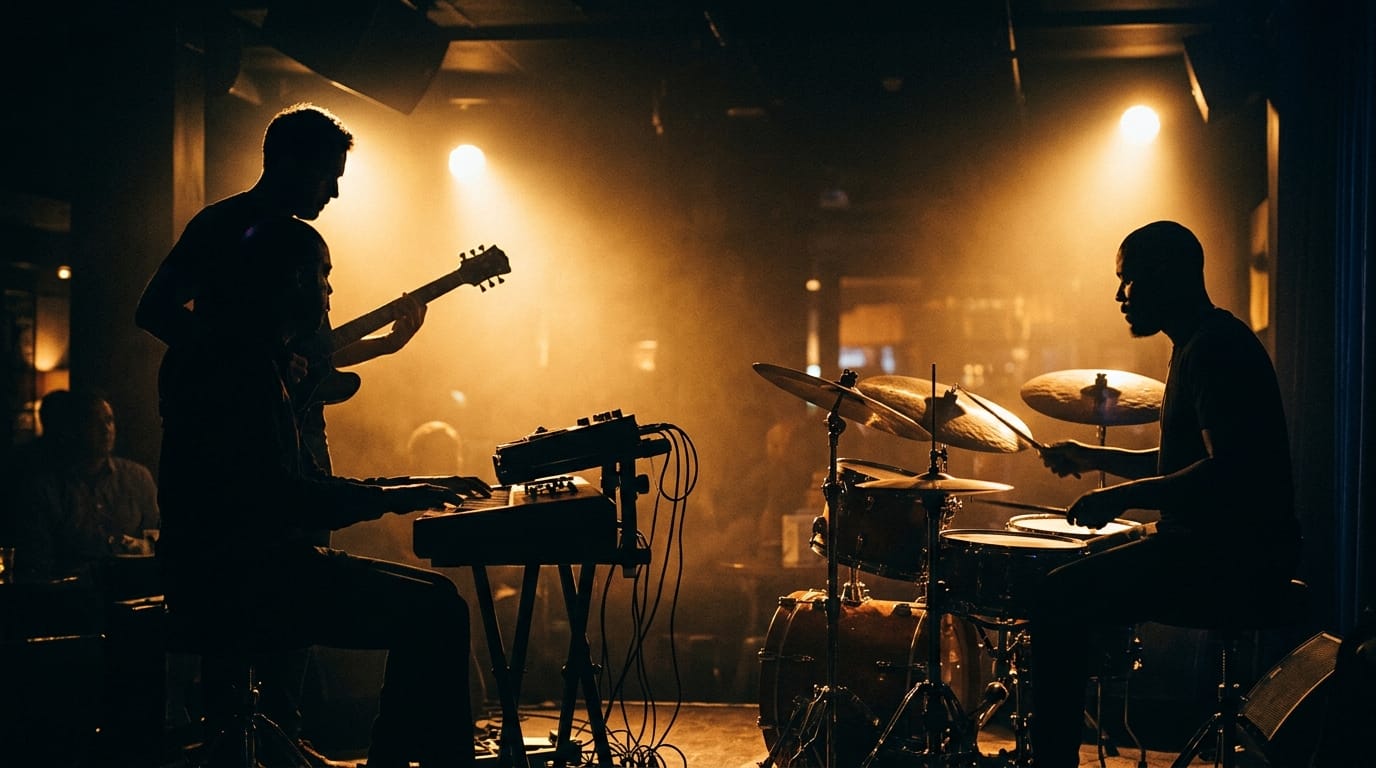
Jazz fusion, also called jazz-rock or simply fusion, is jazz improvisation and harmony played with the electric instruments and rhythms of rock, funk and R&B. It took shape in the late 1960s, and Miles Davis’s In a Silent Way (1969) and Bitches Brew (1970) are the records most often named as its starting point. In the 1970s, bands led by Davis’s former sidemen, above all Weather Report, the Mahavishnu Orchestra, Return to Forever and Herbie Hancock’s Headhunters, took the style into the top 20 of the Billboard album chart.
Table of Contents
- What Does Jazz Fusion Mean?
- What Jazz Fusion Sounds Like
- Jazz vs. Jazz Fusion: The Main Differences
- A Short History of Jazz Fusion
- Before 1969: The First Crossovers
- 1969 and 1970: The Records That Defined It
- The 1970s: The Bands of Davis’s Sidemen
- From 1980 to Today
- The Main Branches of Fusion
- Fusion Tunes That Became Jazz Standards
- Where to Start Listening
- Frequently Asked Questions
- What is jazz fusion in simple terms?
- When did jazz fusion start?
- Is jazz fusion the same as smooth jazz?
- What is the most famous jazz fusion band?
- What is jazz fusion dance?
What Does Jazz Fusion Mean?
In music, fusion means a blend of genres, and the word can describe almost any mix. Used on its own in a jazz context, though, it nearly always means this specific blend: jazz musicians taking up electric guitar, bass guitar, electric piano and synthesizers, and trading the swing rhythm of earlier jazz for rock backbeats and funk grooves, while keeping improvisation at the center. The common textbook statement that jazz fusion combined jazz improvisation with elements of rock, funk and electronic music is accurate.
Fusion jazz and jazz fusion mean the same thing. Jazz-rock is often used as a synonym, although that term also covers rock bands of the late 1960s and 1970s that added horns and jazz elements, such as Blood, Sweat & Tears, Chicago and Soft Machine.
Fusion is better understood as an approach than as a fixed style. A fusion record can be a quiet groove on two chords or a dense composition in odd time signatures, and the same band often recorded both. Carnegie Hall’s Timeline of African American Music gives a short overview of the genre with listening examples.
What Jazz Fusion Sounds Like
Six features turn up on most fusion records, from Bitches Brew to Heavy Weather:
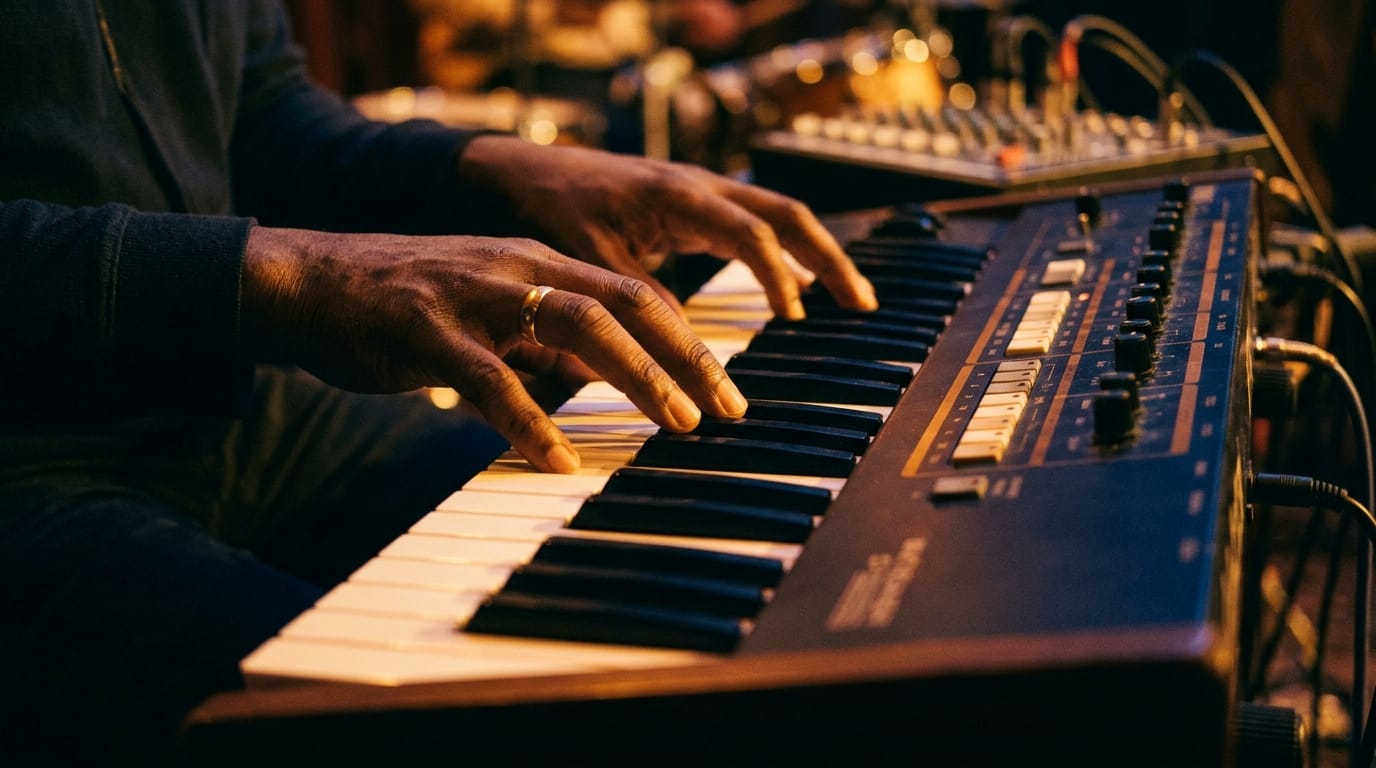
- Electric keyboards. The Rhodes electric piano was the sound of early fusion. Herbie Hancock first played one on a Miles Davis session in 1968, and from In a Silent Way on it was the main keyboard on Davis’s records until the mid-1970s. Synthesizers followed: Jan Hammer of the Mahavishnu Orchestra ran a Minimoog through distortion and used its pitch bend wheel so it sounded like a guitar, and Joe Zawinul built Weather Report’s later sound on ARP and Oberheim instruments.
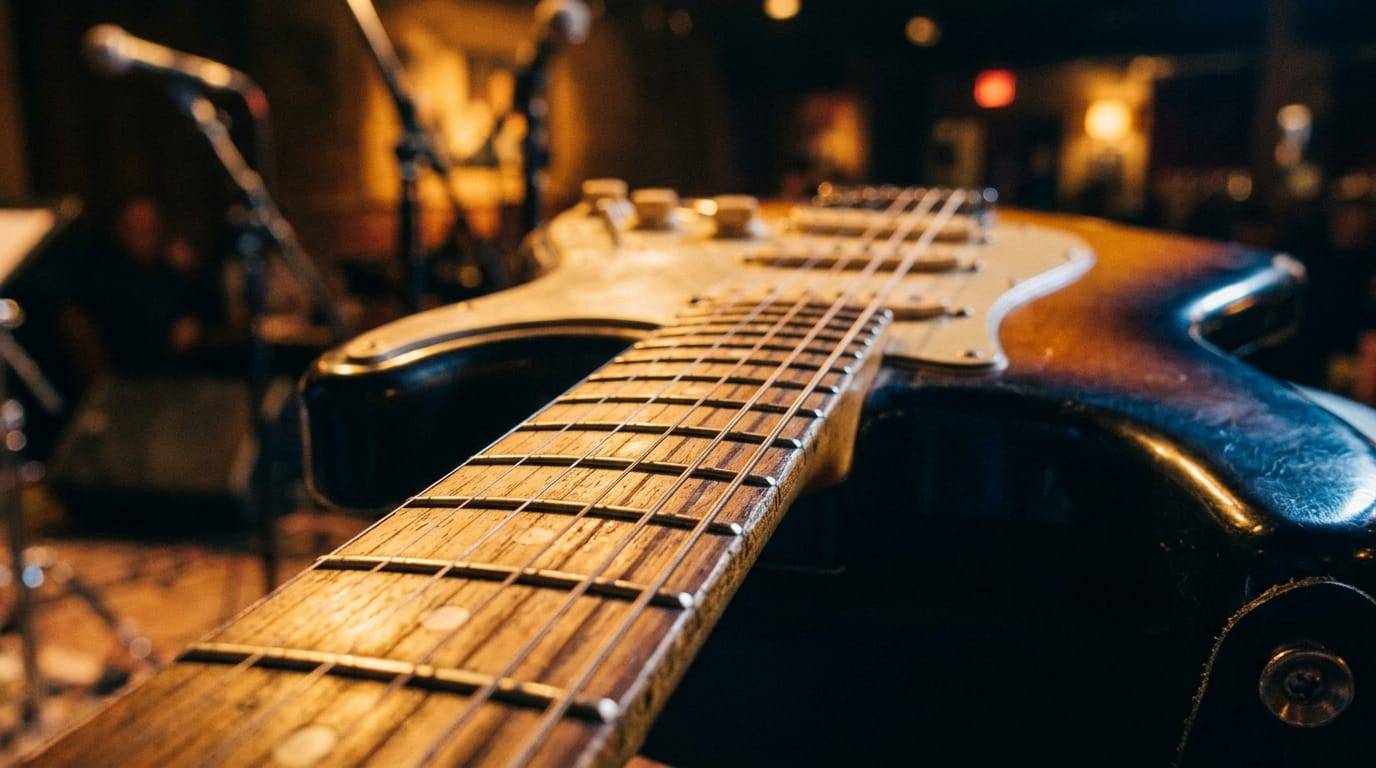
- Electric guitar and bass guitar. The guitar became a lead voice, often distorted. John McLaughlin played a Gibson EDS-1275 double-neck through a Marshall amplifier in the first Mahavishnu Orchestra. The bass guitar largely took over from the double bass, and Jaco Pastorius, who joined Weather Report in 1976, made the fretless bass a melodic solo instrument.
- Rock and funk rhythm. On Bitches Brew Davis mostly dropped the swing beat for a rock backbeat and bass guitar grooves, with two bassists, two or three drummers and several keyboard players playing at once. Drummers such as the Mahavishnu Orchestra’s Billy Cobham played large rock kits.
- Few chords, long vamps. Instead of bebop’s fast chord changes, many fusion pieces stay on one or two chords for minutes at a time, extending the modal approach of Davis’s Kind of Blue (1959). Hancock’s “Chameleon” runs for nearly 16 minutes, most of it over a two-chord vamp in B-flat Dorian, B♭m7 to E♭7. Our explainer on modal jazz covers where that idea came from.
- Odd meters and composed sections. The more ambitious bands wrote complex arrangements in unusual time signatures. The Tony Williams Lifetime’s “Via the Spectrum Road” is a blues of sorts in 11/8, and the Mahavishnu Orchestra combined complex time signatures with ideas taken from Indian classical music.
- The studio as a tool. Producer Teo Macero built In a Silent Way and Bitches Brew by cutting and rearranging long improvised takes after the sessions.
Jazz vs. Jazz Fusion: The Main Differences
Fusion changed the instruments, the rhythm and the way records were made, but not the role of improvisation:
| Element | Swing, bebop and hard bop | Jazz fusion |
|---|---|---|
| Instruments | Acoustic piano, double bass, drums, horns | Electric piano, synthesizers, electric guitar, bass guitar, drums, often horns |
| Rhythm | Swing feel carried by the ride cymbal | Rock backbeat or funk groove, sometimes odd meters |
| Harmony | Chord changes every bar or two | Long vamps on one or two chords, or through-composed sections |
| Recording | Mostly complete takes | Takes often edited and assembled afterward |
| Improvisation | Central | Central |
The argument was heated at the time. When Bitches Brew became a hit, some jazz critics accused Davis of betraying the essence of jazz, and the Tony Williams Lifetime’s debut was largely rejected by jazz listeners because of its heavy rock influence. Weather Report’s members distanced themselves from the fusion label altogether. The case for fusion as jazz rests on two points: the improvising stayed at the center, and the leaders of the main fusion bands of the 1970s had all played in Davis’s groups. For how that improvising works, see our guide to jazz improvisation.
A Short History of Jazz Fusion
Before 1969: The First Crossovers
Until the late 1960s, jazz and rock audiences barely overlapped. Guitarist Larry Coryell, often called the godfather of fusion, formed the Free Spirits in 1966, a band sometimes cited as the first jazz-rock group; their album Out of Sight and Sound came out on ABC in 1967. That year Coryell joined vibraphonist Gary Burton’s quartet, whose album Duster mixed jazz with rock and country.
Miles Davis moved the same way. In his autobiography he wrote that in 1968 and 1969 he was listening to Jimi Hendrix, James Brown and Sly and the Family Stone. On Miles in the Sky (1968), Herbie Hancock plays electric piano and Ron Carter bass guitar on the opening track, “Stuff,” and George Benson adds electric guitar to “Paraphernalia.” On Filles de Kilimanjaro, recorded later that year, Hancock is on Rhodes, and Chick Corea and Dave Holland appear on a Davis album for the first time.
1969 and 1970: The Records That Defined It
In a Silent Way was recorded in a single session on February 18, 1969, at CBS 30th Street Studio in New York, with three keyboard players (Hancock, Corea and Joe Zawinul), guitarist John McLaughlin, Wayne Shorter on soprano saxophone, Holland on bass and Tony Williams on drums. Released that July, it is generally regarded as his first fusion album. Bitches Brew followed: recorded on August 19 to 21, 1969, it came out as a double LP in March 1970. It won the 1971 Grammy for Best Large Jazz Ensemble Album, became Davis’s first gold record in 1976, went platinum in 2003 and was added to the Library of Congress’s National Recording Registry in 2025. Our Miles Davis biography follows the rest of his electric period, from On the Corner (1972) to the Osaka concert album Agharta (1975).
Tony Williams had already left Davis to form the Lifetime, a trio with McLaughlin and organist Larry Young. Its debut, Emergency! (Polydor, 1969), was recorded about three months before Bitches Brew and paired rock volume with jazz improvisation.
The 1970s: The Bands of Davis’s Sidemen
Weather Report, founded in 1970 by Zawinul and Shorter with bassist Miroslav Vitouš, started as a freely improvising group and moved toward funk and R&B. Its Heavy Weather (Columbia, 1977), which opens with Zawinul’s “Birdland,” had sold a million copies in the US by 1991, and the band stayed together until 1986.
John McLaughlin formed the Mahavishnu Orchestra in New York in 1971 with Billy Cobham, keyboardist Jan Hammer, violinist Jerry Goodman and bassist Rick Laird. Its second album, Birds of Fire (1973), reached No. 15 on the Billboard 200 before the original lineup played its last concert at the end of that year.
Chick Corea started Return to Forever in 1972 with Brazilian singer Flora Purim, percussionist Airto Moreira, saxophonist and flutist Joe Farrell and bassist Stanley Clarke. From 1973 it was an instrumental jazz-rock band with drummer Lenny White and, from 1974, guitarist Al Di Meola. Herbie Hancock’s Head Hunters (Columbia, 1973) brought jazz-funk to a mass audience: it reached No. 13 on the Billboard 200 and No. 2 on the R&B albums chart.
Late in the decade the music grew more melodic and polished. The Pat Metheny Group, founded in 1977 by guitarist Pat Metheny and keyboardist Lyle Mays, recorded for ECM until 1984 and won the Grammy for Best Jazz Fusion Performance five times. The individual players and bands get their own entries in our list of jazz fusion artists and bands.
From 1980 to Today
The Recording Academy gave the style its own award in 1980, Best Jazz Fusion Performance, first won by Weather Report for 8:30 and presented until 1991. By then much of the original style had been absorbed into smooth jazz, while Corea kept an electric line going with his Elektric Band. Since 2000 a new generation has taken fusion up again. Snarky Puppy, formed by bassist Michael League in Denton, Texas, in 2004, has won the Grammy for Best Contemporary Instrumental Album four times, and the Armenian pianist Tigran Hamasyan mixes Armenian folk scales with jazz and progressive rock.
The Main Branches of Fusion
- Jazz-rock. Loud, guitar-led and often in odd meters. The Mahavishnu Orchestra’s debut The Inner Mounting Flame (Columbia, 1971) and Emergency! are the starting points.
- Jazz-funk. Groove comes first, with funk drumming, clavinet and synthesizer bass. On Head Hunters Hancock dropped guitar altogether in favor of a Hohner Clavinet.
- Brazilian and Latin fusion. Return to Forever’s Light as a Feather (Polydor, 1973), recorded in London with Purim, Airto, Farrell and Clarke on double bass, sets Corea’s Rhodes over Brazilian rhythms.
- Indian fusion. Shakti, the acoustic group McLaughlin formed in the mid-1970s with violinist L. Shankar and tabla player Zakir Hussain, combined South Indian Carnatic music with jazz improvisation and used no electric instruments at all.
- Jazz and hip-hop. Carnegie Hall’s timeline of jazz hip-hop fusion runs from Gang Starr’s “Jazz Thing” (1990), Guru’s Jazzmatazz (1993) and Davis’s posthumous Doo-Bop (1992) to Robert Glasper Experiment’s Black Radio (Blue Note, 2012), which won the Grammy for Best R&B Album. In London, acid jazz grew out of 1980s clubs where DJs played old jazz-funk and fusion records.
- Smooth jazz. The commercial offshoot: polished melodies, short solos and R&B or pop grooves aimed at radio, with roots in producer Creed Taylor’s CTI records. Kenny G’s Breathless (Arista, 1992) is certified diamond in the US for 12 million copies, and Kenny G has been criticized by jazz and fusion fans alike.
For how these styles fit into the wider family of jazz, see our overview of the main types of jazz.
Fusion Tunes That Became Jazz Standards
A handful of fusion compositions are now played far beyond the bands that recorded them:
- “Birdland” (Joe Zawinul), the opening track of Heavy Weather (1977). The Manhattan Transfer’s vocal version won the Grammy for Best Jazz Fusion Performance in 1981, and Quincy Jones’s version won the same award in 1991.
- “Spain” (Chick Corea), composed in 1971 and first recorded on Light as a Feather. It opens with the adagio from Joaquín Rodrigo’s Concierto de Aranjuez before a fast samba-like theme.
- “Chameleon” (Herbie Hancock with Bennie Maupin, Paul Jackson and Harvey Mason), the opener of Head Hunters. Hancock played its 12-note bass line on an ARP Odyssey synthesizer.
- “Red Clay” (Freddie Hubbard), the title track of his first CTI album (1970) and his signature tune for the rest of his career.
Where to Start Listening
Six records cover the main directions. Choose by what you already like:
- In a Silent Way (Miles Davis, Columbia, 1969): quiet and atmospheric, the gentlest way in.
- Bitches Brew (Miles Davis, Columbia, 1970): dense and long, with up to three drummers playing at once.
- The Inner Mounting Flame (Mahavishnu Orchestra, Columbia, 1971): fast, loud and guitar-led, the place to start if you come from rock.
- Head Hunters (Herbie Hancock, Columbia, 1973): the entry point for funk and R&B listeners.
- Light as a Feather (Return to Forever, Polydor, 1973): Brazilian rhythms, Rhodes and flute, and the original “Spain.”
- Heavy Weather (Weather Report, Columbia, 1977): melodic and synthesizer-heavy, with Jaco Pastorius on fretless bass.
For a longer ranked list, see our selection of the best jazz fusion albums.
Frequently Asked Questions
What is jazz fusion in simple terms?
Jazz fusion is jazz played with the electric instruments and rhythms of rock and funk. The musicians still improvise at length, but over a backbeat or funk groove, with electric piano, synthesizers, electric guitar and bass guitar instead of acoustic piano and double bass.
When did jazz fusion start?
In the late 1960s. Larry Coryell’s Free Spirits and Gary Burton’s quartet mixed jazz and rock in 1966 and 1967, but Miles Davis’s In a Silent Way (1969) and Bitches Brew (1970) are usually treated as the start of fusion as a movement.
Is jazz fusion the same as smooth jazz?
No. Smooth jazz grew out of the commercial side of fusion in the late 1970s and 1980s, but it puts polished melodies and radio-friendly grooves ahead of improvisation. Fusion bands such as the Mahavishnu Orchestra and Weather Report built their music on extended solos, group improvisation and often complex arrangements.
What is the most famous jazz fusion band?
Four 1970s bands are usually cited as the core of the movement: Weather Report, the Mahavishnu Orchestra, Return to Forever and Herbie Hancock’s Headhunters. Weather Report’s Heavy Weather (1977), with the hit Birdland, had sold a million copies in the US by 1991, and Hancock’s Head Hunters reached No. 13 on the Billboard 200.
What is jazz fusion dance?
In dance, jazz fusion is the name many studios give to classes that mix jazz dance technique with other styles such as hip-hop, street jazz, lyrical or contemporary, depending on the teacher. It shares the idea of blending styles with jazz fusion music but is a separate thing.