

Jazz Scales: The 7 Essential Scales Every Jazz Musician Needs to Know
The seven essential jazz scales are the major scale, the Dorian and Mixolydian modes, the melodic minor scale, the blues scale, the bebop dominant scale and the whole-tone scale. Each one belongs to a type of chord, so the real skill is matching scale to chord: Dorian over minor seventh chords, Mixolydian or bebop dominant over dominant sevenths, the major scale over major sevenths. Below are all seven with formulas and spellings, a chord-scale chart and a practice method.
Table of Contents
- How Jazz Musicians Use Scales
- The 7 Essential Jazz Scales
- 1. The Major Scale (Ionian)
- 2. The Dorian Mode
- 3. The Mixolydian Mode
- 4. The Melodic Minor Scale
- 5. The Blues Scale
- 6. The Bebop Dominant Scale
- 7. The Whole-Tone Scale
- Jazz Chord-Scale Chart
- How to Practice Jazz Scales
- Work Through All 12 Keys
- Play Patterns, Not Only Runs
- Practice Over Chords
- On Piano: Scale in the Right Hand, Shell in the Left
- Where to Go Next
- Frequently Asked Questions
- What scales are used in jazz?
- What is the most important scale in jazz?
- What is the difference between the blues scale and the minor pentatonic scale?
- Do I need to learn jazz scales in all 12 keys?

How Jazz Musicians Use Scales
In jazz a scale is less a key than a set of notes that fits one chord: the chord tones (root, third, fifth and seventh) plus the notes in between. This chord-scale system goes back to George Russell’s book Lydian Chromatic Concept of Tonal Organization (1953), spread through Jamey Aebersold’s play-along series, begun in 1967, and is now the most widely used method for teaching improvisation in college jazz programs.
Several of the seven scales are modes: the same notes started from a different degree. Play the C major scale from D and you get D Dorian; start it from G and you get G Mixolydian. A ii-V-I in C (Dm7-G7-Cmaj7) therefore uses three scale names but only seven notes. What changes is which of them are chord tones: D, F, A and C over Dm7; G, B, D and F over G7; C, E, G and B over Cmaj7. The scale shows which notes are available; the chord tones show where to land.
The method has limits. Many older players thought in chord tones and arpeggios rather than scales, and lines built only from scales can sound static. Treat the scales as a map and the chord tones as the destination.
The 7 Essential Jazz Scales
The order runs from the scale the others are built on to the more specialized ones. W is a whole step, H a half step.
1. The Major Scale (Ionian)
Formula W-W-H-W-W-W-H, degrees 1-2-3-4-5-6-7. C major is C-D-E-F-G-A-B. It fits major seventh and major sixth chords (Cmaj7, C6), and it is the parent of Dorian and Mixolydian, so learning it in every key gives you three scales at once.
One note needs care: the fourth. Over Cmaj7 the F sits a half step above the chord’s third (E) and clashes with it, so jazz theory calls it an avoid note, to be used in passing rather than held. Teachers differ on the remedy. Russell paired major chords with the Lydian mode (C-D-E-F♯-G-A-B), which raises the fourth and removes the clash, while John Mehegan, David Baker and Mark Levine taught the major scale as the better match.
2. The Dorian Mode
Formula W-H-W-W-W-H-W, degrees 1-2-♭3-4-5-6-♭7. D Dorian is D-E-F-G-A-B-C, the white keys from D to D. Compared with the natural minor scale it has a major sixth (B instead of B♭), which makes it sound brighter. It is the standard choice over minor seventh chords, both the ii chord of a major key and a minor chord that lasts for many bars.
“So What,” the opening track of Miles Davis’s Kind of Blue (Columbia, 1959), is the textbook case: 16 bars of D Dorian, eight of E♭ Dorian and eight more of D Dorian. John Coltrane’s “Impressions” uses the same plan. How those tunes are built is explained in our article on modal jazz.
3. The Mixolydian Mode
Formula W-W-H-W-W-H-W, degrees 1-2-3-4-5-6-♭7: a major scale with a flat seventh. G Mixolydian is G-A-B-C-D-E-F, the white keys from G. Its root, third, fifth and seventh spell a dominant seventh chord (G-B-D-F), which makes it the basic scale for unaltered dominant chords: the V7 of a ii-V-I and the I7, IV7 and V7 of a blues.
The fourth is again the avoid note: C over G7 lies a half step above the third, B. On a G7sus4 chord, where C replaces the third, it becomes a chord tone and the clash disappears.
4. The Melodic Minor Scale
Formula W-H-W-W-W-W-H, degrees 1-2-♭3-4-5-6-7: a major scale with a flat third. C melodic minor is C-D-E♭-F-G-A-B. Classical theory lowers the sixth and seventh on the way down; jazz musicians use the ascending form in both directions, which is why it is also called the jazz minor scale. On its own root it fits minor chords with a major seventh or a sixth, Cm(maj7) and Cm6, which often serve as the tonic chord in a minor key.
Its bigger role is as a parent scale. Three of its modes cover chords the major-scale modes cannot:
- Lydian dominant (4th mode): from C melodic minor, F-G-A-B-C-D-E♭. It is Mixolydian with a raised fourth and fits F7♯11.
- Locrian ♮2 (6th mode): A-B-C-D-E♭-F-G, for the half-diminished chord Am7♭5.
- Altered scale (7th mode): B-C-D-E♭-F-G-A, for B7alt. Against B7 those notes are the root, ♭9, ♯9, third (E♭ is D♯), ♭5, ♯5 and ♭7: every tension that can be altered is altered. To find it fast, play the melodic minor scale a half step above the dominant’s root, so G7alt takes A♭ melodic minor.
Mark Levine’s The Jazz Theory Book (Sher Music, 1995), a staple of jazz theory, covers these modes in detail, along with the bebop, diminished and whole-tone scales.
5. The Blues Scale
Formula 1-♭3-4-♭5-5-♭7: the minor pentatonic scale (1-♭3-4-5-♭7) plus one chromatic note between the fourth and the fifth, spelled ♭5 or ♯4. C blues is C-E♭-F-G♭-G-B♭. It breaks the one-chord, one-scale rule: one blues scale on the key’s root is commonly played over every chord of a 12-bar blues, and it also works over minor chords.

Over C7 the scale’s E♭ rubs against the chord’s E natural. That clash is part of the blues sound, and players often bend the minor third slightly upward toward the major third. Over F7, the IV chord, the same E♭ is simply the chord’s seventh. The six-note scale first appeared in print in the 1970 revision of Aebersold’s Volume 1, How to Play Jazz and Improvise, and according to the educator Jerry Coker, David Baker may have been the first teacher to present it as a scale. In a jazz blues with ii-V turnarounds, mix it with the chord-scale approach rather than running it over every bar.
6. The Bebop Dominant Scale
The bebop dominant scale is Mixolydian plus a chromatic passing tone between the ♭7 and the root, eight notes in all. G bebop dominant is G-A-B-C-D-E-F-F♯. The extra note solves a rhythmic problem: a seven-note scale run in eighth notes slips against the beat, but with eight notes, a run that starts on a chord tone on a downbeat keeps the chord tones on the beats. Descending from G: G on beat 1, F♯, F on beat 2, E, D on beat 3, C, B on beat 4, A, and G again on the next downbeat. The beats carry G, F, D and B, the four notes of G7.
The educator David Baker gave these scales their name because bebop players such as Charlie Parker, Dizzy Gillespie and Bud Powell used them so often. There is also a major bebop scale with a passing tone between the fifth and sixth (C-D-E-F-G-G♯-A-B). The pianist and teacher Barry Harris called it the major sixth diminished scale: a C6 chord (C-E-G-A) plus a diminished seventh chord (D-F-G♯-B). For bebop lines at full speed, hear Parker’s “Ko-Ko” (Savoy, 1945), built on the chords of “Cherokee,” and see our guide to the bebop style.
7. The Whole-Tone Scale
Six notes, all a whole step apart: W-W-W-W-W-W. C whole tone is C-D-E-F♯-G♯-A♯, with the A♯ usually written B♭ when it acts as a chord’s seventh. Because every step is the same size, only two whole-tone scales exist. The other one is D♭-E♭-F-G-A-B, and every other starting note repeats one of the two.
The scale fits a dominant seventh with a raised fifth (C7♯5, also written C7+ or C+7): it contains the root, third, ♯5 and ♭7, plus the ninth and ♯11. Every triad built from it is augmented, which gives it its floating, unresolved sound. Claude Debussy used it extensively; his piano prelude “Voiles” stays almost entirely within one whole-tone scale. In jazz, Art Tatum and Thelonious Monk used it often. Monk played it in fast runs covering several octaves and wrote it into tunes such as “Four in One” and “Trinkle Tinkle.” Wayne Shorter’s title track for JuJu (Blue Note, 1965) makes heavy use of it.
Jazz Chord-Scale Chart
The table pairs the chords you meet most often with the scale usually taught for each. Everything is spelled from C so the scales are easy to compare; transpose to the root of the chord you are playing.
| Chord | Scale | Notes from C |
|---|---|---|
| Cmaj7, C6 | Major (Ionian), or Lydian | C D E F G A B (Lydian: F♯) |
| Cm7 | Dorian | C D E♭ F G A B♭ |
| C7 | Mixolydian, or bebop dominant | C D E F G A B♭ (bebop adds B) |
| Cm(maj7), Cm6 | Melodic minor | C D E♭ F G A B |
| C7♯11 | Lydian dominant (4th mode of G melodic minor) | C D E F♯ G A B♭ |
| C7alt | Altered (7th mode of D♭ melodic minor) | C D♭ E♭ E G♭ A♭ B♭ |
| C7♯5 | Whole tone | C D E F♯ G♯ B♭ |
| C7♭9 | Half-whole diminished | C D♭ E♭ E F♯ G A B♭ |
| Cm7♭5 | Locrian, or Locrian ♮2 (6th mode of E♭ melodic minor) | C D♭ E♭ F G♭ A♭ B♭ (Locrian ♮2: D) |
| Cdim7 | Whole-half diminished | C D E♭ F G♭ A♭ A B |
Two patterns make the chart easier to remember. Every dominant scale in it keeps the root, third and seventh of C7 (C, E and B♭) and changes only the other notes. And four of the scales come from melodic minor, so one well-learned parent scale covers four chord types.
How to Practice Jazz Scales
Work Through All 12 Keys
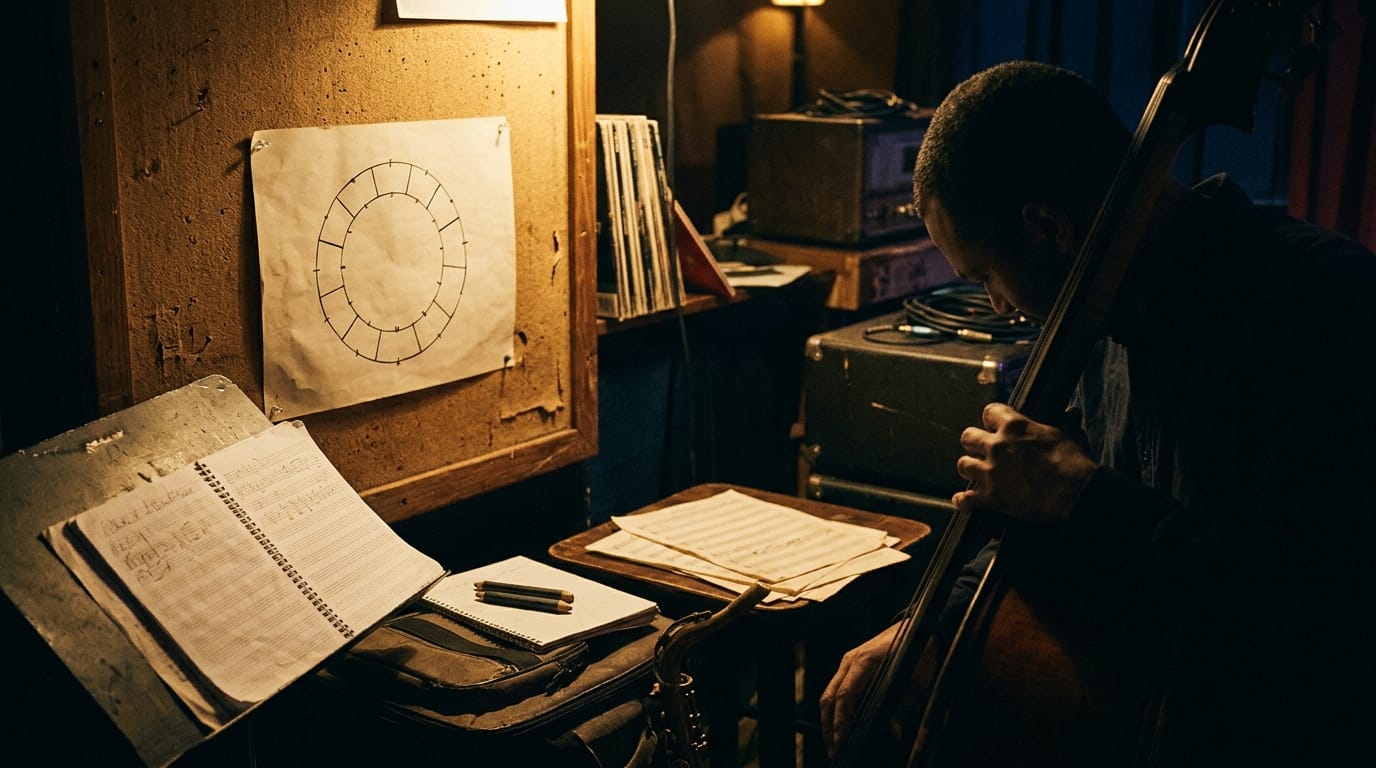
Take one scale at a time around the cycle of fourths: C, F, B♭, E♭, A♭, D♭, G♭, B, E, A, D, G, which is the circle of fifths read counterclockwise. Root movement by fourths is also how a ii-V-I moves (D to G to C), so the order trains your ear for the progression at the same time. Use a metronome at a slow tempo, a few minutes per key, and cover the whole range of your instrument rather than one octave.
Play Patterns, Not Only Runs
Running a scale from root to root trains the fingers more than the ear. Patterns break the scale into shapes you will use in solos: diatonic thirds (C-E, D-F, E-G and so on), four-note cells such as 1-2-3-5 started on each degree, and the seventh chords of the scale played as arpeggios (in C major: Cmaj7, Dm7, Em7, Fmaj7, G7, Am7, Bm7♭5). Play each pattern ascending and descending and start it from different notes. Jerry Coker’s book Patterns for Jazz collects many drills of this kind.
Practice Over Chords
A scale only makes sense against its chord. Loop a ii-V-I with a play-along, such as Aebersold’s Volume 3, The ii/V7/I Progression, which runs through all the major keys, or an app such as iReal Pro, and change scales with the chords. Aim the third or seventh of each chord at a strong beat. In C, the F of Dm7 holds as the seventh of G7 and falls to E, the third of Cmaj7, while the C of Dm7 falls to B, the third of G7, which holds as the seventh of Cmaj7. Once those landing notes are secure, fill the space between them from the scale. Approach notes and enclosures, the next step, are covered in our guide to jazz improvisation.
On Piano: Scale in the Right Hand, Shell in the Left
Pianists can hear scale and chord together. Hold a two-note shell voicing in the left hand (D and C for Dm7, G and B for G7, C and B for Cmaj7) and play the scale in the right hand, starting from each chord tone in turn. You hear at once which notes sit comfortably and which clash, such as the fourth over Cmaj7. The voicings are explained in our guide to jazz piano chords. Guitarists can record a loop of the shapes from our page on jazz guitar chord voicings and play the scales over it.
Where to Go Next
Once the seven are secure in all keys, add the rest of the chart: Lydian, the altered and diminished scales, and Locrian. The diminished scales alternate half and whole steps and are symmetrical, so only three different ones exist. Then test everything on real tunes. Our list of easy jazz standards to learn first is a good starting point, and the harmony behind them is explained in common jazz chord progressions.
Frequently Asked Questions
What scales are used in jazz?
The core set is the major scale and its modes, especially Dorian and Mixolydian; the melodic minor scale and its modes, including Lydian dominant and the altered scale; the blues scale; the bebop scales; the whole-tone scale; and the diminished scales. Major and minor pentatonic scales are common too.
What is the most important scale in jazz?
The major scale, because Dorian and Mixolydian are its modes, and those two cover the minor seventh and dominant seventh chords of the ii-V-I, a progression that is extremely common in jazz. Learn the major scale in all 12 keys first and the two modes come with it.
What is the difference between the blues scale and the minor pentatonic scale?
The minor pentatonic scale has five notes: 1, ♭3, 4, 5 and ♭7, or C, E♭, F, G and B♭ in C. The blues scale adds a sixth note, the ♭5 (G♭ in C), between the fourth and the fifth. That chromatic note gives the blues scale its characteristic tension.
Do I need to learn jazz scales in all 12 keys?
Yes, if you want to play standards with other musicians. Standards are played in many keys and many of them pass through several keys within one chorus, so a scale you only know in C will not help when a ii-V-I arrives in D♭. Working around the cycle of fourths, one scale at a time, covers all 12 keys.