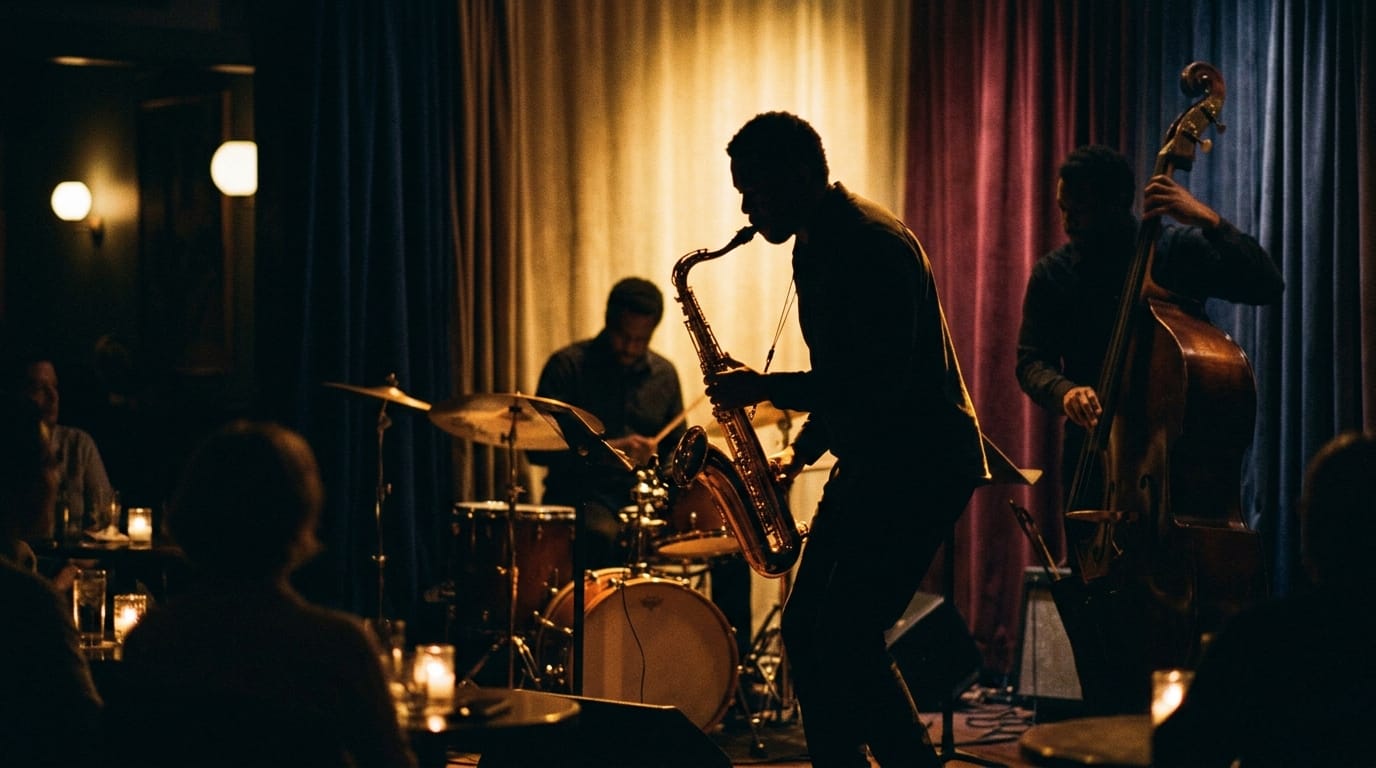
Jazz Improvisation: The Complete Guide for Musicians

Jazz Improvisation: The Complete Guide for Musicians

By James Wright · · 20 min read

What You’ll Learn in This Guide

  • What jazz improvisation is and why it defines the genre
  • How improvisation works structurally, including common song forms
  • The full historical arc from New Orleans to free jazz
  • Core techniques: guide tones, enclosures, motif development, rhythmic displacement
  • Scales for jazz improvisation, from pentatonics to bebop scales
  • Instrument-specific approaches for piano, guitar, and voice
  • A 3-phase learning roadmap with concrete, time-bounded milestones
  • Practice methods, recommended books, online courses, and 5 legendary solos to study

Jazz improvisation is the real-time spontaneous creation of melody, harmony, or rhythm over a pre-established chord progression, song form, or modal framework, and it is the defining musical characteristic that separates jazz from every other genre. Every major jazz subgenre, from bebop to modal to fusion, centers improvisation as its structural engine. The improvised statement a musician delivers is called a solo; each complete pass through the song’s form during that solo is called a chorus. When two musicians alternate improvised phrases of four bars each, they’re trading fours, a practice as old as jazz itself.

Here’s the thing many beginners miss: improvisation is a learnable skill, not a mysterious gift reserved for prodigies. The musicians who built this art form, Charlie Parker, John Coltrane, Miles Davis, all learned by ear, by copying their heroes, and by playing with other people. Our guide to jazz genres and subgenres shows how improvisation threads through every branch of the music.

What Is Jazz Improvisation?

Jazz improvisation is spontaneous melodic invention within a shared musical grammar. That last part matters. Improvisation in jazz doesn’t mean playing anything at any moment; it means making real-time creative decisions within an agreed structure of chords, rhythm, and form.

The Core Definition

Wynton Marsalis, in his book Moving to Higher Ground (Random House, 2008, p. 8), frames improvisation as a disciplined craft rather than unconstrained invention — musicians work within the shared logic of harmony, rhythm, and form, and listeners can recognize which decisions serve the music and which do not. That framing cuts through the mystification. The “grammar” is harmony and rhythm. The “vocabulary” is the scales, patterns, and phrases a musician builds over years of listening and practice.

The composed-versus-improvised binary is also a false one. In a single jazz performance, the written melody (called the head) and the improvised solos coexist. The composition gives everyone a shared map; the improvisation is the journey taken from it.

What a Jazz Improvisation Is Called

A solo is one musician’s improvised statement over the harmony. A chorus is one full pass through the song form during that solo. So a musician might “take two choruses,” meaning they improvise through the entire chord progression twice. Trading fours (or eights) means two or more musicians alternate improvised phrases of four (or eight) bars, creating a call-and-response conversation without a word being spoken.

Why Improvisation Is the Defining Characteristic of Jazz

Jazz is the only major Western genre where improvisation is structural, not ornamental. In classical music, written-out ornaments and cadenzas exist, but the score governs everything. In jazz, the score, if there is one, is a starting point. Improvisation functions as jazz’s conversational core — real-time dialogue between musicians, not a fixed score. Duke Ellington and Charles Mingus both wrote compositions with minimal improvisation, yet the jazz DNA remains present in their harmonic language and rhythmic feel. The improvising tradition shaped even the written parts.

How Jazz Improvisation Works: Structure and Form

Jazz improvisation doesn’t happen in a vacuum. It unfolds over a repeating harmonic structure, and knowing that structure is the first step toward working through it confidently. Most jazz standards fit into a handful of common forms.

Common Song Forms Used in Improvisation

Form Bar Count Structure Example Standard
32-bar AABA 32 bars 8+8+8 (bridge)+8 “Autumn Leaves,” “Rhythm Changes”
12-bar Blues 12 bars I-IV-V cycle “Now’s the Time,” “Blue 7”
Modal / Static Harmony Varies One or two scales, no chord cycle “So What,” “Maiden Voyage”
ABAC 32 bars 8+8+8+8, two contrasting sections “All the Things You Are”
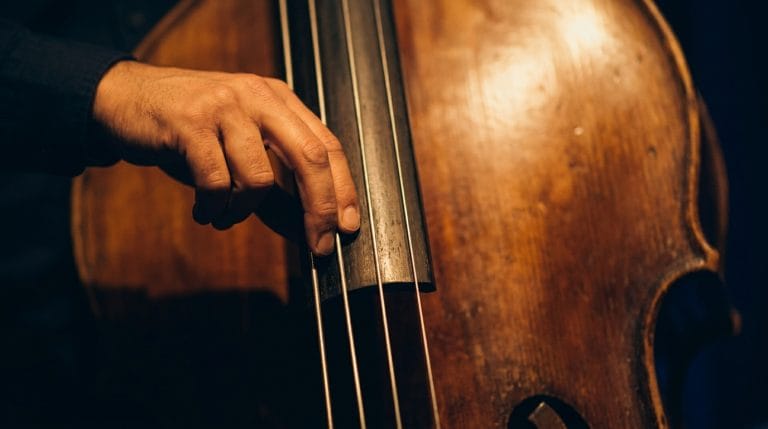
close-up of musician's hands on jazz instrument fingerboard, warm stage lighting, dramatic shadows
Mastering improvisation requires developing muscle memory and fingering patterns across the instrument—a skill built through deliberate practice and repetition of scales and phrases.

The Head-Solo-Head Structure

Most jazz performances follow a clear architecture: head in (everyone plays the melody together), then soloists improvise chorus by chorus, then head out (the melody returns to close). During the solos, the rhythm section, piano, bass, and drums, continues to accompany. They’re not just keeping time; they’re responding, pushing, and supporting the soloist’s ideas in real time.

Call-and-Response and Trading Fours

Call-and-response runs deep in jazz, connecting directly to African musical traditions that shaped American music from the 1800s onward. In improvisation, a soloist might play a four-bar phrase and leave space, almost asking a question. Another musician, or the rhythm section collectively, responds. Trading fours makes this explicit: two musicians alternate four-bar improvisations, passing the spotlight back and forth. New Orleans collective improvisation, where trumpet, clarinet, and trombone all improvised simultaneously over a melody, was the earliest and most dense form of this conversational model.

The History of Jazz Improvisation

Jazz improvisation has evolved more dramatically over its roughly 120-year history than any other musical practice in the Western tradition. Each generation redefined what “spontaneous invention” could mean.

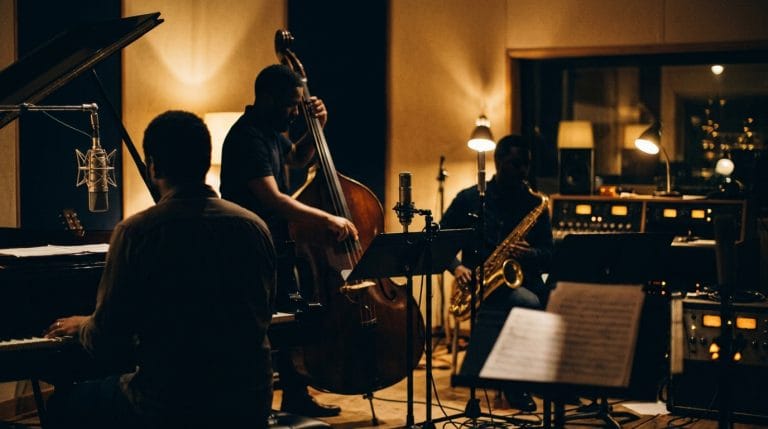
visual representation of jazz song forms and harmonic structures, abstract musical notation style
Understanding common song forms—32-bar AABA, 12-bar blues, modal structures—provides the harmonic roadmap that allows improvisers to navigate and create within a shared musical framework.

New Orleans Collective Improvisation (1900s-1920s)

The earliest jazz improvisation was collective. In New Orleans, the “front line,” trumpet leading, clarinet weaving countermelodies above, trombone filling the low register below, improvised simultaneously over a fixed melody. Louis Armstrong, Jelly Roll Morton, and King Oliver shaped this model. Armstrong’s recorded output from the mid-1920s documents the transition from collective improvisation toward the featured soloist format that would dominate the swing era.

Swing Era: The Rise of the Featured Soloist (1930s)

Big band formats, which became commercially dominant through the 1930s, concentrated improvisation into designated solo spots. The arrangement governed everything except those 8 or 16 bars where one player stepped forward. Coleman Hawkins recorded “Body and Soul” in 1939, developing a single melodic idea across the entire performance in a way that made improvisation look like composition. Lester Young offered a counterpoint: lighter tone, longer horizontal phrases, a cooler emotional temperature.

Bebop: Running the Changes (1940s)

Charlie Parker and Dizzy Gillespie’s harmonic revolution in the 1940s turned improvisation into an intellectual discipline. Running the changes means improvising through rapid chord substitutions, targeting the guide tones of each chord as the harmony moves underneath you at high speed. Parker’s “Ko-Ko” (1945), built on the chord changes of “Cherokee,” became the benchmark for this approach, working through a dense harmonic sequence at a breakneck tempo that few players could match. Bebop made improvisation a virtuosic art form studied as seriously as classical performance technique.

Modal Jazz Improvisation (1959)

Miles Davis‘s Kind of Blue (1959, Columbia Records) redirected the entire conversation. Instead of dense, fast-moving chord changes, modal jazz gave improvisers one or two scales per section and let them explore. On “So What,” the structure is D Dorian for 16 bars, Eb Dorian for 8 bars, then D Dorian again for 8 bars. That’s it. The freedom felt radical after bebop’s complexity. John Coltrane, who played on that session, was simultaneously developing his “sheets of sound” approach, running arpeggios through chords in dense cascading lines, pointing toward his own harmonic explorations on Giant Steps (Atlantic, 1960).

Free Jazz Improvisation (1960 Onward)

Ornette Coleman’s Free Jazz: A Collective Improvisation (Atlantic, 1961) pushed the boundary further. A double quartet with no pre-set harmonic framework improvised simultaneously, with texture and collective energy replacing chord-by-chord navigation. Albert Ayler and Cecil Taylor extended this: Ayler used folk-hymn fragments dissolved into pure sound; Taylor built dense, percussive piano attacks closer to the avant-garde classical tradition than anything in bebop. Free jazz improvisation doesn’t abandon skill, it redefines what skills are relevant. That debate is still alive today.

Core Jazz Improvisation Techniques

Every jazz improviser, beginner or professional, draws from the same toolkit. Master these techniques and you’ll recognize them immediately in recordings. More importantly, you’ll start deploying them yourself.

Guide Tones (3rds and 7ths)

The 3rd and 7th of any chord define its quality. On a Cmaj7 chord, the 3rd is E and the 7th is B. On a C7 (dominant seventh), the 3rd stays E but the 7th drops to Bb. That single half-step difference changes the entire harmonic character. Guide tone lines are melodies built exclusively from these two notes across a chord progression, and they’re the skeleton of all jazz improvisation. Beginners: compose a guide tone line through “Autumn Leaves” before adding any other notes. You’ll be surprised how musical a two-note vocabulary sounds.

Chromatic Approach Notes

A chromatic approach note lands a half-step above or below a target note, then resolves. It creates forward momentum and gives lines that characteristic bebop “lean.” A single approach comes from one direction; a double chromatic approach surrounds the target from both sides before landing. Listen to Parker’s lines carefully and you’ll hear these constantly, the bass walking a lazy chromatic half-step into each chord tone while his alto dances above.

Types of Enclosures in Jazz Improvisation

An enclosure surrounds the target note with neighboring tones before landing on it. It’s a more elaborate version of the approach note, and bebop players used all four types constantly. Here’s the breakdown:

  • Diatonic enclosure: upper neighbor (diatonic scale tone) + lower neighbor (chromatic half-step) resolves to target
  • Chromatic enclosure from above: half-step above + half-step below resolves to target
  • Chromatic enclosure from below: two half-steps below resolve up to target
  • Double chromatic enclosure: half-step above + whole-step below resolves to target

Charlie Parker used all four types, often in rapid succession. Enclosures are among the most studied devices in bebop transcription, yet most beginner resources ignore them entirely. Practice each type slowly at 40 BPM, approaching every chord tone of a Cmaj7 with each enclosure type before moving to the next chord.

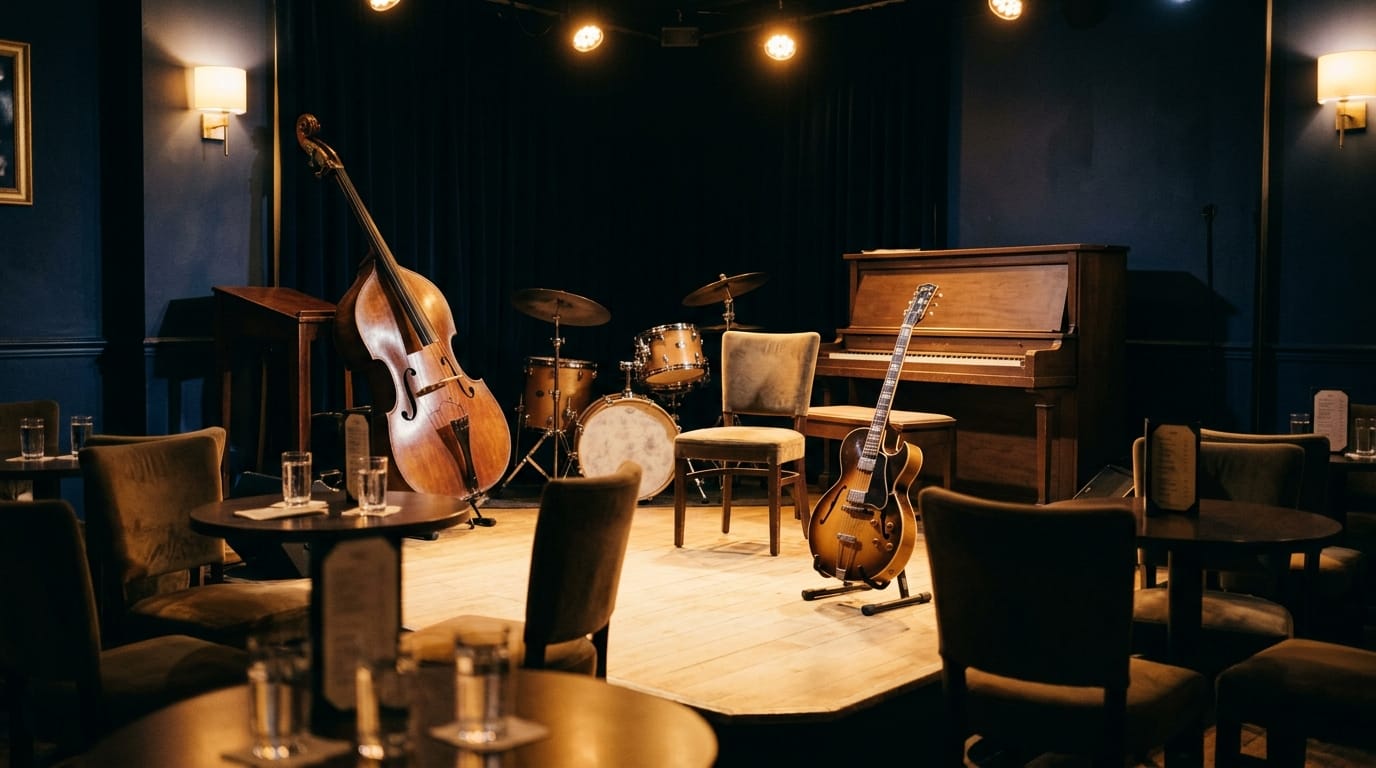
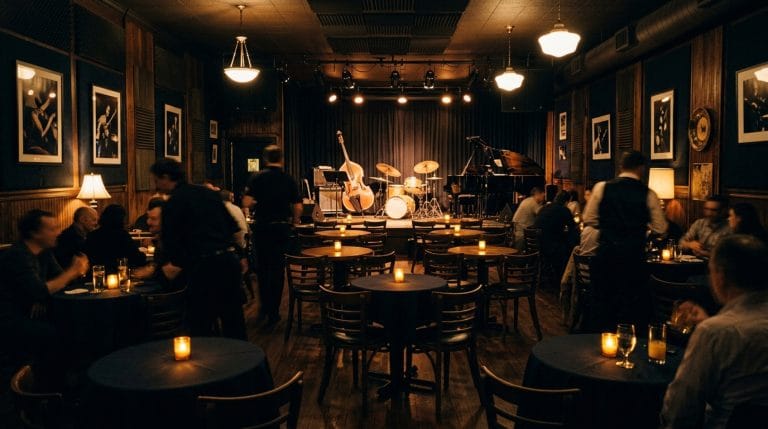
vintage jazz club stage with warm amber lighting, empty instruments on stand, intimate venue atmosphere
The jazz club stage—where improvisation happens live—remains the crucible where musicians test ideas, respond to audiences, and develop their improvisational voice through direct performance experience.

Motif Development

A motif is a short melodic cell, two to four notes, that you establish and then vary. You can transpose it up or down, invert it (flip the intervals upside-down), augment it (stretch the rhythms out), or diminish it (compress the rhythms). Sonny Rollins’s “Blue 7” on Saxophone Colossus (Prestige, 1956) is the canonical study: Rollins constructs an entire solo from a single three-note figure, demonstrating that great improvisation is more about commitment to an idea than quantity of vocabulary.

Rhythmic Displacement

Take a phrase you already know. Now shift its starting point by an eighth note, or by a full beat. The notes don’t change; the relationship between the phrase and the underlying pulse does. This creates tension without new harmonic material and is one of the most effective tools in advanced jazz improvisation. It sounds wrong, then it resolves, and that moment of resolution lands harder than anything you’d planned.

Scales for Jazz Improvisation

Scales give you the raw material; your ear decides which notes to use and when. Start with the scales that fit your current repertoire, and add new ones as your chord knowledge deepens. Our jazz education section has additional theory resources to support this study.

Major Modes and When to Use Them

Mode Built On Use Over Sound
Ionian (Major) 1st degree Imaj7 Bright, resolved
Dorian 2nd degree ii-7 Minor, warm
Mixolydian 5th degree V7 Dominant, bluesy
Lydian 4th degree IVmaj7 Dreamy, raised 4th

Each mode is simply a major scale started from a different degree. C Dorian uses the same notes as Bb major, but starts on C. That relationship makes learning modes practical: you’re not learning 7 separate scales, you’re learning one scale from 7 starting points.

Pentatonic Scales for Jazz Improvisation

The minor pentatonic (intervals: 1, b3, 4, 5, b7) is the safest entry point for jazz improvisation for beginners. It fits over minor chords and dominant chords with minimal dissonance. The major pentatonic (1, 2, 3, 5, 6) works beautifully over Imaj7 chords. The most essential pattern to practice is the 1-2-3-5 cell: four notes, played ascending and descending through every position. John Coltrane used pentatonic scales superimposed over distant chord centers, a technique that requires deep harmonic understanding but starts with this same four-note building block.

Bebop Scales

The dominant bebop scale is a Mixolydian scale (1, 2, 3, 4, 5, 6, b7) with one chromatic passing tone added between the b7 and the root, giving you 8 notes total. That eighth note is the whole point: an 8-note scale fits perfectly into an 8th-note line, keeping chord tones on the strong beats (downbeats) where they create harmonic clarity. The major bebop scale adds a chromatic passing tone between the 5th and 6th degrees of the major scale. Both scales sound like jazz immediately because the chromatic tone mimics what bebop players were already doing intuitively.

Altered and Diminished Scales

The altered scale is the 7th mode of melodic minor. It contains b9, #9, #11, and b13, all the available tensions over a V7alt chord. When a chord chart says “C7alt,” reach for the C altered scale (same notes as Db melodic minor). The whole-half diminished scale alternates whole steps and half steps and works over dominant 7b9 and fully diminished chords. Its symmetry means only three fingering positions cover all 12 keys, making it one of the most efficient scales to learn for the return on investment it provides.

Jazz Improvisation by Instrument

The core techniques apply across all instruments, but each instrument presents its own specific challenges and opportunities. Check our complete guide to jazz instruments for context on how each instrument functions in an ensemble.

Jazz Piano Improvisation

The piano presents a unique challenge: the left and right hands must operate independently. In jazz piano improvisation, the left hand typically comps (short for “accompanies”), using shell voicings (root, 3rd, and 7th of each chord), while the right hand improvises single-note lines or melodic fragments. Bill Evans’s Waltz for Debby (Riverside, 1962) and Herbie Hancock’s Maiden Voyage (Blue Note, 1965) are the two essential listening documents for this approach. A practical exercise: play guide tone lines in the left hand while improvising pentatonics in the right, slowly building independence.

Jazz Guitar Improvisation

Guitar players navigate jazz improvisation through two distinct approaches: single-note bebop lines and the chord-melody method, where melody and harmony sound simultaneously. The CAGED system, a framework mapping chord shapes to scale positions across the neck, helps guitarists link modal scales to their physical positions on the fretboard. Wes Montgomery’s octave lines on The Incredible Jazz Guitar (Riverside, 1960), Joe Pass’s chord-melody work on Virtuoso (Pablo, 1974), and Pat Metheny’s modal phrasing on Bright Size Life (ECM, 1976) each represent a distinct branch of jazz guitar improvisation worth deep study. Half-position shifts, sliding one fret toward the nut, are the guitarist’s primary tool for chromatic approach notes.

Vocal Improvisation in Jazz Singing: Scat and Beyond

Scat singing is vocal jazz improvisation using nonsense syllables (“doo,” “bah,” “shoo-be-doo”) rather than lyrics, allowing the voice to function as a horn. Louis Armstrong is widely credited with popularizing scat on “Heebie Jeebies” (Okeh Records, 1926), reportedly after dropping his sheet music mid-take and continuing anyway. Whether that story is apocryphal or not, the recording stands as the first commercially successful scat vocal.

Ella Fitzgerald brought a clean melodic precision to vocal jazz improvisation: her Ella in Berlin (Verve, 1960), recorded live, includes a full scat chorus on “How High the Moon” that remains one of the most studied examples in the genre. Sarah Vaughan applied an operatically trained range to jazz harmony, reaching into chord extensions that most horn players wouldn’t attempt. Bobby McFerrin expanded the vocabulary still further, using percussive breath sounds, multiphonics (two pitches simultaneously), and body percussion as rhythmic tools. The unique challenge for jazz singers: without keys or frets as a physical reference, singers must internalize harmony entirely. Every interval lives in the ear, not the fingers.

How to Learn Jazz Improvisation: The 3-Phase Roadmap

Let’s be honest: most jazz education resources give you a list of things to practice without telling you in what order. This roadmap gives you time-bounded phases with specific, self-assessable milestones.

Phase 1: Beginner (Months 0-6)

Goal: Internalize the 12-bar blues form and the minor pentatonic scale; learn 5 jazz standards by ear. Specific milestones to hit before moving forward: play a 12-bar blues with a steady quarter-note pulse; learn the melody and chord symbols to “Autumn Leaves” without reading from a chart; improvise using only guide tones (3rds and 7ths) through a simple chord progression. Your primary listening assignment is one album per week. Start with Kind of Blue, Somethin’ Else (Cannonball Adderley, Blue Note, 1958), and A Love Supreme (Coltrane, Impulse!, 1965).

Phase 2: Intermediate (Months 6-24)

Goal: Navigate AABA form fluently; apply the dominant bebop scale and all four enclosure types; transcribe 10 complete solos. Milestones: solo through Rhythm Changes (the chord progression from Gershwin’s “I Got Rhythm”) at 120 BPM without stopping; transcribe and analyze the “Ko-Ko” head note for note; develop a personal vocabulary of 5 to 10 memorized phrases (“licks”) practiced in all 12 keys. Transposing everything to all 12 keys is tedious and essential. There’s no way around it.

Phase 3: Advanced (2+ Years)

Goal: Develop a personal voice; explore modal and free approaches; play with live rhythm sections consistently. Milestones: improvise convincingly over the “Coltrane substitutions” in “Giant Steps” (major thirds cycling through B, G, and Eb); lead a jam session, call tunes and tempos; record yourself monthly and analyze your phrasing critically over time. The gap between Phase 2 and Phase 3 is less about new information and more about accumulated hours of playing with other humans. No app replaces that.

How to Practice Jazz Improvisation

Knowing what to practice and knowing how to practice are different skills. The most common mistake is spending 90% of practice time playing through tunes and 10% on focused technical work. Flip that ratio, especially in Phase 1 and Phase 2.

Transcription: The Non-Negotiable Method

Transcription is the process of learning a recorded solo entirely by ear. The method: select a 4 to 8 bar phrase, slow it to 50% speed using software like Amazing Slow Downer or Transcribe!, sing it until you can match every pitch and rhythm, then play it on your instrument, then write it out in notation, then transpose it to all 12 keys. Charlie Parker, Miles Davis, and John Coltrane all learned by ear-copying their predecessors. No shortcut replaces transcription for building real jazz vocabulary. It’s slow, frustrating, and absolutely irreplaceable.

Essential Exercises

  • 1-2-3-5 pattern: the foundational pentatonic cell, practiced ascending and descending through all modes in all 12 keys
  • Digital patterns: running intervals like 1-2-3-4 and 1-3-2-4 through diatonic scales in all positions; builds finger independence and note knowledge simultaneously
  • Guide tone lines: compose a melody using only 3rds and 7ths through a chord progression; record it and listen back critically
  • Enclosure drills: approach each chord tone using all four enclosure types at 40 to 60 BPM before increasing speed

Play-Along Tools

The Jamey Aebersold Play-Along Series offers more than 100 volumes, each including a rhythm section recording and lead sheet. Volume 1, “How to Play Jazz and Improvise,” is the correct starting point for beginners. iReal Pro (approximately $14.99 as a one-time purchase, though pricing is subject to change) provides chord charts for more than 1,300 jazz standards with an adjustable tempo and key. Band-in-a-Box offers more complex arrangement-based accompaniment for intermediate and advanced players. Use these tools as a complement to transcription, not a replacement.

5 Legendary Jazz Improvisation Examples to Study

These five solos represent the clearest windows into specific techniques. Each one rewards hours of repeated listening and, eventually, full transcription.

For the deepest context on these recordings, our ranking of the 50 best jazz albums of all time covers each record’s place in the broader canon.

Miles Davis: “So What” (Kind of Blue, 1959)

Why study it: This is the textbook of modal jazz improvisation. Davis plays long, lyrical phrases over D Dorian and treats silence as an active musical decision. His trumpet tone sits cool and slightly detached over Bill Evans’s comping, creating a quality of restrained tension. Technique to identify: D Dorian motif development; rests used as rhythmic punctuation; how he changes almost nothing when the harmony shifts to Eb Dorian for 8 bars, letting the rhythm section do the harmonic work.

Charlie Parker: “Ko-Ko” (1945)

Why study it: Parker navigates the complex chord changes of “Cherokee” at a speed that makes bebop’s harmonic logic audible in pure form. Every phrase lands on a guide tone; every connecting passage is a chromatic or enclosure-based run. Technique to identify: chromatic enclosures on every strong beat, digital patterns through the harmonic rhythm, and the way Parker’s phrases begin slightly before the beat, creating forward momentum throughout.

John Coltrane: “Giant Steps” (Giant Steps, Atlantic, 1960)

Why study it: Widely regarded as one of the most harmonically demanding single choruses in recorded jazz history. Coltrane’s substitution system cycles major thirds through three key centers: B major, G major, and Eb major. The chords move every two beats in places, making bar-by-bar chord navigation nearly impossible. Coltrane’s solution was arpeggio-based lines that outline each key center rather than each individual chord. Technique to identify: arpeggiation through three harmonic poles, scalar passages that connect them, and the relentless rhythmic momentum that makes the density feel inevitable rather than mechanical.

Herbie Hancock: “Maiden Voyage” (Maiden Voyage, Blue Note, 1965)

Why study it: Modal improvisation on suspended dominant chords sounds completely different from standard ii-V-I modal playing. Hancock uses quartal voicings (chords built from stacked fourths rather than thirds) in both hands, creating a sound that floats without resolving. His improvisation sounds orchestral because he treats each phrase as a color change, not a chord-by-chord argument. Technique to identify: quartal harmony, spacious phrasing with long rests, and motivic cells that recur transformed across multiple choruses.

Sonny Rollins: “Blue 7” (Saxophone Colossus, Prestige, 1956)

Why study it: A landmark of thematic improvisation. Rollins builds his entire solo from a single three-note cell, subjecting it to transposition, inversion, augmentation, and diminution across a 12-bar blues. Music critic Gunther Schuller’s essay “Sonny Rollins and the Challenge of Thematic Improvisation,” published in the first issue of The Jazz Review in November 1958, helped establish “thematic improvisation” as a recognized critical concept. Technique to identify: motif transposition, rhythmic augmentation (stretching the motif into longer note values), and inversion (flipping the interval direction).

Best Jazz Improvisation Books

These are real, published books used in conservatories and practice rooms worldwide. Our editorial recommendation: start with Levine for theory, Baker for foundation, and Coker for pattern drilling.

Book Author Best For Focus
Patterns for Jazz Jerry Coker Intermediate-Advanced Digital patterns in all keys
Jazz Improvisation David Baker Beginner-Intermediate Melodic and harmonic foundations
The Jazz Theory Book Mark Levine All levels complete theory reference
How to Improvise Hal Crook Intermediate Rhythmic and melodic concept building
Tao of Jazz Improvisation Bert Ligon Intermediate-Advanced Guide tones, enclosures, bebop vocabulary

Coker’s Patterns for Jazz gives you hundreds of permutations to work through in all 12 keys, mechanical but essential for building finger memory. Baker’s Jazz Improvisation builds the melodic logic from the ground up. Crook’s How to Improvise focuses specifically on rhythm and phrase structure, an underrated entry point. Ligon’s Tao of Jazz Improvisation covers enclosures and guide tone lines more thoroughly than any other published text. We recommend The Jazz Theory Book by Mark Levine as the single best all-levels reference; use Baker or Coker alongside it for pattern practice.

Jazz Improvisation Courses: Online Learning Options

Online courses can’t replace playing with a real rhythm section, but they give you structured harmonic and conceptual foundation when a teacher or bandmate isn’t available.

MasterClass: Herbie Hancock

The MasterClass course focused on jazz improvisation is taught by Herbie Hancock. The course runs 25 video lessons covering improvisation philosophy, modal thinking, harmonic freedom, and the creative process behind recordings like Maiden Voyage. It’s best suited to intermediate players who already know their basic chord vocabulary and want conceptual depth rather than scale drills.

Coursera / Berklee Online: “Developing Your Musicianship” with Gary Burton

Vibraphonist Gary Burton’s Berklee-accredited course on Coursera covers jazz harmony and improvisation fundamentals with university-level rigor. A certificate is available, and the course is self-paced. It’s the strongest structured option for beginners who want curriculum rather than a collection of YouTube lessons.

Open Studio Jazz

Open Studio Jazz is a subscription-based platform with multiple instructors and genre-specific improvisation tracks. It works well for players at any level who want ongoing lesson variety and the ability to move between instructors and topics without committing to a single course arc.

Course Instructor Platform Level Est. Cost
Jazz Improvisation Herbie Hancock MasterClass Intermediate ~$120/yr (all-access)
Developing Your Musicianship Gary Burton Coursera/Berklee Online Beginner Free audit / ~$49 cert
Jazz Improvisation Track Multiple Open Studio Jazz All levels ~$20/mo

FAQ: Jazz Improvisation

What is a jazz improvisation called?

An improvised statement by one musician is called a solo. Each complete pass through the song’s chord progression during that solo is called a chorus. When musicians alternate improvised phrases of four bars, they’re trading fours.

What are the 7 techniques of improvisation in jazz?

The seven core techniques are: guide tones (targeting the 3rd and 7th of each chord), chromatic approach notes, enclosures (surrounding a target note with neighboring tones), motif development, rhythmic displacement, scale-based improvisation (modes, bebop scales, altered scales), and call-and-response phrasing. Each technique can be studied independently and then combined in practice.

What are the best scales for jazz improvisation beginners?

Start with the minor pentatonic and major pentatonic, both forgiving over a wide range of chords. Add the Dorian mode once you’re comfortable with minor ii-V-I progressions. Introduce the dominant bebop scale when your 7th-chord vocabulary is solid. The jazz education section has deeper scale resources when you’re ready to expand.

How long does it take to learn jazz improvisation?
Reaching basic 12-bar blues improvisation takes 3 to 6 months of daily practice. working through jazz standards competently takes 6 to 24 months. Professional fluency with a personal voice generally requires 2 to 5 or more years. The single biggest variable is consistent transcription. Players who transcribe regularly compress that timeline measurably.

What is the difference between modal jazz improvisation and free jazz improvisation?

Modal jazz improvisation is anchored to a specific scale or mode for each section of the music. A structural framework still exists. Free jazz improvisation abandons fixed harmony, meter, and pre-set form entirely. The improvisation itself generates the structure in real time, which requires deep musical knowledge to pull off with coherence rather than chaos.

The musicians who changed jazz improvisation most completely, Parker, Davis, Coltrane, Coleman, Hancock, Fitzgerald, all started exactly where you’re starting now. The path is well-documented because so many people walked it before you and left recordings behind. Pick one album from the listening examples above, give it 20 concentrated listens, and then pick up your instrument. That’s how this has always worked, and it still does.

James Wright
Written by

James Wright

James Wright writes our long-form features, historical deep dives, and educational guides from Chicago. A former music educator, he brings a teacher's instinct to the page: break the idea down, show the working, then put it back together so the reader walks away having actually learned something. His coverage centers on jazz history from the New Orleans roots through the bebop revolution, hard bop, modal jazz, and the free jazz that followed. On the education side he writes practical explainers on chord changes, modes, harmonic substitution, and the specific devices that define individual players' approaches. He is interested in why Wayne Shorter's compositions feel the way they do, what Bill Evans actually does with voice leading, and how Coltrane's sheets-of-sound technique is built. James works best on pieces that require a longer runway: biographical features, influence-mapping essays, and theory pieces that connect a musical idea to the recording where you can hear it in action. His work sits across our Features, Jazz History, Jazz Education, and Artist Profiles sections. If a piece needs to trace where an idea came from and where it went, it is usually under his byline.

More by James Wright →