Best Jazz Albums for Beginners: 15 Records to Start Your Collection
Start with three records: Miles Davis’s Kind of Blue (1959), the Dave Brubeck Quartet’s Time Out (1959) and Getz/Gilberto (1964) by Stan Getz and João Gilberto. All three are built on tunes you can hum after one play, and together they cover the calm modal sound of Davis’s sextet, Brubeck’s catchy experiments with unusual meters and the soft Brazilian bossa nova that took “The Girl from Ipanema” into the US Top 5. The other 12 albums below, released between 1956 and 1973, were chosen on the same basis: a clear melody early on, a steady beat and nothing you need to study first, and each entry names the one track to play first.
Table of Contents
- The 15 Best Jazz Albums for Beginners
- 1. Kind of Blue by Miles Davis (1959)
- 2. Time Out by the Dave Brubeck Quartet (1959)
- 3. Moanin’ by Art Blakey and the Jazz Messengers (1958)
- 4. The Sidewinder by Lee Morgan (1964)
- 5. Getz/Gilberto by Stan Getz and João Gilberto (1964)
- 6. Head Hunters by Herbie Hancock (1973)
- 7. Blue Train by John Coltrane (1958)
- 8. Ella and Louis by Ella Fitzgerald and Louis Armstrong (1956)
- 9. Waltz for Debby by the Bill Evans Trio (1962)
- 10. Night Train by the Oscar Peterson Trio (1963)
- 11. Mingus Ah Um by Charles Mingus (1959)
- 12. The Incredible Jazz Guitar of Wes Montgomery (1960)
- 13. A Charlie Brown Christmas by the Vince Guaraldi Trio (1965)
- 14. Saxophone Colossus by Sonny Rollins (1957)
- 15. Maiden Voyage by Herbie Hancock (1965)
- What to Listen For
- Where to Go After These 15 Albums
- Frequently Asked Questions
- What is the best jazz album for a beginner?
- Which jazz artists are best for beginners?
- Is jazz hard to get into?
- What should I listen to after these albums?
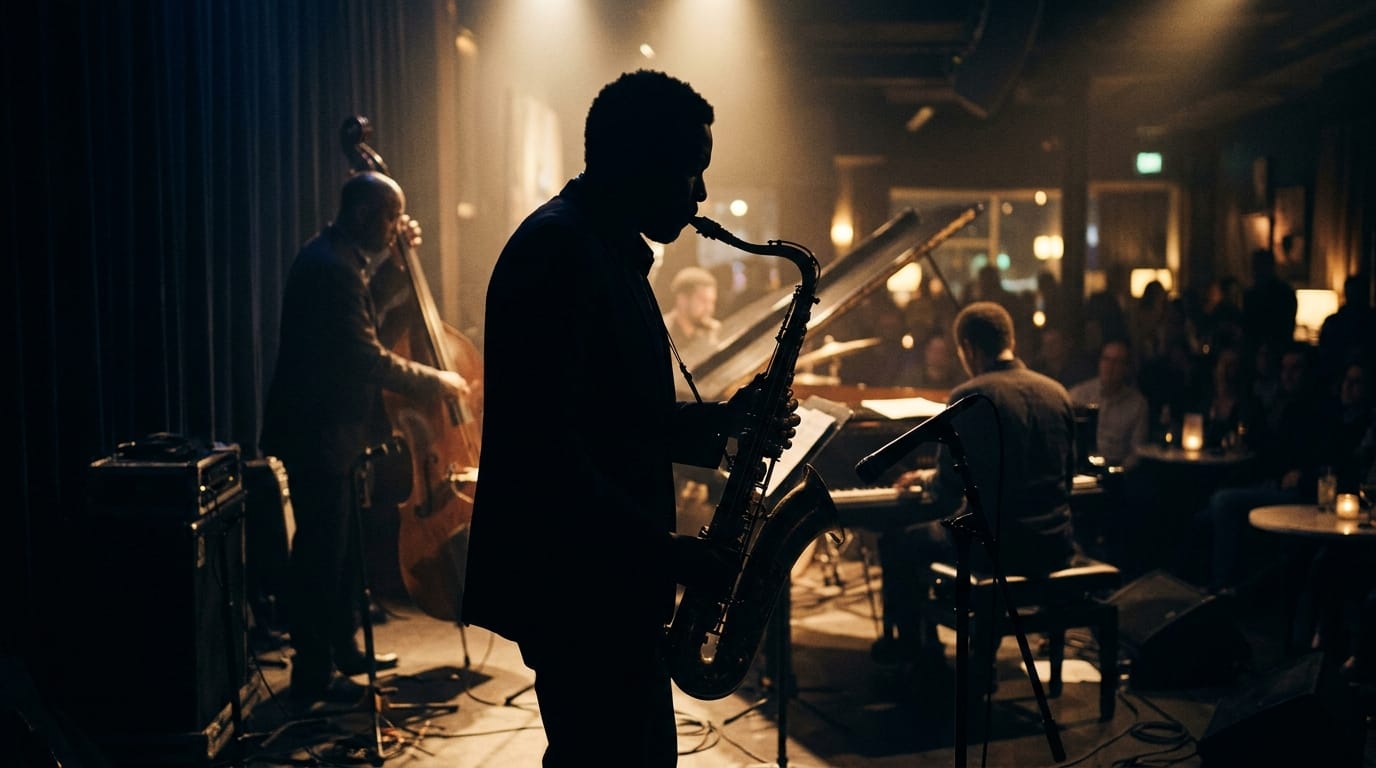
The list mixes modal jazz, cool jazz, hard bop, soul jazz, bossa nova, vocal jazz, piano trios and 1970s jazz-funk, so you find out quickly which sound suits you. If one clicks, our overview of jazz styles shows where it leads. Free jazz and the long suites of the mid-1960s are left out for now.
The 15 Best Jazz Albums for Beginners
1. Kind of Blue by Miles Davis (1959)
Davis built the tunes on Kind of Blue on scales (modes) instead of fast-moving chord changes, so the harmony shifts slowly and every soloist has room: John Coltrane on tenor saxophone, Cannonball Adderley on alto and Bill Evans on piano (Wynton Kelly takes one track), with Paul Chambers on bass and Jimmy Cobb on drums. The five tracks, recorded for Columbia in March and April 1959, are long but never hurried. In 2019 the RIAA certified the album 5× Platinum. When you want more, our ranking of Miles Davis albums picks the next ones.
Start with: “So What.” Chambers plays the theme on the double bass and the band answers each phrase with a two-chord reply, so the structure is easy to follow.
2. Time Out by the Dave Brubeck Quartet (1959)
Most pieces on Time Out play with meter, yet it is one of the easiest jazz albums to like. “Blue Rondo à la Turk” opens in 9/8, and “Take Five”, written by alto saxophonist Paul Desmond, stays in 5/4 over a repeating piano figure. Released by Columbia in December 1959, the album reached No. 2 on the Billboard albums chart and became the first jazz album to sell a million copies.
Start with: “Take Five.” You probably know the melody already; the full track, with Desmond’s dry, light alto, leads straight into the rest of the album.
3. Moanin’ by Art Blakey and the Jazz Messengers (1958)
Hard bop kept the drive of bebop and added blues and gospel feeling, and Moanin’ is one of its clearest examples. The quintet recorded it for Blue Note on October 30, 1958, with Lee Morgan on trumpet, Benny Golson on tenor saxophone, Bobby Timmons on piano and Jymie Merritt on bass, all pushed along by Blakey’s drumming. Timmons wrote the title tune, a call-and-response melody that sounds as if it came from church; Golson wrote “Along Came Betty” and “Blues March”.
Start with: “Moanin’.” One phrase, then an answer from the band: within a minute you hear how a jazz group talks to itself.
4. The Sidewinder by Lee Morgan (1964)
Morgan was 25 when he recorded The Sidewinder for Blue Note in December 1963, with Joe Henderson on tenor saxophone, Barry Harris on piano, Bob Cranshaw on bass and Billy Higgins on drums. The title track, a 24-bar blues over a loose, danceable beat, became a surprise crossover hit: an edited single reached No. 81 on the Billboard Hot 100, and the album climbed to No. 25. Blue Note then encouraged its other artists to copy the tune’s boogaloo beat. More on Morgan is in our list of the great jazz trumpet players.
Start with: “The Sidewinder.” It runs over ten minutes, but the groove never lets up.
5. Getz/Gilberto by Stan Getz and João Gilberto (1964)
Bossa nova, the Brazilian style that sets a soft samba rhythm under jazz harmony, is about as gentle as jazz gets. Recorded in New York in March 1963 and released by Verve a year later, Getz/Gilberto pairs the American tenor saxophonist with the Brazilian singer and guitarist, with Antonio Carlos Jobim on piano. Jobim wrote or co-wrote most of the songs, including “Desafinado” and “Corcovado”. At the 1965 Grammys it won Album of the Year, only the second jazz record to do so, and “The Girl from Ipanema” won Record of the Year.
Start with: “The Girl from Ipanema.” João Gilberto sings in Portuguese and Astrud Gilberto in English; a shortened single without João’s verse reached No. 5 on the Billboard Hot 100.
6. Head Hunters by Herbie Hancock (1973)
If you grew up on funk, R&B or hip-hop, start here. Hancock recorded Head Hunters for Columbia in September 1973 with Bennie Maupin on reeds, Paul Jackson on bass guitar, Harvey Mason on drums and Bill Summers on percussion, a band later known as the Headhunters. Hancock plays Fender Rhodes, clavinet and synthesizers over funk grooves, and one track, “Sly”, is dedicated to Sly Stone. The album reached No. 13 on the Billboard 200 and was the best-selling jazz album until George Benson’s Breezin’ in 1976.
Start with: “Chameleon.” The bass line is Hancock on an ARP Odyssey synthesizer, and the track stretches past 15 minutes.
7. Blue Train by John Coltrane (1958)
Coltrane’s later records can be dense for new ears; Blue Train catches him earlier, leading a hard bop sextet. Recorded on September 15, 1957, and released in January 1958, it is his only album as a leader for Blue Note, and he wrote every tune except the standard “I’m Old Fashioned”. Lee Morgan on trumpet and Curtis Fuller on trombone complete a three-horn front line, with Kenny Drew, Paul Chambers and Philly Joe Jones behind them.
Start with: “Blue Train.” The three horns state a slow, minor-sounding blues theme together before Coltrane solos. Then try the faster “Moment’s Notice”.
8. Ella and Louis by Ella Fitzgerald and Louis Armstrong (1956)
Vocal jazz removes one hurdle for new listeners: there is a lyric to hold on to. Producer Norman Granz paired Fitzgerald and Armstrong for Verve in August 1956, backed by the Oscar Peterson Quartet with Herb Ellis, Ray Brown and Buddy Rich. The songs are by the Gershwins, Irving Berlin and Hoagy Carmichael, among them “They Can’t Take That Away from Me” and “Cheek to Cheek”, mostly at relaxed tempos. Her clear, light voice against his rasp is the whole appeal. For more voices, see our list of the greatest jazz singers.
Start with: “Isn’t This a Lovely Day?”, where the two trade lines like old friends.
9. Waltz for Debby by the Bill Evans Trio (1962)
Recorded live at the Village Vanguard in New York on June 25, 1961, and released by Riverside the next year, this is the record for anyone who comes from classical music. Evans plays with a soft touch, and bassist Scott LaFaro and drummer Paul Motian act as equal partners rather than accompanists. You can hear glasses and conversation in the club, which makes it feel intimate. LaFaro died in a car accident ten days later. Evans also features among the greatest jazz pianists.
Start with: “My Foolish Heart”, the slow ballad that opens the album.
10. Night Train by the Oscar Peterson Trio (1963)
Peterson recorded Night Train for Verve in December 1962 with Ray Brown on bass and Ed Thigpen on drums, using material that swings and needs no explanation: blues and Duke Ellington tunes such as “C Jam Blues” and “Things Ain’t What They Used to Be”. None of the eleven tracks runs longer than six minutes. It closes with “Hymn to Freedom”, which Peterson wrote in the studio at producer Norman Granz’s suggestion.
Start with: “Night Train”, the opening blues, taken at an easy, rolling tempo.
11. Mingus Ah Um by Charles Mingus (1959)
Bassist and composer Charles Mingus wrote pieces that each have a clear mood, and Mingus Ah Um, recorded for Columbia in May 1959, is his most approachable set. “Better Git It in Your Soul” is a shouting gospel-blues; “Goodbye Pork Pie Hat” is a slow tribute to saxophonist Lester Young, who had died shortly before; “Fables of Faubus” targets Arkansas governor Orval Faubus, who in 1957 stood against school integration in Little Rock. Columbia rejected its lyrics, so it was recorded as an instrumental. The album entered the Library of Congress’s National Recording Registry in 2003.
Start with: “Better Git It in Your Soul”, which opens the album.
12. The Incredible Jazz Guitar of Wes Montgomery (1960)
Guitar is the instrument most rock and pop listeners know best, which makes Montgomery an easy way in. On this Riverside album, recorded in January 1960 with Tommy Flanagan, Percy Heath and Albert Heath, you hear his two trademarks: he picked the strings with his thumb, which gives a round, warm sound, and he often played melodies in octaves. He wrote four of the eight tunes. Our list of the greatest jazz guitarists follows the line before and after him.
Start with: “West Coast Blues”, then “Four on Six”.
13. A Charlie Brown Christmas by the Vince Guaraldi Trio (1965)
Many people know this music without knowing it is jazz. Guaraldi’s trio recorded it as the soundtrack to the 1965 Peanuts TV special, and Fantasy released it that December. “Linus and Lucy” and “Christmas Time Is Here” show the piano trio in its simplest form. In August 2026 the RIAA certified the album 6× Platinum, which made it the best-selling jazz album of all time, ahead of Kind of Blue.
Start with: “Linus and Lucy.” You know the tune; this time, listen to what the left hand and the bass do underneath it.
14. Saxophone Colossus by Sonny Rollins (1957)
Rollins has a big, warm tenor sound, and on Saxophone Colossus his solos keep circling back to the tune, which makes them easy to follow. He recorded it for Prestige on June 22, 1956, with Tommy Flanagan, Doug Watkins and Max Roach, and it came out the following year. “St. Thomas” is based on a Caribbean nursery song his mother sang to him, and “Moritat” is Kurt Weill’s tune better known as “Mack the Knife”. For more tenor and alto players, see the great jazz saxophonists.
Start with: “St. Thomas”, a bright, calypso-flavored tune that is easy to sing back.
15. Maiden Voyage by Herbie Hancock (1965)
Think of Maiden Voyage as the next step after Kind of Blue: still modal and spacious, a little more adventurous, and a different side of Hancock than Head Hunters. He recorded it for Blue Note in March 1965 with Freddie Hubbard, George Coleman, Ron Carter and Tony Williams; Hancock, Coleman, Carter and Williams had all recently played in Miles Davis’s quintet. The five pieces form a loose concept around the sea, from “The Eye of the Hurricane” to “Dolphin Dance”.
Start with: “Maiden Voyage”, then “Dolphin Dance”.
What to Listen For
Most performances here follow the same shape. The band plays the tune first (musicians call it the head), each soloist improvises over its chords, and the head returns at the end. On a second play, follow the rhythm section: the bass walks or repeats a figure, the drums keep time and push the soloist, and the piano or guitar fills in the chords.
Where to Go After These 15 Albums
Follow the musicians. Coltrane, Lee Morgan, Paul Chambers, Bill Evans, Tommy Flanagan, Ray Brown and Herbie Hancock each play on at least two of these records. Our list of the 50 best jazz albums of all time is the natural next stop, and Jazz at Lincoln Center’s ten essential albums for new listeners shares five picks with this list and adds records by Hank Mobley, Sarah Vaughan and Gregory Porter.
Save two records for later: John Coltrane’s A Love Supreme (Impulse!, 1965), a four-part suite, and Miles Davis’s electric Bitches Brew (Columbia, 1970), whose title track runs 27 minutes. For free listening, WBGO, the public jazz station in Newark, New Jersey, and Jazz24, run by public radio station KNKX, both stream online at no cost.
Frequently Asked Questions
What is the best jazz album for a beginner?
Miles Davis’s Kind of Blue (1959) is the most common first recommendation: the tunes are built on slow-moving scales rather than fast chord changes, and the opening track, “So What”, is easy to follow. For something brighter, try Dave Brubeck’s Time Out (1959); for something softer, Getz/Gilberto (1964).
Which jazz artists are best for beginners?
Start with musicians whose records are melodic and keep a steady beat: Miles Davis, Dave Brubeck, Stan Getz, Ella Fitzgerald, Louis Armstrong, Oscar Peterson, Wes Montgomery and Herbie Hancock. With John Coltrane, begin with his 1950s records such as Blue Train.
Is jazz hard to get into?
Not if you start with records that state a clear melody and keep a steady beat. Most jazz tracks follow one pattern: the band plays the tune, the musicians take turns improvising over its chords, and the tune returns at the end. You do not need to know any music theory to hear that.
What should I listen to after these albums?
Follow the musicians you liked into their other records, then try albums often saved for later, such as John Coltrane’s A Love Supreme (1965) and Miles Davis’s Bitches Brew (1970).