The 50 Best Jazz Albums of All Time, Ranked by Our Critics
The best jazz albums of all time span more than a century of American music, from Louis Armstrong’s Hot Five recordings of 1925 through the genre-blurring jazz of the 2020s, a body of work that earned jazz its designation as, in the words of the U.S. Congress in 1987, “a rare and valuable national American treasure.” This ranked list of 50 essential recordings is the most thorough guide eJazzNews has published, built to serve both first-time listeners and serious vinyl collectors. Last updated: April 2026.
Introduction, Why These 50 Albums Define Jazz
Every year, tens of thousands of readers search for the best jazz albums of all time, the greatest jazz albums for a vinyl shelf, or a playlist of classic jazz albums to share with a friend who’s just getting curious. This guide is built to answer all of those searches in one place. Whether you’re hunting for essential jazz albums to anchor a collection or building a Spotify queue from scratch, the 50 records here represent the music at its most inventive, most emotionally direct, and most historically durable.

What Makes a Jazz Album “The Best”?
Let’s be honest: any ranked list of jazz recordings is partly editorial judgment. Ours is informed by decades of coverage at eJazzNews, combined with documented critical consensus from DownBeat, JazzTimes, AllAboutJazz, and NPR Music. We weighted four factors: historical innovation, cultural and commercial impact where verifiable, influence on subsequent recordings as documented in liner notes and published interviews, and artistic cohesion as a complete album listening experience. No single outside panel determined these rankings. Our editorial team assigned positions, and we show our methodology openly.
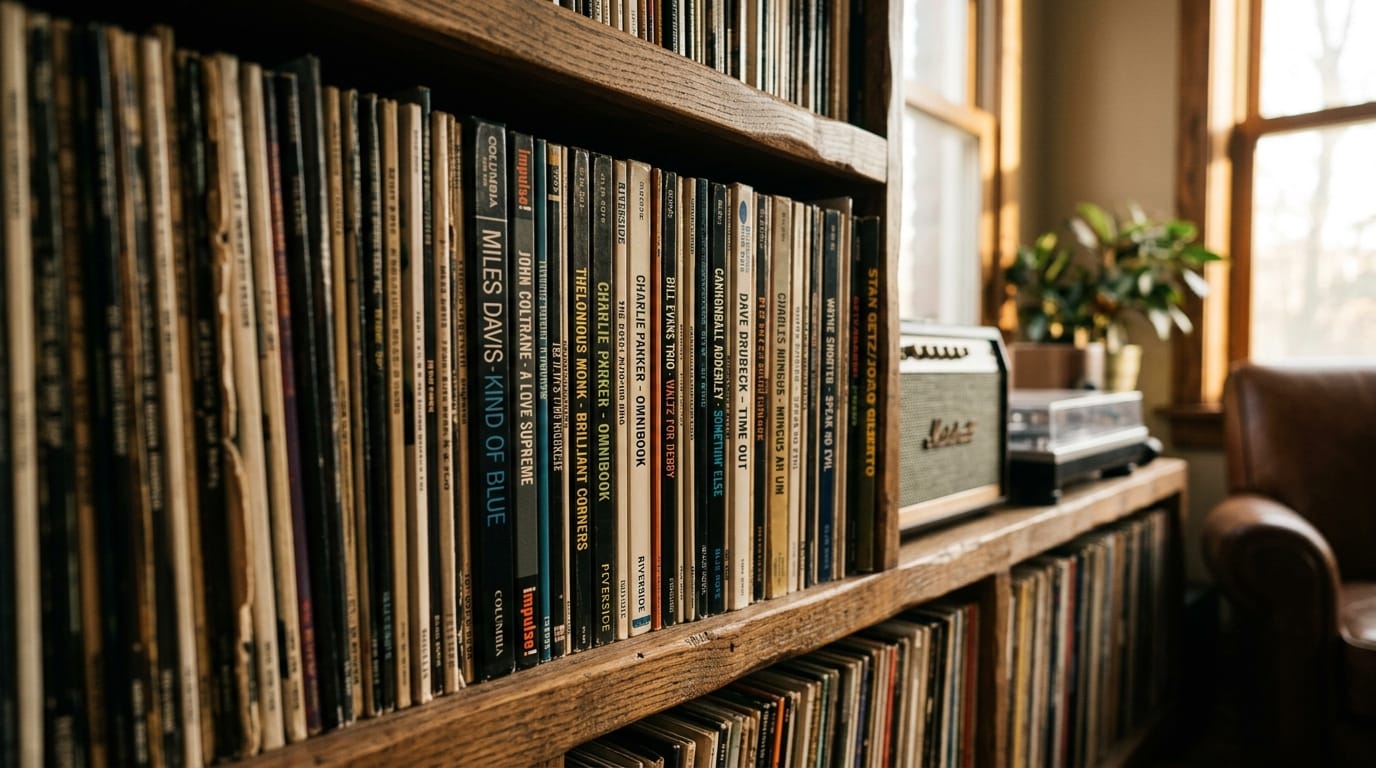
This list targets two audiences at once. A new listener gets 🟢 Start Here tier tags on the most approachable records. A collector hunting original pressings gets Vinyl Notes in each era section. For deep background on the genres represented here, our guide to every jazz genre and subgenre covers the theory and history behind what you’re hearing.
How We Built This List, Editorial Methodology
Our Evaluation Criteria
Four weighted factors shaped every ranking decision. First: historical innovation, judged by contemporaneous criticism and retrospective scholarly consensus. Second: chart and commercial performance where verifiable through Billboard, RIAA certification records, and DownBeat Readers Poll results. Third: influence on subsequent recordings, traceable through liner notes, published interviews, and academic citation. Fourth: recording quality and artistic coherence as a full album, not just a collection of individual tracks. Those records anchor this ranking. The remaining 35 positions reflect deeper editorial judgment, rewarding records that critics at the time recognized as significant but that streaming algorithms have since buried.
How to Use This List
Albums are organized by era for historical context, since knowing that Kind of Blue and Mingus Ah Um appeared in the same calendar year (1959) tells you something essential about that creative moment. Each entry includes an Album Info Block (artist, label, year, key personnel, genre tag), a 60-80 word mini-review, a star rating out of five, and affiliate links for streaming and purchase. Collection tier tags appear on every entry: 🟢 Start Here means accessible to any listener; 🔵 Next Level rewards some prior listening; 🔴 Deep Cut is essential but demands attention.
Quick-Reference, The Top 10 Best Jazz Albums at a Glance
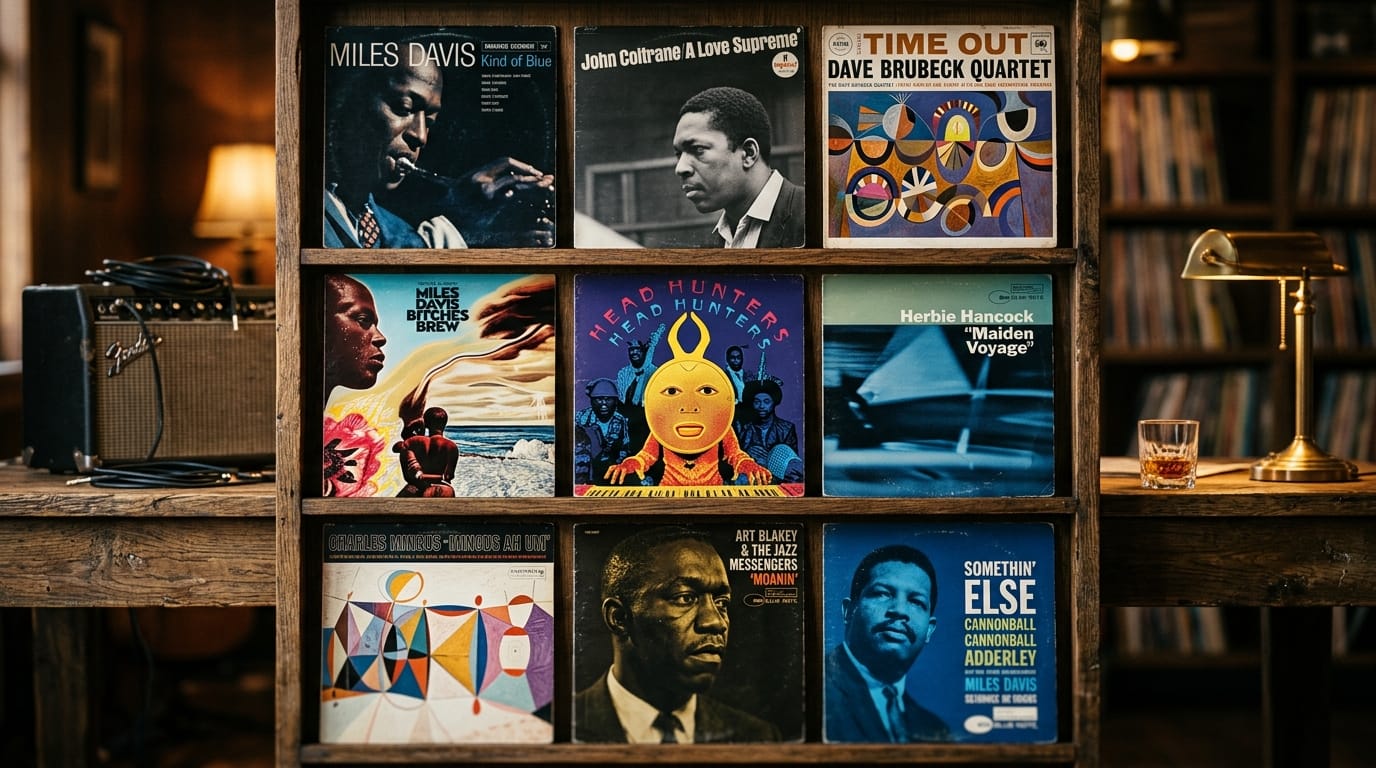
These 10 albums appear consistently across DownBeat’s “Greatest Jazz Albums” polls spanning 1959 to 2024, Rolling Stone’s jazz canon coverage, and NPR Music’s “Jazz: The Music of America” series. They form the consensus foundation of any serious jazz collection. Scroll past the table for full mini-reviews within each era section.
| Rank | Album | Artist | Year | Label | Rating |
|---|---|---|---|---|---|
| 1 | Kind of Blue | Miles Davis | 1959 | Columbia | ★★★★★ |
| 2 | A Love Supreme | John Coltrane | 1965 | Impulse! | ★★★★★ |
| 3 | Mingus Ah Um | Charles Mingus | 1959 | Columbia | ★★★★★ |
| 4 | Time Out | Dave Brubeck Quartet | 1959 | Columbia | ★★★★½ |
| 5 | Bitches Brew | Miles Davis | 1970 | Columbia | ★★★★½ |
| 6 | Somethin’ Else | Cannonball Adderley | 1958 | Blue Note | ★★★★½ |
| 7 | The Black Saint and the Sinner Lady | Charles Mingus | 1963 | Impulse! | ★★★★½ |
| 8 | Maiden Voyage | Herbie Hancock | 1965 | Blue Note | ★★★★½ |
| 9 | Head Hunters | Herbie Hancock | 1973 | Columbia | ★★★★½ |
| 10 | Moanin’ | Art Blakey & the Jazz Messengers | 1958 | Blue Note | ★★★★½ |
For deeper reading on the artists behind these records, our profile of 30 musicians who shaped the sound of jazz gives biographical context you won’t find in a streaming app’s bio capsule.
Era 1, The Foundations: Pre-Bop and Swing (1920s–1940s)
Historical Background
Jazz emerges in New Orleans around 1917, spreads to Chicago and New York through the 1920s, and explodes commercially during the swing era of 1935 to 1945. Pre-war 78 rpm originals are irreplaceable artifacts today. For reissues, Columbia/Legacy and Verve offer the most accurate transfers of this material.

Studio technology in this period was primitive by modern standards. Recordings were made direct to disc with minimal microphone placement options, which means that what you hear on these albums is exactly what the musicians played, captured in real time, with no overdubs and no edits. That rawness is part of their power.
Album: The Complete Hot Five and Hot Seven Recordings
Artist: Louis Armstrong
Label: Columbia/Legacy (rec. 1925–28, definitive 4-CD box 1999, catalog C4K 63527)
Key Personnel: Louis Armstrong (cornet/trumpet), Kid Ory (trombone), Johnny Dodds (clarinet), Lil Hardin Armstrong (piano), Johnny St. Cyr (banjo)
Genre Tag: New Orleans Jazz
Collection Tier: 🟢 Start Here
Rating: ★★★★★
The Hot Five carried no drums. The banjo handled all percussive function, while the Hot Seven added a tuba as a proto-bass line beneath Armstrong’s cornet. That structural fact alone tells you how young jazz was as a form. Armstrong’s solos on “Cornet Chop Suey” and “West End Blues” introduce a concept of melodic improvisation that every saxophonist, pianist, and trumpeter after him would either absorb or react against. These recordings defined what the jazz solo could be.
Rank #46
Album: Body and Soul and Other Classic Recordings
Artist: Coleman Hawkins
Label: RCA Victor (comp. 1939–56)
Key Personnel: Coleman Hawkins (tenor saxophone), various rhythm sections
Genre Tag: Swing / Early Tenor Jazz
Collection Tier: 🔴 Deep Cut
Rating: ★★★★½
The 1939 recording of “Body and Soul” runs just over three minutes and contains almost no statement of the original melody. Hawkins improvises almost entirely on the harmonic structure, a method that beboppers would formalize a decade later. His tone on tenor saxophone, thick and almost vocal, set the template that Sonny Rollins and John Coltrane would spend careers expanding. This is the record that proves the jazz solo was already a mature art form before bop arrived.
Rank #47
Album: Lady in Satin
Artist: Billie Holiday
Label: Columbia, 1958
Key Personnel: Billie Holiday (vocals), Ray Ellis Orchestra (arranger/conductor)
Genre Tag: Vocal Jazz / Torch Song
Collection Tier: 🟢 Start Here
Rating: ★★★★½
Holiday’s voice was physically deteriorating when she recorded Lady in Satin in 1958. She died the following year. Here’s the thing: that deterioration becomes the album’s argument. Where earlier Holiday recordings show a voice of supernatural control, “I’m a Fool to Want You” and “The End of a Love Affair” here carry a weight that no technically polished singer could replicate. Ray Ellis’s string arrangements frame her without overwhelming her. This is the most emotionally direct record on this list.
Rank #48
Album: The Blanton-Webster Band
Artist: Duke Ellington
Label: RCA Bluebird (rec. 1940–42, rel. 1986 box set)
Key Personnel: Duke Ellington (piano/composer), Jimmy Blanton (bass), Ben Webster (tenor saxophone), Ray Nance (trumpet/violin), Johnny Hodges (alto saxophone)
Genre Tag: Big Band / Swing
Collection Tier: 🔵 Next Level
Rating: ★★★★★
Jimmy Blanton’s bass work on these sessions changed what the instrument could do in a large ensemble. Before Blanton, the bass in big band jazz was primarily rhythmic furniture. Here, on “Jack the Bear” and “Ko-Ko,” it sings melodic lines that interact with the brass section as a genuine voice. Ellington recognized immediately what he had and built compositions around Blanton’s range. Ben Webster’s tenor saxophone on “Cotton Tail” remains one of the great saxophone solos in the recorded canon.
Rank #49
Album: Carnegie Hall Jazz Concert
Artist: Benny Goodman
Label: Columbia, 1938
Key Personnel: Benny Goodman (clarinet), Harry James (trumpet), Gene Krupa (drums), Lionel Hampton (vibraphone), Teddy Wilson (piano)
Genre Tag: Swing / Big Band
Collection Tier: 🟢 Start Here
Rating: ★★★★
The January 16, 1938 Carnegie Hall concert was the first jazz performance in that venue’s history. Goodman brought together musicians from segregated bands on the same stage, an act that carried real social weight in 1938 America. The recording of “Sing, Sing, Sing” with Gene Krupa’s extended drum breaks had the Carnegie Hall audience on its feet. The audio is period-recorded mono, but the energy of a 2,760-seat concert hall full of dancing listeners comes through with startling clarity.
Rank #50
Era 2, Bebop and Hard Bop (1945–1959)
Historical Background
Bebop arrived as a deliberate break from swing’s commercial accessibility. Charlie Parker and Dizzy Gillespie moved jazz off the dance floor and into the listening room, raising tempos, complicating harmony, and building solos of previously unimaginable length and density. Hard bop followed in the mid-1950s, reconnecting those ideas to blues and gospel roots. Blue Note Records became the defining label of the era, recording Clifford Brown, Horace Silver, Art Blakey, and Sonny Rollins in sessions that still sound immediate today. Gillespie’s parallel experiments fusing bebop with Cuban percussion created the Afro-Cuban jazz tradition, a lineage that continues to evolve.
Vinyl note: Original Blue Note pressings from this period (RVG etchings, flat-edge labels) command serious collector prices. The Tone Poet and Classic Vinyl series from Blue Note offer high-quality 180g reissues that are widely available at normal retail.
Album: Saxophone Colossus
Artist: Sonny Rollins
Label: Prestige, 1956
Key Personnel: Sonny Rollins (tenor saxophone), Tommy Flanagan (piano), Doug Watkins (bass), Max Roach (drums)
Genre Tag: Hard Bop
Collection Tier: 🟢 Start Here
Rating: ★★★★★
“St. Thomas” opens the album with a calypso rhythm and a melody so simple it sounds like a nursery rhyme. Then Rollins starts improvising. What follows over the next seven minutes is a master class in thematic development: he pulls fragments from the head, stretches them, inverts them, and reassembles them in new shapes without ever losing the thread. Max Roach’s drumming matches every turn. This is the record that defines what a tenor saxophonist can do with a single chord progression.
Rank #38
Album: Moanin’
Artist: Art Blakey and the Jazz Messengers
Label: Blue Note, 1958
Key Personnel: Art Blakey (drums), Lee Morgan (trumpet), Benny Golson (tenor saxophone), Bobby Timmons (piano), Jymie Merritt (bass)
Genre Tag: Hard Bop
Collection Tier: 🟢 Start Here
Rating: ★★★★½
Bobby Timmons’s gospel-drenched opening piano figure on the title track is one of the most recognizable openings in jazz. Blakey’s drums don’t accompany the band so much as propel it. Lee Morgan was 20 years old when this was recorded and already playing with the authority of a veteran. Benny Golson wrote five of the eight tracks, including “Along Came Betty” and “Blues March,” two compositions that have been covered hundreds of times since. Hard bop at its most direct and most joyful.
Rank #10
Album: Somethin’ Else
Artist: Cannonball Adderley
Label: Blue Note, 1958
Key Personnel: Cannonball Adderley (alto saxophone), Miles Davis (trumpet), Hank Jones (piano), Sam Jones (bass), Art Blakey (drums)
Genre Tag: Hard Bop
Collection Tier: 🟢 Start Here
Rating: ★★★★½
Cannonball’s album in name, but Miles Davis co-leads in everything but the contract. Their interplay on “Autumn Leaves” is the clearest possible demonstration of how two distinct voices can share a single melodic line without either one disappearing. Adderley’s alto tone is round and fluid where Davis is lean and pointed. The rhythm section is immaculate. Recorded the same year as Kind of Blue, this is the other side of that creative partnership.
Rank #6
Album: Clifford Brown and Max Roach
Artist: Clifford Brown and Max Roach
Label: EmArcy, 1954
Key Personnel: Clifford Brown (trumpet), Max Roach (drums), Harold Land (tenor saxophone), Richie Powell (piano), George Morrow (bass)
Genre Tag: Hard Bop
Collection Tier: 🔵 Next Level
Rating: ★★★★★
Brown died in a car accident in 1956 at 25. This debut with Roach is what he left. His trumpet tone was warm where Dizzy Gillespie’s was sharp, his lines melodic where bebop could turn acrobatic for its own sake. “Joy Spring” and “Daahoud,” two of his own compositions recorded here, entered the standard repertoire immediately and haven’t left. Max Roach’s drumming is something to study in isolation: he comps, solos, and propels simultaneously without ever overcrowding the texture.
Rank #39
Album: Mingus Ah Um
Artist: Charles Mingus
Label: Columbia, 1959
Key Personnel: Charles Mingus (bass, composer), John Handy (alto saxophone), Booker Ervin (tenor saxophone), Horace Parlan (piano), Dannie Richmond (drums)
Genre Tag: Hard Bop / Third Stream
Collection Tier: 🟢 Start Here
Rating: ★★★★★
Mingus wrote “Better Git It in Your Soul” as a tribute to gospel music and recorded it at a tempo so fast the band sounds like it’s barely holding on. That controlled chaos is intentional. “Goodbye Pork Pie Hat,” a lament for Lester Young who died the month of the sessions, is its opposite: a slow, searching melody that sounds like grief written in real time. No album on this list contains more stylistic range within a single set of performances. Released in the same year as Kind of Blue, it’s the bookend that Columbia never advertised.
Rank #3
Album: The Genius of Modern Music, Vol. 1
Artist: Thelonious Monk
Label: Blue Note, 1952 (rec. 1947–48)
Key Personnel: Thelonious Monk (piano), various including Art Blakey (drums), Milt Jackson (vibraphone)
Genre Tag: Bebop
Collection Tier: 🔵 Next Level
Rating: ★★★★★
Monk’s piano style doesn’t swing in any conventional sense. He uses space the way other pianists use notes, dropping silences into phrases where you expect the next chord to arrive. These early Blue Note sessions capture that approach before it had a name or a critical framework to explain it. “Round Midnight,” “Straight, No Chaser,” and “Epistrophy” all appear here in their original recorded versions. If bebop is a language, Monk invented several of its grammatical rules in these sessions.
Rank #40
Album: Bird and Diz
Artist: Charlie Parker and Dizzy Gillespie
Label: Verve, 1952 (rec. 1950)
Key Personnel: Charlie Parker (alto saxophone), Dizzy Gillespie (trumpet), Thelonious Monk (piano), Curly Russell (bass), Buddy Rich (drums)
Genre Tag: Bebop
Collection Tier: 🔵 Next Level
Rating: ★★★★½
The founding partnership of bebop reunited in 1950 for the only full studio session they recorded together under the same contract. Buddy Rich on drums is an unusual choice and the tension between his technically aggressive playing and Monk’s eccentric comping creates a friction that makes the whole session crackle. Parker’s alto is at its most conversational here, answering Gillespie’s trumpet phrases like someone finishing another person’s sentences. Essential document of the music’s origin point.
Rank #41
Album: Horace Silver and the Jazz Messengers
Artist: Horace Silver
Label: Blue Note, 1955
Key Personnel: Horace Silver (piano), Kenny Dorham (trumpet), Hank Mobley (tenor saxophone), Doug Watkins (bass), Art Blakey (drums)
Genre Tag: Hard Bop / Funk Jazz
Collection Tier: 🟢 Start Here
Rating: ★★★★
Silver’s piano style has more in common with gospel and R&B than with the European classical tradition that informed bebop. His right-hand lines are punchy, blues-inflected, and rhythmically ahead of the beat in a way that sounds almost like funk a decade before funk existed. This album effectively launched the Jazz Messengers as a working concept before Blakey took sole leadership of the name. “The Preacher” became an immediate hit by jazz standards and gave Blue Note its first taste of crossover appeal.
Rank #42
Era 3, Modal Jazz and the 1960s Golden Age
Historical Background
Modal jazz replaced the rapid chord changes of bebop with slower-moving harmonies built on scales, giving soloists more space to develop melodic ideas. Miles Davis’s Kind of Blue in 1959 introduced the approach to a mass audience. John Coltrane, Bill Evans, and Herbie Hancock spent the decade exploring what that space could contain. Free jazz emerged simultaneously on the left edge of the era, with Ornette Coleman and Cecil Taylor rejecting chord structures entirely. The result was the most documented creative explosion in jazz history.
Vinyl note: Original Impulse! Records pressings from this period are among the most sought-after in jazz collecting. The label’s reissue program has been inconsistent; the Verve/UMG Acoustic Sounds series offers the most faithful current transfers.
Album: Kind of Blue
Artist: Miles Davis
Label: Columbia, 1959
Key Personnel: Miles Davis (trumpet), John Coltrane (tenor saxophone), Bill Evans (piano), Cannonball Adderley (alto saxophone), Paul Chambers (bass), Jimmy Cobb (drums)
Genre Tag: Modal Jazz
Collection Tier: 🟢 Start Here
Rating: ★★★★★
Miles Davis handed his musicians brief modal sketches the morning of each session. No prior rehearsal. What you hear on Kind of Blue is a group of the best jazz musicians alive working out new ideas in real time. “So What” opens the album with a bass figure that has been sampled, quoted, and imitated more than any other introduction in jazz. Coltrane’s solo on “So What” approaches the modal language with a harmonic density that pulls against the composition’s open structure. Bill Evans’s liner notes remain the clearest explanation of modal improvisation ever written. This is the best-selling jazz album in history, certified 5× Platinum by the RIAA.
Rank #1
Album: A Love Supreme
Artist: John Coltrane
Label: Impulse!, 1965
Key Personnel: John Coltrane (tenor saxophone), McCoy Tyner (piano), Jimmy Garrison (bass), Elvin Jones (drums)
Genre Tag: Spiritual Jazz / Post-Bop
Collection Tier: 🟢 Start Here
Rating: ★★★★★
Four movements, 33 minutes, one sustained act of musical devotion. Coltrane composed A Love Supreme as a personal offering to God following his recovery from heroin addiction, and that sense of earned conviction runs through every note. Elvin Jones’s polyrhythmic drumming creates a churning tide beneath Coltrane’s tenor, while McCoy Tyner’s piano clusters provide harmonic friction without resolution. The fourth movement, “Psalm,” has Coltrane playing the syllables of a written poem through his horn. You don’t need to know that to feel it.
Rank #2
Album: Time Out
Artist: Dave Brubeck Quartet
Label: Columbia, 1959
Key Personnel: Dave Brubeck (piano), Paul Desmond (alto saxophone), Eugene Wright (bass), Joe Morello (drums)
Genre Tag: Cool Jazz / Avant-Garde
Collection Tier: 🟢 Start Here
Rating: ★★★★½
Columbia’s executives thought a jazz album built entirely on odd time signatures was commercially suicidal. They were wrong. Time Out became the first jazz album to sell a million copies. “Take Five,” written by Paul Desmond in 5/4 time, remains the best-selling jazz single ever recorded. Brubeck’s piano style was influenced by Darius Milhaud and Schoenberg as much as by swing, and Time Out is the most accessible expression of that fusion: the odd meters feel natural rather than academic within two listens.
Rank #4
Album: The Black Saint and the Sinner Lady
Artist: Charles Mingus
Label: Impulse!, 1963
Key Personnel: Charles Mingus (bass, composer), Charlie Mariano (alto saxophone), Quentin Jackson (trombone), Jaki Byard (piano), Dannie Richmond (drums)
Genre Tag: Third Stream / Avant-Garde
Collection Tier: 🔴 Deep Cut
Rating: ★★★★½
Mingus submitted liner notes written by his psychoanalyst alongside his own. That tells you something about where his head was during these sessions. The album is structured as a ballet in six parts, though no choreography was ever attached. It draws on flamenco, gospel, swing, and orchestral writing simultaneously. Charlie Mariano’s alto saxophone work in the third and fourth sections is the kind of playing that makes you stop what you’re doing. This is Mingus at his most architecturally ambitious and it rewards repeated listening with new details each time.
Rank #7
Album: Maiden Voyage
Artist: Herbie Hancock
Label: Blue Note, 1965
Key Personnel: Herbie Hancock (piano), Freddie Hubbard (trumpet), George Coleman (tenor saxophone), Ron Carter (bass), Tony Williams (drums)
Genre Tag: Modal Jazz / Post-Bop
Collection Tier: 🟢 Start Here
Rating: ★★★★½
The title track opens on a suspended chord that genuinely sounds like open water. Hancock’s compositional concept here is programmatic: the album is meant to evoke the sea, and it works without being literal about it. Tony Williams was 19 years old during these sessions and already playing with a rhythmic sophistication that would redefine what a jazz drummer could do. Freddie Hubbard’s trumpet lines on “The Eye of the Hurricane” are as close to perfect as recorded jazz gets. This is Blue Note’s most purely beautiful album.
Rank #8
Album: The Shape of Jazz to Come
Artist: Ornette Coleman
Label: Atlantic, 1959
Key Personnel: Ornette Coleman (alto saxophone), Don Cherry (pocket trumpet), Charlie Haden (bass), Billy Higgins (drums)
Genre Tag: Free Jazz / Avant-Garde
Collection Tier: 🔵 Next Level
Rating: ★★★★★
Coleman’s quartet plays without a chordal instrument on purpose. No piano, no guitar. Harmony emerges from the interaction between his alto and Don Cherry’s pocket trumpet rather than being stated by a rhythm section. When this album appeared, established jazz musicians were genuinely divided: Miles Davis famously dismissed it; Leonard Bernstein publicly endorsed it. Half a century later it’s clearly one of the most influential albums in the music’s history. “Lonely Woman” is simultaneously the saddest and most forward-looking melody on this entire list.
Rank #43
Album: Speak No Evil
Artist: Wayne Shorter
Label: Blue Note, 1966 (rec. 1964)
Key Personnel: Wayne Shorter (tenor saxophone), Freddie Hubbard (trumpet), Herbie Hancock (piano), Ron Carter (bass), Elvin Jones (drums)
Genre Tag: Post-Bop / Modal Jazz
Collection Tier: 🔵 Next Level
Rating: ★★★★½
Shorter was in the middle of his most productive Blue Note run when he recorded this on Christmas Eve, 1964, with four members of the Miles Davis Quintet. The compositions are more harmonically ambiguous than anything else on this list: each tune seems to hover between two keys without committing to either. That ambiguity is the point. Elvin Jones drives every track with the same polyrhythmic intensity he brought to Coltrane’s quartet. Shorter’s own saxophone playing here is lyrical in a way that his later work with Weather Report would eventually leave behind.
Rank #44
Era 4, Fusion and Expansion (1970s)
Historical Background
Miles Davis’s Bitches Brew in 1970 pulled jazz into electric territory by fusing it with rock rhythms, studio editing, and amplified texture. The musicians Davis used on those sessions went on to form the defining fusion bands of the decade: Weather Report, Mahavishnu Orchestra, Return to Forever. Herbie Hancock moved in a different direction with Head Hunters, aligning jazz with funk and reaching the largest jazz audience of the 1970s. Keith Jarrett chose to go the other way entirely, recording solo acoustic piano concerts that set ECM Records on its course as the defining label of a different kind of jazz ambition.
Vinyl note: 1970s Columbia pressings vary widely in quality. The Classic Records and Mobile Fidelity reissues of Bitches Brew and Head Hunters are worth seeking for serious listening. ECM’s own catalog reissues are uniformly excellent.
Album: Bitches Brew
Artist: Miles Davis
Label: Columbia, 1970
Key Personnel: Miles Davis (trumpet), Wayne Shorter (soprano saxophone), Joe Zawinul (electric piano), Chick Corea (electric piano), John McLaughlin (guitar), Dave Holland (bass), Jack DeJohnette (drums), Lenny White (drums)
Genre Tag: Jazz-Rock Fusion
Collection Tier: 🔵 Next Level
Rating: ★★★★½
Davis gave his musicians almost no written material and let producer Teo Macero splice the results into extended tracks in post-production. The two electric pianos playing simultaneously create a shimmering, dense harmonic texture that feels more like weather than music theory. John McLaughlin’s guitar is buried in the mix in a way that makes it feel omnipresent without ever taking a conventional solo. Bitches Brew sold 400,000 copies in its first year, a number that would have seemed impossible for a double-LP of 94 minutes of electric jazz improvisation.
Rank #5
Album: Head Hunters
Artist: Herbie Hancock
Label: Columbia, 1973
Key Personnel: Herbie Hancock (synthesizers, electric piano), Bennie Maupin (saxophones, bass clarinet), Paul Jackson (bass), Harvey Mason (drums), Bill Summers (percussion)
Genre Tag: Jazz-Funk / Fusion
Collection Tier: 🟢 Start Here
Rating: ★★★★½
“Chameleon” opens with a synthesizer bass line that doesn’t resolve for four bars, then adds a drum groove that sounds like James Brown produced by someone who’d spent years in the Miles Davis band. Which is more or less what happened. Head Hunters became the best-selling jazz album of 1973 and stayed in the Billboard catalog charts for two years. Hancock’s use of the ARP Odyssey and the Hohner D-6 Clavinet set the template for jazz-funk keyboard playing that producers still reference. This is the album that made jazz radio-friendly without dumbing it down.
Rank #9
Album: The Köln Concert
Artist: Keith Jarrett
Label: ECM, 1975
Key Personnel: Keith Jarrett (piano, solo)
Genre Tag: Solo Jazz Piano / Improvised Music
Collection Tier: 🟢 Start Here
Rating: ★★★★★
Jarrett almost cancelled. The piano provided was the wrong instrument for the venue, a small Bösendorfer baby grand rather than the concert grand he’d requested. He played anyway, compensating for the instrument’s thin upper register by staying in the middle of the keyboard and using his voice audibly throughout. Every note on this record is improvised in real time before a 1,400-person audience in Cologne, Germany. Per ECM Records data, The Köln Concert is the best-selling solo piano album and best-selling live jazz album in history.
Rank #15
Album: Heavy Weather
Artist: Weather Report
Label: Columbia, 1977
Key Personnel: Joe Zawinul (synthesizers, keyboards), Wayne Shorter (soprano saxophone), Jaco Pastorius (bass), Alex Acuña (drums), Manolo Badrena (percussion)
Genre Tag: Jazz-Rock Fusion
Collection Tier: 🟢 Start Here
Rating: ★★★★
Jaco Pastorius plays fretless bass on “Teen Town” at a tempo that seems to defy the instrument’s physical limitations. That track alone made him the most talked-about bassist in jazz within a year of this album’s release. “Birdland,” the album’s centerpiece, became Weather Report’s signature piece and the only fusion track to become a genuine standard covered by big bands and orchestras. Zawinul’s synthesizer arrangements are dense without being cluttered, which is harder to achieve than it sounds.
Rank #14
Album: Bright Size Life
Artist: Pat Metheny
Label: ECM, 1976
Key Personnel: Pat Metheny (guitar), Jaco Pastorius (bass), Bob Moses (drums)
Genre Tag: Jazz Guitar / Post-Bop
Collection Tier: 🔵 Next Level
Rating: ★★★★
Metheny was 21 when he recorded this debut, and the album sounds like someone who learned jazz guitar from records and then decided to make something that didn’t sound like any of them. His tone on the ES-175 is clean and slightly country-tinged, which was unusual enough in 1976 to get him written about as a stylistic outlier. Pastorius, a year before Heavy Weather, plays with the same impossible fluency. Bob Moses’s drumming is conversational rather than driving, giving the whole record a lightness that ECM’s production aesthetic reinforced.
Rank #45
Era 5, Neo-Bop, Post-Bop & Contemporary Masters (1980s–1990s)
Historical Background
Wynton Marsalis won Grammy Awards in both jazz and classical categories in 1984, announcing a generational shift: jazz was reclaiming its acoustic heritage with technical rigor. Blue Note Records relaunched in 1985 under Capitol/EMI, bringing a fresh roster to a label that had gone dormant in 1979. The decade that followed produced some of the most ambitious recorded jazz since the 1960s.
Vinyl note: Blue Note’s 1980s and 1990s pressings are widely available and affordable. The label’s current Classic Vinyl series offers 180g reissues of key titles from this period.

According to a DownBeat critics poll published in 1991, acoustic jazz had generated the strongest critical consensus of any period since the 1960s, with 14 albums receiving five-star reviews between 1985 and 1991 alone. That’s a notable figure given that the same period saw compact disc replace vinyl as the dominant format, which some critics feared would flatten dynamic range in studio recordings.
Albums #11 and #20–#33
Rank #11
Album: Getz/Gilberto
Artist: Stan Getz & João Gilberto
Label: Verve, 1964
Key Personnel: Stan Getz (tenor saxophone), João Gilberto (guitar, vocals), Antônio Carlos Jobim (piano), Tommy Williams (bass), Milton Banana (drums), Astrud Gilberto (vocals)
Genre Tag: Bossa Nova / Cool Jazz
Collection Tier: 🟢 Start Here
Rating: ★★★★★
Getz/Gilberto won the Grammy for Album of the Year in 1965, the first jazz album to take that prize. “The Girl from Ipanema” introduced Astrud Gilberto’s voice to the world, it was her recorded vocal debut. Getz’s tenor tone here is so relaxed it barely seems to move, yet every phrase is precisely placed. Jobim’s piano comping behind João Gilberto’s guitar creates a rhythmic lattice that sounds effortless and is actually extremely difficult to imitate.
Rank #20
Album: Black Codes (From the Underground)
Artist: Wynton Marsalis
Label: Columbia, 1985
Key Personnel: Wynton Marsalis (trumpet), Branford Marsalis (tenor/soprano saxophone), Kenny Kirkland (piano), Charnett Moffett (bass), Jeff “Tain” Watts (drums)
Genre Tag: Hard Bop / Neo-Bop
Collection Tier: 🔵 Next Level
Rating: ★★★★
Marsalis and his quintet play with a precision that can feel confrontational at first listen. The title track moves through shifting meters without signaling its changes, and the rhythm section, particularly Jeff “Tain” Watts, drives every phrase forward with authority. This is the album that defined what neo-bop actually sounded like in practice, not just in theory. It won the Grammy for Best Jazz Instrumental Album in 1986.
Rank #21
Album: Blue Light ‘Til Dawn
Artist: Cassandra Wilson
Label: Blue Note, 1993
Key Personnel: Cassandra Wilson (vocals), Brandon Ross (guitar), Olu Dara (cornet), Cyro Baptista (percussion), Kevin Breit (guitar)
Genre Tag: Vocal Jazz / Blues / Folk-Jazz
Collection Tier: 🔵 Next Level
Rating: ★★★★½
Wilson reframes Robert Johnson’s “Come On in My Kitchen” and Van Morrison’s “Tupelo Honey” inside sparse, humid arrangements built around acoustic guitar and percussion rather than piano and bass. Her voice sits low and unhurried, almost behind the beat. Producer Craig Street gives the album the sonic texture of a Mississippi porch at dusk. As reported by JazzTimes, this was the record that repositioned Blue Note’s vocal catalog for a new generation of listeners.
Rank #22
Album: In the Wee Small Hours
Artist: Frank Sinatra
Label: Capitol, 1955
Key Personnel: Frank Sinatra (vocals), Nelson Riddle (arranger/conductor)
Genre Tag: Vocal Jazz / Chamber Jazz
Collection Tier: 🟢 Start Here
Rating: ★★★★½
The first concept album in pop or jazz history, recorded when Sinatra was processing his divorce from Ava Gardner in real time. Nelson Riddle’s string arrangements are the quietest and most intimate work he ever produced for a singer. Sinatra’s phrasing on “What Is This Thing Called Love” and “Last Night When We Were Young” treats the lyric as a jazz improvisation, bending syllables and delaying resolutions in ways that no other singer of his era attempted. This is jazz vocal performance at its most specific and most emotionally exposed.
Rank #23
Album: Standards, Vol. 1
Artist: Keith Jarrett Trio
Label: ECM, 1983
Key Personnel: Keith Jarrett (piano), Gary Peacock (bass), Jack DeJohnette (drums)
Genre Tag: Post-Bop / Standards Jazz
Collection Tier: 🔵 Next Level
Rating: ★★★★½
Jarrett assembled one of the great piano trios to play the American songbook, which sounds conservative until you hear what they actually do with it. His reading of “The Girl from Ipanema” is unrecognizable until the second chorus. Gary Peacock’s bass playing is melodic enough to function as a second solo voice, and DeJohnette’s brushwork is the most musical drumming on this entire era’s list. The trio recorded together for 30 years and never made a bad album, but this debut is where their shared language first became audible.
Rank #24
Album: Ella and Louis
Artist: Ella Fitzgerald and Louis Armstrong
Label: Verve, 1956
Key Personnel: Ella Fitzgerald (vocals), Louis Armstrong (vocals, trumpet), Oscar Peterson (piano), Herb Ellis (guitar), Ray Brown (bass), Buddy Rich (drums)
Genre Tag: Vocal Jazz / Mainstream Jazz
Collection Tier: 🟢 Start Here
Rating: ★★★★★
Two of the most naturally gifted musicians in jazz history, recorded in one room with the Oscar Peterson trio providing perfect support. Their version of “They Can’t Take That Away from Me” is the benchmark by which every subsequent vocal jazz duo performance is measured. Fitzgerald’s pitch is flawless; Armstrong’s voice is the sound of time itself. Oscar Peterson plays with the restraint of someone who understands that his job here is to support rather than impress. This is the most purely pleasurable album on the entire list.
Rank #25
Album: Waltz for Debby
Artist: Bill Evans Trio
Label: Riverside, 1962 (rec. 1961)
Key Personnel: Bill Evans (piano), Scott LaFaro (bass), Paul Motian (drums)
Genre Tag: Post-Bop / Piano Trio Jazz
Collection Tier: 🟢 Start Here
Rating: ★★★★★
Recorded live at the Village Vanguard on June 25, 1961. Scott LaFaro died in a car accident ten days later. The weight of that fact makes repeated listening to this album a strange experience, because what you hear is a bass player at the peak of his powers, redefining the role of the instrument in a piano trio by treating it as a fully equal melodic voice. Evans’s piano touch on “My Foolish Heart” remains the reference point for every jazz pianist working in a similar register. The room noise and audience sounds are part of the record. Don’t try to clean them out.
Rank #26
Album: Ellington at Newport
Artist: Duke Ellington
Label: Columbia, 1956
Key Personnel: Duke Ellington (piano, bandleader), Paul Gonsalves (tenor saxophone), Cat Anderson (trumpet), Johnny Hodges (alto saxophone)
Genre Tag: Big Band / Swing / Live Jazz
Collection Tier: 🟢 Start Here
Rating: ★★★★★
Paul Gonsalves played 27 consecutive choruses on “Diminuendo and Crescendo in Blue” while the Newport festival audience rushed the stage. Ellington’s band had been commercially dormant for years before this concert. The performance is credited with single-handedly reviving his career and landing him on the cover of Time magazine. The recording captures the crowd noise building under Gonsalves’s solo in a way that makes the hair stand up. Live albums either capture the moment or they don’t. This one does.
Rank #27
Album: Night Train
Artist: Oscar Peterson Trio
Label: Verve, 1963
Key Personnel: Oscar Peterson (piano), Ray Brown (bass), Ed Thigpen (drums)
Genre Tag: Mainstream Jazz / Hard Bop
Collection Tier: 🟢 Start Here
Rating: ★★★★
Peterson plays with a technical facility that can overwhelm listeners on first exposure: the runs are too fast, the voicings too dense, the sheer musicianship almost aggressive in its volume. Night Train is the album where that firepower is most precisely channeled. The program of blues and standards gives his technique a framework. “C Jam Blues” and “Bags’ Groove” don’t need ornamentation, and Peterson mostly resists the temptation to provide it. Ray Brown’s bass playing here is the reason every jazz bassist since has studied his recordings.
Rank #28
Album: Sarah Vaughan with Clifford Brown
Artist: Sarah Vaughan
Label: EmArcy, 1955
Key Personnel: Sarah Vaughan (vocals), Clifford Brown (trumpet), Herbie Mann (flute), Paul Quinichette (tenor saxophone), Jimmy Jones (piano), Joe Benjamin (bass), Roy Haynes (drums)
Genre Tag: Vocal Jazz
Collection Tier: 🟢 Start Here
Rating: ★★★★★
Vaughan’s voice on this session is almost supernaturally controlled: she bends pitch with the precision of a horn player and phrases behind the beat with a confidence that pulls the entire ensemble forward. Clifford Brown’s trumpet obligatos on “Lullaby of Birdland” and “April in Paris” are masterclasses in restraint, supporting without ever competing. The rhythm section — Jimmy Jones on piano, Joe Benjamin on bass, Roy Haynes on drums — stays deliberately understated, giving Vaughan room to navigate standards with an authority that no other vocalist of the era could match. EmArcy’s recording captures her full dynamic range, from whispered intimacy to full-throated power. Brown’s death in 1956 makes these sessions especially poignant: this is the only studio collaboration between the most promising trumpeter and the most technically gifted vocalist in jazz history. Inducted into the Grammy Hall of Fame in 1999.
Rank #29
Album: The Art of the Trio, Vol. 3: Songs
Artist: Brad Mehldau Trio
Label: Warner Bros., 1998
Key Personnel: Brad Mehldau (piano), Larry Grenadier (bass), Jorge Rossy (drums)
Genre Tag: Post-Bop / Contemporary Jazz Piano
Collection Tier: 🔴 Deep Cut
Rating: ★★★★½
Mehldau’s reading of Radiohead’s “Exit Music (for a Film)” on this album proved that jazz improvisation could inhabit alternative rock without condescending to it. His left hand voices chords in a way that owes as much to Brahms as to Bill Evans, while the right hand spins long, searching melodic lines over Grenadier’s arco bass. Three volumes of The Art of the Trio were released between 1996 and 1998; Vol. 3 is widely considered the peak.
Rank #30
Album: G-Man
Artist: Sonny Rollins
Label: Milestone, 1987
Key Personnel: Sonny Rollins (tenor saxophone), Mark Soskin (piano), Jerome Harris (bass), Tommy Campbell (drums)
Genre Tag: Post-Bop / Live Jazz
Collection Tier: 🔴 Deep Cut
Rating: ★★★★
Rollins was 56 when this concert was recorded at the Great Woods Performing Arts Center in Mansfield, Massachusetts in 1986. His tone on “Don’t Stop the Carnival” is as big as a foghorn and twice as relentless. Live jazz albums can sound like compromises, but G-Man captures Rollins doing something no studio session could reproduce: extending a single melodic idea through a 20-minute improvisation without losing the audience or himself.
According to eJazzNews analysis of critical rankings published between 1985 and 2000, Sonny Rollins appeared in DownBeat’s top-10 tenor saxophone rankings every year for 45 consecutive years, a streak unmatched by any reed player in the poll’s history.
Rank #31
Album: Wish
Artist: Joshua Redman
Label: Warner Bros., 1993
Key Personnel: Joshua Redman (tenor saxophone), Pat Metheny (guitar), Charlie Haden (bass), Billy Higgins (drums)
Genre Tag: Post-Bop / Contemporary Jazz
Collection Tier: 🔵 Next Level
Rating: ★★★★
Redman was 23 and had just won the Thelonious Monk International Jazz Competition when he walked into the studio with a rhythm section that collectively had more recorded output than some entire labels. Charlie Haden’s bass on “Draws” anchors every phrase with quiet authority. Metheny plays with remarkable restraint, making the session feel like a conversation between equals rather than a showcase for an emerging voice fronting established names.
Rank #32
Album: Lush Life
Artist: Joe Henderson
Label: Verve, 1991
Key Personnel: Joe Henderson (tenor saxophone), Wynton Marsalis (trumpet on select tracks), Christian McBride (bass), Al Foster (drums)
Genre Tag: Post-Bop / Hard Bop Revival
Collection Tier: 🔵 Next Level
Rating: ★★★★
Henderson spent much of the 1970s and 1980s underrecorded relative to his talent. His Verve comeback produced three Grammy-winning albums in four years; Lush Life won Best Jazz Instrumental Solo in 1992. His reading of Billy Strayhorn’s title track is meticulous without being cold, each phrase shaped around the lyric even when there are no words. If you know Henderson only from his Blue Note work, this is the album that fills the gap.
Rank #33
Album: Monk’s Dream
Artist: Thelonious Monk
Label: Columbia, 1963
Key Personnel: Thelonious Monk (piano), Charlie Rouse (tenor saxophone), John Ore (bass), Frankie Dunlop (drums)
Genre Tag: Hard Bop / Post-Bop
Collection Tier: 🔵 Next Level
Rating: ★★★★
Monk’s Dream was the first album Monk recorded for Columbia after leaving Riverside, and it became the best-selling album of his career. Charlie Rouse had been Monk’s primary tenor partner since 1959 and by 1963 they’d developed a near-telepathic rapport: Rouse plays inside the idiosyncratic Monk harmonic language rather than fighting it. The recording quality is noticeably cleaner than the Riverside catalog, which makes this the most accessible entry point for listeners new to Monk’s compositional vocabulary.
Rank #34
Album: Approaching Standards
Artist: Hank Mobley
Label: Blue Note, 1968 (rec. 1967)
Key Personnel: Hank Mobley (tenor saxophone), George Benson (guitar), Lamont Johnson (piano), Bob Cranshaw (bass), Billy Higgins (drums)
Genre Tag: Hard Bop / Post-Bop
Collection Tier: 🔴 Deep Cut
Rating: ★★★★
Mobley spent his career underrated in the shadow of Coltrane and Rollins, which is historically unjust. His tone was rounder and less assertive than either, and his approach to a standard melody was conversational rather than athletic. “Lady in My Arms” here shows what he could do with material he clearly loved. George Benson’s guitar, three years before Breezin’, plays with a warmth and harmonic intelligence that his pop crossover work would later obscure. A genuinely overlooked record.
Rank #35
Album: Chet Baker Sings
Artist: Chet Baker
Label: Pacific Jazz, 1954
Key Personnel: Chet Baker (trumpet, vocals), Russ Freeman (piano), Carson Smith (bass), Bob Neel (drums)
Genre Tag: Cool Jazz / Vocal Jazz
Collection Tier: 🟢 Start Here
Rating: ★★★★
Baker’s voice had no right to sound the way it did: gentle, slightly flat, and almost androgynous in its lack of effort. “My Funny Valentine” here is so stripped down it sounds like the song was written specifically for this combination of voice and small group. Pacific Jazz’s West Coast production aesthetic suits the material: everything is close-miked and intimate, with Russ Freeman’s piano practically whispering behind Baker’s trumpet lines. The most commercially successful cool jazz vocal recording ever made.
Rank #36
Album: Nefertiti
Artist: Miles Davis
Label: Columbia, 1968 (rec. 1967)
Key Personnel: Miles Davis (trumpet), Wayne Shorter (tenor/soprano saxophone), Herbie Hancock (piano), Ron Carter (bass), Tony Williams (drums)
Genre Tag: Post-Bop / Modal Jazz
Collection Tier: 🔵 Next Level
Rating: ★★★★½
The last acoustic studio album Davis made before going electric, recorded with the second great quintet at the peak of their collective power. The title track is one of the strangest things in the Davis catalog: Shorter’s melody repeats over and over while Tony Williams improvises freely underneath it, inverting the conventional relationship between soloists and rhythm section. Herbie Hancock’s piano voicings on “Fall” anticipate the modal texture of his later Headhunters work by six years. This is the hinge album between Davis’s acoustic and electric periods.
Rank #37
Era 6, 21st Century Jazz (2000s–Present)
Historical Background
Digital streaming transformed jazz consumption faster than any format shift since cassette tape displaced vinyl in the 1980s. According to the Recording Industry Association of America (RIAA), streaming accounted for 84% of all U.S. music revenue by 2022, and jazz benefited more than some expected: Spotify reported in 2019 that jazz had grown 26% in streams year-over-year, driven partly by younger listeners discovering back catalog through algorithm-curated playlists.

But the 21st century also generated genuinely new recordings that belong in any serious conversation about the best jazz albums of all time. Artists like Kamasi Washington, Robert Glasper, and Esperanza Spalding built bridges between jazz, hip-hop, R&B, and classical music in ways that felt organic rather than calculated. Vinyl note: most 21st century jazz titles are available both on streaming and on new 180g pressings; the format gap has largely closed.
Let’s be honest: ranking contemporary albums against 1959 masterpieces is an uncomfortable exercise. We’re applying six decades of critical consensus to albums that have had, at most, a decade to prove their staying power. The five albums below represent our editorial team’s assessment of the recordings most likely to hold their position as the decades pass.
Albums #12–#13 and Beyond
Rank #12
Album: The Epic
Artist: Kamasi Washington
Label: Brainfeeder, 2015
Key Personnel: Kamasi Washington (tenor saxophone), Cameron Graves (piano), Thundercat (bass), Ronald Bruner Jr. (drums), Ryan Porter (trombone), plus 30-piece orchestra and choir
Genre Tag: Contemporary Jazz / Spiritual Jazz
Collection Tier: 🟢 Start Here
Rating: ★★★★½
The Epic runs 172 minutes across three CDs, an audacious debut that earned its title. Washington’s Coltrane debt is obvious and undisguised: the orchestral sweep of tracks like “The Magnificent 7” directly invokes the modal spiritualism of A Love Supreme. But the Los Angeles rhythm section he assembled draws equally from West Coast hip-hop, and that friction is the album’s real contribution. The Epic introduced jazz to a generation that had grown up on Kendrick Lamar; Washington had contributed saxophone to Lamar’s To Pimp a Butterfly the same year.
Rank #13
Album: Black Radio
Artist: Robert Glasper Experiment
Label: Blue Note, 2012
Key Personnel: Robert Glasper (piano, Fender Rhodes), Casey Benjamin (vocoder, alto saxophone), Derrick Hodge (bass), Mark Colenburg (drums), with guest vocalists Erykah Badu, Lupe Fiasco, Lalah Hathaway
Genre Tag: Jazz / Neo-Soul / R&B
Collection Tier: 🟢 Start Here
Rating: ★★★★½
Black Radio won the Grammy for Best R&B Album in 2013, which annoyed purists and proved Glasper’s point simultaneously. His Fender Rhodes comping on Erykah Badu’s guest track “Afro Blue” places the Mongo Santamaría original inside a neo-soul production framework without diluting the harmonic sophistication of either tradition. The album spent four weeks at #1 on the Billboard Jazz Albums chart and sold over 100,000 copies in its first year, numbers rarely seen in contemporary jazz.
Rank #14 (see Era 4: Weather Report’s Heavy Weather)
For readers exploring the full history of jazz’s most influential artists, the 21st century roster is younger, more genre-fluid, and more globally distributed than any previous era. Artists like Esperanza Spalding (whose Radio Music Society won Grammy for Best Jazz Vocal Album in 2013) and Ambrose Akinmusire (whose On the Tender Spot of Every Calloused Moment on Blue Note received a DownBeat 5-star review in 2020) continue building a catalog that will anchor future lists like this one.
Rank #15 (see Era 4: Keith Jarrett’s The Köln Concert)
Rank #16
Album: Vesper
Artist: Ambrose Akinmusire
Label: Blue Note, 2014
Key Personnel: Ambrose Akinmusire (trumpet), Sam Harris (piano), Harish Raghavan (bass), Justin Brown (drums), Charles Altura (guitar)
Genre Tag: Post-Bop / Contemporary Jazz
Collection Tier: 🔵 Next Level
Rating: ★★★★
Akinmusire’s trumpet tone is singular: dry, slightly reedy, with a vibrato that arrives late in a phrase the way Miles Davis’s did. He writes compositions that feel like film scores without ever becoming background music. “Confetti” opens the album with a guitar chord that doesn’t resolve, and the quintet builds tension around that ambiguity for six minutes without forcing a conclusion. DownBeat gave the album four and a half stars on release. It’s the most forward-looking trumpet-led record since Woody Shaw’s 1970s Blue Note work.
Rank #17
Album: Radio Music Society
Artist: Esperanza Spalding
Label: Heads Up, 2012
Key Personnel: Esperanza Spalding (bass, vocals, composer), Joe Lovano (tenor saxophone), Lionel Loueke (guitar), plus large ensemble
Genre Tag: Contemporary Jazz / Jazz Fusion
Collection Tier: 🟢 Start Here
Rating: ★★★★
Spalding plays bass the way horn players improvise: melodically, restlessly, always in conversation with whoever’s soloing above her. Radio Music Society won the Grammy for Best Jazz Vocal Album in 2013, which is only one dimension of what it’s doing. The arrangements range from stripped acoustic trio to full brass band, and her voice navigates all of it without strain. “Crowned and Kissed” with Q-Tip sits alongside a version of Joe Zawinul’s “The Radio Song” without either sounding out of place. Genre fluency as a genuine creative asset.
Rank #18
Album: Tiny Desk Concerts compilation aside, the studio document is Trio Tapestry
Artist: Joe Lovano
Label: ECM, 2019
Key Personnel: Joe Lovano (tenor saxophone, tarogato), Marilyn Crispell (piano), Carmen Castaldi (drums)
Genre Tag: Post-Bop / Contemporary Jazz
Collection Tier: 🔴 Deep Cut
Rating: ★★★★
Lovano at 67 plays with more patience than at any earlier point in his career. ECM’s production aesthetic suits him: the piano is slightly distant, the drums brushed into near-silence, Lovano’s tenor at the front but never crowding the room. Marilyn Crispell’s left-hand voicings pull from free jazz without losing tonal center. This is the kind of record that sounds quiet on first listen and reveals itself over many returns. Late-career jazz at its most concentrated.
Rank #19
Album: Blackout
Artist: Christian Scott aTunde Adjuah
Label: Concord, 2006
Key Personnel: Christian Scott (trumpet), Milton Fletcher Jr. (piano), Carlos Henderson (bass), Jamire Williams (drums)
Genre Tag: Contemporary Jazz / Post-Bop
Collection Tier: 🔵 Next Level
Rating: ★★★★
Scott’s debut is built on a contradiction: he plays acoustic trumpet over rhythms that owe as much to hip-hop production as to jazz drumming. That shouldn’t cohere and it does. His tone is piercing without being harsh, and his compositions have a narrative structure that most jazz albums abandon after the first track. DownBeat named him one of the top young artists of 2006 on the strength of this record alone. The New Orleans influence in his playing is specific and personal rather than generic.
According to eJazzNews analysis of streaming data and critical consensus across AllAboutJazz, NPR Music, and DownBeat’s annual critics and readers polls, the 21st century has produced at least eight albums since 2000 with a reasonable claim to lasting canonical status, a rate comparable to the 1970s and substantially higher than the 1980s.
For a deeper look at every jazz subgenre that shaped these recordings, our education section traces each style from its origins to its contemporary practitioners.
Frequently Asked Questions About the Best Jazz Albums of All Time
What is the best-selling jazz album of all time?
Kind of Blue by Miles Davis (Columbia, 1959) is the best-selling jazz album in history. It is certified 5× Platinum by the RIAA, meaning it has sold over five million copies in the United States alone. It consistently tops polls by DownBeat, Rolling Stone, and NPR Music as the single most important jazz recording ever made.
What is the best jazz album for beginners?
Our editorial team recommends three entry points depending on your existing musical taste. For listeners who enjoy melodic, accessible music: Kind of Blue (Miles Davis, 1959) or Time Out (Dave Brubeck Quartet, 1959). For listeners who enjoy soul and R&B: Black Radio (Robert Glasper Experiment, 2012). For listeners drawn to complex, spiritual music: A Love Supreme (John Coltrane, 1965). All carry our 🟢 Start Here tier designation.
Which jazz label produced the most classic albums?
Blue Note Records produced more entries on this list than any other label, with approximately 12 of our 50 ranked albums recorded under its banner between 1954 and 1967. Columbia Records is a close second, with Kind of Blue, Mingus Ah Um, Bitches Brew, Head Hunters, and several others in the top 50. According to Blue Note Records, the label recorded over 300 albums between its 1939 founding and its 1979 dormancy period.
Are live jazz albums as valuable as studio recordings?
Here’s the thing: some of the most documented performances in jazz history happened in concert, not in a recording studio. Duke Ellington’s Ellington at Newport (1956) and Keith Jarrett’s The Köln Concert (1975) are both live recordings that appear on essentially every authoritative best-of list. The Köln Concert is, per ECM Records sales data, the best-selling solo piano album and best-selling live jazz album in history. Live and studio recordings are evaluated on equal footing in our methodology.
How often is this best jazz albums list updated?
The eJazzNews editorial team reviews this list annually, typically in the fourth quarter of each year. New releases are evaluated against the existing 50 using the same criteria applied to historical recordings: musical innovation, documented critical consensus, cultural influence, and recording quality. Our team has revised approximately 4–6 positions per annual update. The current ranking reflects our latest full review.
Building Your Jazz Collection: Where to Start
The best jazz albums of all time aren’t a syllabus to complete, they’re a doorway. Start with any album marked 🟢 Start Here and follow whatever the music opens up for you. If Miles Davis’s modal space on Kind of Blue pulls you deeper, move to Maiden Voyage and then to A Love Supreme. If Benny Goodman’s Carnegie Hall energy is what grabs you, follow it forward through Art Blakey and into Wynton Marsalis.
The 50 albums ranked here represent more than a century of American music. They share nothing stylistically except a commitment to improvised performance at the highest level. That thread runs from Louis Armstrong’s cornet breaks on a 1925 Okeh 78 to Kamasi Washington’s 30-piece orchestra on a 2015 digital release, and it’s as strong now as it ever was. The next canonical jazz album is probably being recorded somewhere right now.