
Karl Berger’s Stone Workshop Orchestra
Karl Berger: Vibraphonist, Educator, and Creative Music Pioneer
Karl Berger spent six decades proving that improvisation is not chaos — it is conversation. Born in Heidelberg, Germany in 1935, the vibraphonist and pianist became one of the most influential figures in free jazz education, a musician whose impact on how improvised music is taught far outweighs his name recognition.
His story is one of unlikely connections: a German musician drawn to American free jazz, a collaborator of Ornette Coleman who built a school in the Catskill Mountains, a performer who believed that listening matters more than technique.
From Heidelberg to Paris to New York
Berger studied musicology and philosophy at the University of Heidelberg before turning to jazz performance full-time in the late 1950s. In 1965, he moved to Paris, where he met trumpeter Don Cherry. The two shared a fascination with music that crossed cultural and structural boundaries. Berger joined Cherry’s group and spent two years touring Europe, playing a style of jazz that drew equally from West African rhythms, Indian ragas, and the harmonic freedom of Ornette Coleman.
In 1966, Berger followed Cherry to New York. He quickly became part of the downtown free jazz scene, performing alongside Coleman, Pharoah Sanders, Dave Holland, and Carla Bley. His vibraphone playing — melodic but unpredictable, warm but rhythmically angular — earned him a reputation as a musician who could anchor an ensemble without constraining it.
The Creative Music Studio
In 1971, Berger and his partner, vocalist Ingrid Sertso, co-founded the Creative Music Studio (CMS) in Woodstock, New York. Ornette Coleman served as an early advisor and supporter. The school operated on a radical premise: music is a natural human language, and the best way to learn it is through direct experience — listening, responding, and creating in real time.
CMS did not teach scales, chord changes, or repertoire in the traditional sense. Instead, students participated in ensemble workshops where the goal was collective improvisation guided by what Berger called “the ear.” Faculty included John Cage, Anthony Braxton, Roscoe Mitchell, Jack DeJohnette, and Ed Blackwell. Over its initial run from 1971 to 1984, CMS trained hundreds of musicians who went on to shape contemporary jazz and experimental music worldwide.
The studio was revived in 2007 and continued hosting workshops and concerts until Berger’s death in 2023 at age 87.
The Stone Workshop Orchestra
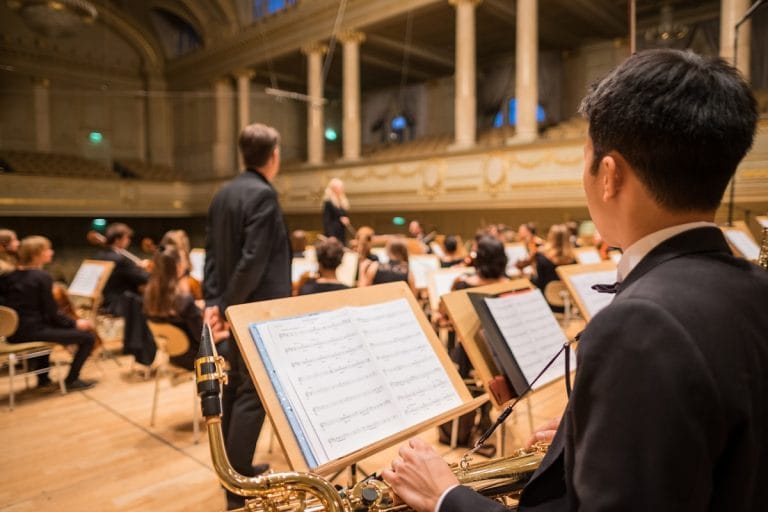
Among Berger’s most distinctive projects was the Stone Workshop Orchestra, an ensemble that performed at The Stone, the avant-garde music venue founded by John Zorn on Manhattan’s Lower East Side. The orchestra brought together musicians from different generations and traditions — conservatory-trained players alongside self-taught improvisers, jazz veterans alongside electronic experimentalists.
The performances were structured but not scripted. Berger would conduct using hand signals and gestural cues, shaping the ensemble’s dynamics in real time. The result was music that sounded composed and spontaneous simultaneously — a direct extension of the CMS philosophy applied to large-ensemble performance.
Recognition and Legacy
Berger received grants from the National Endowment for the Arts and a Guggenheim Fellowship for his work in composition and music education. He recorded more than twenty albums as a leader or co-leader, including collaborations with Don Cherry, Dave Holland, and Lee Konitz.
His influence is harder to measure in recordings than in people. Musicians who studied at CMS — including Pat Metheny, John Zorn, and Marilyn Crispell — carried Berger’s emphasis on listening and collective creativity into their own careers. Contemporary jazz artists who prioritize ensemble interaction over individual virtuosity owe a philosophical debt to the approach Berger spent a lifetime developing.
Essential Listening
We Are You (1971, ESP-Disk) — Berger’s debut as a leader. Vibraphone and piano duets with bassist Dave Holland. Spare, conversational, and surprisingly lyrical for a free jazz record.
Oral Tradition / Live at the Donaueschingen Music Festival (1998) — A large-ensemble recording that captures the CMS approach at scale. Conducted improvisation with twenty-plus musicians, balancing structure and freedom.
Stillpoint (2003, Tzadik) — Late-career work on John Zorn’s label. Berger on vibraphone and piano with Ingrid Sertso on vocals. Meditative, patient, and deeply personal.