
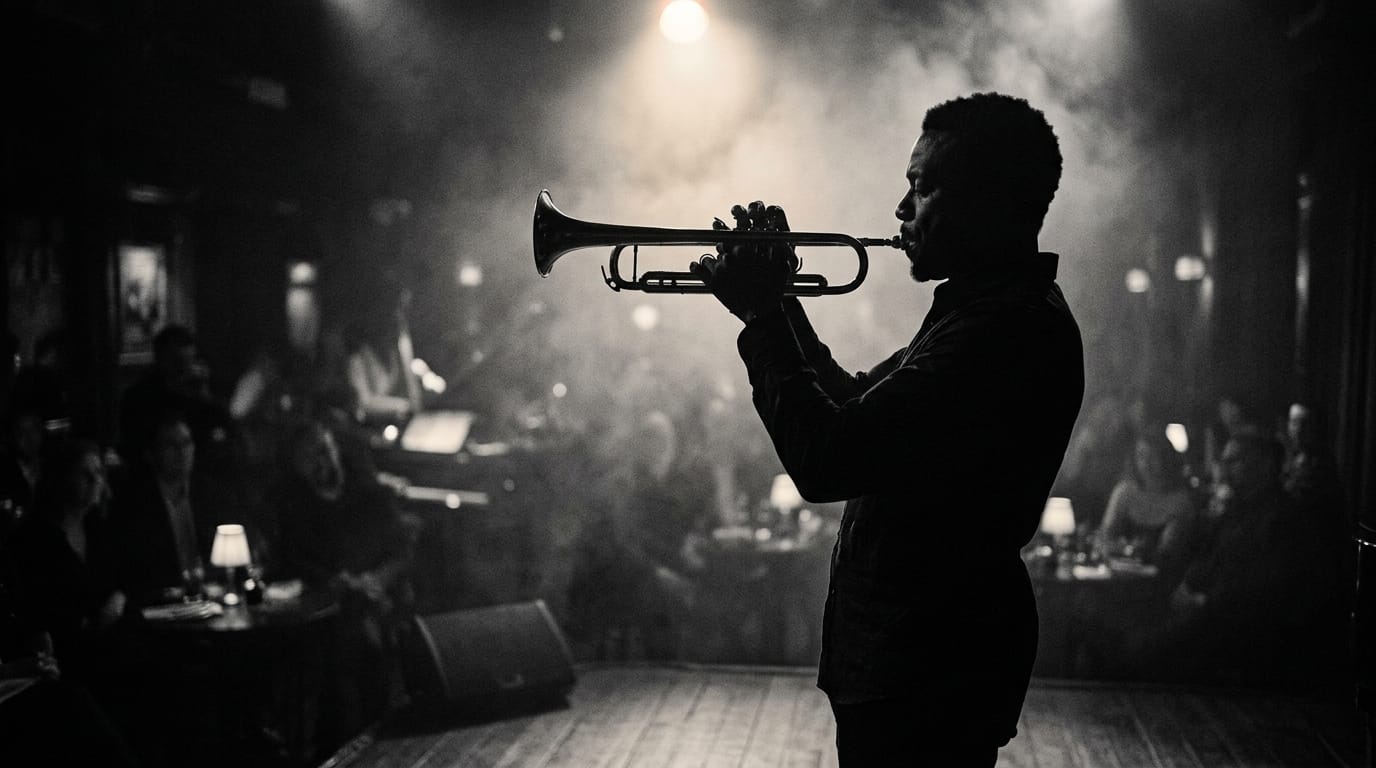
Miles Davis Quotes: 30 Memorable Quotes from the Prince of Darkness
These 30 Miles Davis quotes all have a source you can check: his 1989 autobiography, interviews and articles in Playboy, The Jazz Review, Jet and the International Herald Tribune, and first-hand accounts from musicians who played in his bands. The source is given with every quote. Popular lines that circulate on quote sites without any traceable origin are not in the list; they are covered in a separate section near the end.
Table of Contents
- Miles Davis Quotes About Music, Space and Silence
- On Jazz, Change and Being Called a Legend
- On Practice, Sound and Attitude
- On Creativity, Style and Life
- On Race and Respect
- On Other Musicians
- Popular Miles Davis Quotes With No Traceable Source
- Frequently Asked Questions
- What is Miles Davis’s most famous quote?
- Where does “the note is only 20 percent” come from?
- Did Miles Davis say “Don’t play what’s there, play what’s not there”?
- Which book has the most Miles Davis quotes in his own words?
Davis was born in Alton, Illinois, on May 26, 1926, and died in Santa Monica, California, on September 28, 1991. Writers began calling him the Prince of Darkness in album liner notes of the 1950s, and the name stuck. His most complete record in his own words is Miles: The Autobiography (Simon & Schuster, 1989), written with poet and journalist Quincy Troupe, who had interviewed him for Spin in 1985. For the life story itself, see our Miles Davis biography.

Miles Davis Quotes About Music, Space and Silence
- “Don’t play what’s there, play what’s not there.” Reported by bassist Dave Holland in Ian Carr’s Miles Davis: A Critical Biography (1982) and repeated in The Christian Science Monitor in October 1991. Holland explained it as Davis telling him not to play what his fingers fell into, but to play the next thing.
- “I know what the power of silence is… I would take my mute off the microphone, and I would play something so soft that you could hardly hear it.” Said to Julie Coryell for Jazz-Rock Fusion: The People, The Music (1978), and quoted in Jack Chambers’s biography Milestones. He was describing how he played to loud club audiences.
- “I always listen to what I can leave out.” Davis on how he listened to his own music, quoted by Amiri Baraka in The Music: Reflections on Jazz and Blues (1987). The original interview is not identified, but the line was in print by 1986.
- “I think a movement in jazz is beginning away from the conventional string of chords, and a return to emphasis on melodic rather than harmonic variation. There will be fewer chords but infinite possibilities as to what to do with them.” From Nat Hentoff’s “An Afternoon with Miles Davis,” The Jazz Review, December 1958, a few months before the Kind of Blue sessions. It is the clearest statement in his own words of the idea behind modal jazz.
- “Good music is good no matter what kind of music it is. And I always hated categories.” Miles: The Autobiography (1989), in a passage arguing that music should have no boundaries.
- “I’ll play it and tell you what it is later.” Studio talk from the 1956 Prestige sessions that produced Relaxin’ with the Miles Davis Quintet (released 1958). John Szwed’s biography So What (2002) describes it as his answer to an unheard question from producer Bob Weinstock. Quote sites often add the word “first,” which Szwed’s version does not have.
- “The thing to judge in any jazz artist is does the man project, and does he have ideas.” Playboy, September 1962, in the interview by Alex Haley that launched the magazine’s long-form interview series. He was refusing to rank other trumpet players.
On Jazz, Change and Being Called a Legend
- “I never thought that the music called ‘jazz’ was ever meant to reach just a small group of people, or become a museum thing locked under glass like all other dead things that were once considered artistic.” Miles: The Autobiography (1989). It is part of a longer argument against the idea that the fewer people who hear you, the better you are.
- “Bebop was about change, about evolution. It wasn’t about standing still and becoming safe. If anybody wants to keep creating they have to be about change.” Miles: The Autobiography (1989). Online versions often start with “It’s not about standing still,” which drops the subject: he was talking about bebop and what it stood for.
- “A legend is an old man with a cane known for what he used to do. I’m still doing it.” Said to journalist Mike Zwerin, who printed it in the International Herald Tribune on July 17, 1991. The Yale Book of Quotations (2006) lists it under Davis.
- “I know what I’ve done for music, but don’t call me a legend. Just call me Miles Davis.” Jet, June 9, 1986, two weeks after his 60th birthday.
- “For me, the urgency to play and create music today is worse than when I started. It’s more intense. It’s like a curse.” From near the end of Miles: The Autobiography (1989). The short version that circulates, “I have to change. It’s like a curse,” appears in later books without a primary source.
On Practice, Sound and Attitude
- “He don’t have a sound of his own. He copies everybody’s sound, and you don’t want to do that. You want to be your own man, have your own sound.” Davis quoting his father, a dentist, about a mockingbird outside the window, in Miles: The Autobiography (1989).
- “Anybody can play. The note is only 20 percent. The attitude of the motherfucker who plays it is 80 percent.” Paul Tingen’s Miles Beyond: The Electric Explorations of Miles Davis, 1967-1991 (2001) says Davis told this to percussionist James Mtume, who played in his band from 1971 to 1975. It is a secondhand account, and the only printed source we found for the line.
- “That’s what I tell all my musicians; I tell them be ready to play what you know and play above what you know.” Quoted by Leonard Feather in The Encyclopedia of Jazz in the Seventies (1976) and in Ian Carr’s 1982 biography. The short form, “Play what you know and play above what you know,” is often listed as unsourced, but this is where it comes from.
- “Don’t play the butter notes.” Herbie Hancock, who joined Davis’s quintet in 1963, told this story in his first Norton lecture at Harvard in February 2014, as reported by The Boston Globe. Davis leaned over and said it during a gig at Lennie’s on the Turnpike in Peabody, Massachusetts. Hancock took butter to mean the obvious notes and started leaving the thirds and sevenths out of his chords.
On Creativity, Style and Life
- “I’m always thinking about creating. My future starts when I wake up every morning… Every day I find something creative to do with my life.” Miles: The Autobiography (1989). The version on quote sites joins the first and last lines of a longer passage about waking up, seeing the first light and feeling grateful.
- “When you’re creating your own shit, man, even the sky ain’t the limit.” Miles: The Autobiography (1989).
- “For me, music and life are all about style.” Miles: The Autobiography (1989). He goes on to compare it with picking a certain pair of shoes, shirt or coat to look and feel a certain way.
- “Knowledge is freedom and ignorance is slavery, and I just couldn’t believe someone could be that close to freedom and not take advantage of it.” Miles: The Autobiography (1989), on going to the library to borrow scores by Stravinsky, Alban Berg and Prokofiev.
- “If you understood everything I said, you’d be me.” Quoted in The Independent (London) on October 6, 1991, the source given by The Yale Book of Quotations. The interview collection Miles on Miles (2009) has it as part of a conversation in which he brushes off questions about himself.
On Race and Respect
- “In high school, I was the best in the music class on the trumpet… all the contest first prizes went to the boys with blue eyes. It made me so mad I made up my mind to outdo anybody white on my horn.” Playboy, September 1962. Much of that interview is about racism in clubs, in the record business and on television.
- “…changed my whole life and my whole attitude again, made me bitter and cynical again when I was really starting to feel good about the things that had changed in this country.” Miles: The Autobiography (1989), about the night in August 1959 when a police officer told him to move on outside Birdland, where he was working. When he refused, he was arrested and beaten over the head and needed five stitches. He was acquitted by January 1960.
- “It’s like, how did Columbus discover America when the Indians were already here? What kind of shit is that, but white people’s shit?” Miles: The Autobiography (1989). He wrote it right after describing a singer who bled to death after an accident on a Mississippi back road because no white hospital would take her in. That matches the long-told story of Bessie Smith’s death, which historians have since discredited.
- “Well, I’ve changed music five or six times…” and “Now, tell me what have you done of any importance other than be white, and that ain’t important to me, so tell me what your claim to fame is?” Miles: The Autobiography (1989), his reply to a white woman at the White House in 1987 who asked what he had done to be invited. The shorter version often quoted (“I’ve changed music four or five times”) comes from John Szwed’s retelling in So What (2002).

On Other Musicians
- “The greatest feeling I ever had in my life, with my clothes on, was when I first heard Diz and Bird together in St. Louis, Missouri, back in 1944.” The opening of Miles: The Autobiography (1989), about hearing Dizzy Gillespie and Charlie Parker with Billy Eckstine’s band.
- “You can’t play anything on a horn that Louis hasn’t played.” Davis to Nat Hentoff in The Jazz Review (1958). Four years later he told Playboy, “I love Pops,” while objecting to Armstrong’s digs at modern jazz. For Armstrong in his own words, see our collection of Louis Armstrong quotes.
- “He never wasted a melody. He never wasted a phrase. He and Duke Ellington changed the whole sound.” On arranger Gil Evans after Evans died on March 20, 1988, as quoted in the booklet of Miles Davis and Gil Evans: The Complete Columbia Studio Recordings (1996) and in Leonard Feather and Ira Gitler’s The Biographical Encyclopedia of Jazz (1999).
- “But Jimi Hendrix came from the blues, like me. We understood each other right away because of that. He was a great blues guitarist.” Miles: The Autobiography (1989). Hendrix and Sly Stone were among the musicians Davis listened to as he moved toward jazz fusion, and plans to record with Hendrix ended with the guitarist’s death.
- “But Prince got some Marvin Gaye and Jimi Hendrix and Sly in him, also, even Little Richard. He’s a mixture of all those guys and Duke Ellington.” Miles: The Autobiography (1989).
A much-repeated Davis story about John Coltrane is harder to pin down. When Coltrane said he did not know how to stop a long solo, Davis told him to try taking the horn out of his mouth. Books give at least four different wordings, so treat it as an anecdote rather than an exact quote.
Popular Miles Davis Quotes With No Traceable Source
We checked the following against full-text searches of the autobiography, the Carr and Szwed biographies and the interview collections The Miles Davis Companion (1996) and Miles on Miles (2009). They turn up only in quote anthologies and self-help books, so they are not in the list above:
- The line telling you not to fear mistakes because there are none.
- The line saying it is not the note you play that is wrong, but the note you play afterwards that makes it right or wrong.
- Both versions of the idea that it takes a long time to sound, or play, like yourself. The documented version of that idea is his father’s mockingbird advice.
- Learn your instrument, then forget all that and just play. Books usually credit this to Charlie Parker.
- Clothes being like a beat, and the record business taking your music and giving you back a Cadillac.
To hear the music behind these words, start with our ranking of the best Miles Davis albums.
Frequently Asked Questions
What is Miles Davis’s most famous quote?
Among the best known are “Don’t play what’s there, play what’s not there,” reported by bassist Dave Holland in Ian Carr’s 1982 biography; “A legend is an old man with a cane known for what he used to do. I’m still doing it,” printed in the International Herald Tribune in July 1991; and the line that the note is only 20 percent and the attitude 80 percent, which Paul Tingen’s book Miles Beyond (2001) traces to percussionist James Mtume.
Where does “the note is only 20 percent” come from?
The earliest source we found is Paul Tingen’s Miles Beyond: The Electric Explorations of Miles Davis, 1967-1991 (Billboard Books, 2001). Tingen writes that Davis told percussionist James Mtume in the 1970s: “Anybody can play. The note is only 20 percent. The attitude of the motherfucker who plays it is 80 percent.” It is a secondhand account, not a recorded interview.
Did Miles Davis say “Don’t play what’s there, play what’s not there”?
It comes to us through bassist Dave Holland, who quoted Davis’s advice in Ian Carr’s Miles Davis: A Critical Biography (1982). Holland explained it as an instruction not to play the notes your fingers fall into on a chord, but to play the next thing. The Christian Science Monitor repeated Holland’s account in October 1991.
Which book has the most Miles Davis quotes in his own words?
Miles: The Autobiography (Simon & Schuster, 1989), written with Quincy Troupe, is the main source. It won an American Book Award in 1990. For interviews, The Miles Davis Companion (1996), edited by Gary Carner, and Miles on Miles (2009), edited by Paul Maher and Michael K. Dorr, reprint pieces from Playboy, The Jazz Review and other magazines.