New Orleans Jazz Fest: Dates, Tickets, Stages, and What to Know
The New Orleans Jazz & Heritage Festival, better known as Jazz Fest, runs over two Thursday-to-Sunday weekends at the end of April and the start of May at the Fair Grounds Race Course, 1751 Gentilly Boulevard, New Orleans. The next edition is scheduled for April 22-25 and April 29-May 2, 2027, with gates open from 11 a.m. to 7 p.m. each day. Tickets are sold on nojazzfest.com and go on sale when the lineup is announced, and everything on the grounds is paid for by card or phone because the festival is cashless.
Table of Contents
- When Is Jazz Fest?
- Where Is Jazz Fest? The Fair Grounds Race Course
- The Stages and the Music
- The 2026 Lineup
- Jazz Fest Tickets
- Getting to the Fair Grounds
- Where to Stay
- What to Eat at Jazz Fest
- Tips for a First Visit
- A Short History of Jazz Fest
- Frequently Asked Questions
- When is the next New Orleans Jazz Fest?
- When do Jazz Fest tickets go on sale?
- Is Jazz Fest only jazz?
- Can you pay with cash at Jazz Fest?
- What is the best way to get to Jazz Fest?
| Jazz Fest at a glance | |
|---|---|
| Next edition | April 22-25 and April 29-May 2, 2027 |
| Daily hours | 11 a.m. to 7 p.m. (last admission 6:30 p.m.) |
| Venue | Fair Grounds Race Course, 1751 Gentilly Blvd., New Orleans |
| Tickets | nojazzfest.com, on sale with the lineup announcement |
| Payment | Cashless: cards and mobile payments only |
| Shuttle | Jazz Fest Express from four departure points |
| Official host hotel | Sheraton New Orleans, 500 Canal St. |
When Is Jazz Fest?
Jazz Fest keeps the same shape every year: two four-day weekends, Thursday through Sunday, covering the last weekend of April and the first weekend of May. The festival has confirmed Thursday, April 22 to Sunday, April 25 and Thursday, April 29 to Sunday, May 2 for 2027. The 2026 edition ran April 23-26 and April 30-May 3.
The lineup is announced months in advance, but the day-by-day grid of stages and set times, known as “the cubes,” usually appears about a month before the festival on nojazzfest.com and in the free official app. If you can only attend one weekend, the festival’s own advice is that it spreads the music evenly over both, so choose by the acts on each day rather than by which weekend has the bigger reputation.
Where Is Jazz Fest? The Fair Grounds Race Course
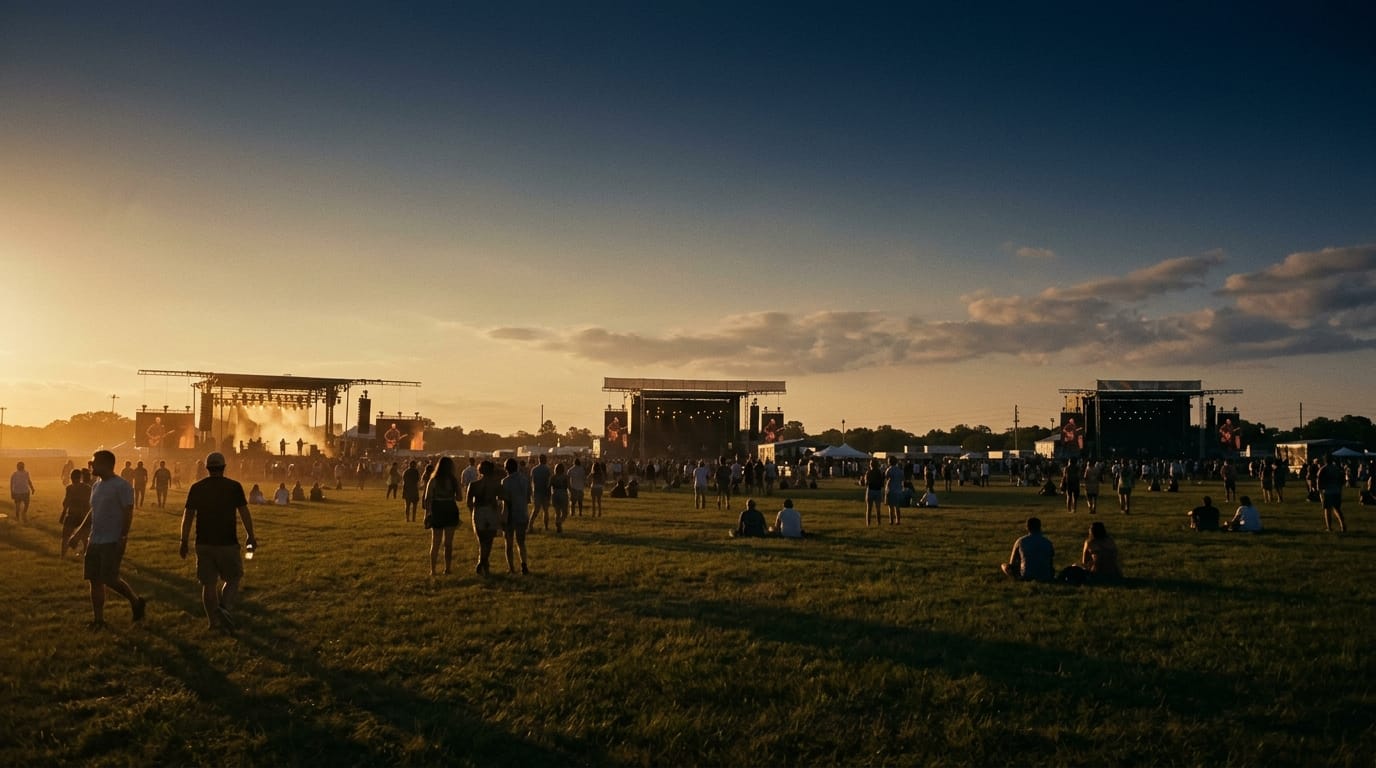
The festival moved to the infield of the Fair Grounds Race Course in 1972 and now uses the whole 145-acre site. The Fair Grounds is a working thoroughbred track that held its first race card in 1872. During the festival the stages, tents and food areas fill the infield, while the grandstand holds exhibits, air-conditioning and cold drinking water. The festival describes the location as about 10 minutes from the French Quarter. Pedestrians can enter and leave through three public gates on Gentilly Boulevard, Trafalgar Street and Sauvage Street.
The Stages and the Music
Despite the name, Jazz Fest programs every style tied to New Orleans and Louisiana: blues, R&B, gospel, Cajun, zydeco, Afro-Caribbean, folk, Latin, rock, rap, country and bluegrass, alongside traditional and contemporary jazz. The festival says 85 to 90 percent of the bands it presents are active members of the Louisiana music community, and public applications to perform are limited to bands from Louisiana. Our overview of the main styles of jazz explains the jazz labels on the schedule.
More than a dozen stages and tents run at the same time. The big outdoor stages, led by the Festival Stage, carry the headliners; in 2026 the Eagles and Stevie Nicks were both booked there. The Congo Square Stage takes its name from the square where enslaved Africans gathered on Sundays to trade, play music and dance. For jazz, the WWOZ Jazz Tent is the main room; Herbie Hancock had its closing slot on the last day of the 2026 festival. The Economy Hall Tent programs mostly traditional New Orleans bands, and its 2026 schedule included Gregg Stafford’s Jazz Hounds, Kid Simmon’s Local International Allstars and Kermit Ruffins’ Tribute to Louis Armstrong. The Gospel Tent, the Blues Tent and the Fais Do-Do Stage, which hosts Cajun and zydeco bands, each run their own program. The Allison Miner Music Heritage Stage, named after the co-founder who created it, is where musicians sit down for interviews between sets.
Music is only part of the site. Brass bands, Mardi Gras Indians and social aid and pleasure clubs parade through the grounds, the Louisiana Folklife Village and the Native American Village present craft and cultural traditions, and three craft markets sell work by local, national and international artisans. The festival’s cultural pavilion has featured places from Cuba and Haiti to Mali and Brazil; in 2026 the focus was Jamaica.
The 2026 Lineup
The first weekend of the 2026 bill included Kings of Leon and Raye on Thursday, Jon Batiste and Lorde on Friday, Stevie Nicks, Tyler Childers and Nas on Saturday, and Rod Stewart, David Byrne, St. Vincent and The Isley Brothers on Sunday. The second weekend brought Widespread Panic and Lake Street Dive on Thursday, Lainey Wilson and The Black Keys on Friday, the Eagles, Alabama Shakes and T-Pain on Saturday, and Teddy Swims, Earth, Wind & Fire and Tedeschi Trucks Band on the closing Sunday, when Trombone Shorty & Orleans Avenue had the closing slot on the Festival Stage.
The jazz program went deeper than the headliners. Herbie Hancock, the Ron Carter Quartet, Dianne Reeves and Hiromi’s Sonicwonder were on the bill, along with the Preservation Hall Jazz Band, Nicholas Payton with Butcher Brown, Delfeayo Marsalis & The Uptown Jazz Orchestra and Dr. Michael White’s Original Liberty Jazz Band. New Orleans trumpeter Terence Blanchard and saxophonist Ravi Coltrane presented a centennial program for Miles Davis and John Coltrane, both born in 1926 (our Miles Davis biography covers his side of that story). Irma Thomas was booked for both weekends, the second time with a gospel set, and the Jamaica focus brought Monty Alexander’s “Jamericana,” Burning Spear, The Skatalites and Ziggy Marley. The full 2026 lineup by day is still posted on the official music page, and every performer since 1970 can be searched in the Jazz Fest Database, compiled from the festival’s program books.
Jazz Fest Tickets
Tickets are sold through nojazzfest.com and go on sale together with the lineup announcement; for 2027, the official tickets page says they will be available once the lineup is out. The festival’s newsletter and SMS list carry the on-sale date. Besides general admission there are VIP packages, and three of them, Big Chief, Grand Marshal and Krewe of Jazz Fest, are the only way to pre-purchase parking on the festival grounds.
Buy through the official site rather than from unofficial resellers. Patrons with disabilities can use the festival’s Access Program; a limited number of parking spaces for people with disabilities is sold at the Horseman’s Gate on Gentilly Boulevard on a first-come, first-served basis.
Getting to the Fair Grounds
The Jazz Fest Express is the only shuttle that drops off and picks up inside the festival gates. It runs on all eight festival days from 10:30 a.m. to 7:30 p.m. (or until the grounds are empty) between the Fair Grounds and four departure points: the Steamboat Natchez dock at 400 Toulouse Street in the French Quarter, the Sheraton New Orleans at 500 Canal Street, the Hyatt Regency at 601 Loyola Avenue, and the Wisner lot at 5700 Wisner Boulevard in City Park, where parking is included. Round-trip tickets are sold at the departure points, and a one-way pass is available at the Fair Grounds when you leave.
Rideshare cars are not allowed to drop off or pick up inside a perimeter around the Fair Grounds, so check the festival’s transportation map for the designated pick-up zone. Taxi stands are at Stallings Playground on Gentilly Boulevard, across from the entrance, and at Walter Wolfman Washington Memorial Park on Esplanade Avenue at Mystery Street. Free bike parking is available near the Gentilly Boulevard and Sauvage Street gates; do not lock bikes to fences. Driving is the weakest option: there is no general parking on site, and parking in the surrounding neighborhood is restricted to residents. Streetcar and bus information is linked from the official FAQ.
Where to Stay
Hotel demand during Jazz Fest is high. The festival advises booking as early as possible, noting that some hotels take reservations a year ahead and that many visitors book in the fall before the festival. Its official host hotel is the Sheraton New Orleans on Canal Street, which is also a shuttle departure point, and nojazzfest.com links to a hotel directory.
Hotels in the French Quarter and along Canal Street and Loyola Avenue sit close to three of the four Jazz Fest Express stops. A rental in the residential streets around the Fair Grounds lets you walk to a gate, but you cannot park there during the festival.
What to Eat at Jazz Fest
The festival’s rule is no “carnival” food: vendors must be full-time Louisiana residents, dishes are rarely duplicated, and openings for new vendors are rare. The menu runs to more than 200 items spread over Food Area 1, Food Area 2, Congo Square, Heritage Square and the Grandstand, and vegetarian items are marked on the official food list.
Dishes on the 2026 menu included Crawfish Monica, the cochon de lait po-boy from Walker’s BBQ / Love At First Bite, the pheasant, quail and andouille gumbo from Prejean’s Restaurant in Lafayette, the fried soft-shell crab po-boy from The Galley in Metairie, ya-ka-mein from Ms. Linda’s Catering, strawberry lemonade in Heritage Square, and the mango freeze sold by community radio station WWOZ. There is also a vegan soul food stand. Every food, drink, craft and merchandise booth takes cards and mobile payments, and none takes cash.
Tips for a First Visit
Dress for sun. There are a few shade trees on the Fair Grounds, but the infield is mostly open, so the festival recommends a wide-brimmed hat, sunglasses, sunscreen, light clothing and comfortable shoes for a lot of walking. Keep drinking water through the day. The tents on the infield and in Heritage Square give shade, and the grandstand has air-conditioning and cold water.
Expect a security screening at the gate with bag checks and metal detectors, and read the prohibited-items list on nojazzfest.com before you pack. Download the free official app, which carries the schedule and any emergency messages. Once the cubes are out, mark the few sets you will not miss and leave the rest of the day open; with this many stages running at once, some of the best hours come from walking into a tent you had not planned on.
A Short History of Jazz Fest
George Wein, founder of the Newport Jazz Festival, was hired to design the first New Orleans Jazz & Heritage Festival, held April 22-26, 1970. Its daytime Louisiana Heritage Fair took place in Congo Square, then called Beauregard Square, with a lineup that included Mahalia Jackson, Duke Ellington, Pete Fountain, Al Hirt, Clifton Chenier, Fats Domino, The Meters and the Preservation Hall band. The festival’s founding story is the moment Wein handed Jackson a microphone and she sang along with the Eureka Brass Band as it led a second line through the grounds. About 350 people attended that first year, roughly half the number of musicians and other participants. Wein hired two young locals, Quint Davis and Allison Miner, and Davis became the festival’s main creative force.
Growth came quickly once the event moved to the Fair Grounds in 1972. Attendance reached 80,000 in 1975, the first year of the festival’s silkscreen poster series. From 1976 to 1978 the Heritage Fair ran over two full weekends, the 1979 tenth anniversary was scheduled over three, and in 1991 a Thursday was added to open the second weekend. The 2001 festival celebrated the Louis Armstrong centennial and drew more than 650,000 people in total, with a single-day record of 160,000. After Hurricane Katrina in 2005 the 2006 edition went ahead on the usual two weekends, supported by a long-term presenting sponsorship from Shell. The 2020 festival was cancelled because of the COVID-19 pandemic, a planned October 2021 edition was cancelled as well, and Jazz Fest returned in 2022.
The festival’s own history fills in more detail. Its nonprofit parent, the New Orleans Jazz & Heritage Festival and Foundation, puts festival revenue into year-round work: it runs radio station WWOZ 90.7 FM, keeps an archive of festival recordings and photographs, and operates the George & Joyce Wein Jazz & Heritage Center in Tremé, home of the Don “Moose” Jamison Heritage School of Music.
Frequently Asked Questions
When is the next New Orleans Jazz Fest?
The 2027 New Orleans Jazz & Heritage Festival runs Thursday, April 22 to Sunday, April 25 and Thursday, April 29 to Sunday, May 2, 2027, at the Fair Grounds Race Course. Gates open at 11 a.m., music ends at 7 p.m., and the last admission is at 6:30 p.m.
When do Jazz Fest tickets go on sale?
Tickets go on sale on nojazzfest.com at the same time as the lineup announcement. The festival’s newsletter and SMS list carry the on-sale date.
Is Jazz Fest only jazz?
No. It covers every style associated with New Orleans and Louisiana, from blues, gospel, Cajun and zydeco to rock and rap, with traditional and contemporary jazz in the WWOZ Jazz Tent and the Economy Hall Tent.
Can you pay with cash at Jazz Fest?
No. Jazz Fest is cashless. Ticket, food, drink, craft and merchandise booths accept credit, debit and prepaid cards and mobile payments such as Apple Pay, Google Pay and Samsung Pay.
What is the best way to get to Jazz Fest?
The Jazz Fest Express shuttle is the only shuttle that stops inside the gates. It runs from the French Quarter, the Sheraton New Orleans on Canal Street, the Hyatt Regency on Loyola Avenue and a City Park lot with parking. Rideshares must use a pick-up zone outside a perimeter around the Fair Grounds, and there is no general parking on site.