Hard Bop: How Art Blakey and the Jazz Messengers Brought Soul Back to Bebop
Hard bop is a subgenre of jazz that emerged in the mid-1950s as a deliberate intensification of bebop, fusing the harmonic complexity of bebop with the emotional directness of blues, gospel, and rhythm and blues. Rooted primarily in New York City, hard bop dominated the jazz space from roughly 1954 to the mid-1960s, producing a sound that was simultaneously sophisticated and viscerally soulful. Where bebop prized abstraction and velocity, hard bop reanchored jazz in the Black church and the blues tradition. Art Blakey and the Jazz Messengers are universally recognized as its founding ensemble.
Table of Contents
- The Jazz space Before Hard Bop
- From Swing to Bebop: Setting the Stage
- Cool Jazz and the West Coast Divergence
- The Origin Story: Mid-1950s to Mid-1960s
- Where and When Hard Bop Began
- Why Did Hard Bop Emerge When It Did?
- Who Coined the Term “Hard Bop”?
- Hard Bop Characteristics
- Rhythmic Feel: The Groove as Foundation
- Harmonic Approach: Blues and Gospel Voicings
- Improvisational Philosophy
- Melody and Composition
- Performance Context and Audience
- Key Instruments in Hard Bop
- The Standard Quintet Formation
- The Rhythm Section’s Elevated Role
- The Horn Voices
- Subgenres, Variants, and Comparisons
- Hard Bop vs. Bebop: Direct Comparison
- Soul Jazz: The Populist Offshoot
- Post-Bop: The Intellectual Extension
- Funk Jazz and the Bridge to Fusion
- West Coast Hard Bop
- The Defining Bands and Players
- Art Blakey and the Jazz Messengers
- Horace Silver
- Clifford Brown
- Sonny Rollins
- Lee Morgan
- Miles Davis (Hard Bop Phase)
- Hank Mobley
- Freddie Hubbard
- Essential Hard Bop Albums
- 1. Art Blakey and the Jazz Messengers, A Night at Birdland, Vol. 1 & 2 (Blue Note, 1954)
- 2. Art Blakey and the Jazz Messengers, Moanin’ (Blue Note, 1958)
- 3. Sonny Rollins, Saxophone Colossus (Prestige, 1956)
- 4. Miles Davis, Cookin’ with the Miles Davis Quintet (Prestige, 1957)
- 5. Horace Silver Quintet, Song for My Father (Blue Note, 1964)
- 6. Lee Morgan, The Sidewinder (Blue Note, 1964)
- 7. Hank Mobley, Soul Station (Blue Note, 1960)
- 8. Clifford Brown and Max Roach, Study in Brown (EmArcy, 1955)
- Hard Bop Theory Primer
- The Blues Scale as the Emotional Core
- ii-V-I and the Blues Form
- Gospel Voicings and the IV Chord
- Hard Bop Guitar: The Overlooked Voice
- Why Guitar Was Marginalized in Classic Hard Bop
- The Players Who Made It Work
- The Guitar’s Comeback in Later Hard Bop
- Blue Note Records and the Architecture of the Hard Bop Sound
- Alfred Lion and Max Margulis’s Recording Philosophy
- The Label as Artistic Ecosystem
- New York City’s Venues as Hard Bop Incubators
- The Key Rooms
- Why NYC? The Industry Infrastructure
- Decline, Legacy, and Continuing Influence
- What Ended the Hard Bop Era?
- Hard Bop’s Downstream Legacy
- Why Hard Bop Remains the Most-Studied Jazz Subgenre
- Frequently Asked Questions About Hard Bop
- What is hard bop?
- How is hard bop different from bebop?
- What are some essential hard bop songs?
- What is the best hard bop album to start with?
- Is hard bop still being made today?
- What hard bop is and why it emerged when it did, from the mid-1950s to the mid-1960s
- How hard bop differs from bebop, cool jazz, and West Coast jazz
- The defining musical characteristics: rhythm, harmony, melody, and feel
- The key artists, bands, and albums that shaped the genre
- Hard bop’s subgenres, variants, and the instruments that define the sound
- Where hard bop went after its peak and why it still matters today
The Jazz space Before Hard Bop
To understand hard bop, you need to understand what musicians were reacting against. Jazz didn’t arrive at hard bop in a straight line; it took two sharp turns first, through swing and then bebop, before the music found its way back to the blues.
From Swing to Bebop: Setting the Stage
The Swing Era of the 1930s gave jazz its broadest popular audience. Big bands led by Duke Ellington, Count Basie, and Benny Goodman filled ballrooms and sold records to a mass market that danced to the music. By the early 1940s, a younger generation of musicians, including Charlie Parker, Dizzy Gillespie, and Thelonious Monk, deliberately dismantled that accessibility. Bebop was their answer: small groups, breakneck tempos, dense chromatic harmonies, and a clear signal that jazz was art music, not dance music.
The trade-off was real. Bebop gained harmonic depth and artistic credibility, but it lost the danceability and the broad Black working-class audience that swing had cultivated. Tempos on bebop recordings routinely pushed into extreme ranges, and the average listener had no easy entry point. The music demanded concentration rather than participation.
Cool Jazz and the West Coast Divergence
By the early 1950s, a second divergence was underway. Miles Davis‘s Birth of the Cool sessions, recorded for Capitol between 1949 and 1950, pointed toward a lighter, more cerebral approach. On the West Coast, Gerry Mulligan, Chet Baker, and Dave Brubeck developed what critics called cool jazz: smoother tone, lighter swing feel, and a strong European classical influence. The music was undeniably sophisticated, but it carried less blues content and a noticeably cooler emotional temperature.
The racial and cultural subtext was hard to ignore. Cool jazz was largely associated with white West Coast musicians and coded as cerebral and European-influenced. For Black East Coast musicians who had grown up in the church and on R&B radio, the direction felt like a departure from jazz’s roots. That perception made the East Coast counterstatement, hard bop, historically inevitable. You can explore the broader sweep of these stylistic shifts in our guide to every jazz genre and subgenre.
The Origin Story: Mid-1950s to Mid-1960s
Hard bop didn’t arrive with a manifesto. It arrived with a live recording at a Broadway nightclub and a performance at a summer festival, two events in 1954 that together mark the genre’s founding moment.
Where and When Hard Bop Began
The geographic origin is New York City, specifically Harlem and Midtown Manhattan. The commonly cited year of emergence is 1954 to 1955, and two specific events anchor that date. First, the A Night at Birdland sessions, recorded live on February 21, 1954, at Birdland on Broadway at 52nd Street. Art Blakey’s quintet that night included Clifford Brown on trumpet, Lou Donaldson on alto saxophone, Horace Silver on piano, and Curly Russell on bass. The music was recorded by Rudy Van Gelder for Blue Note Records and released as two volumes that became the genre’s founding document.
Second, Miles Davis’s 1954 studio recording “Walkin'” served as a direct and deliberate rebuttal to cool jazz aesthetics: earthy, blues-drenched, and swinging hard. The following July, on July 17, 1955, Davis performed “‘Round Midnight” in an unbilled appearance at the Newport Jazz Festival, a performance widely credited with reviving his career and leading to his signing with Columbia Records. Together, these events defined the new direction.
Why Did Hard Bop Emerge When It Did?
The cultural context matters enormously here. The early 1950s saw an R&B boom, with Ray Charles and Muddy Waters capturing Black urban audiences that bebop had largely lost. Scholar David Rosenthal, in his study Hard Bop: Jazz & Black Music, 1955-1965, identifies R&B rather than cool jazz as the chronological bridge between bebop and hard bop in Black communities. Young jazz musicians were listening to R&B, absorbing its blues-gospel fusion, and bringing that energy back into the jazz context.
Writer James Lincoln Collier framed hard bop as an attempt to re-center jazz as African American cultural expression, to put the soul back in without sacrificing the harmonic sophistication bebop had earned. Both framings are correct, and they reinforce each other. Hard bop wasn’t a retreat from complexity; it was a reconnection with community.
Who Coined the Term “Hard Bop”?
No single person coined the term. It surfaced organically in trade publications like DownBeat and Metronome in the mid-1950s as critics sought a label for the new direction coming out of New York. Notably, musicians themselves rarely used it. The label was a critical convenience, not a musician’s declaration.
Hard Bop Characteristics
Hard bop has a sound you recognize immediately, even if you can’t name it. The groove hits harder, the melodies stick in your head, and the solos feel like they’re telling you something rather than just demonstrating technique. Here’s what’s actually happening musically.
Rhythmic Feel: The Groove as Foundation
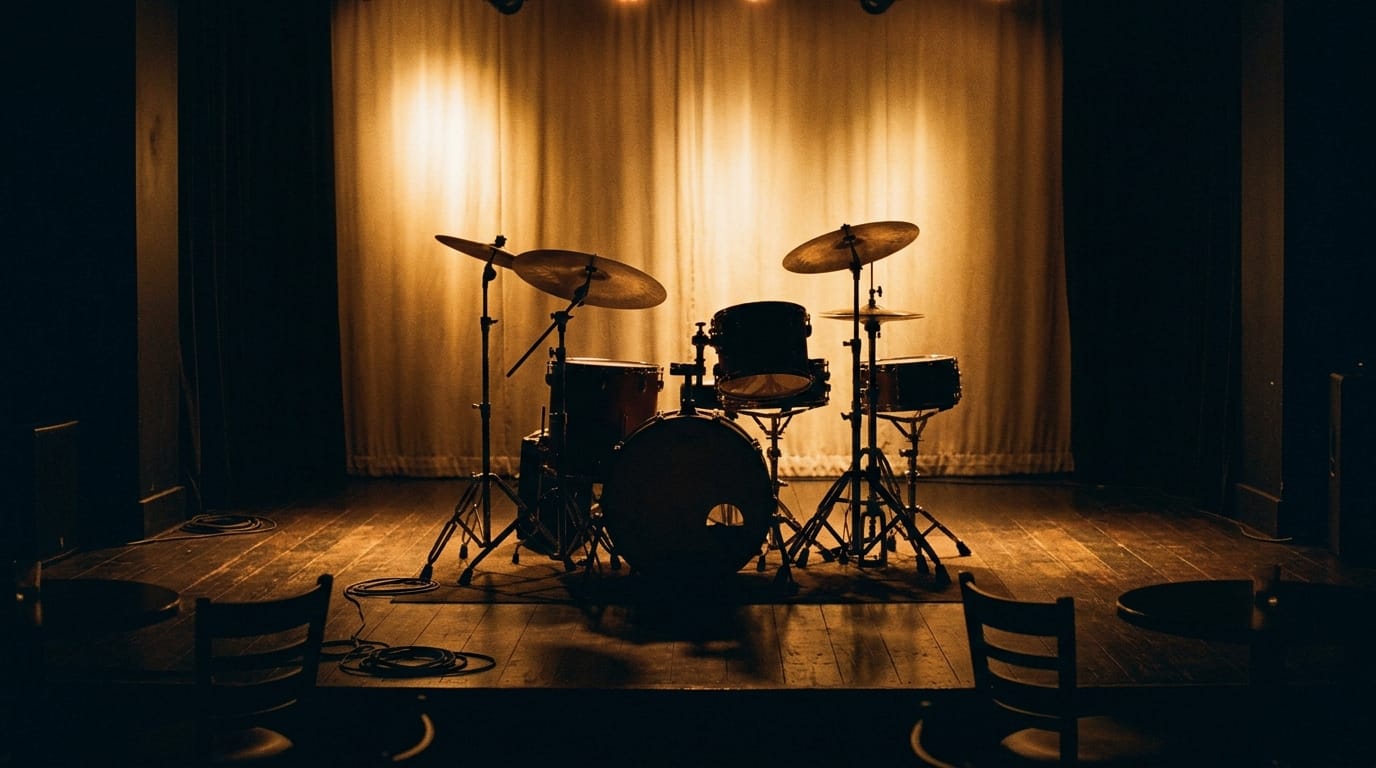
The most immediate difference between bebop and hard bop is rhythmic. Bebop drummers kept time with a light, flowing ride cymbal pattern, staying out of the soloist’s way. Hard bop drummers, led by Art Blakey, moved toward a heavier, more accented swing feel. The bass drum came back into play for emphatic accents, what musicians call “bombs,” punctuating phrases and driving the ensemble forward rather than simply marking time.
Tempos shifted too. Mid-tempo groove tracks in roughly the 100 to 160 BPM range became as central to the hard bop repertoire as fast bebop showpieces. This wasn’t a slowdown; it was a recalibration toward a feel that listeners could physically connect with. The backbeat emphasis, borrowed directly from gospel and R&B, gave audiences a rhythmic anchor that bebop had deliberately removed. Blakey’s signature “press roll,” a sustained snare technique that builds tension before a phrase, became one of the genre’s most recognizable devices.
Harmonic Approach: Blues and Gospel Voicings
Hard bop retained bebop’s core harmonic language, the ii-V-I progression (a minor seventh chord moving to a dominant seventh chord resolving to a major seventh chord) that gives jazz its characteristic forward motion. But hard bop filtered that language through blues-inflected voicings and gospel chord movements. Horace Silver was the primary architect of this synthesis, introducing IV-I resolutions and pentatonic scale patterns over bebop changes that gave the music a church-rooted warmth bebop had avoided.
Melodic heads became simpler and more song-like compared to bebop’s “contrafact” complexity, where composers wrote new melodies over borrowed chord changes at high speed. Hard bop composers wrote themes you could actually remember. By the late 1950s, modal elements began appearing in hard bop recordings as well, reflecting cross-pollination with Miles Davis’s modal experiments, though the blues foundation remained the emotional core.
Improvisational Philosophy
Bebop improvisation prized maximum harmonic density: “running the changes” at high velocity, hitting every chord tone and chromatic alteration as fast as possible. Hard bop valued something different. The storytelling arc of a solo mattered as much as its harmonic content. Space and silence became deliberate tools. A hard bop soloist might sit on a single rhythmic idea for several bars, developing it motivically before moving on, rather than sprinting through the chord changes.
Blues feeling came back into solos in a direct way: bent notes, call-and-response phrasing, the kind of vocal quality that connects jazz improvisation to its African American roots. Sonny Rollins’s approach to motivic development, building an entire solo from a single rhythmic or melodic cell, became a textbook example of hard bop’s improvisational philosophy. His work on Saxophone Colossus remains the clearest demonstration of this approach in the recorded canon.
Melody and Composition
Hard bop composers wrote structured, memorable heads. The standard form, intro-head-solos-head-outro, became the genre’s architecture. Bobby Timmons’s “Moanin'” from 1958 is the canonical example: a gospel piano vamp so irresistible it practically demands a physical response, followed by a simple but perfectly constructed melody. Horace Silver’s “The Preacher,” recorded in 1955, was one of the first definitive hard bop compositions, its blues-rooted simplicity a direct statement of intent. Silver’s later “Song for My Father” demonstrates how far that compositional aesthetic could travel while staying true to its roots.
Performance Context and Audience
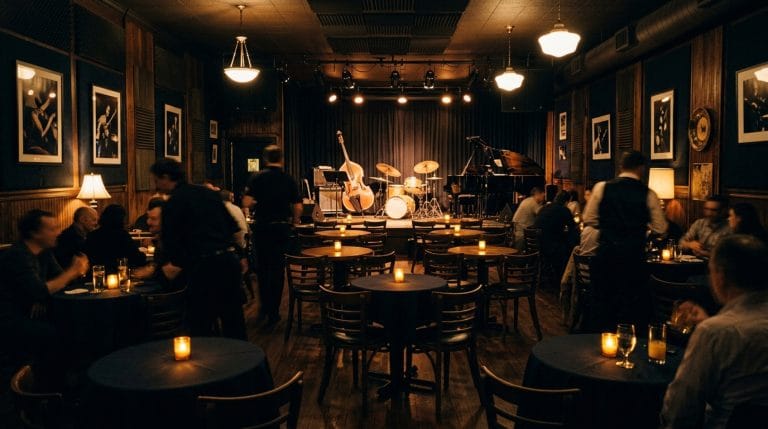
Hard bop was primarily a small-group, live-performance genre. Quintets and quartets played nightclubs rather than concert halls, maintaining jazz’s communal and participatory character. This matters. The nightclub setting kept musicians in direct contact with their audience, and that contact shaped the music. Hard bop explicitly rejected the academic concert-music aspirations of Third Stream jazz, a contemporaneous movement that sought to merge jazz with European classical composition. Hard bop went the other direction entirely, back toward the people.
Key Instruments in Hard Bop
The instrumentation of hard bop isn’t accidental. Each instrument in the standard lineup serves a specific function, and the way those functions changed from bebop to hard bop tells you a lot about what the music was trying to do.
The Standard Quintet Formation
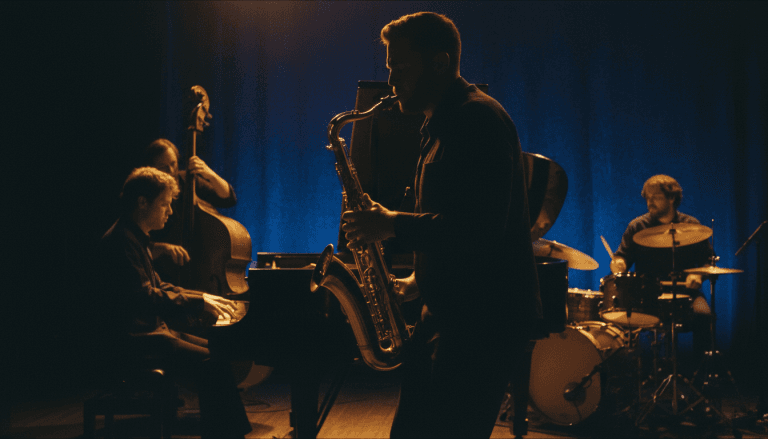
The canonical hard bop lineup is trumpet and tenor saxophone on the front line, supported by piano, upright bass, and drums. The two-horn front line allowed for contrapuntal ensemble interplay, with the trumpet and saxophone trading phrases, harmonizing, or playing in unison, without requiring the size of a big band. This was a deliberate choice. Bebop had often centered on a single alto saxophone (the Charlie Parker model), but hard bop’s two-horn front line created a richer, more orchestral sound from a small group.
The Rhythm Section’s Elevated Role
Hard bop elevated the rhythm section from accompaniment to co-equal voice. The drum chair became a featured position in its own right. Art Blakey, Max Roach, Philly Joe Jones, and Elvin Jones weren’t just keeping time; they were shaping the emotional arc of every performance. The piano took on a dual role, comping behind soloists with gospel block chords and bluesy left-hand bass lines, then stepping forward as a featured solo voice. The upright bass walked steady time but increasingly took on melodic solo responsibilities as well.
The Horn Voices
The trumpet maintained bebop’s lyrical and harmonic role but with more blues inflection and a darker, warmer tone. Clifford Brown, Lee Morgan, and Freddie Hubbard each brought a singing quality to the instrument that bebop’s more angular approach had sometimes sacrificed. The tenor saxophone became the prestige hard bop voice: big, warm, and blues-rooted in a way the alto saxophone wasn’t. Sonny Rollins, John Coltrane, Hank Mobley, and Joe Henderson each defined a different facet of what the tenor could do in this context.
| Instrument | Bebop Role | Hard Bop Role |
|---|---|---|
| Drums | Light ride cymbal, time-keeping | Heavy groove, bass drum accents, featured voice |
| Piano | Sparse comping, fast runs | Gospel voicings, bluesy bass lines, dual role |
| Bass | Walking time | Walking time plus melodic solo voice |
| Trumpet | Fast, angular melodic lines | Soulful, blues-inflected phrasing |
| Saxophone | Alto-led (Parker model) | Tenor-led, warm and muscular tone |
Subgenres, Variants, and Comparisons
Hard bop didn’t exist in isolation. It generated offshoots, absorbed influences from adjacent styles, and eventually fed into the next generation of jazz forms. Understanding these relationships clarifies what hard bop actually was and what it became.
Hard Bop vs. Bebop: Direct Comparison
Hard bop and bebop share the same DNA: ii-V-I harmonic language, virtuosic improvisation, and small-group format. The differences are real but not absolute. Hard bop’s average tempos were slower, its melodic heads more accessible, its rhythmic feel heavier, and its blues and gospel influences far more prominent. The intent diverged most sharply: bebop was artistic emancipation from commercialism, while hard bop sought reconnection with the Black community without sacrificing artistic complexity. Let’s be honest, that’s a harder balance to strike, and not every hard bop recording achieves it.
| Characteristic | Bebop | Hard Bop |
|---|---|---|
| Era | Early to mid-1940s | Mid-1950s to mid-1960s |
| Typical tempo | Very fast | Mid-to-fast range |
| Primary influences | European harmony, Afro-Cuban | Blues, gospel, R&B |
| Melodic complexity | Highly abstract, chromatic | More song-like, blues-rooted |
| Audience intent | Art music | Community music and art music |
| Key figures | Parker, Gillespie, Monk | Blakey, Silver, Brown, Rollins |
For a deeper look at bebop’s foundations, our complete guide to bebop jazz covers the style’s origins, key recordings, and defining techniques in full.
Soul Jazz: The Populist Offshoot
Soul jazz pushed hard bop’s blues and gospel elements further toward R&B, simplifying harmonies for maximum danceability and centering the Hammond B-3 organ as the lead voice. Jimmy Smith, Ramsey Lewis, and Wes Montgomery all worked in this territory. Soul jazz emerged roughly between the mid-1950s and mid-1960s and became hard bop’s most commercially successful variant, reaching audiences that the harder-edged quintet format never quite touched.
Post-Bop: The Intellectual Extension
Post-bop retained hard bop’s intensity but absorbed modal jazz and free jazz elements, producing a more harmonically open and rhythmically complex music. Wayne Shorter, Herbie Hancock, and the later work of John Coltrane all fall into this territory. Post-bop emerged from the mid-1960s onward as hard bop’s most intellectually ambitious descendant, and it remains the dominant framework for serious jazz composition today.
Funk Jazz and the Bridge to Fusion
Hard bop’s rhythmic emphasis created a direct pathway to jazz-funk and fusion in the 1970s. Art Blakey’s later Jazz Messengers lineups from the mid-1960s onward bridge the eras, incorporating funkier grooves and electric textures while maintaining the ensemble discipline of classic hard bop. Miles Davis’s electric period drew directly on this rhythmic inheritance.
West Coast Hard Bop
Hard bop was primarily an East Coast phenomenon, but West Coast players developed parallel strands. Harold Land, who played tenor saxophone with the Clifford Brown-Max Roach Quintet before returning to California, and bassist Curtis Counce both led groups in Los Angeles during the late 1950s that brought hard bop’s blues intensity to the West Coast scene. Their work complicates any simple East-West binary and shows how widely the style’s influence spread.
The Defining Bands and Players
Hard bop produced a remarkable concentration of talent in a short period. These are the artists and groups whose recordings define the genre, each contributing something irreplaceable to the canon.
Art Blakey and the Jazz Messengers
Art Blakey co-founded the Jazz Messengers with Horace Silver in 1954 and assumed full leadership by 1956. His drums were the genre’s defining rhythmic voice: the press roll, the polyrhythmic African influences he absorbed during a period of study in West Africa in the late 1940s, the sheer physical force of his playing. The Messengers functioned as what musicians called a “jazz university,” with alumni including Lee Morgan, Wayne Shorter, Freddie Hubbard, Keith Jarrett, and Wynton Marsalis. The Jazz Messengers released a remarkable body of work across multiple labels, and Blakey received the Grammy Lifetime Achievement Award in 2005. Canonical recording: Moanin’ (Blue Note, 1958).
Horace Silver
Silver co-founded the original Jazz Messengers and left to lead his own quintet in 1956. As a pianist and composer, he defined hard bop’s gospel-blues compositional language more completely than anyone else. His voicings had a funky, churchy quality that made even complex harmonic ideas feel immediately accessible. The series of Blue Note albums Silver recorded established him as one of jazz’s major composer-pianists. “The Preacher,” recorded in 1955, stands as one of the first definitive hard bop compositions. Canonical recording: Song for My Father (Blue Note, 1964).
Clifford Brown
Clifford Brown was a trumpet prodigy who co-led the Brown-Roach Quintet with drummer Max Roach from 1954 to 1956. His tone was warm and singing, technically flawless without ever sounding cold. Every hard bop trumpet player who followed him, from Lee Morgan to Freddie Hubbard, worked in his shadow. Brown died at age 25 in a car crash in June 1956, leaving behind four years of recordings that remain among the most admired in jazz history. Canonical recording: Study in Brown (EmArcy, 1955).
Sonny Rollins
Rollins brought rhythm and blues roots and bebop technique together in a way that felt entirely his own. His mastery of motivic improvisation, developing a single rhythmic or melodic idea across an entire solo rather than sprinting through chord changes, gave his playing a narrative coherence that set a new standard. He worked as a sideman with both Miles Davis and Clifford Brown before leading his own groups. Rollins received a Grammy Lifetime Achievement Award in 2004. Canonical recording: Saxophone Colossus (Prestige, 1956).
Lee Morgan
Morgan joined the Jazz Messengers at age 18 in 1956, bringing a bebop fluency and a deep blues feel that made him one of the most exciting young voices in jazz. He blended technical command with an emotional directness that few trumpeters have matched. Morgan was one of the key hard bop musicians of the 1960s, and The Sidewinder became a surprise commercial hit that reached mainstream audiences rarely touched by jazz. Canonical recording: The Sidewinder (Blue Note, 1964).
Miles Davis (Hard Bop Phase)
Davis’s 1954 studio recording of “Walkin'” is a founding moment of hard bop, a deliberate statement of blues-rooted intent after his cool jazz period. His mid-1950s quintets, featuring Red Garland on piano, Paul Chambers on bass, Philly Joe Jones on drums, and John Coltrane on tenor saxophone, produced some of the most essential hard bop recordings before Davis moved toward modal jazz. Davis transcended any single genre classification, but his hard bop work represents one of the most productive phases of a remarkable career. Canonical recordings: Cookin’, Workin’, Relaxin’, and Steamin’ (Prestige, recorded 1956, released across 1956 to 1961).
Hank Mobley
Mobley was a Blue Note Records house musician who recorded prolifically for the label across the late 1950s and 1960s. Critic Leonard Feather famously described him as the “middleweight champion of the tenor saxophone,” a phrase that captured both his strengths and the way he was sometimes underestimated. His tone was warm and lyrical, his blues feeling deep, and his invention consistently high. Mobley hit his peak in the first half of the 1960s with hard bop cornerstones for Blue Note. Canonical recording: Soul Station (Blue Note, 1960).
Freddie Hubbard
Hubbard emerged in the late 1950s as the natural successor to Clifford Brown in the hard bop trumpet lineage. His technique was extraordinary, his tone bright and penetrating, and his range of expression wide enough to work credibly in both hard bop and free jazz contexts. He appeared as a sideman on Ornette Coleman’s Free Jazz in 1960 while simultaneously recording his own hard bop sessions for Blue Note. Hubbard stands as one of the boldest and most inventive artists of the bop, hard-bop, and post-bop eras. Canonical recording: Open Sesame (Blue Note, 1960).
Essential Hard Bop Albums
These eight albums form the core of any hard bop education. Each one captures a different facet of the genre, and together they map the style’s full range from its 1954 founding moment to its mid-1960s peak.
For a broader listening guide that includes hard bop alongside other essential jazz styles, see our best jazz albums for beginners.
1. Art Blakey and the Jazz Messengers, A Night at Birdland, Vol. 1 & 2 (Blue Note, 1954)
The genre’s founding document, recorded live at Birdland on February 21, 1954, with Clifford Brown’s trumpet work setting the sonic template for hard bop trumpet playing. The energy is raw and immediate, the kind of performance that makes you wish you’d been in the room. Essential tracks: “Split Kick,” “Once in a While.”
2. Art Blakey and the Jazz Messengers, Moanin’ (Blue Note, 1958)
Recorded on October 30, 1958, and released on Blue Note, this album defines the mature Jazz Messengers sound with Lee Morgan on trumpet and Bobby Timmons on piano. Bobby Timmons’s gospel vamp on the title track is one of the most recognized intros in jazz, four bars of churchy piano that announce exactly what kind of music you’re about to hear. Essential tracks: “Moanin’,” “Blues March.”
3. Sonny Rollins, Saxophone Colossus (Prestige, 1956)
Recorded on June 22, 1956, at Rudy Van Gelder’s studio in Hackensack, New Jersey, this album displays Rollins’s motivic improvisation approach in peak form. “St. Thomas” introduced a Caribbean rhythmic feel that expanded hard bop’s palette, while “Blue 7” remains a textbook study in motivic development. Essential tracks: “St. Thomas,” “Blue 7.”
4. Miles Davis, Cookin’ with the Miles Davis Quintet (Prestige, 1957)
One of four albums recorded in two marathon sessions in 1956 and released across 1956 to 1961, Cookin’ showcases the Miles Davis Quintet’s rhythm section, Red Garland, Paul Chambers, and Philly Joe Jones, as a hard bop master class. The interplay between Davis’s spare trumpet lines and Coltrane’s searching tenor saxophone solos captures a band at the height of its powers. Essential tracks: “My Funny Valentine,” “Tune Up.”
5. Horace Silver Quintet, Song for My Father (Blue Note, 1964)
Silver’s Afro-Cuban and gospel influences reach full synthesis here. The title track’s bass line became widely known beyond jazz circles when Steely Dan incorporated a similar figure into “Rikki Don’t Lose That Number” in 1974. The album demonstrates how far hard bop’s compositional aesthetic could travel while remaining rooted in the blues. Essential tracks: “Song for My Father,” “The Witch Doctor.”
6. Lee Morgan, The Sidewinder (Blue Note, 1964)
A surprise commercial hit, The Sidewinder reached a mainstream audience rarely touched by jazz. The title track’s funky, mid-tempo groove represents hard bop’s most accessible late iteration, incorporating soul jazz elements without losing the harmonic sophistication of the quintet format. Essential tracks: “The Sidewinder,” “Totem Pole.”
7. Hank Mobley, Soul Station (Blue Note, 1960)
Widely cited as Mobley’s definitive statement and one of the most perfectly realized hard bop albums ever recorded. Art Blakey on drums, Wynton Kelly on piano, and Paul Chambers on bass form a rhythm section of extraordinary cohesion. The album’s warm, unhurried feel makes it an ideal entry point for listeners new to the genre. Essential tracks: “Remember,” “This I Dig of You.”
8. Clifford Brown and Max Roach, Study in Brown (EmArcy, 1955)
The definitive document of the Brown-Roach Quintet, recorded in New York in early 1955. Brown’s tone and fluency set the trumpet standard that every subsequent hard bop trumpeter measured themselves against. The fact that Brown died the following year gives the album a bittersweet weight that only deepens with repeated listening. Essential tracks: “Cherokee,” “Jacqui.”
Hard Bop Theory Primer
You don’t need a music degree to understand what makes hard bop sound the way it does. Three theoretical concepts explain most of it: the blues scale, the 12-bar blues form, and gospel voicings. Here’s how they work in practice.
The Blues Scale as the Emotional Core
Hard bop improvisers layered the blues scale over bebop chord changes. The blues scale runs: root, flat third, fourth, flat fifth, fifth, flat seventh. Those flatted intervals, particularly the flat third and flat seventh, create the characteristic “bent note” vocal quality that separates hard bop from bebop’s purely chromatic approach. When a tenor saxophone player slides into a note from below, or a pianist comps with a chord that has that slightly unresolved, yearning quality, the blues scale is doing that work.
Sonny Rollins’s solo on “Blue 7” from Saxophone Colossus is a textbook demonstration of how a hard bop improviser uses blues scale material motivically, returning to the same melodic fragment repeatedly and varying it rhythmically rather than simply running through chord changes. Gunther Schuller analyzed this solo in detail in his musicological writing, and it remains one of the most studied improvisations in jazz education.
ii-V-I and the Blues Form
Hard bop retained bebop’s ii-V-I harmonic motion but frequently placed it within a 12-bar blues form. The 12-bar blues gives even complex harmonic improvisation a predictable, audience-legible structure: listeners know where they are in the form even if they can’t name the chords. Many hard bop “heads” are built on blues forms. “Moanin’,” “The Sidewinder,” and “Blues March” all use blues structures, which is part of why they feel so immediately satisfying even on first listen.
Gospel Voicings and the IV Chord
Gospel music’s emphasis on the subdominant, the IV chord, creates a feeling of harmonic resolution that bebop largely avoided. Horace Silver’s piano voicings frequently resolve to the IV before returning to the I, and that motion is the sonic signature of the gospel influence in hard bop. Compare the piano intro of “The Preacher” to any bebop-era piano comping and the difference is immediate: one feels like a church, the other feels like a conservatory. Both are valid. Hard bop just chose the church. For a deeper look at the harmonic language underlying all of this, our guide to jazz chord progressions covers ii-V-I and blues forms in full detail.
Hard Bop Guitar: The Overlooked Voice
Guitar is the instrument most conspicuously absent from the classic hard bop quintet, and that absence is worth explaining. When guitar does appear in hard bop recordings, it produces some of the genre’s most distinctive work.
Why Guitar Was Marginalized in Classic Hard Bop
The standard hard bop quintet had no guitar slot because piano already fulfilled the chordal role. Adding guitar created harmonic redundancy and, in the club settings where hard bop lived, volume problems. Early amplification made it genuinely difficult for a guitar to compete with a trumpet and drums in a small room without losing tone quality. Many hard bop bandleaders simply didn’t write for the instrument, and the quintet format became so established that guitar felt like an addition rather than a natural fit.
The Players Who Made It Work
Kenny Burrell found the solution through blues. His 1963 album Midnight Blue on Blue Note is the defining hard bop guitar record: blues-drenched, soulful, and built around a tone so warm it sounds like the guitar is singing. Burrell’s approach stripped away harmonic complexity and leaned into the blues feeling that hard bop valued most. Wes Montgomery took a different route, developing a thumb-picking technique and an octave-playing approach that gave guitar the warmth and sustain needed to hold its own in a quintet context. Smokin’ at the Half Note on Verve is the landmark document of Montgomery’s hard bop work. Grant Green played the most vocally blues-inflected guitar of the era, his lines pure and direct, minimal harmonic complexity, maximum emotional content. Green was a prolific Blue Note sideman throughout the early 1960s and remains one of the most sampled guitarists in jazz history. For more on jazz guitar’s broader history and technique, our complete guide to jazz guitar covers the instrument from the 1920s to the present.
The Guitar’s Comeback in Later Hard Bop
By the early 1960s, guitarists were more regularly integrated into hard bop recordings, particularly in soul jazz-adjacent sessions. The organ trio format, guitar plus organ plus drums, gave guitar a featured role it never had in the standard quintet. Jimmy Smith’s Blue Note recordings with Kenny Burrell are the prime example: the guitar and organ share the harmonic and melodic responsibilities, and the result is a groove-centered hard bop variant that became enormously popular.
Blue Note Records and the Architecture of the Hard Bop Sound
Hard bop had a label, and that label shaped the music as much as any individual musician. Blue Note Records didn’t just document hard bop; it created the conditions in which hard bop could develop into a coherent artistic movement.
Alfred Lion and Max Margulis’s Recording Philosophy
Blue Note Records was founded in 1939 by Alfred Lion and Max Margulis, both German Jewish immigrants who had fled Berlin. Their approach to recording was unusual for the era: Lion paid musicians for rehearsal time before sessions, which allowed arrangements to be refined and produced the polished-yet-spontaneous sound that defines the Blue Note catalog. Recording engineer Rudy Van Gelder, working first at his studio in Hackensack, New Jersey, and later in Englewood Cliffs, New Jersey, captured the sessions with close-miked drums and warm horn tones that became inseparable from hard bop’s sonic identity. The “Van Gelder sound” is as much a part of hard bop as the music itself.
The Label as Artistic Ecosystem
The Blue Note artist roster reads like a hard bop hall of fame: Art Blakey, Horace Silver, Lee Morgan, Hank Mobley, Clifford Brown, Freddie Hubbard, Kenny Burrell, Grant Green, and Jimmy Smith. Essentially the genre’s entire first tier recorded for the label. Reid Miles’s LP cover design aesthetic, stark typography and black-and-white photography by Wolff, gave hard bop a visual identity as distinctive as its sound. Over an eleven-year tenure, Miles designed more than 500 album covers for Blue Note, creating one of the most recognizable visual languages in recorded music history. Richard Cook’s Blue Note Records: The Biography documents this institutional story in full detail for readers who want to go deeper.
New York City’s Venues as Hard Bop Incubators
Hard bop didn’t happen in a vacuum. It happened in specific rooms on specific streets, and those rooms shaped the music in ways that studio recordings can only partially capture.
The Key Rooms
Birdland, at 1678 Broadway at 52nd Street, opened in December 1949 with Charlie Parker as the headliner. It became the genre’s founding venue, the room where A Night at Birdland was recorded in February 1954. The Five Spot Café, located at 5 Cooper Square in the Bowery neighborhood, was home to the more experimental crossover between hard bop and free jazz. Thelonious Monk’s 1957 residency there with John Coltrane was documented in later-released recordings that capture the moment when hard bop’s harmonic language began pushing toward its outer limits. Café Bohemia, at 15 Barrow Street in Greenwich Village, was where Miles Davis documented his return to small-group jazz in 1955. Small’s Paradise, at 2294½ 7th Avenue in Harlem, predated hard bop but remained an active venue for Black audiences throughout the era, maintaining the Harlem connection that gave the music its cultural grounding.
Why NYC? The Industry Infrastructure
New York concentrated everything hard bop needed in a small geographic area. Blue Note, Prestige, Riverside, and Verve all operated recording operations in or near the city. The dense concentration of working musicians made spontaneous jam sessions and pick-up group recording dates logistically feasible in a way that no other city could match. The club circuit provided steady income that allowed musicians to develop material over long residencies, refining arrangements night after night before committing them to tape. That process of live development before recording is audible in the confidence and cohesion of the best hard bop albums.
Decline, Legacy, and Continuing Influence
Hard bop’s dominance was real but finite. By the mid-1960s, three forces were pulling the music in different directions simultaneously, and the genre’s center couldn’t hold.
What Ended the Hard Bop Era?
Free jazz, led by Ornette Coleman and the later work of John Coltrane, pushed avant-garde musicians away from tonal structures entirely. Modal jazz, crystallized by Miles Davis’s Kind of Blue in 1959, offered a new harmonic vocabulary that absorbed much of hard bop’s key personnel, including Coltrane, Bill Evans, and Cannonball Adderley. Rock and soul music captured the mainstream popular audience that hard bop had briefly touched with records like The Sidewinder. Commercial pressure pushed some labels toward more accessible soul jazz, diluting the harder edge that gave the genre its name. Hard bop didn’t end so much as it dispersed, its best musicians moving into post-bop, fusion, or free jazz while its rhythmic and harmonic language became the foundation for everything that followed.
Hard Bop’s Downstream Legacy
Jazz-rock fusion, from Miles Davis’s Bitches Brew onward, descended directly from hard bop’s rhythmic intensity. The neo-bop revival of the 1980s, led by Wynton Marsalis and Branford Marsalis, both of whom came up through the Jazz Messengers, explicitly revived the hard bop aesthetic. Wynton Marsalis was a Jazz Messengers member from 1980 to 1982, and his early Blue Note recordings carry the Messengers’ DNA unmistakably. Contemporary musicians including Christian McBride, Ambrose Akinmusire, and Nicholas Payton have all cited hard bop as foundational in published interviews, and the style’s blues-gospel foundation continues to be the entry point through which many musicians connect jazz to its African American cultural roots.
Why Hard Bop Remains the Most-Studied Jazz Subgenre
More college and conservatory jazz curricula use hard bop repertoire than any other subgenre. The reasons are practical: the compositions are well-structured enough to teach form and harmony, the recordings are well-documented and widely available, and the improvisational approach is demanding enough to challenge advanced students while remaining grounded enough to be legible to beginners. The Jazz Messengers alone produced a discography of 47 studio albums and 21 live albums, according to Wikipedia’s documented discography, giving educators an enormous body of material to draw from. Hard bop is where most jazz musicians learn to play jazz, and that pedagogical centrality ensures its influence will continue long after the era that produced it has passed. You can find profiles of many of the artists who carried this tradition forward in our guide to the great jazz trumpet players and our coverage of the jazz saxophone players who defined the instrument.
Frequently Asked Questions About Hard Bop
What is hard bop?
Hard bop is a subgenre of jazz that emerged in the mid-1950s as an intensification of bebop, incorporating the emotional directness of blues, gospel, and rhythm and blues into bebop’s harmonic framework. It originated primarily in New York City and dominated jazz from roughly 1954 to the mid-1960s. Art Blakey and the Jazz Messengers are its founding ensemble. The style is characterized by heavier rhythmic grooves, more accessible melodic heads, and a strong blues feeling in both composition and improvisation.
How is hard bop different from bebop?
Both styles share ii-V-I harmonic language, virtuosic improvisation, and small-group format. Hard bop differs in its slower average tempos, its prominent blues and gospel influences, its more song-like and memorable melodic heads, and its heavier rhythmic feel. Bebop was primarily an artistic statement of emancipation from commercial music; hard bop sought to reconnect jazz with the Black community without sacrificing artistic complexity. The emotional temperature is warmer, the groove is heavier, and the blues is always present.
What are some essential hard bop songs?
“Moanin'” by Bobby Timmons, recorded by Art Blakey and the Jazz Messengers in 1958, is the genre’s most recognized composition. Other essential tracks include “The Preacher” by Horace Silver (1955), “St. Thomas” by Sonny Rollins from Saxophone Colossus (1956), “The Sidewinder” by Lee Morgan (1964), “Blues March” from the Messengers’ Moanin’ album, and “Song for My Father” by Horace Silver (1964). Each track demonstrates a different facet of hard bop’s range, from gospel-drenched piano vamps to Caribbean-inflected tenor saxophone to funky mid-tempo grooves.
What is the best hard bop album to start with?
Art Blakey and the Jazz Messengers’ Moanin’ (Blue Note, 1958) is the most common recommendation for first-time listeners, and for good reason. It’s immediately accessible, rhythmically compelling, and features some of the genre’s most memorable compositions. Sonny Rollins’s Saxophone Colossus (Prestige, 1956) is the better choice for listeners who want to understand hard bop improvisation at its most sophisticated. Horace Silver’s Song for My Father (Blue Note, 1964) works best for listeners drawn to the gospel and Afro-Cuban elements of the style.
Is hard bop still being made today?
Yes, though it’s rarely labeled as such. The hard bop tradition continues in the work of musicians who prioritize blues feeling, swinging grooves, and compositional clarity over avant-garde abstraction. Christian McBride, Ambrose Akinmusire, and Nicholas Payton all work in a post-bop idiom that draws directly on hard bop’s vocabulary. Many of the most respected working jazz groups today use the hard bop quintet format and repertoire as their foundation, even when they’re pushing the music in new directions. The style’s influence is so thoroughly embedded in jazz education and practice that it functions less as a historical period and more as a permanent foundation.
Hard bop’s greatest achievement was proving that sophistication and soul aren’t opposites. The musicians who built this genre refused to choose between harmonic complexity and emotional directness, between artistic ambition and community connection. That refusal produced some of the most enduring recordings in jazz history, and it continues to set the standard for what jazz can be when it’s working at its best. If you’re building a jazz education from scratch, start here: put on Moanin’, turn it up, and let Art Blakey’s drums tell you everything you need to know.