P Bass vs Jazz Bass: Which Fender Bass Should You Buy?
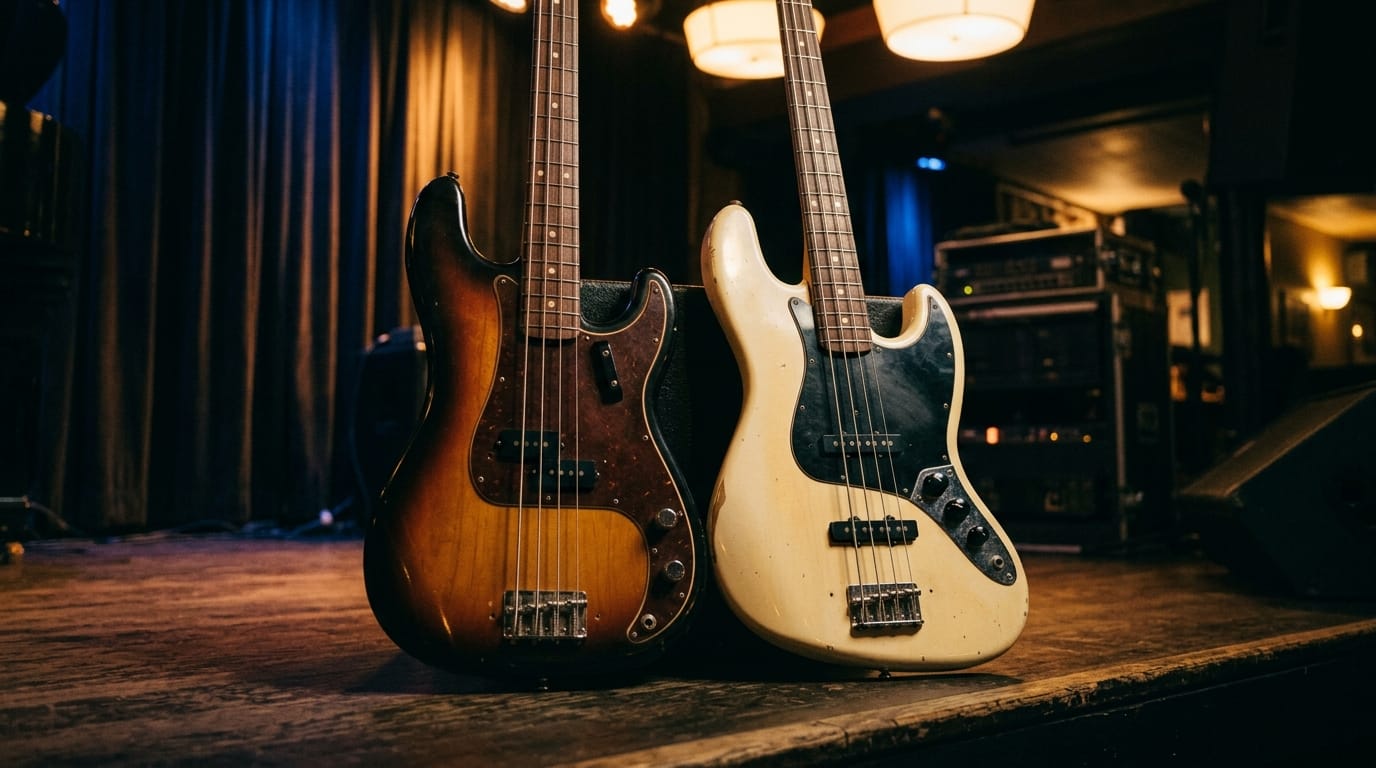
The Fender Precision Bass and Fender Jazz Bass are two distinct electric bass guitar models introduced nine years apart, each built around a different design philosophy and tonal identity. In the p bass vs jazz bass debate, the short answer is this: choose the P Bass if you want a thick, fundamental-forward tone with dead-simple controls; choose the Jazz Bass if you want tonal flexibility, a slimmer neck profile, and a brighter, more articulate sound that rewards active shaping.
Table of Contents
- Quick Verdict: P Bass vs Jazz Bass at a Glance
- Fender Precision Bass: History, Design, and Sound
- Origins and Design Intent
- The P Bass Sound
- Who Plays the P Bass?
- Fender Jazz Bass: History, Design, and Sound
- The Jazz Bass Sound
- Who Plays the Jazz Bass?
- Head-to-Head: P Bass vs Jazz Bass Across Six Dimensions
- Sound Character: Warmth vs. Articulation
- Playability: Jazz Bass Neck vs P Bass Neck
- Genre Versatility: Jazz vs P Bass
- Recording vs. Live Performance
- Price and Value
- For Beginners vs. Advanced Players
- The PJ Configuration: When You Want Both
- How These Basses Actually Behave in a Band Mix
- P Bass vs Jazz Bass on the Used Market
- Which Should You Buy? Recommendations by Use Case
- You Play Rock, Punk, or Classic Rock
- You Play Jazz, Fusion, or R&B
- You Play Funk or Slap Bass
- You’re Recording in a Studio
- You’re a Beginner
- You Want One Bass for Everything
- FAQ: P Bass vs Jazz Bass Common Questions
- How do you tell if a bass is a Precision or Jazz?
- Is the Jazz Bass or P Bass better for beginners?
- Can a Jazz Bass sound like a P Bass?
- Is the P Bass or Jazz Bass more popular?
- What is a PJ bass and is it a better option?
- Final Verdict
Both instruments have shaped recorded music for decades across rock, funk, soul, jazz, and beyond. Neither is objectively superior. The right choice depends on your hands, your genre, and what you need a bass to do in a mix. This guide breaks down every meaningful difference so you can make that call with confidence.
Quick Verdict: P Bass vs Jazz Bass at a Glance
Before diving deep, here’s how the fender p bass vs jazz bass comparison breaks down across eight key attributes. The table below draws on verified Fender specification data; verify current MSRP at Fender.com before purchasing, as pricing can shift between model years.
| Attribute | Fender Precision Bass | Fender Jazz Bass |
|---|---|---|
| Pickup Configuration | Single split-coil humbucker | Two single-coil pickups (neck + bridge) |
| Neck Width at Nut | 1.625 in (41.3 mm) | 1.5 in (38.1 mm) |
| Neck Profile | C-shape, medium | Tapered C-shape, slim |
| Body Contour | Symmetrical slab (with comfort contours on modern versions) | Offset waist |
| Tonal Character | Warm, midrange-forward, punchy | Bright, articulate, versatile |
| Hum Canceling | Yes (split-coil design, always) | Partial (when both pickups at equal volume) |
| Common Genres | Rock, punk, Motown, country | Jazz, funk, fusion, R&B, rock |
| U.S. MSRP Range (verify at Fender.com) | ~$849-$1,899 (Player to Am. Pro II) | ~$849-$1,899 (Player to Am. Pro II) |
Fender Precision Bass: History, Design, and Sound
Origins and Design Intent
According to Fender’s own published history, the first commercial unit of the Precision Bass was produced in October 1951. Leo Fender designed it as the first commercially successful electric bass guitar, and the name “Precision” came directly from the fretted neck: players could now hit notes with measurable accuracy compared to the fretless upright bass. The original instrument had a slab ash body with two horns and a single-coil pickup.
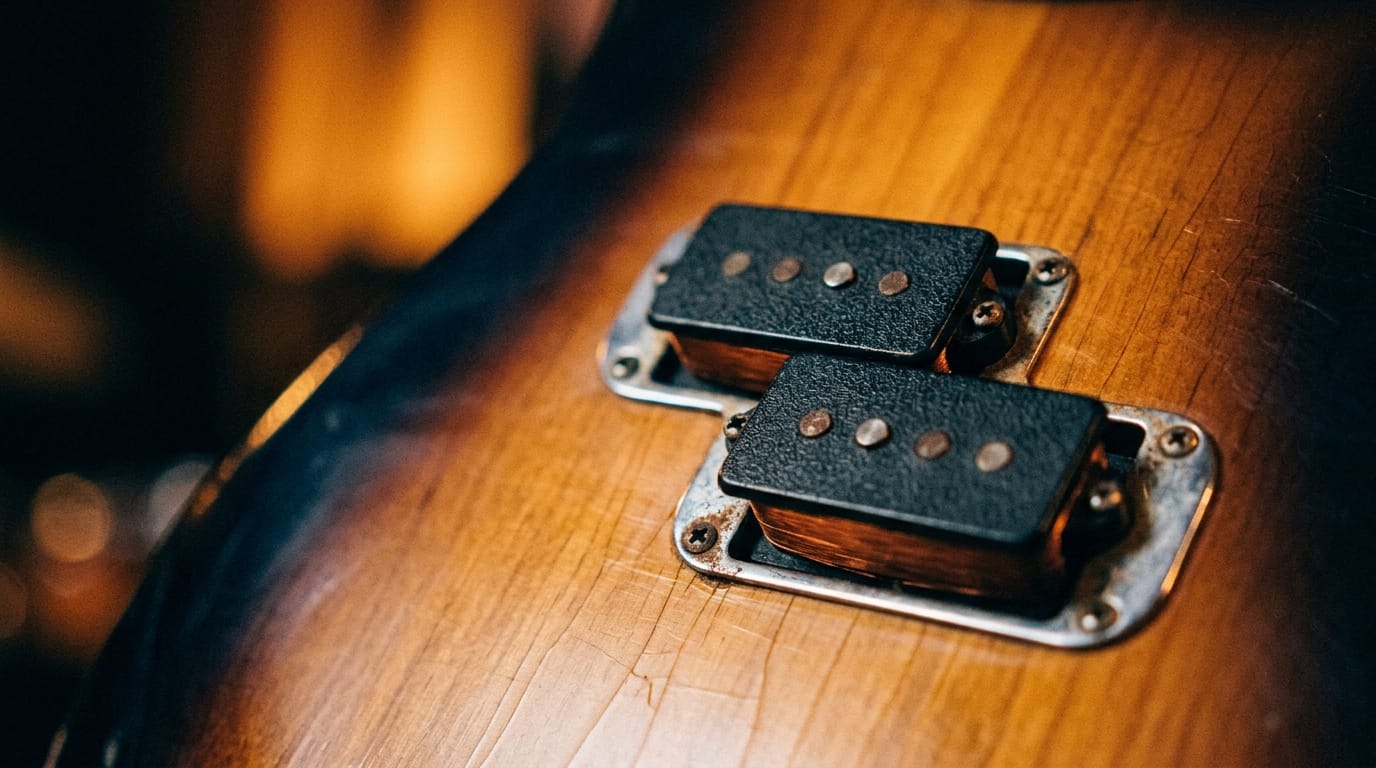
The design evolved significantly through the 1950s. The original single-coil pickup gave way to the now-iconic split-coil humbucker configuration in 1957, and the body gained comfort contours that aligned it visually and ergonomically with the Stratocaster guitar. That split-coil design is the P Bass’s defining technical feature, and it’s been largely unchanged ever since.
The P Bass Sound
The P Bass produces a thick, low-midrange bloom that sits naturally in a dense mix. Its split-coil humbucker cancels hum at all times, regardless of pickup blend, which is a practical advantage in live and studio settings. The tone control rolls off high frequencies smoothly, and the single volume knob keeps the signal chain minimal. There’s no blending, no second pickup to manage. You plug in, and the bass sounds like a bass.
That simplicity is a feature, not a limitation. The P Bass’s fundamental-heavy character means engineers rarely need to reach for EQ to carve it a place in a guitar-driven arrangement. It occupies the low-mid frequency range where bass guitar lives most naturally, and it does so without fuss.
Who Plays the P Bass?
The documented list of P Bass players reads like a history of popular music. James Jamerson played a P Bass on the vast majority of Motown’s hit recordings through the 1960s and early 1970s, though Motown did not list session musician credits at the time. Dee Dee Ramone, founding bassist of the Ramones, is among the most documented P Bass players in punk history. Sting used a P Bass during his early years with The Police, and Kim Deal of the Pixies and The Breeders is a well-documented P Bass player. Pino Palladino, one of the most in-demand session bassists of the past four decades, has used P Bass instruments across a wide range of recording work, as documented in multiple published gear features.
Fender Jazz Bass: History, Design, and Sound
The Jazz Bass Sound
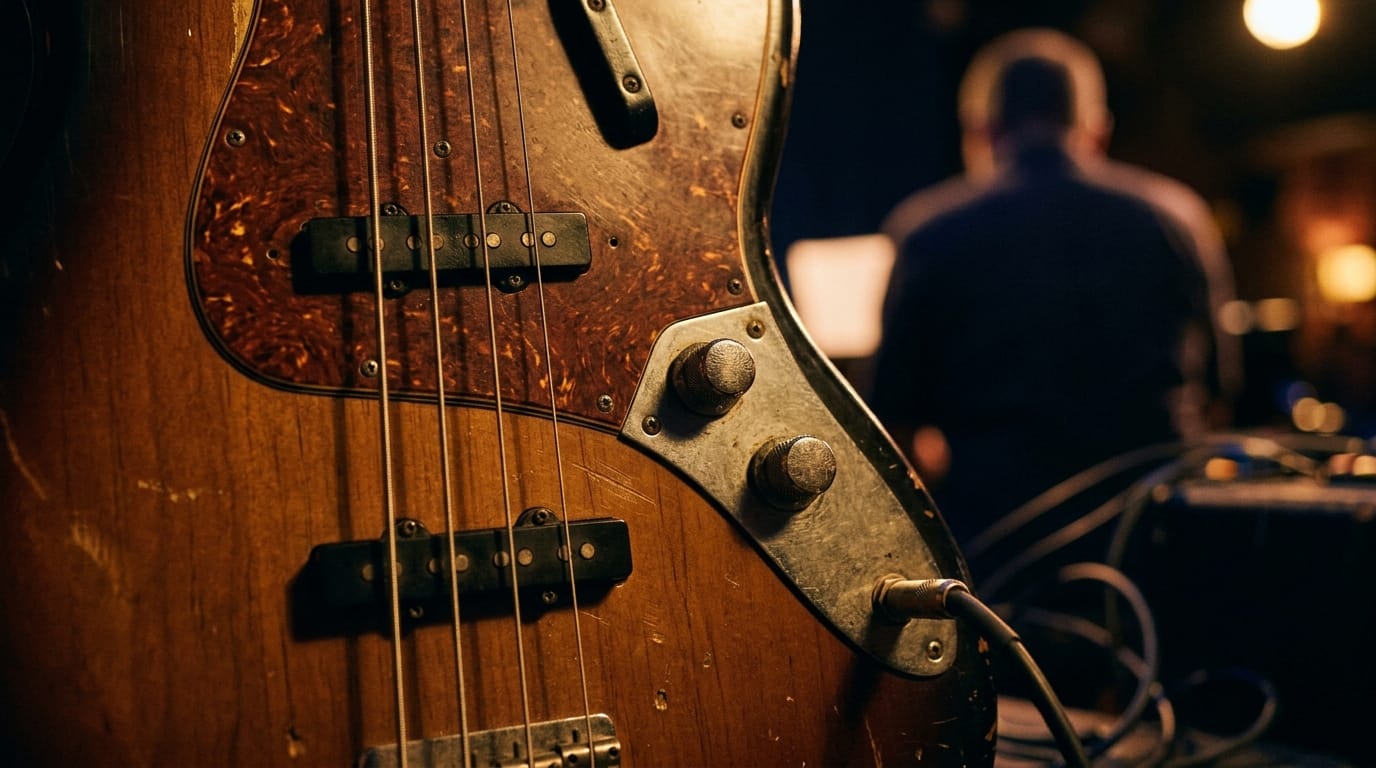
The Jazz Bass gives you two single-coil pickups with individual volume controls, and the tonal range that combination produces is genuinely wide. The bridge pickup alone delivers a trebly, aggressive edge. The neck pickup alone produces warmth that approaches P Bass territory, though the character is thinner and less compressed. Blend both pickups at equal volumes and you get partial hum cancellation through an out-of-phase relationship between the two coils, along with a scooped midrange character that contrasts directly with the P Bass’s mid-forward presence.
That scooped quality, where the low end and high end are both present but the midrange recedes slightly, is the Jazz Bass’s signature in many players’ hands. It rewards active tonal shaping and responds differently depending on where your right hand sits relative to each pickup.
Who Plays the Jazz Bass?
Jaco Pastorius, widely regarded as one of the most influential bassists in music history, built his entire recorded legacy on a fretless Jazz Bass. Marcus Miller, a multiple Grammy-winning bassist and producer, has been associated with the Jazz Bass throughout his career, including his work producing Miles Davis‘s Tutu in 1986. John Paul Jones of Led Zeppelin and Larry Graham, the bassist credited with pioneering slap bass technique with Sly and the Family Stone, are both documented Jazz Bass players, as confirmed by GuitarGuitar’s published rundown of iconic Jazz Bass players.
Head-to-Head: P Bass vs Jazz Bass Across Six Dimensions
Sound Character: Warmth vs. Articulation
The P Bass’s split-coil produces a thick, low-mid bloom that naturally compresses in a mix. You don’t need to do much to it. The Jazz Bass’s dual single-coils reward active tonal shaping: the bridge pickup alone cuts through with a bright, almost aggressive presence, while the neck pickup softens things considerably. Neither configuration is strictly better. It depends entirely on what the arrangement needs.
Think of it this way: the P Bass speaks clearly in a dense, guitar-heavy mix without additional EQ. The Jazz Bass speaks clearly in a sparse arrangement where its upper-mid detail is audible and musically valuable. The jazz bass vs p bass sound debate often comes down to this single question: how much space does your arrangement give the bass to breathe?
Playability: Jazz Bass Neck vs P Bass Neck
This is where the jazz bass neck vs p bass neck comparison gets concrete. The P Bass nut width is 1.625 inches (41.3 mm); the Jazz Bass nut width is 1.5 inches (38.1 mm). That 0.125-inch difference is immediately noticeable under the fretting hand, especially for players coming from guitar or those with smaller hands. The Jazz Bass neck also tapers, meaning it’s narrower at the nut and widens gradually toward the heel, which many players find comfortable for fast passages.
The P Bass neck has a medium C-shape profile and a broader feel overall. Players with larger hands often prefer it. On balance, the Jazz Bass offset body improves upper-body balance on a strap, while the P Bass’s traditional symmetrical body can produce some neck dive depending on strap button placement. This is a widely documented community observation, not a manufacturing defect, and it varies by individual instrument weight.
Genre Versatility: Jazz vs P Bass
Here’s a practical breakdown of documented genre associations for the jazz vs p bass question:
| Genre | Dominant Choice | Notes |
|---|---|---|
| Rock / Punk | P Bass | Documented by player history (Dee Dee Ramone, Sting) |
| Motown / Soul | P Bass | James Jamerson’s documented instrument |
| Jazz / Fusion | Jazz Bass | Jaco Pastorius, Marcus Miller documented use |
| Funk / Slap | Jazz Bass (P Bass documented in early funk) | Larry Graham (Jazz Bass); Motown-era funk used P Bass |
| Country | P Bass | Documented session use |
| Metal | Both viable | P Bass hum cancellation is a practical advantage in high-gain rigs |
On the “J bass or P bass for metal” question: both instruments appear throughout metal’s history. The P Bass’s permanent hum cancellation is a real advantage when running high-gain amplifier settings, where single-coil noise becomes more audible. Player preference and tone goals dominate the decision here more than any genre rule.
Recording vs. Live Performance
In the studio, the Jazz Bass’s dual-pickup blending gives engineers more tonal options without reaching for pedals or outboard gear. The P Bass, by contrast, requires less EQ to sit in a dense mix because its midrange character is already focused. Both approaches are valid; the right choice depends on the arrangement density and the engineer’s workflow.
Live, the P Bass’s single-pickup simplicity reduces variables. There’s nothing to accidentally nudge between songs. The Jazz Bass’s single-coil pickups introduce hum when the two pickups are not balanced at equal volumes, which can be an issue in venues with high electromagnetic interference from lighting rigs or older electrical systems. This is a documented technical characteristic of single-coil pickups, not a flaw unique to Fender’s design.
Price and Value
The fender p bass vs jazz bass comparison on price is straightforward: both models occupy identical price tiers across Fender’s current lineup. The Player Series sits at the entry point of the Mexican-made range, the American Professional II represents the core U.S.-made offering, and the American Vintage II series covers vintage-spec reissues at a premium. Verify current MSRP at Fender.com before purchasing, as pricing adjusts between model years.
On the used market, both instruments hold strong resale value historically, with American-made examples commanding a clear premium over Player Series instruments. The quality and specification differences between Mexican-made and U.S.-made Fender basses are documented in Fender’s own production disclosures and widely covered in the bass press.
For Beginners vs. Advanced Players
Let’s be honest: neither bass is wrong for a beginner. The P Bass wins on simplicity. One pickup, one volume knob, one tone knob. You plug in and play without managing a blend. The Jazz Bass wins on neck feel for players with smaller hands or those crossing over from guitar, where the 1.5-inch nut width feels more familiar.
Advanced players find different rewards in each instrument. The Jazz Bass rewards technique: right-hand position relative to each pickup changes the tone meaningfully, and pickup blending becomes a real-time expressive tool. The P Bass rewards commitment. You choose a sound and you commit to it, which forces you to find expression through touch and dynamics rather than knob-tweaking.
The PJ Configuration: When You Want Both
Here’s a third path that doesn’t get enough attention in most P Bass vs Jazz Bass comparisons. A PJ bass combines a P-style split-coil pickup at the neck position with a J-style single-coil at the bridge. Fender offers this configuration as a factory option on select models (verify current availability at Fender.com), and it’s also a popular aftermarket upgrade on standard P Bass bodies.
The tonal logic is straightforward: you get the P Bass’s warm, fundamental-heavy foundation from the neck pickup, with the option to blend in the Jazz Bass bridge pickup’s brightness and articulation. It’s a genuinely broader tonal range than either instrument alone. The caveat is that the J-style bridge pickup introduces single-coil hum when used alone, since it lacks the split-coil’s inherent noise cancellation. That’s a documented technical behavior of single-coil pickups, not a defect. For players who genuinely can’t decide between the two instruments, the PJ configuration is the most practical single-bass solution available.
The BassBuzz forum community shows consistent appetite for this option, with multiple threads identifying the PJ as a “go-to” configuration for players who want both tonal characters without owning two basses. For more on how jazz bassists approach tone and technique, the profiles of jazz instrumentalists on eJazzNews offer useful context on how tone choices shape musical identity.
How These Basses Actually Behave in a Band Mix
Competitors rarely address this with any specificity, so let’s go there. The P Bass’s midrange bloom occupies roughly the 200-600 Hz band where bass guitar and rhythm guitar often compete for space. In a dense, guitar-driven arrangement, the P Bass speaks clearly without additional EQ because its fundamental sits exactly where the ear expects bass to live. It doesn’t need help finding its place in the mix.
The Jazz Bass’s brighter character and upper-mid presence extends its audible range higher in the frequency spectrum. In a sparse arrangement, a jazz trio or a funk quartet with room to breathe, that detail is musically valuable. You hear the note’s attack, the string’s texture, the player’s touch. In a dense arrangement with multiple guitars and keyboards, that same brightness can compete with other instruments rather than complement them.
The practical implication: choosing a bass for recording is partly about arrangement density, not just genre. A Jazz Bass in a sparse jazz trio recording will sound more detailed and present than a P Bass in the same context. That same Jazz Bass in a wall-of-guitars rock recording may need more EQ work to sit correctly. Neither outcome is wrong; it’s just useful to know before you book the session.
P Bass vs Jazz Bass on the Used Market
Both models have continuous production histories spanning more than six decades, which means the used market offers a wide range of era-specific specifications. The CBS acquisition of Fender in 1965 and the subsequent period through the mid-1980s produced instruments with documented spec variations that collectors and players track carefully. Pre-CBS examples command significant premiums. Vintage reissues from Fender’s American Vintage II series replicate specific era specs at new-instrument prices.
When buying used, the practical checklist is consistent across both models: check the neck pocket fit for gaps or shimming, inspect the pickup condition and output (a weak or dead pickup is a repair cost), verify tuner function and string post condition, and check the nut for wear. American-made vs. Mexican-made (Player Series) instruments have documented quality and price differences that are verifiable through Fender’s own production disclosures. Platforms like Reverb.com and Guitar Center’s used and vintage divisions are real-world marketplaces where both models appear regularly; verify current pricing at time of purchase rather than relying on figures from any article.
One related question that comes up frequently: P Bass vs Jazz Bass vs Stingray. The Ernie Ball Music Man Stingray is a distinct third option with an active electronics system and a humbucker pickup that produces a different tonal character from either Fender model. It deserves its own dedicated comparison, and it’s as a legitimate alternative if neither Fender model fully satisfies your tonal requirements. For broader context on the instruments that define jazz, eJazzNews’s coverage of jazz instruments covers the full range of the genre’s sonic toolkit.
Which Should You Buy? Recommendations by Use Case
The jazz bass vs p bass decision comes down to use case. Here’s a direct recommendation for each scenario, without hedging.
You Play Rock, Punk, or Classic Rock
Choose the P Bass. Its documented history in these genres is extensive, from Dee Dee Ramone’s foundational punk work to Sting’s early Police recordings. The simple control layout suits high-volume live performance where you don’t want to manage blend settings between songs.
You Play Jazz, Fusion, or R&B
Choose the Jazz Bass. Tonal flexibility and documented professional adoption in these genres, from Jaco Pastorius’s fretless work to Marcus Miller’s studio productions, make it the established choice. The brighter character and upper-mid presence suit the sonic space these genres occupy.
You Play Funk or Slap Bass
Choose the Jazz Bass as a default. The bridge pickup’s brightness rewards slap technique, and Larry Graham’s documented Jazz Bass use connects the instrument directly to the technique’s origins. That said, P Bass funk playing is well-documented from the Motown era onward. If your tone preference leans thick and fundamental-heavy, the P Bass is a legitimate funk instrument.
You’re Recording in a Studio
Choose the Jazz Bass for maximum versatility across different arrangement types. Choose the P Bass if the arrangement is dense and guitar-driven and you want a mid-forward tone that sits without EQ surgery. Both are studio-proven across decades of recorded music.
You’re a Beginner
Either instrument is appropriate. Try both if you have access to a music store. The Jazz Bass nut width of 1.5 inches may suit smaller hands or guitar crossovers; the P Bass’s simpler control layout reduces decision fatigue when you’re still learning the instrument.
You Want One Bass for Everything
The Jazz Bass edges ahead on tonal range. The fender jazz bass vs p bass comparison on versatility consistently favors the Jazz Bass for players who need one instrument to cover multiple genres and contexts. The PJ configuration, discussed above, is the broadest-range single-bass solution if you’re willing to consider it.
FAQ: P Bass vs Jazz Bass Common Questions
How do you tell if a bass is a Precision or Jazz?
Three visual identifiers separate them immediately. First, body shape: the Jazz Bass has an offset waist contour that curves asymmetrically; the P Bass has a more symmetrical body. Second, pickup configuration: the P Bass has one split-coil pickup with two offset halves; the Jazz Bass has two single-coil pickups, one near the neck and one near the bridge. Third, neck width: the Jazz Bass is noticeably narrower at the nut. The headstock shape and control layout (P Bass has one volume and one tone; Jazz Bass has two volumes and one tone) also differ.
Is the Jazz Bass or P Bass better for beginners?
Both are appropriate starting instruments. The P Bass wins on control simplicity: one volume, one tone, no blending decisions. The Jazz Bass wins on neck feel for players with smaller hands or those transitioning from guitar. The best approach is to play both at a music store before deciding. Neither will hold back a developing player.
Can a Jazz Bass sound like a P Bass?
Partially. With both pickups at equal volume and the tone control rolled back, a Jazz Bass can approximate the warmth and reduced high-frequency content of a P Bass. But the split-coil character of the P Bass, its specific midrange compression and fundamental weight, isn’t fully replicable through pickup blending alone. The two instruments have genuinely different tonal identities at their cores. This is a widely documented community observation consistent with the acoustic logic of different pickup designs.
Is the P Bass or Jazz Bass more popular?
Community polling on forums like BassBuzz suggests the Jazz Bass has a slight edge in overall popularity among active players, though many professionals express a preference for the P Bass in specific contexts. Both instruments have been in continuous production since their introduction, which itself reflects sustained demand for each. Specific sales figures aren’t publicly available from Fender.
What is a PJ bass and is it a better option?
A PJ bass combines a P-style split-coil pickup at the neck position with a J-style single-coil at the bridge, offering the tonal range of both instruments in a single bass. It’s a practical solution for players who genuinely need both characters. The trade-off is some tonal purity: the J bridge pickup introduces single-coil hum when used alone, and the combined sound is its own character rather than a perfect replica of either instrument. See the PJ section above for a full breakdown.
Final Verdict
The p bass vs jazz bass decision is genuinely use-case dependent, but the core distinction is clear. The Jazz Bass is the broader-range instrument: more tonal options, a slimmer neck, and a brighter character that rewards active playing and suits sparse arrangements. The P Bass is the more focused, mix-ready instrument: a thick, fundamental-heavy tone that sits in dense arrangements without EQ work, with permanent hum cancellation and a control layout that removes all variables. Neither is wrong. They’re different tools built for different jobs, and the best players know which one a given situation calls for.
If you’re still building your understanding of how bass fits into jazz and contemporary music, eJazzNews’s coverage of the instrumentalists who defined jazz's sound and our deep dives into every instrument in the jazz toolkit offer useful context for where the bass sits in the broader picture.