What Was the Jazz Age? America in the 1920s and the Music That Defined It

What Was the Jazz Age? America in the 1920s and the Music That Defined It

By James Wright · · 23 min read

The Jazz Age was a period of American cultural history spanning approximately 1920 to 1933, defined by the mainstream rise of jazz music, a transformation in social mores, and an era of economic expansion that ended with the Great Depression. The term covers roughly the same years as the Roaring Twenties, though the two labels aren’t identical: “Roaring Twenties” describes the economic and social mood, while “Jazz Age” names the music that gave that mood its pulse. Writer F. Scott Fitzgerald popularized the phrase, first in his 1922 short story collection Tales of the Jazz Age and later in his 1931 essay Echoes of the Jazz Age, where he declared the era finished. The period still shapes American culture today, from the template it set for youth rebellion to the racial dynamics it embedded in the music industry.

Table of Contents

Defining the Jazz Age: A Starting Point

The Jazz Age, in its simplest definition, was the decade-plus period when jazz music moved from the margins of American life to its center, carrying with it new fashions, new dances, new literature, and new social freedoms. In U.S. history classrooms, the jazz age definition typically anchors to 1920 (when Prohibition took effect and post-war energy exploded) through 1933 (when Prohibition was repealed and the Swing Era began emerging from the Depression’s wreckage). That’s a wider window than “the 1920s” alone, and the distinction matters.

The Roaring Twenties and the Jazz Age overlap almost completely but aren’t synonyms. The Roaring Twenties is primarily an economic and social descriptor. The Jazz Age is a cultural one, centered on music as the engine of change. Scott Fitzgerald Society, Fitzgerald (1896-1940) was the era’s most acute literary chronicler, and his coinage of the term stuck precisely because it captured something the economic labels missed: the sound of the decade.

Fitzgerald himself was ambivalent about what he’d named. In Echoes of the Jazz Age, he wrote that the era “had no interest in politics at all.” It was a time of deliberate forgetting, of dancing past the wreckage of the Great War. That ambivalence, celebration laced with dread, is what separates the Jazz Age from simple nostalgia.

The Conditions That Made the Jazz Age Possible

The Jazz Age didn’t arrive from nowhere. Four specific historical forces converged between 1918 and 1920 to make it structurally inevitable.

The Aftermath of World War I

Approximately 116,516 Americans died in World War I, according to U.S. Department of Veterans Affairs historical data. That number doesn’t capture the psychological weight carried home by survivors. The war shattered Victorian certainties about progress, morality, and the natural order of things. What replaced those certainties, for a generation of young Americans, was a fierce appetite for pleasure. Writers like Fitzgerald and Ernest Hemingway documented this “Lost Generation” in fiction; jazz gave it a soundtrack.

The hedonism of the 1920s wasn’t shallow. It was a deliberate rejection of the values that had sent young men into the trenches. Dancing until dawn, drinking in speakeasies, listening to music that made your body move against your better judgment, these were acts of defiance against a world that had proven itself capable of industrial-scale slaughter.

Prohibition and the Underground Economy of Jazz

The 18th Amendment was ratified in January 1919 and took effect in January 1920, banning the manufacture and sale of alcohol across the United States. The result was not sobriety. It was the speakeasy. At the height of Prohibition, there were an estimated 32,000 speakeasies in New York City alone, according to widely cited Prohibition-era historical estimates. These illegal venues needed entertainment, and jazz, with its energy and improvisational edge, was the perfect fit.

Jazz didn’t just benefit from Prohibition’s underground economy. It was shaped by it. The music acquired an outlaw glamour that made it more attractive to young audiences and more threatening to moral authorities. Al Capone’s documented connections to Chicago jazz venues illustrate how deeply the music was embedded in the era’s illegal commerce. Jazz was the sound of a society breaking its own rules.

The Great Migration and Urban Density

Between 1910 and 1940, approximately 1.6 million Black Americans relocated from the South to Northern cities during the First Great Migration, according to U.S. Census historical data. Chicago and New York City absorbed the largest numbers. By 1920, Harlem had become the cultural capital of Black America, a neighborhood dense with musicians, poets, painters, and audiences who understood what they were creating.

This concentration was the precondition for everything that followed. Jazz needed critical mass: enough musicians to form bands, enough venues to employ them, enough audiences to sustain a scene. The Great Migration provided all three simultaneously. Without it, jazz might have remained a regional Southern sound rather than becoming the defining music of a national era.

Economic Expansion and Disposable Income

The 1920s saw significant U.S. economic growth, with a rising middle class that had money to spend on entertainment, consumer goods, and leisure. Phonographs, radios, and tickets to dance halls were affordable luxuries for a new consumer class. That spending power created the market that jazz filled. It’s worth being honest about the limits of this prosperity, though: agricultural workers and the majority of Black Americans were largely excluded from the decade’s economic gains, even as their cultural contributions drove the era’s defining art form.

What Defined the Jazz Age? Five Cultural Pillars

The Jazz Age wasn’t just a music phenomenon. It was a full cultural system, with interconnected elements that reinforced each other. Here are the five pillars that held it up.

The Music, From New Orleans to Nationwide

Jazz predates the Jazz Age by at least two decades. Its roots run through Congo Square in New Orleans, where West African rhythmic traditions fused with European harmony and the blues in the late 19th century. But the music exploded nationally after 1920, carried by new recording technology and radio. The Original Dixieland Jazz Band’s 1917 recording of “Livery Stable Blues” for Victor Records is documented as the first commercially released jazz record, establishing the format that would dominate the decade.

Early Jazz Age music was dominated by Dixieland, an ensemble style built on collective improvisation where cornet, clarinet, and trombone wove around each other over a rhythm section. By mid-decade, the style was shifting. Louis Armstrong’s recordings on OKeh Records between 1925 and 1928 moved jazz toward soloist-centered expression, a shift that changed the music permanently. The 1920s jazz age produced recordings that still define what jazz sounds like in the popular imagination.

Year Recording Artist Label Significance
1917 “Livery Stable Blues” Original Dixieland Jazz Band Victor First commercially released jazz record
1923 “Chimes Blues” King Oliver’s Creole Jazz Band (feat. Armstrong) Gennett Armstrong’s first recorded solo
1926 “Heebie Jeebies” Louis Armstrong & His Hot Five OKeh Established scat singing on record
1927 “Black and Tan Fantasy” Duke Ellington Brunswick Ellington’s arrival as a major composer
1924 Rhapsody in Blue (premiere) George Gershwin / Paul Whiteman Orchestra Aeolian Hall, NYC Jazz entering the concert hall
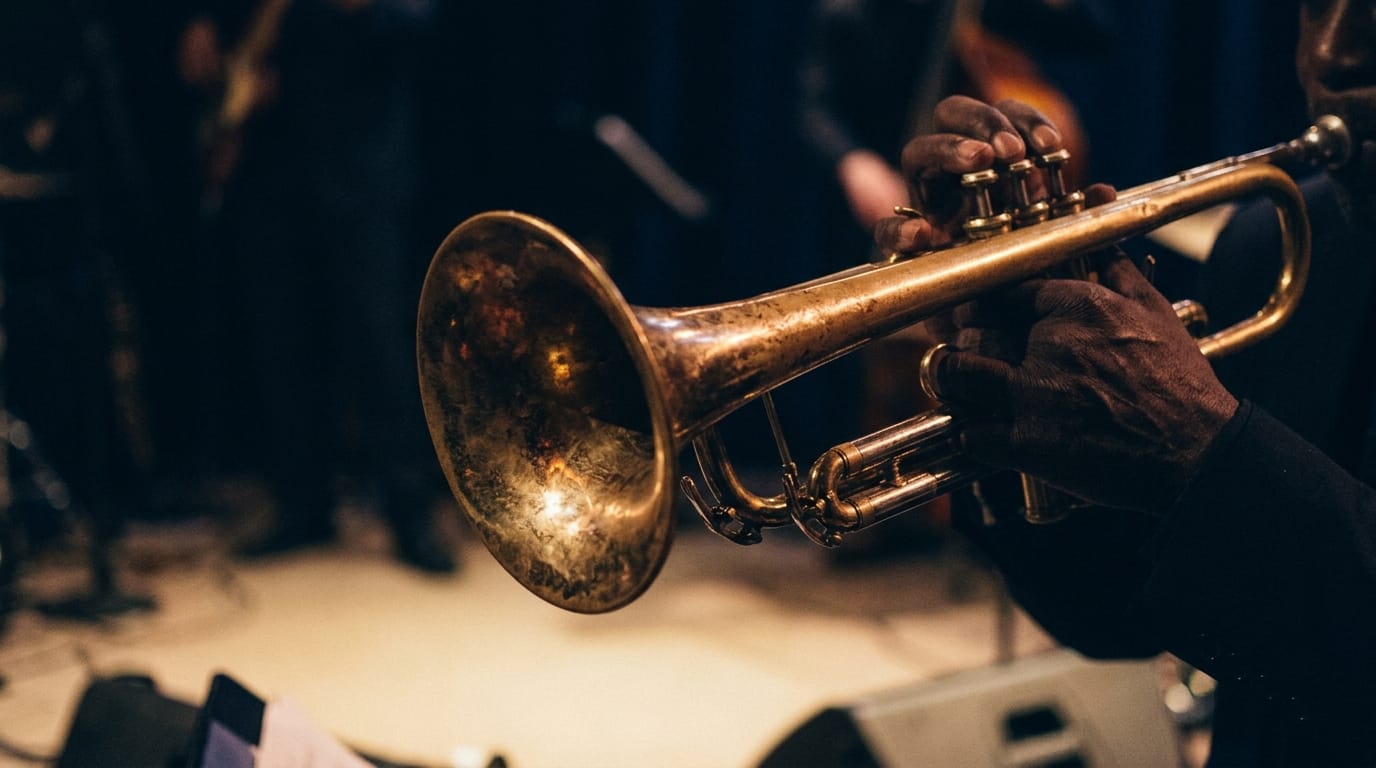
Jazz musician playing vintage brass trumpet on stage with warm spotlight lighting
A seasoned jazz trumpeter delivers a soulful solo, capturing the intimate energy and technical mastery that defines live jazz performance.

Jazz Age Fashion, The Flapper and the New Silhouette

Jazz age fashion was inseparable from the music. The flapper aesthetic, with its dropped waistlines, hemlines rising from ankle to knee across the decade, bobbed hair, and beaded headbands, was the visual equivalent of syncopation: it broke the expected rhythm of what a woman was supposed to look like. Clothing became a form of rebellion, and the dance floor was where that rebellion was performed most publicly.

Men’s fashion shifted too. Wide-legged Oxford bags, two-tone shoes, and raccoon coats on college campuses signaled a new kind of masculine ease. Coco Chanel’s documented influence on liberating women’s silhouettes in the post-World War I era ran parallel to these changes, replacing the corseted Edwardian form with something freer and more functional. The fashion and the music fed each other: you couldn’t dance the Charleston in a corset.

Literature and the Jazz Age Imagination

F. Scott Fitzgerald is the era’s unavoidable literary figure. This Side of Paradise (1920), Tales of the Jazz Age (1922), and The Great Gatsby (1925) form a trilogy of Jazz Age documentation, each book more precise than the last about the era’s pleasures and its rot. Fitzgerald didn’t just observe the Jazz Age; he lived it, and his writing carries the specific weight of someone who knew the party would end badly.

The Harlem Renaissance ran as a parallel literary movement, equally vital and far less celebrated at the time. Langston Hughes, a central figure in the Harlem Renaissance, wrote poetry that treated jazz as a literary form in itself. Zora Neale Hurston documented Black Southern folk culture with anthropological precision. Claude McKay, the Jamaican-American poet and novelist, published Home to Harlem in 1928, a novel that brought Harlem’s nightlife into sharp literary focus. These writers and Fitzgerald were documenting the same era from opposite sides of the color line.

Jazz in the 1920s shaped American culture in ways that extended far beyond the music itself

Dance, The Charleston, the Black Bottom, and the Body in Motion

The Charleston was first popularized through James P. Johnson’s 1923 musical Runnin’ Wild, a documented origin that most accounts of the dance overlook. The Black Bottom preceded it, emerging from Black Southern communities before reaching Broadway in George White’s Scandals in 1926. Both dances shared a quality that made moral authorities nervous: they required the whole body, not just the feet, and they were explicitly joyful in a way that Victorian social dance was not.

The Savoy Ballroom, which opened in Harlem on March 12, 1926, could hold approximately 4,000 people and became the era’s most important dance space. It was also one of the few racially integrated public venues in New York City, a fact that made it both a social experiment and a cultural landmark. The Savoy’s two bandstands, running competing orchestras simultaneously, created the “battle of the bands” format that would define swing-era entertainment.

Social Mores, Gender, Race, and the Loosening of Norms

The 19th Amendment granted women the right to vote in 1920, the same year the Jazz Age effectively began. That timing wasn’t coincidental. New political rights and new social freedoms arrived together, and jazz was the soundtrack to both. Courtship norms shifted; the automobile created private social space that hadn’t existed before; young people moved to cities and away from parental supervision.

The resistance was real and documented. The Ladies’ Home Journal published “Does Jazz Put the Sin in Syncopation?” in August 1921, a verifiable primary source that captures the moral panic jazz provoked. Religious leaders denounced it from pulpits. The music was condemned as a corrupting influence on youth, which, predictably, made young people love it more.

Key Figures Who Shaped the Jazz Age

The Jazz Age had no shortage of jazz age musicians, but a handful of figures defined its sound, its image, and its contradictions.

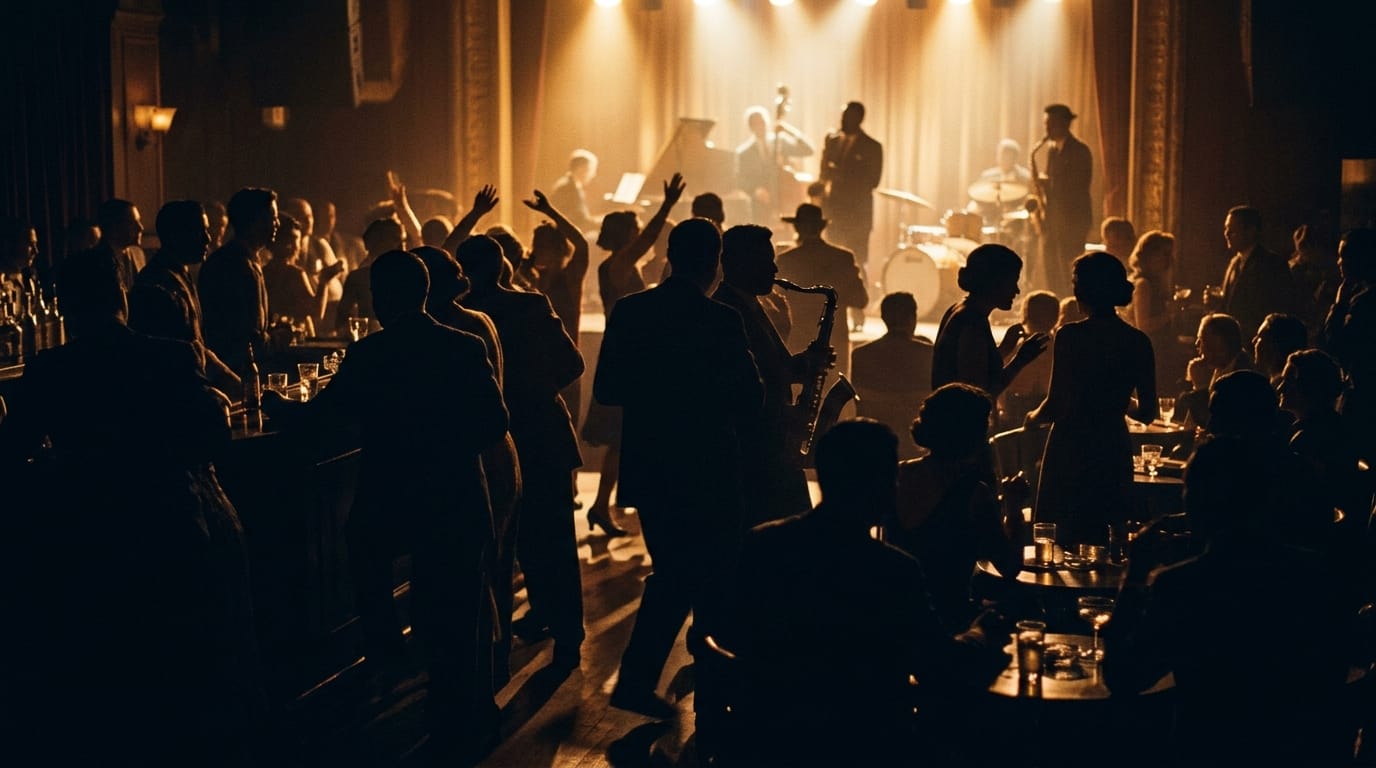
Energetic jazz club audience dancing and celebrating with live band performing on stage
The vibrant energy of a live jazz performance captures the essence of intimate club culture where musicians and audiences connect through improvisation and rhythm.

Louis Armstrong, The Soloist Who Changed Everything

Born August 4, 1901, in New Orleans, Armstrong moved to Chicago in 1922 to join King Oliver’s Creole Jazz Band. His first recorded solo, on “Chimes Blues” in 1923, announced a musician of extraordinary gifts. When he formed the Hot Five in 1925 and began recording for OKeh Records, he didn’t just document jazz, he redefined it. According to the Louis Armstrong House Museum, his improvised solos transformed jazz from an ensemble art into a vehicle for individual expression. That shift is the Jazz Age’s single most consequential musical development.

“Heebie Jeebies,” recorded in 1926, established scat singing on record, a technique where the voice becomes an instrument, improvising syllables rather than words. It’s a small detail with enormous consequences: it meant the human voice could do what a trumpet did, and Armstrong proved it. His Hot Five and Hot Seven recordings remain the most influential documents of the 1920s jazz age.

Duke Ellington, Composer, Bandleader, Institution

Edward Kennedy “Duke” Ellington was born April 29, 1899, in Washington, D.C. He arrived in New York in 1923 and began his residency at the Cotton Club in Harlem in December 1927. That residency changed everything. The Cotton Club’s CBS radio broadcasts carried Ellington’s music to a national white audience that would never set foot in Harlem, making him simultaneously the house musician of a segregated venue and the most famous Black bandleader in America.

His 1920s compositions, including “East St. Louis Toodle-Oo” (1926) and “Black and Tan Fantasy” (1927, co-written with Bubber Miley), showed a composer thinking in colors and textures rather than just chord changes. Britannica describes him as “the greatest jazz composer and bandleader of his time,” and the Jazz Age is where that greatness first became visible to a national audience.

Bessie Smith, The Empress of the Blues

Bessie Smith (April 15, 1894 – September 26, 1937) was the point where blues and jazz intersected most powerfully during the Jazz Age. Columbia Records signed her in 1923, and her records sold in the hundreds of thousands, demonstrating the commercial viability of Black artists to an industry that had largely ignored them. Her voice, a deep, commanding instrument that could fill a theater without amplification, carried the weight of the blues tradition into the jazz era. She was nicknamed the “Empress of the Blues” and earned it.

Smith’s commercial success also illustrated the exploitation built into the system. Labels profited enormously from Black artists while offering them limited royalties and restricted distribution. Her story is inseparable from the racial economics of the Jazz Age.

F. Scott Fitzgerald, The Jazz Age’s Biographer

Fitzgerald wasn’t a musician, but he’s inseparable from the Jazz Age’s definition. He coined the term, lived the era with reckless commitment, and documented it with enough precision that his novels still function as primary sources. What competitors rarely note is his ambivalence: Fitzgerald loved the Jazz Age and was destroyed by it. His 1931 essay Echoes of the Jazz Age reads less like a celebration than a eulogy, written by someone who understood exactly what had been lost.

Paul Whiteman, Commercial Jazz and Its Contradictions

Paul Whiteman called himself “The King of Jazz,” a title that tells you everything about the era’s racial dynamics. According to The Syncopated Times, Whiteman led the most popular orchestra of the decade, mixing jazz pieces with semi-classical works and sweet vocals. His 1924 concert “An Experiment in Modern Music” at Aeolian Hall in New York premiered George Gershwin’s Rhapsody in Blue, a moment that positioned jazz as a legitimate concert art form. His version of jazz prioritized orchestration over improvisation, which made it more palatable to white mainstream audiences and more profitable for white-owned labels.

Whiteman’s 1920 recording “Whispering” sold nearly two million copies by 1921 and was later inducted into the Grammy Hall of Fame. His commercial dominance while Black originators struggled for distribution is one of the Jazz Age’s defining contradictions.

Jelly Roll Morton, The Bridge Between Ragtime and Jazz

New Orleans pianist Jelly Roll Morton claimed, controversially, to have invented jazz. The claim is impossible to verify and probably false, but it reflects something real: Morton was present at the creation, a musician whose work bridged ragtime’s formal structures and jazz’s improvisational freedom. According to Music Rising at Tulane, Morton was a second-generation New Orleans jazz musician whose birth year is listed variously as 1885 or 1890. His Red Hot Peppers recordings for Victor between 1926 and 1930 documented the New Orleans jazz style at its creative peak, preserving a sound that was already being displaced by the Chicago and New York styles Armstrong and Ellington were developing.

The Technology That Spread Jazz Across America

This is the angle that most Jazz Age histories skip entirely. The music didn’t spread by word of mouth alone. Two specific technologies, the phonograph and the radio, mechanically amplified jazz from a regional sound into a national phenomenon, and the speed of that amplification was unprecedented in American cultural history.

The Phonograph Industry and the Jazz Economy

The phonograph was already established before 1920, but the decade brought mass-market pricing and, after 1925, the electric microphone, which replaced acoustic recording horns and dramatically improved sound quality. Victor Talking Machine Company and Columbia Records dominated the market. Annual U.S. record sales reached approximately 100 million units by the mid-1920s, a figure cited in music industry historical accounts. That volume created an economy of scale that made jazz commercially viable at a national level.

OKeh Records launched its “race records” series in 1920, a documented marketing category that targeted Black audiences with recordings by Black artists. The category was commercially segregated by design, but it had an unintended consequence: it created a documented archive of Black jazz and blues at the moment of the music’s greatest vitality. The 78rpm format’s three-minute limitation shaped how jazz was composed and performed for live recording, forcing musicians to distill their ideas into tight, focused statements. That constraint produced some of the era’s most concentrated music.

Radio, The Accelerant

KDKA in Pittsburgh went on air in November 1920, documented as the first commercial radio broadcast in the United States. The growth was staggering: from just 67 licensed stations in March 1922 to over 500 by year’s end, reaching 556 stations by 1923, according to Federal Radio Commission historical data. By the late 1920s, radio had created something that had never existed before: a national shared music culture, where millions of Americans in different cities and states heard the same music simultaneously.

Duke Ellington’s Cotton Club broadcasts on CBS are the clearest example of radio’s power. A segregated Harlem nightclub that employed Black performers for exclusively white audiences became, through radio, the source of the most sophisticated jazz in America, heard by listeners who would never visit Harlem. Radio could reach everywhere. The venues it broadcast from remained racially segregated. That tension, between the music’s universal reach and the social restrictions that surrounded it, defines the Jazz Age’s central contradiction.

Vinyl record player turntable with stylus on spinning jazz record under warm studio lighting
The analog warmth of vinyl remains central to jazz appreciation, capturing the genre’s rich sonic heritage.

The Racial Paradox at the Heart of the Jazz Age

Let’s be honest about something that competitors consistently underplay: the Jazz Age was built on Black creativity and monetized primarily by white commercial infrastructure. That’s not a peripheral detail. It’s the central fact of the era’s music industry.

Black Creativity, White Profit

Jazz was created by Black Americans in New Orleans and developed through Black communities in Chicago and Harlem. The Cotton Club, the Jazz Age’s most famous venue, employed Black performers for exclusively white audiences. Paul Whiteman, Ted Lewis, and other white bandleaders dominated mainstream commercial jazz sales while Black originators had limited distribution and lower royalties. The “race records” category wasn’t just a marketing label; it was a commercial segregation that kept Black artists in a separate, lower-revenue market.

Langston Hughes addressed this directly in his 1926 essay “The Negro Artist and the Racial Mountain,” published in The Nation magazine. Hughes argued that Black artists faced pressure to assimilate into white cultural standards, and that resisting that pressure was an act of artistic and political integrity. His essay remains one of the most precise primary sources on the racial dynamics of the Jazz Age, written from inside the experience rather than observing it from outside.

The Harlem Renaissance as Parallel Movement

The Harlem Renaissance wasn’t identical to the Jazz Age, but the two movements were inseparable. Running roughly from the late 1910s through the 1930s, the Harlem Renaissance was a flowering of Black intellectual, literary, and artistic life that produced Langston Hughes’s poetry, Zora Neale Hurston’s anthropological fiction, Aaron Douglas’s visual art, and Duke Ellington’s compositions simultaneously. These weren’t separate streams; they fed each other.

White “slumming” in Harlem was a documented social phenomenon of the era. Carl Van Vechten, a white writer and patron of the Harlem Renaissance, documented this world in his 1926 novel Nigger Heaven, a book that generated fierce debate within the Black community about whether white fascination with Harlem was appreciation or exploitation. The answer, then as now, was: both.

Why This Paradox Matters to Understanding the Jazz Age

The Jazz Age cannot be fully understood as a white cultural phenomenon. It was a Black cultural creation with a white commercial superstructure built on top of it. Understanding that structure is what makes the era significant beyond nostalgia. The pattern it established, Black artists creating, white industry profiting, white performers receiving mainstream credit, repeated itself with rhythm and blues in the 1950s and hip-hop in the 1990s. The Jazz Age was the prototype.

The Jazz Age Goes Global, America’s First Cultural Export

While American historians focus on Harlem and Chicago, the Jazz Age was simultaneously an international phenomenon. Jazz crossed the Atlantic in real time, carried by touring musicians and phonograph records, and it landed in European cities that were hungry for something new.

Paris and the Jazz Invasion

Josephine Baker (1906-1975) arrived in Paris in 1925 as part of La Revue Nègre, a show that opened at the Théâtre des Champs-Élysées and introduced African American jazz performance to Parisian audiences in a way that generated immediate, documented press coverage. Baker became a sensation overnight, her performances combining jazz dance with a theatrical charisma that Paris had never seen. She stayed, became a French citizen, and spent the rest of her life there.

Ada “Bricktop” Smith ran her club Chez Bricktop in Paris from the mid-1920s onward, a venue documented as a gathering point for Fitzgerald, Hemingway, Cole Porter, and the expatriate American community. Django Reinhardt, born in 1910, was developing his guitar style in France during the late 1920s, absorbing jazz influences that would eventually produce his own distinctive synthesis. Paris wasn’t just receiving American jazz; it was beginning to transform it.

London and Berlin

The Original Dixieland Jazz Band toured London in 1919, establishing the pathway before the Jazz Age officially began. The Savoy Orpheans, the resident dance orchestra at London’s Savoy Hotel from 1923 to 1927, brought American-style jazz to British high society through nightly broadcasts on the BBC, and even performed the UK premiere of Gershwin’s Rhapsody in Blue at the hotel in June 1925. Berlin’s Weimar-era cabaret culture absorbed jazz influences throughout the decade, documented in cultural histories of the period. The music’s transgressive energy fit naturally into Weimar Berlin’s atmosphere of political instability and artistic experimentation.

Jazz as Soft Power

The U.S. State Department would formalize jazz as cultural diplomacy in the 1950s through the Jazz Ambassadors program, sending Louis Armstrong, Dizzy Gillespie, and others abroad as unofficial representatives of American culture. But the Jazz Age was the unofficial first chapter of that story. Jazz arrived in Europe not as policy but as irresistible cultural force, and it arrived decades before anyone in Washington thought to take credit for it.

Common Misconceptions About the Jazz Age

Several myths about the Jazz Age get repeated so often they’ve become accepted history. Here are the three most persistent, and why they’re wrong.

Misconception 1, The Jazz Age Ended in 1929

The stock market crash of October 1929 didn’t instantly end the Jazz Age. Fitzgerald himself didn’t declare it over until his 1931 essay Echoes of the Jazz Age, two years after the crash. The cultural attitudes of the era, the permissiveness, the urban energy, the appetite for new music, eroded gradually through the early Depression years rather than collapsing overnight. Jazz music not only continued but evolved: the Swing Era, which emerged around 1935, was a direct outgrowth of Jazz Age developments. The music outlasted the mood that created it.

Misconception 2, Jazz Was Universally Celebrated

The Ladies’ Home Journal‘s August 1921 article “Does Jazz Put the Sin in Syncopation?” is a verifiable primary source that captures the genuine moral panic the music provoked. Jazz was denounced from pulpits, condemned in civic publications, and debated in newspapers as a corrupting influence on American youth. Even within the Black community, there was documented debate in publications like The Crisis about whether jazz dignified or demeaned Black culture. The idea that the Jazz Age was a universally celebrated party is a retrospective fantasy. At the time, it was a battleground.

Misconception 3, The Jazz Age Was Purely an American Phenomenon

As the global section above documents, jazz spread to Europe in real time during the 1920s. Josephine Baker’s Paris performances, Bricktop’s club, the Original Dixieland Jazz Band’s London tour, and Berlin’s absorption of jazz into Weimar cabaret culture all happened during the Jazz Age itself, not after it. The term “Jazz Age” is specifically American, and European contemporaries used different names for the period. But the music and the cultural energy it carried were genuinely international from early in the decade.

The Jazz Age’s Lasting Legacy, What It Created

The Jazz Age didn’t just produce great music. It established patterns that American culture has repeated ever since.

The Path to Swing, Bebop, and Beyond

The direct lineage from the Jazz Age to later jazz styles is documented and traceable. The Jazz Age’s emphasis on improvisation fed directly into the Swing Era’s big band structures, which in turn provided the harmonic vocabulary that bebop musicians like Charlie Parker and Dizzy Gillespie would dismantle and rebuild in the 1940s. Coleman Hawkins, who recorded in the 1920s as a member of Fletcher Henderson’s orchestra, became a bebop collaborator in the 1940s, a living bridge between the eras. The through-line is unbroken.

Bebop jazz took the improvisational foundations of the Jazz Age and pushed them into harmonic territory that still defines modern jazz

The Jazz Age Template for American Youth Culture

Here’s the thing: the Jazz Age established a repeating American cultural pattern that has never stopped repeating. A new music form, perceived as transgressive and morally dangerous, is adopted by youth, denounced by elders, commercially exploited by the music industry, and eventually mainstreamed. Rock and roll in the 1950s followed this template exactly. Hip-hop in the 1980s and 1990s followed it again. The Jazz Age was the prototype, the first time recording technology and radio allowed a subculture to scale nationally fast enough to become the dominant culture before the moral authorities could stop it.

Fashion, Language, and Everyday Life

The Jazz Age’s linguistic legacy is embedded in everyday American English. Words like “cool,” “cat,” “hip,” and “gig” entered mainstream usage from jazz culture during this period, and they’ve never left. The flapper silhouette influenced fashion cycles for decades; the 1960s mod movement consciously revived elements of it. Jazz age fashion wasn’t just a 1920s curiosity. It was the first time American popular music generated a complete lifestyle aesthetic, from the clothes you wore to the slang you used, a template that every subsequent music-driven youth culture has followed.

Jazz Age Timeline, Key Dates and Events

The Jazz Age unfolded across more than a decade, with specific events that mark its beginning, its peak, and its gradual transformation into something new. The table below captures the essential chronology.

Year Event
1917 Original Dixieland Jazz Band records “Livery Stable Blues” for Victor, first commercial jazz record
1919 18th Amendment ratified, Prohibition takes effect January 1920
1920 19th Amendment grants women the vote; KDKA launches first commercial radio broadcast; OKeh Records launches “race records” series
1922 Fitzgerald publishes Tales of the Jazz Age, term enters popular usage
1923 Louis Armstrong joins King Oliver’s Creole Jazz Band; Bessie Smith signs with Columbia Records
1924 Gershwin’s Rhapsody in Blue premieres at Aeolian Hall, New York, at Paul Whiteman’s “An Experiment in Modern Music”
1925 Armstrong forms the Hot Five; The Great Gatsby published; Josephine Baker arrives in Paris for La Revue Nègre
1926 Savoy Ballroom opens in Harlem on March 12; Langston Hughes publishes “The Negro Artist and the Racial Mountain” in The Nation
1927 Duke Ellington begins Cotton Club residency; CBS begins broadcasting his performances nationally
1929 Stock market crash, October, the Great Depression begins
1931 Fitzgerald declares the Jazz Age over in Echoes of the Jazz Age
1933 Prohibition repealed; Swing Era begins emerging from the Depression

Frequently Asked Questions About the Jazz Age

What was the Jazz Age in simple terms?

The Jazz Age was the period, roughly 1920 to 1933, when jazz music became the dominant popular music of the United States and the soundtrack to a broader cultural transformation. It was a time of new social freedoms, new fashions, new dances, and new literature, all driven by the energy of a music that had emerged from Black American communities in New Orleans and spread nationally through records and radio. F. Scott Fitzgerald named it, lived it, and eventually mourned it.

Who coined the term “Jazz Age”?

F. Scott Fitzgerald coined the term. He used it first as the title of his 1922 short story collection Tales of the Jazz Age, and returned to it in his 1931 essay Echoes of the Jazz Age, where he declared the era finished. The mood the term describes existed before Fitzgerald named it, but his label stuck because it captured something precise: this wasn’t just an economic boom or a social shift. It was a musical era, defined by a specific sound.

When did the Jazz Age start and end?

The Jazz Age started approximately in 1920, when Prohibition took effect, post-World War I energy exploded, and the first jazz records began reaching national audiences. It ended approximately in 1933, when Prohibition was repealed, the Depression had fully reshaped American life, and the Swing Era was beginning to emerge as jazz’s next form. The exact boundaries are debated: Fitzgerald placed the end in 1929, but the music and many of its cultural attitudes persisted well into the early 1930s.

Why is the 1920s called the Jazz Age?

The 1920s is called the Jazz Age because jazz was the decade’s dominant popular music, and it embodied the era’s defining qualities: energy, transgression, improvisation, and modernity. Jazz was urban, it was Black in its origins, it was associated with dancing and drinking and staying out late, and it was new in a way that felt genuinely threatening to established social order. Fitzgerald’s coinage made the label stick, but the music itself earned it.

What is significant about the Jazz Age today?

The Jazz Age established jazz as America’s first original art form and set the template for how American popular music works: a Black-created genre spreads nationally through new technology, gets commercially exploited by white-owned industry, generates a complete lifestyle aesthetic, and eventually becomes mainstream. That pattern has repeated with every major American music movement since. The Jazz Age also produced recordings, compositions, and literary works that remain primary cultural documents. Its racial dynamics prefigure ongoing conversations about cultural appropriation that haven’t been resolved in the century since.

The Jazz Age was simultaneously a liberation and a contradiction, freedom for some, exploitation for others, and the template for both problems in American popular culture ever since. Understanding it fully means holding both truths at once: the genuine joy of Armstrong’s Hot Five recordings and the structural inequity that surrounded them; the literary brilliance of Fitzgerald and the Harlem Renaissance writers he rarely acknowledged; the global reach of a music that was still being performed in segregated venues at home. For anyone who wants to understand how American popular culture works, the Jazz Age is where the story starts. Explore the greatest jazz singers who carried the Jazz Age vocal tradition forward and the full arc of jazz history to see how far that story has traveled.

James Wright
Written by

James Wright

James Wright writes our long-form features, historical deep dives, and educational guides from Chicago. A former music educator, he brings a teacher's instinct to the page: break the idea down, show the working, then put it back together so the reader walks away having actually learned something. His coverage centers on jazz history from the New Orleans roots through the bebop revolution, hard bop, modal jazz, and the free jazz that followed. On the education side he writes practical explainers on chord changes, modes, harmonic substitution, and the specific devices that define individual players' approaches. He is interested in why Wayne Shorter's compositions feel the way they do, what Bill Evans actually does with voice leading, and how Coltrane's sheets-of-sound technique is built. James works best on pieces that require a longer runway: biographical features, influence-mapping essays, and theory pieces that connect a musical idea to the recording where you can hear it in action. His work sits across our Features, Jazz History, Jazz Education, and Artist Profiles sections. If a piece needs to trace where an idea came from and where it went, it is usually under his byline.

More by James Wright →