Jazz Guitar Chords: The Complete Guide to Voicings, Progressions, and Theory
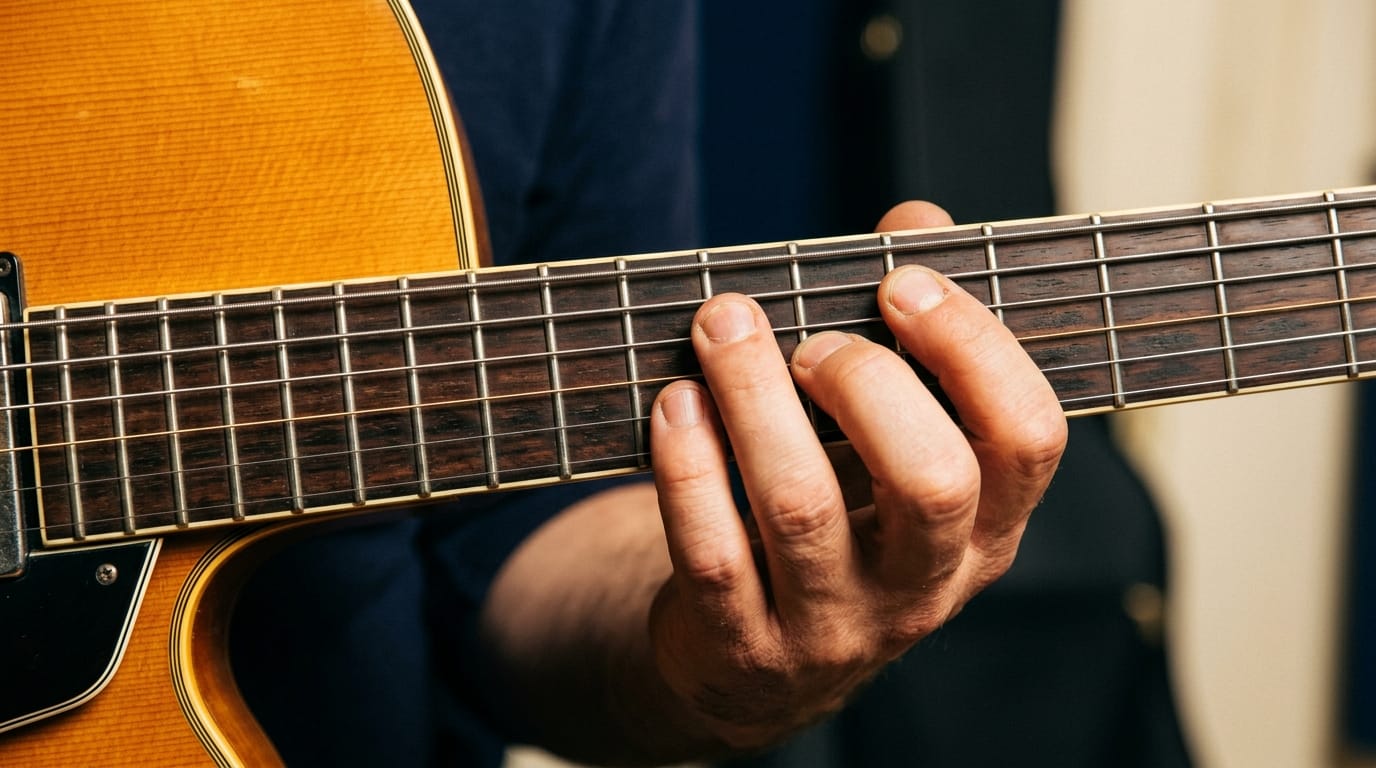
Jazz guitar chords are extended harmonies, 7ths, 9ths, 11ths, and 13ths, built on guitar-specific voicings that prioritize the guide tones (3rd and 7th) over root-position stacks. Unlike the open-string triads and power chords that dominate pop and rock guitar, jazz chords treat the instrument as a harmonic conversation partner: every note earns its place, the root is often omitted entirely, and the rhythm is comped (syncopated, interactive) rather than strummed. Jazz guitarists from the bebop era onward, including Charlie Christian and Barney Kessel, moved toward close-voiced 7th chords precisely because those voicings blended with horns without cluttering the low register.
Table of Contents
- What Makes Jazz Guitar Chords Different
- The 5 Core Jazz Chord Types: Your Foundation
- Major 7 Chords (Maj7)
- Dominant 7 Chords (7)
- Minor 7 Chords (m7)
- Minor 7♭5 Chords (Half-Diminished, ø7)
- Diminished 7 Chords (°7)
- Extensions, 9ths, 11ths, and 13ths
- Adding the 9th
- The 11th and Suspended Voicings
- The 13th
- Altered Dominant Extensions (7♭9, 7#9, 7♭13, 7#11)
- Jazz Guitar Voicings 101, Drop-2, Shell, and Rootless
- Shell Voicings (Guide Tone Chords)
- Drop-2 Voicings
- Rootless Voicings
- The Guitarist’s Adaptation Problem
- The ii-V-I Progression, Jazz’s Most Essential Chord Movement
- Voice Leading Through the ii-V-I
- The Minor ii-V-i
- Other Essential Jazz Chord Progressions for Guitar
- The Turnaround (I-VI-ii-V)
- The Jazz Blues Progression
- Rhythm Changes
- Comping Patterns, Rhythm and Feel on Guitar
- The Freddie Green Four-to-the-Bar Strum
- Syncopated Comping (The Standard Jazz Feel)
- Chord Melody Basics
- Connecting Chords to Scales and Arpeggios
- The Chord-Scale Relationship
- Arpeggios as Chord Outlines
- Using Licks Over Chord Changes
- How Jazz Guitar Voicings Evolved, A Brief History
- Freddie Green to Charlie Christian (1930s-40s)
- The Bebop Chord Vocabulary (1940s-50s)
- Joe Pass and the Chord-Melody Standard (1960s-70s)
- Modern Era, Lage, Rosenwinkel, and Extended Harmony
- Practice Routine for Beginners, 30 Minutes a Day
- The 30-Minute Structure
- Recommended Resources
- Essential Books
- Online Tools and Apps
- Recommended Listening for Chord Study
- Jazz Guitar Chords, Frequently Asked Questions
- What are the most important jazz guitar chords for beginners?
- How is a jazz guitar chord chart different from a regular chord chart?
- What jazz scales go with jazz guitar chords?
- What is the difference between drop-2 and shell voicings on guitar?
- How long does it take to learn jazz guitar chords?
- What to Learn Next
- The 5 core jazz chord types and how to finger them on guitar
- How extensions (9, 11, 13) change a chord’s character and color
- Drop-2, shell, and rootless voicings explained with practical fingering logic
- The ii-V-I progression worked through in 3 keys
- Turnaround, blues, and rhythm changes progressions for guitar
- Comping rhythms specific to guitar in small-group and big-band settings
- How jazz guitar chords connect to scales and arpeggios
- A 30-minute daily practice structure for beginners
What Makes Jazz Guitar Chords Different
Jazz guitar chords function through voice leading, not block strumming. The 3rd and 7th of any chord, called guide tones, carry its full harmonic identity. The root and 5th are so harmonically neutral that jazz guitarists routinely drop them, especially when a bassist is covering the low end. What remains is a lean, moveable shape that implies the full chord without muddying the frequency spectrum.
Every jazz chord shape on guitar is a closed-position, moveable voicing, no open strings. Slide the same shape up two frets and you’ve transposed it a whole step. This means you learn shapes and positions, not individual chords. One well-understood Maj7 shape gives you all 12 major 7 chords instantly. That’s the core efficiency of the jazz guitar approach, and it’s why the jazz guitar tradition places such emphasis on understanding chord geometry rather than memorizing isolated fingerings.
| Feature | Pop/Rock Guitar Chords | Jazz Guitar Chords |
|---|---|---|
| Typical chord type | Power chord / major triad | 7th chord minimum |
| Note count | 2-3 notes | 3-6 notes |
| Root in bass | Almost always | Often omitted |
| Open strings | Common | Rarely used |
| Rhythm feel | Strummed | Comped (syncopated) |
| Moveable shapes | Less critical | Essential |
Register matters too. Voicings above the 5th fret avoid the muddy low-end frequencies that make dense chords sound indistinct. This is why jazz comping naturally gravitates toward the middle strings, D, G, B, and high e, where chord tones ring clearly and don’t compete with the bass guitar or double bass.
The 5 Core Jazz Chord Types: Your Foundation
Every jazz standard you’ll ever play draws from five fundamental chord types. Master these and you have functional access to the harmonic language of the entire jazz repertoire. Each type has a distinct interval formula, a characteristic sound, and a specific harmonic role, and understanding all three is what separates a guitarist who knows shapes from one who actually hears the harmony.

Major 7 Chords (Maj7)
The major 7 chord uses the formula 1-3-5-7 and appears on lead sheets as Maj7, M7, or ▽7. Its sound is bright and stable, floating, almost suspended, and it functions as the I chord in major keys. In jazz, avoid the familiar open-string Cmaj7 shape; instead, use a closed 4-note voicing on the upper strings or a 3-note shell on strings 6, 4, and 3. These shapes cover basic jazz chords on guitar and form the foundation of most jazz guitar chord shapes.
Dominant 7 Chords (7)
The dominant 7 uses the formula 1-3-5-♭7 and appears as C7 or Cdom7. It’s the most harmonically active chord type in jazz: its 3rd and ♭7 form a tritone (an interval of three whole steps) that creates intense tension demanding resolution. This chord is the engine of the ii-V-I motion, the V chord that drives everything forward. Without a solid dominant 7 voicing, jazz harmony stalls.
Minor 7 Chords (m7)
The minor 7 uses the formula 1-♭3-5-♭7 and appears as Cm7, C-7, or Cmin7. Its sound is warm and introspective, less tense than the dominant, more colorful than a plain minor triad. It functions as the ii chord in major keys and the i chord in minor keys, making it one of the most common jazz guitar chords you’ll encounter in any standard. These are essential jazz guitar chords no player can skip.
Minor 7♭5 Chords (Half-Diminished, ø7)
The minor 7♭5, also called the half-diminished chord, uses the formula 1-♭3-♭5-♭7 and appears as Cm7♭5 or Cø. Its sound sits darker than a plain minor 7, unresolved and slightly unstable. This is the ii chord in minor key progressions, and it’s one of the most misunderstood chord types for beginners. Get comfortable with it early: you’ll see it constantly in minor ii-V-i progressions through standards like “Autumn Leaves.”
Diminished 7 Chords (°7)
The diminished 7 uses the formula 1-♭3-♭5-♭♭7 (that double-flat 7 equals a major 6th) and appears as C°7 or Cdim7. Its sound is maximally tense and symmetric. Here’s the practical gift: because the chord divides the octave into four equal minor thirds, the same shape repeats every 3 frets. Only 3 unique diminished 7 chord shapes exist across the entire guitar neck. That symmetry makes it one of the most physically efficient jazz chord shapes to learn, and it rewards guitarists who understand the theory behind the pattern.
Extensions, 9ths, 11ths, and 13ths
Extensions are chord tones that sit above the octave: the 9th is the 2nd an octave higher, the 11th is the 4th, and the 13th is the 6th. They don’t change a chord’s harmonic function, a G13 is still a dominant chord resolving to C, but they dramatically alter its color and sophistication. The key voice-leading principle: extensions always sit above the guide tones (3rd and 7th), never below them.

Adding the 9th
The 9th is the most immediately usable extension. Maj9, dom9, and m9 all add warmth without harmonic complexity, the chord still functions identically, just with more color. On guitar, the 9th is typically voiced on the high e or B string, one or two frets above the root shape. This makes it physically accessible without requiring a complete revoicing of the chord. Advanced jazz chords on guitar almost always include the 9th as a default color tone.
The 11th and Suspended Voicings
The natural 11th creates a problem in major and dominant contexts: it sits a tritone away from the major 3rd, producing a clash. The solution is the #11 (raised 11th), drawn from the Lydian dominant scale, which adds brightness without conflict. The natural 11th works beautifully in suspended chords (sus4), where the 3rd is absent. The 7sus4 and 13sus4 voicings became modern jazz staples, widely used by pianists like Herbie Hancock and McCoy Tyner, and guitarists adapted these voicings to strings 5 through 1 for comping in contemporary settings.
The 13th
The dom13 is theoretically the “full stack” dominant chord, but on guitar you can’t play all seven notes simultaneously. In practice, the 9th, 11th, and 5th are omitted, leaving a 3-note rootless dom13 voicing built from the 3rd, 7th, and 13th. This compact shape sits naturally in the midrange and locks perfectly under a pianist’s or bassist’s root note. Jazz chord voicings on guitar are always about choosing which tones to keep, not how many you can cram in.
Altered Dominant Extensions (7♭9, 7#9, 7♭13, 7#11)
The altered dominant chord takes a dominant 7 and raises or lowers its extensions using notes from the altered scale (also called Super Locrian). The result is maximum harmonic tension before resolution. A culturally familiar entry point: Jimi Hendrix’s “Purple Haze,” released as a single in 1967, opens with an E7#9, a documented, widely analyzed example of an altered dominant in popular music. Jazz guitarists use these same extensions constantly in minor ii-V-i progressions.
| Symbol | Extensions Added | Scale Source | Tension Level |
|---|---|---|---|
| 7♭9 | ♭9 | Half-Whole Diminished | High |
| 7#9 | #9 | Altered | High |
| 7#11 | #11 | Lydian Dominant | Medium |
| 7♭13 | ♭13 | Altered | High |
| 7alt | ♭9 or #9 + ♭5 or #5 | Altered | Maximum |
Jazz Guitar Voicings 101, Drop-2, Shell, and Rootless
A voicing system is a method for arranging the same chord tones across the guitar’s six strings, not a different chord, just a different physical layout of the same harmony. Three systems dominate jazz guitar: shell voicings, drop-2 voicings, and rootless voicings. Each serves a different musical context, and a working jazz guitarist needs all three. Let’s be honest: most beginners learn shapes without understanding the system behind them, which is why their chord vocabulary stalls after a dozen shapes.
Shell Voicings (Guide Tone Chords)
Shell voicings use just three notes: root, 3rd, and 7th. The 5th is omitted entirely. Why does this work? Because the tritone relationship between the 3rd and 7th in a dominant chord carries the full harmonic information, the ear hears the function without needing the 5th. Two shell shapes per chord quality (1-3-7 and 1-7-3 inversions) give you a complete jazz guitar chord chart in miniature. These are ideal for trio or quartet settings where the bassist covers the root, and they’re the fastest-moving voicings for quick-changing progressions.
Drop-2 Voicings
Drop-2 is the standard voicing system in every major jazz guitar method, including Ted Greene’s Chord Chemistry and William Leavitt’s A Modern Method for Guitar (Berklee Press). The concept: take a close-position 4-note chord, then drop the second-highest note down one octave. The result spreads the chord across 4 adjacent strings in a physically comfortable way. Close-position clusters are nearly impossible to fret on guitar; drop-2 solves that problem elegantly. A Cmaj7 in close position (E-G-B-C from bottom to top) becomes a drop-2 voicing with C on the 5th string, G on the 3rd, B on the 2nd, and E on the 1st, a natural, graspable shape.

Rootless Voicings
Rootless voicings omit the root entirely, keeping the 3rd, 7th, 9th, and sometimes the 13th. In a band context with a bassist, the guitarist’s rootless voicing sits in the midrange and doesn’t compete with bass frequencies. There’s also an elegant theoretical shortcut here: rootless voicings can be understood as upper structure triads, a simple triad built on the 3rd or 7th of the underlying chord. For example, a B major triad voiced over a G7 chord produces a G7#11 sound. Advanced jazz guitar chords often work this way, layering simple shapes to create complex harmony.
The Guitarist’s Adaptation Problem
Here’s the thing that piano-based jazz theory books won’t tell you: their voicing systems don’t translate directly to guitar. A pianist has 10 independent fingers spanning 5-plus octaves; a guitarist has 4 fretting fingers across 6 strings with a range of roughly 3.5 octaves in practical playing position. The consequence is that jazz guitarists must constantly choose which chord tones to prioritize. The rule is consistent: 3rd and 7th always, root when necessary, extensions when space permits. As jazz educators have noted, studying how pianists voice chords, then adapting that logic to the guitar’s physical constraints, is the most direct path to sophisticated jazz guitar voicings.
The ii-V-I Progression, Jazz’s Most Essential Chord Movement
The ii-V-I is the fundamental harmonic unit of jazz. It appears in virtually every standard in the repertoire, and fluency with it in multiple keys is the single most important technical benchmark for a developing jazz guitarist. The function is straightforward: the ii chord (minor 7) creates mild tension, the V chord (dominant 7) creates maximum tension, and the I chord (major 7) resolves. Mark Levine’s The Jazz Theory Book (Sher Music, 1995), the most widely cited jazz theory text in accredited programs, documents this progression as the bedrock of bebop and post-bop harmony.
All three chords in a ii-V-I derive from the same parent major scale. In C major: Dm7 (ii), G7 (V), Cmaj7 (I). Every note in all three chords comes from the C major scale. That diatonic unity is why the progression sounds so inevitable, and why it’s the ideal framework for connecting jazz chord progressions to scale and arpeggio study.
Here are the three essential keys every guitarist should internalize first:
- Key of C: Dm7 – G7 – Cmaj7 (common position, 5th-string root shapes)
- Key of F: Gm7 – C7 – Fmaj7 (5th-string root shapes, moves logically up the neck)
- Key of B♭: Cm7 – F7 – B♭maj7 (a horn-friendly key; essential for playing with saxophonists and trumpeters)
Voice Leading Through the ii-V-I
Here’s what makes the ii-V-I so elegant at the harmonic level: the 3rd of the ii chord becomes the 7th of the V chord, and the 7th of the ii chord becomes the 3rd of the V chord. They swap roles. This creates smooth, stepwise voice movement, often just a half-step shift between chords, which is the foundation of professional comping. Play a Dm7 shell voicing, then a G7 shell: notice the top voice moves by a single semitone. That’s voice leading in action, and it’s what separates chord-to-chord playing from genuine jazz harmony.
The Minor ii-V-i
The minor version of the progression, Dm7♭5 – G7alt – Cm(maj7), introduces both the half-diminished chord and the altered dominant in their natural habitat. The altered G7 (voiced as 7♭9 or 7#9) is the idiomatic choice in minor progressions, supported by analysis of standards including “Autumn Leaves” and “Alone Together,” both widely published in The Real Book (Hal Leonard). The minor ii-V-i is where jazz guitar chord progressions get genuinely complex, and where your altered dominant voicings earn their keep.
Other Essential Jazz Chord Progressions for Guitar
Beyond the ii-V-I, three progressions appear so frequently in jazz standards that fluency with them is non-negotiable. Each one builds directly on the chord types and voicings covered above, they’re not new vocabulary, just new arrangements of familiar material. Working through these jazz chord progressions on guitar will unlock the majority of the standard repertoire.
The Turnaround (I-VI-ii-V)
The turnaround is the most common 4-bar cycle in jazz standards. It appears in “All The Things You Are,” “Autumn Leaves,” “There Will Never Be Another You,” and dozens more. In C major: Cmaj7 – Am7 – Dm7 – G7. A guitarist can cycle through this using only 6th-string-root shell voicings, moving in a logical descending path down the neck. The chromatic variation, substituting tritone-related dominant chords for the VI and I (Cmaj7 – E♭7 – A♭maj7 – D♭7), introduces the concept of tritone substitution, where a dominant chord is replaced by the dominant chord whose root sits a tritone away. Same resolution function, far more harmonic color.
The Jazz Blues Progression
The 12-bar jazz blues differs fundamentally from its rock counterpart. It uses a IV7 chord in bar 2 (not bar 5), a ♭VII7 turnaround substitution, and a ii-V-I in the final 4 bars. The most common jazz blues key is B♭, horn-friendly and deeply embedded in the tradition. Wes Montgomery, whose The Incredible Jazz Guitar of Wes Montgomery was recorded for Riverside Records in January 1960, demonstrates jazz blues comping at its highest level. That album has since been inducted into the National Recording Registry, a testament to its enduring influence on jazz guitar chord progressions.
| Bar | Chord (Key of B♭) | Function |
|---|---|---|
| 1 | B♭7 | I7 (tonic dominant) |
| 2 | E♭7 | IV7 |
| 3 | B♭7 | I7 |
| 4 | B♭7 | I7 |
| 5 | E♭7 | IV7 |
| 6 | E♭7 | IV7 |
| 7 | B♭7 | I7 |
| 8 | G7 | VI7 (secondary dominant) |
| 9 | Cm7 | ii |
| 10 | F7 | V7 |
| 11 | B♭7 | I7 |
| 12 | Cm7 – F7 | ii-V turnaround |
Rhythm Changes
Rhythm changes are built on the harmonic sequence of George Gershwin’s “I Got Rhythm,” published in 1930 for the musical Girl Crazy. The A section (repeated twice in a 32-bar AABA form) cycles through I-VI-ii-V. The B section (the bridge) moves through four dominant 7 chords, each a 4th apart: III7 – VI7 – II7 – V7. In B♭, that’s D7 – G7 – C7 – F7. Fluency with rhythm changes is considered a benchmark of jazz competence, and the bridge’s four consecutive dominant 7 chords are an ideal context for practicing altered extensions and tritone substitutions. Common jazz chords on guitar don’t get a more demanding workout than this.
Comping Patterns, Rhythm and Feel on Guitar
Comping, short for accompanying, is the art of supporting a soloist or singer with rhythmically active, harmonically responsive chord playing. It’s distinct from strumming: a comping guitarist listens, reacts, and leaves space. The rhythmic placement of chords matters as much as the voicings themselves. These jazz guitar exercises in rhythm are where theory meets feel.
The Freddie Green Four-to-the-Bar Strum
Freddie Green (1911-1987), the rhythm guitarist of the Count Basie Orchestra for nearly five decades, played four quarter-note chords per bar on acoustic guitar, a technique that functioned more as percussion than harmony. His voicings were often just 2 or 3 strings, chosen for attack and blend rather than color. The biography Rhythm Is My Beat: Jazz Guitar Great Freddie Green and the Count Basie Band documents this approach in detail. In modern contexts, four-to-the-bar comping suits big band settings and duo situations where the guitarist needs to provide a rhythmic foundation.
Syncopated Comping (The Standard Jazz Feel)
In small-group jazz, the rule is simple: avoid beats 1 and 3. Those are the bassist’s domain. A jazz guitarist’s chord stabs land on the “and” of 2, beat 4, the “and” of 4, and other syncopated positions. The most fundamental rhythmic cell is the Charleston rhythm, a chord on beat 1 followed by a chord on the “and” of 2, but in practice, good comping varies constantly, responding to the soloist rather than repeating a fixed pattern. Think of it as rhythmic conversation, not rhythmic wallpaper.
Chord Melody Basics
Chord melody is the technique of playing the melody note always on top of the voicing, so the guitarist simultaneously carries both the tune and the harmony. It’s a complete solo guitar approach, no bassist, no pianist needed. Joe Pass brought this technique to its highest documented form on Virtuoso (Pablo Records, 1973), a solo guitar recording that critics widely regard as one of the most complete statements in jazz guitar history. Chord melody deserves its own deep study; for now, the key principle is that your melody note always sits on the highest string of the voicing, and the chord below it supports rather than obscures it.
Connecting Chords to Scales and Arpeggios
Most jazz guitar chord articles stop at the voicings. This one doesn’t. Every chord type maps directly to a parent scale and a corresponding arpeggio pattern, and understanding those connections is what allows you to move fluidly between comping and soloing over the same progression. Jazz guitar scales, jazz guitar arpeggios, and jazz guitar licks aren’t separate subjects. They’re the same harmonic information expressed in three different ways.
The Chord-Scale Relationship
Each chord type has a parent scale that shares its characteristic tones. When you improvise over a chord using its parent scale, every note you play is harmonically justified. This is the foundation of modal jazz thinking, and it applies equally to chord-based playing. The table below is the most actionable chord-scale reference a jazz guitarist can have in a single view.
| Chord Type | Parent Scale | Key Characteristic |
|---|---|---|
| Major 7 | Ionian (Major) | Natural 7th, bright sound |
| Dominant 7 | Mixolydian | Same as major, ♭7 |
| Minor 7 | Dorian | Minor with raised 6th |
| Minor 7♭5 | Locrian | ♭2, ♭5, darkest mode |
| Diminished 7 | Half-Whole Diminished | Symmetrical, alternating H-W steps |
| Dominant 7alt | Altered (Super Locrian) | All extensions altered |
For a deeper look at how these scales work across the fretboard, the jazz scales guide covers all seven essential patterns with practical fingering systems.
Arpeggios as Chord Outlines
A jazz guitar arpeggio is simply the chord tones played in sequence, one note at a time. It makes the chord sound melodic. When you play a Dm7 arpeggio over a Dm7 chord, every note is a chord tone, maximum harmonic clarity. The standard approach uses three arpeggio shapes per chord type (root on the 6th string, 5th string, and 4th string), giving you coverage across the entire neck. Mick Goodrick’s The Advancing Guitarist (Hal Leonard) presents this three-shapes system as a foundational framework for connecting chord knowledge to single-note playing.
Using Licks Over Chord Changes
A jazz guitar lick is a short melodic phrase derived from the parent scale or arpeggio of the chord it’s played over. It implies the harmony without stating it as a block chord. A G7alt lick, for example, draws from the G altered scale, which is identical to the A♭ melodic minor scale starting from G. The notes sound chromatic and tense, perfectly matching the altered dominant’s harmonic character. Learning to connect licks to specific chord types is how jazz guitar improvisation develops from scale-running into genuine melodic expression. For more on this, the jazz improvisation guide covers the full framework.
How Jazz Guitar Voicings Evolved, A Brief History
Jazz guitar chord vocabulary didn’t arrive fully formed. It evolved across decades, shaped by amplification technology, bebop’s harmonic demands, and individual players who pushed the instrument into new territory. Understanding this history gives you context for why certain voicings exist, and why they work.
Freddie Green to Charlie Christian (1930s-40s)
Freddie Green defined the rhythm guitar role in the swing era: chords as percussion, minimal voicing color, four-to-the-bar pulse. His guitar was the heartbeat of the Count Basie Orchestra. Then amplification changed everything. Charlie Christian, who joined Benny Goodman’s Sextet in 1939, used the electric guitar’s new projection to introduce single-note lines and harmonically active chord work. He won DownBeat’s best guitarist poll for three consecutive years, a documented measure of his immediate impact on the jazz world.
The Bebop Chord Vocabulary (1940s-50s)
Bebop guitarists adopted dense 4-note voicings modeled on piano bebop harmony. Barney Kessel, known particularly for his knowledge of chords and inversions, became a first-call studio musician in Los Angeles while maintaining a serious jazz career. Tal Farlow, nicknamed “Octopus” for his large, quick hands, and Jimmy Raney, who won the DownBeat Critics’ Poll for guitar in 1954 and 1955, both pushed the harmonic vocabulary of the instrument into bebop territory through recordings on Verve and Prestige.
Joe Pass and the Chord-Melody Standard (1960s-70s)
Joe Pass established chord-melody playing as a complete art form with Virtuoso (Pablo Records, 1973), a solo guitar recording of jazz standards that demonstrated the guitar could function as a fully self-sufficient jazz instrument. Pass won a Grammy Award for Best Jazz Performance by a Group at the Grammy Awards of 1975 for The Trio with Oscar Peterson, but Virtuoso remains his most influential statement on guitar harmony. Critics widely regard it as one of the few classic jazz albums produced in the 1970s.
Modern Era, Lage, Rosenwinkel, and Extended Harmony
Kurt Rosenwinkel, who attended Berklee College of Music, brought extended and quartal harmony to the forefront of modern jazz guitar with albums such as The Enemies of Energy (Verve, 2000). Julian Lage, who performed at the Grammy Awards at age 12 and signed with Blue Note Records in 2021, represents a generation that synthesizes traditional chord vocabulary with contemporary extended harmony. Both players’ voicing approaches are transcribed in published Hal Leonard folios, making their innovations accessible to studying guitarists.
Practice Routine for Beginners, 30 Minutes a Day
Thirty focused minutes beats two unfocused hours. Research published in music education journals consistently shows that slow, deliberate practice produces faster retention than extended sessions without clear targets. The structure below applies that principle directly to basic jazz chords on guitar, building from isolated shapes to applied comping within a single session.
The 30-Minute Structure
| Time Block | Activity | Focus |
|---|---|---|
| 0-5 min | Warm-up | Major scale on one string, all 12 positions |
| 5-10 min | Shell voicings drill | ii-V-I in one key, both root positions |
| 10-15 min | Drop-2 voicings | One chord quality, one string set |
| 15-20 min | Progression practice | Full ii-V-I in 3 keys |
| 20-25 min | Arpeggio/scale connection | One chord type → parent scale → 2-bar lick |
| 25-30 min | Applied comping | Play along with a slow standard (50-60 BPM) |
Rotate keys systematically through the circle of 5ths, cover all 12 keys across 12 practice sessions. Recommended tempos: shell voicing drills at 60 BPM, progression practice at 70-80 BPM, and free comping at 100-120 BPM once the shapes feel secure under your fingers. Never practice faster than you can play cleanly. Speed is a byproduct of accuracy, not a goal in itself.
The arpeggio-to-lick segment (minutes 20-25) is the section most beginners skip, and it’s the most important for connecting jazz guitar chords to actual improvisation. Even a single 2-bar phrase derived from a Dm7 arpeggio, practiced slowly over a backing track, builds the neural connection between harmony and melody that defines jazz musicianship.
Recommended Resources
The resources below are verifiable, commercially available, and consistently cited in jazz education contexts. No invented tools, no unnamed “specialists”, just the books and apps that working jazz guitarists actually use.
Essential Books
- Ted Greene, Chord Chemistry (Alfred Publishing): the most complete single-volume jazz guitar chord reference available, covering hundreds of voicings with clear diagrams and theoretical context. Greene (1946-2005) was renowned worldwide as the author of this text.
- Mark Levine, The Jazz Theory Book (Sher Music, 1995): the standard jazz theory reference cited in virtually every accredited jazz program. Levine (1938-2022) was an American jazz pianist and educator whose book remains the definitive theoretical foundation for jazz musicians of all instruments.
- Mickey Baker, Complete Course in Jazz Guitar: the foundational beginner-to-intermediate method, continuously in print since the mid-1950s. Baker (1925-2012) was an American musician and studio guitarist whose instructional approach remains practical and direct.
- William Leavitt, A Modern Method for Guitar (Berklee Press): the standard Berklee curriculum text. Leavitt (1926-1990) chaired Berklee’s Guitar Department from 1965 to 1990 and shaped guitar pedagogy at the college level for a generation of players.
- Mick Goodrick, The Advancing Guitarist (Hal Leonard): a conceptual approach to the guitar that connects chord knowledge, scale patterns, and arpeggio systems into a unified framework. Goodrick (1945-2022) spent most of his career as a teacher and is widely regarded as one of the most influential mentors in jazz guitar history.
Online Tools and Apps
- iReal Pro: the industry-standard backing track app used by professional musicians worldwide. It generates play-along tracks for any standard in any key and tempo, making it the most practical tool for applied comping practice. Widely documented in the jazz press as an essential practice companion.
- Fretboard Warrior: a free web app for fretboard note memorization. Knowing where every note lives on the neck is a prerequisite for transposing jazz chord shapes fluently across all 12 keys.
Recommended Listening for Chord Study
Theory makes more sense when you hear it in context. These recordings are the canonical listening examples for jazz guitar chord study:
- Joe Pass, Virtuoso (Pablo Records, 1973): solo guitar chord melody at its most complete
- Wes Montgomery, The Incredible Jazz Guitar of Wes Montgomery (Riverside Records, 1960): comping, chord melody, and single-note lines in perfect balance
- Jim Hall & Bill Evans, Undercurrent (United Artists Jazz, 1962): a masterclass in sparse, voice-led guitar comping alongside piano
For a broader listening map, the 50 best jazz albums of all time includes several essential guitar records with context on what makes each one worth studying.
Jazz Guitar Chords, Frequently Asked Questions
What are the most important jazz guitar chords for beginners?
The four essential starting points are Maj7, dominant 7, minor 7, and minor 7♭5, these four types cover the vast majority of chord symbols you’ll encounter in standard jazz repertoire. Shell voicings (root + 3rd + 7th) of these four types, learned in both 6th-string and 5th-string root positions, give a beginner guitarist functional access to most jazz standards. With focused 30-minute daily practice, most players with basic guitar fluency can build working versions of these basic jazz chords on guitar within 4-6 weeks.
How is a jazz guitar chord chart different from a regular chord chart?
A jazz guitar chord chart presents moveable, closed-position shapes organized by chord quality (Maj7, dom7, m7, etc.) rather than by key. Because all jazz shapes are transposable, a single shape at fret 3 in one diagram becomes every one of the 12 major 7 chords simply by sliding up or down the neck. A regular chord chart, by contrast, shows open-string shapes in specific keys, shapes that don’t move and don’t apply to jazz harmony. The jazz guitar chord chart is a system; the regular chord chart is a key-specific reference.
What jazz scales go with jazz guitar chords?
Each chord type pairs with a corresponding parent scale: major 7 with Ionian, dominant 7 with Mixolydian, minor 7 with Dorian, minor 7♭5 with Locrian, and dominant 7alt with the Altered (Super Locrian) scale. Learning these pairings allows a guitarist to move fluidly between chord voicings and single-note improvisation over the same progression, the chord and the scale are two expressions of the same harmonic information. Jazz guitar scales and jazz guitar chords are the same subject viewed from different angles.
What is the difference between drop-2 and shell voicings on guitar?
Shell voicings use only 3 notes (root, 3rd, 7th) and prioritize harmonic clarity and speed of movement between chords. Drop-2 voicings use 4 notes spread across 4 adjacent strings by dropping the second-highest note of a close-position chord down one octave, they’re richer harmonically but require more precise fingering. Shells are ideal for fast-moving progressions and quick-changing standards; drop-2 voicings suit slower, more harmonic contexts like ballads and chord-melody arrangements. Most working jazz guitarists use both, switching based on musical context.
How long does it take to learn jazz guitar chords?
A player with basic guitar fluency can learn functional shell voicings for the four core chord types in roughly 4-6 weeks of 30-minute daily practice. Reaching comfortable drop-2 voicing fluency across all 12 keys typically takes 6-12 months of consistent work. Full command of extensions, altered voicings, and rootless upper structures is a multi-year study, consistent with the learning timelines documented in Berklee Online curriculum materials. The good news: you can play real jazz standards with just shell voicings, so the entry point is much closer than most beginners expect.
What to Learn Next
Jazz guitar chords are the foundation, but the real fluency comes from applying them in motion. If you’ve built solid shell voicings, the next step is working through jazz chord progressions in all 12 keys with a backing track. If single-note lines are calling, the jazz scales guide maps every parent scale covered in this article to practical fretboard patterns. And if you want to study the players who built this vocabulary from the ground up, the profiles of the greatest jazz guitarists connect historical context to specific recordings worth transcribing. Pick one direction, go deep, and bring what you learn back to the chord shapes, that cycle of theory, listening, and application is how jazz guitar actually develops.