Jazz Fusion: The Complete Guide to Origins, Sound, and Essential Listening
Jazz fusion is a music genre that emerged between approximately 1965 and 1970 by blending jazz harmony and improvisation with the rhythms and electric instrumentation of rock, funk, and R&B. Where traditional jazz relied on acoustic instruments and swing-feel rhythms, jazz fusion plugged in, turned up, and absorbed the energy of a generation raised on Jimi Hendrix and James Brown. The result was one of the most technically demanding and culturally charged genres in American music history, and its influence runs through everything from hip-hop production to modern film scoring.
Table of Contents
- What You’ll Learn in This Guide
- The Origin Story: How Jazz Fusion Emerged (1965-1970)
- The Cultural Context That Made Fusion Possible
- Miles Davis and the Electric Turn
- The Bands That Followed Davis’s Lead
- Jazz Fusion History: Key Dates
- Defining Characteristics of Jazz Fusion
- Fusion Jazz Characteristics: The Core Elements
- What Makes Jazz Fusion “Jazz” (Not Just Rock)
- Jazz Fusion vs. Traditional Jazz: Quick Comparison
- Key Instruments in Jazz Fusion
- Keyboards
- Guitar
- Bass
- Drums
- Winds and Additional Colors
- Subgenres and Variants of Jazz Fusion
- Jazz-Rock Fusion
- Jazz-Funk Fusion
- Latin Jazz Fusion
- Electronic Jazz Fusion
- Progressive Jazz Fusion
- Smooth Jazz: And How It Differs from Jazz Fusion
- Indian and Global Jazz Fusion
- Hip-Hop Jazz Fusion
- The Defining Bands and Players
- Miles Davis
- Weather Report
- Return to Forever
- Mahavishnu Orchestra
- Herbie Hancock’s Headhunters
- Pat Metheny Group
- Essential Jazz Fusion Albums: The Seven Foundational Records
- Jazz Fusion Theory Primer: Scales, Chords, and the Modal Approach
- Jazz Fusion Scales
- Jazz Fusion Chord Progressions
- The Modal Approach in Context
- The Decline and the Modern Revival
- The 1980s: Commercialization and the Smooth Jazz Divergence
- The Underground Persistence
- The 21st-Century Revival
- Why Jazz Fusion Still Matters
- Frequently Asked Questions About Jazz Fusion
- What is jazz fusion music?
- When did jazz fusion start?
- Why was jazz fusion controversial?
- Is jazz fusion considered real jazz?
- What is the most famous jazz fusion band?
- Start Here, Then Go Deeper
The Origin Story: How Jazz Fusion Emerged (1965-1970)
Jazz fusion didn’t appear overnight. It grew from a specific collision of cultural forces in the mid-to-late 1960s, when rock music was getting smarter and jazz musicians were getting restless. Understanding that collision is the fastest way to understand what jazz fusion actually is and why it sounded so radical when it first appeared.
The Cultural Context That Made Fusion Possible
By the mid-1960s, rock music had outgrown its three-chord origins. Jimi Hendrix’s Are You Experienced (1967) demonstrated that electric guitar could carry harmonic and textural complexity previously associated with jazz. Cream brought extended improvisation to rock audiences. Sly and the Family Stone fused funk, soul, and psychedelia into something that felt genuinely new. Jazz audiences were shrinking while rock audiences were exploding, and young jazz musicians were listening hard to what was happening on the other side of the fence.
The pressure was both artistic and commercial. Jazz had spent the early 1960s pushing into increasingly abstract territory with free jazz and avant-garde experimentation. Some musicians wanted to reconnect with a broader audience without abandoning the improvisational depth that made jazz worth playing. Rock offered a solution: its rhythms were visceral and immediate, its electric instruments were loud and expressive, and its audiences were hungry for something more sophisticated than pop radio. The crossover was almost inevitable.
Miles Davis and the Electric Turn
No single musician drove the birth of jazz fusion more directly than Miles Davis. His Second Great Quintet, featuring Wayne Shorter, Herbie Hancock, Ron Carter, and Tony Williams, had already pushed post-bop to its outer limits by the mid-1960s. By 1968, Davis was ready to go further. Miles in the Sky (1968) marked the first appearance of electric piano on a Davis studio album, with Hancock playing Fender Rhodes on the track “Stuff.” Filles de Kilimanjaro (1968) continued the electric integration, with Chick Corea and Dave Holland joining the sessions.
The decisive leap came with In a Silent Way, recorded in a single session on February 18, 1969, at CBS 30th Street Studio in New York City. Producer Teo Macero edited hours of session footage down to two side-length tracks, using tape-splicing as a compositional tool in its own right. The personnel included Chick Corea, Herbie Hancock, and Joe Zawinul on three electric keyboards simultaneously, with John McLaughlin on electric guitar introducing rock texture without rock aggression. The album is widely regarded as the first fully realized jazz fusion recording.
Then came Bitches Brew (1970, Columbia). A double LP featuring 13 musicians, multiple electric keyboards, two bass guitars, and two drummers playing simultaneously, it was unlike anything jazz had produced before. As the Carnegie Hall Timeline of African American Music documents, Davis was directly inspired by Jimi Hendrix’s electric experimentation, and Chick Corea has described Davis as sensing early that something big was shifting in the culture. Bitches Brew went on to earn RIAA Platinum certification and won the Grammy Award for Best Large Jazz Ensemble Album in 1971. According to JazzTimes, it remains one of the most influential jazz albums of the 20th century.

The Bands That Followed Davis’s Lead
Davis’s electric experiments functioned as a permission slip for a generation of musicians. Tony Williams, Davis’s former drummer, formed the Tony Williams Lifetime in 1969 with guitarist John McLaughlin and organist Larry Young, releasing Emergency! on Polydor that same year. The album brought proto-metal energy into direct contact with jazz freedom. McLaughlin then formed the Mahavishnu Orchestra in 1971, with drummer Billy Cobham and keyboardist Jan Hammer, pushing jazz-rock fusion into its most technically extreme form with asymmetric time signatures and twin-neck guitar. Weather Report, founded in 1970 by Austrian keyboardist Joe Zawinul, took a more impressionistic, textural approach. Return to Forever, Chick Corea’s primary group vehicle from 1972, evolved through multiple lineups ranging from Latin-acoustic to hard-rock electric. Each band pulled the genre in a distinct direction from a single trunk.
Jazz Fusion History: Key Dates
| Year | Event |
|---|---|
| 1967 | Jimi Hendrix, Are You Experienced, Davis hears it repeatedly |
| 1968 | Miles in the Sky, first Fender Rhodes on a Davis studio album |
| 1969 | In a Silent Way; Tony Williams Lifetime, Emergency! |
| 1970 | Bitches Brew; Weather Report founded |
| 1971 | Mahavishnu Orchestra founded; The Inner Mounting Flame |
| 1972 | Return to Forever founded |
| 1973 | Herbie Hancock, Head Hunters; Billy Cobham, Spectrum; Return to Forever, Light as a Feather |
Defining Characteristics of Jazz Fusion
Jazz fusion has a specific, identifiable sound. It’s not simply jazz played loudly, and it’s not rock with jazz solos dropped in. The genre has a coherent set of characteristics that distinguish it from both parent traditions, and understanding those characteristics is the key to recognizing it on first listen.
Fusion Jazz Characteristics: The Core Elements
Here are the defining features that appear consistently across jazz fusion recordings, from Bitches Brew to Heavy Weather to Head Hunters:
- Electric Instrumentation. The Fender Rhodes electric piano, electric guitar (often with distortion or wah-wah pedal), electric bass guitar, and synthesizers replace or augment their acoustic counterparts. The sonic palette shifts from warm wood and brass to amplified, processed, and sometimes distorted tones.
- Rock and Funk Rhythms. The swing feel driven by ride cymbal, the defining rhythmic signature of bebop and hard bop, gives way to a backbeat emphasis, syncopated funk grooves, and heavier snare and kick drum patterns borrowed from rock and R&B.
- Modal and Post-Bop Harmony. Fusion typically uses fewer chord changes per bar than bebop. Open modal vamps allow improvisers to explore a single harmonic region for extended periods, following the approach Miles Davis established on Kind of Blue (1959) but applying it at higher volume and faster tempos.
- Virtuoso Improvisation. Technical complexity remains central. Extended solos over static or slowly-evolving harmonic backdrops are the norm, not the exception. Fusion musicians are, almost without exception, among the most technically accomplished players in jazz history.
- Extended Composition and Form. Pieces routinely run 10 to 20 minutes. The 32-bar AABA standard form common in bebop largely disappears, replaced by through-composed sections, open vamps, and hybrid structures that mix written material with collective improvisation.
- Polyrhythm and Odd Meters. The Mahavishnu Orchestra’s use of 5/8, 7/8, 9/8, and 10/8 time signatures became a signature of the genre’s most ambitious wing. Layered rhythmic structures, with different instruments implying different meters simultaneously, create a density absent from most rock.
- Studio as Instrument. Producer Teo Macero’s tape-editing on Davis recordings, including overdubbing, looping, and splicing techniques borrowed from rock production, made the studio itself a compositional tool rather than simply a recording space.
What Makes Jazz Fusion “Jazz” (Not Just Rock)
Here’s the thing: critics debated this question vigorously in the 1970s, and the debate was real. The answer is improvisation. In jazz fusion, improvisation isn’t ornamental. It’s structurally central, the primary vehicle for musical expression, not a brief guitar solo between verses. The harmonic sophistication also persists beneath the electric surface: jazz-derived chord voicings, substitutions, and modal frameworks remain the language musicians speak, even when the rhythm section sounds like a rock band. George Duke, who played with Frank Zappa and led his own fusion groups, articulated the underlying philosophy clearly in published interviews: he believed it was both possible and necessary for good music to communicate with a broad audience without sacrificing artistic integrity.
Jazz Fusion vs. Traditional Jazz: Quick Comparison
| Feature | Traditional Jazz | Jazz Fusion |
|---|---|---|
| Instrumentation | Acoustic (piano, upright bass, horns) | Electric (Rhodes, synth, bass guitar, amplified guitar) |
| Rhythm | Swing feel, ride cymbal-driven | Rock/funk backbeat, heavier kick and snare |
| Harmony | Complex bebop changes or standards | Modal vamps, fewer changes, open forms |
| Song length | 3-6 minutes (studio); longer live | Often 10-20+ minutes |
| Improvisation | Central | Central |
| Production | Live-to-tape, minimal post-production | Overdubbing, looping, editing common |
Key Instruments in Jazz Fusion
The instruments of jazz fusion tell the story of the genre’s hybrid identity. Each one carries a specific sonic role, and together they create the dense, layered texture that distinguishes fusion from both acoustic jazz and straight rock. If you want to understand the genre’s sound, start here.

Keyboards
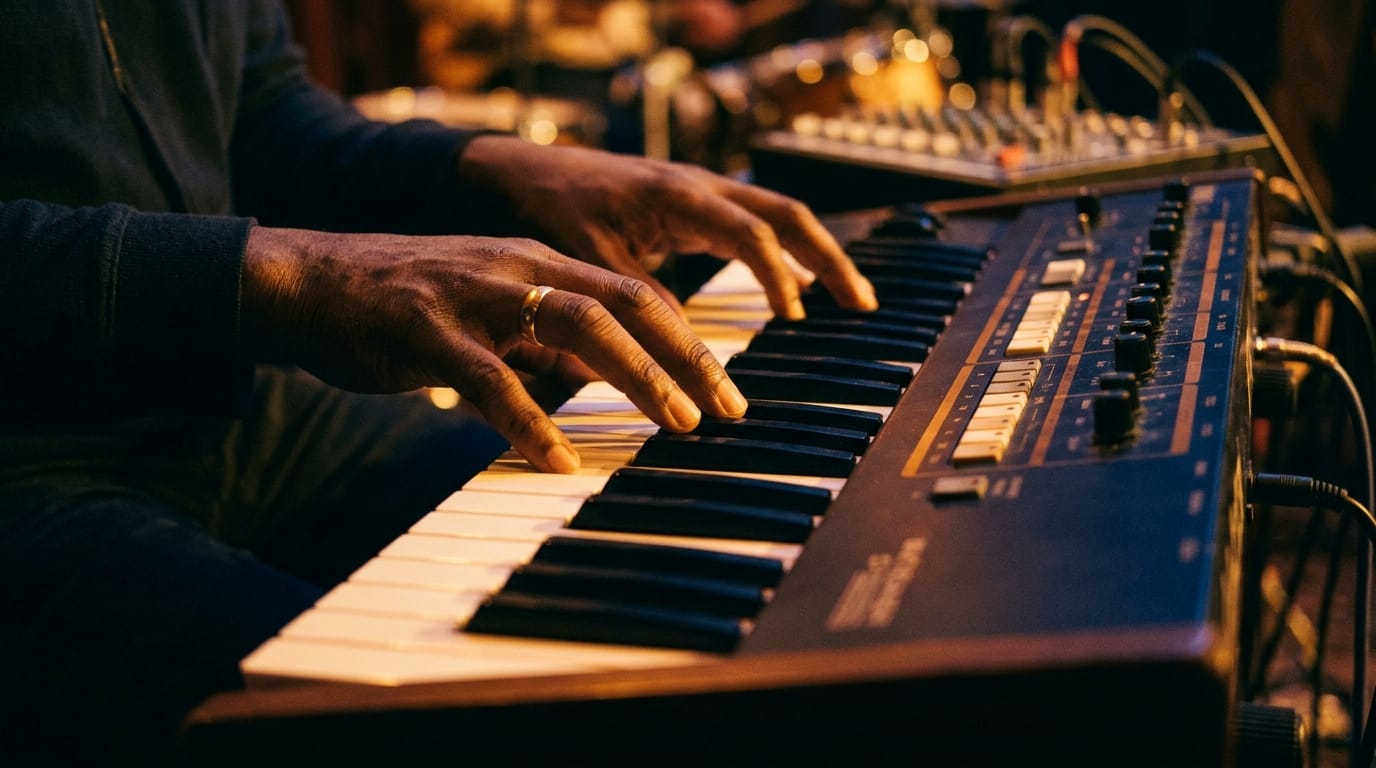
The Fender Rhodes Stage Piano is the signature keyboard voice of jazz fusion. Its warm, bell-like electric tone appears throughout the genre’s foundational recordings: Herbie Hancock plays it throughout Head Hunters, Joe Zawinul uses it as a primary voice in Weather Report, and Chick Corea’s Rhodes work on the early Return to Forever albums defined the instrument’s expressive range. The Rhodes sounds nothing like an acoustic piano. It sustains differently, responds to touch in a more percussive way, and takes effects pedals beautifully.
Synthesizers arrived quickly. Jan Hammer (Mahavishnu Orchestra) and Joe Zawinul (Weather Report) both exploited the ARP 2600 and Minimoog for monophonic lead lines, bass tones, and textural pads. The Hammond B-3 organ, played by Larry Young in the Tony Williams Lifetime, bridged the soul-jazz and fusion worlds with its sustained, harmonically rich tone. By the late 1970s, polyphonic synthesizers were adding orchestral density to fusion recordings that no acoustic ensemble could have produced.
Guitar
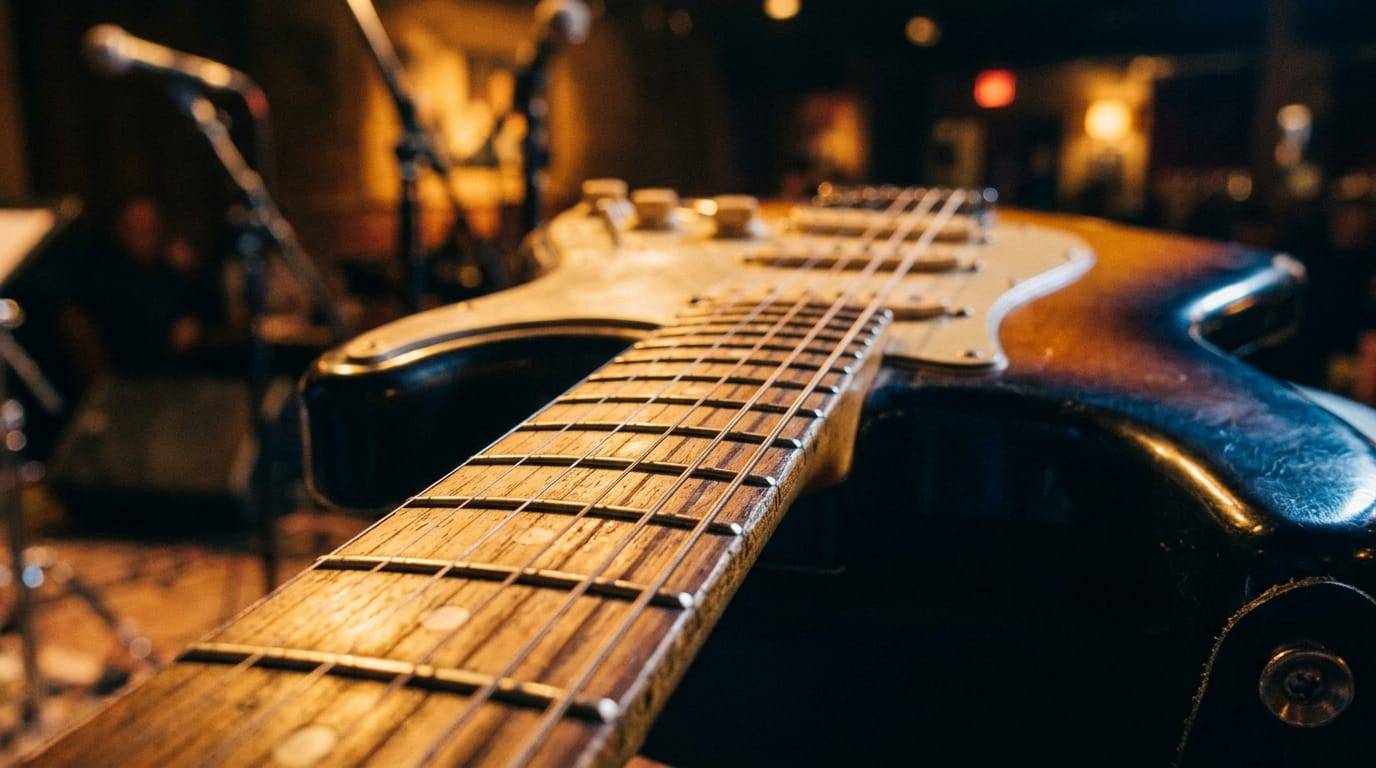
Jazz fusion transformed the guitar’s role. In traditional jazz, the guitar comps quietly behind soloists, playing clean chords on a hollow-body instrument. In fusion, the guitar becomes an equal lead voice, often amplified with distortion and processed through wah-wah pedals. John McLaughlin played a twin-neck Gibson EDS-1275 with the Mahavishnu Orchestra, switching between six and twelve strings mid-performance. Pat Metheny brought a more lyrical, melodic approach. Larry Coryell, John Scofield, and Allan Holdsworth each developed distinct fusion guitar vocabularies that influenced generations of players after them.
Bass
Electric bass guitar replaced the upright bass almost entirely in hard-fusion contexts. The instrument’s ceiling was raised permanently by Jaco Pastorius, who joined Weather Report in 1976 and played a fretless electric bass with a melodic fluency and harmonic awareness that had never been heard on the instrument before. His bassline on “Birdland” from Heavy Weather (1977) remains one of the most studied bass parts in jazz education. Stanley Clarke of Return to Forever brought both upright and electric bass to the genre, adding a percussive slap technique that pushed the instrument into lead-voice territory.
Drums
Fusion drumming demands a rock-influenced kit setup: larger bass drums, heavier cymbals, more tom-toms than a bebop drummer would typically use. Billy Cobham of the Mahavishnu Orchestra played with an ambidextrous, open-handed technique that generated extraordinary power and speed simultaneously. His solo album Spectrum (1973, recorded at Electric Lady Studios in New York) remains a benchmark of fusion drumming technique. Tony Williams was the transition figure, applying his bebop polyrhythm vocabulary to rock-volume contexts and proving that the two approaches weren’t mutually exclusive.
Winds and Additional Colors
Saxophone stayed in the mix. Wayne Shorter’s soprano saxophone served as Weather Report’s primary melodic voice, its bright, slightly nasal tone cutting through dense keyboard and bass textures. Miles Davis processed his trumpet through a wah-wah pedal on Bitches Brew and On the Corner (1972), creating a sound that was simultaneously recognizable as trumpet and alien to the jazz tradition. Violinist Jean-Luc Ponty brought classical bowing technique into fusion contexts, recording multiple albums that demonstrated the instrument’s viability in high-volume electric settings. In Indian jazz fusion variants, tabla and sitar entered the picture, as discussed in the subgenres section below.
Subgenres and Variants of Jazz Fusion
Jazz fusion is not monolithic. Its core DNA of jazz improvisation plus external rhythmic and harmonic influence has produced distinct regional and stylistic variants since the early 1970s. Each subgenre below is defined by a specific combination of influences, and each has produced its own essential recordings.
Jazz-Rock Fusion
This is the original and most commonly referenced form of the genre. The Mahavishnu Orchestra, Tony Williams Lifetime, and the electric period of Return to Forever define it most clearly. Distorted guitar, rock dynamics, and jazz improvisation length and complexity are its hallmarks. The music is loud, fast, and technically demanding. It asks as much of the listener as it does of the musicians, and that’s precisely what made it controversial with mainstream rock audiences while earning it devoted followers among musicians.
Jazz-Funk Fusion
As soul transformed into funk in the early 1970s, the rhythms of James Brown and the electronic sounds of Sly and the Family Stone inspired a distinct jazz fusion variant. Herbie Hancock’s Head Hunters (1973, Columbia) is the definitive document. It became the best-selling jazz album of its era, driven by “Chameleon,” a 15-minute groove built on a repeating Fender Rhodes and clavinet vamp. George Duke and Grover Washington Jr. worked in adjacent territory, and jazz-funk fusion served as the direct forerunner of what would eventually become smooth jazz, though the two are not the same thing.
Latin Jazz Fusion
Chick Corea’s early Return to Forever recordings, particularly Return to Forever (1972) and Light as a Feather (1973, Polydor), merged Brazilian samba and bossa nova rhythms with jazz improvisation and largely acoustic instrumentation. Vocalist Flora Purim and percussionist Airto Moreira were central voices in this lineup. The approach is distinct from Afro-Cuban jazz, though both draw from Latin traditions. It’s warmer and more melodically open than jazz-rock fusion, and it remains one of the most accessible entry points into the broader genre.
Electronic Jazz Fusion
Synthesizer-dominant fusion emerged as keyboard technology advanced through the 1970s. Weather Report’s later period and Jan Hammer’s solo work pushed electronic textures to the foreground. Zawinul’s Mysterious Traveller (1974) and Black Market (1976) are early examples of synthesizer integration that went beyond simple lead lines into full orchestral replacement. By the 1980s, digital sampling and MIDI sequencing entered fusion contexts, and in the 21st century this subgenre overlaps directly with electronic dance music production tools.
Progressive Jazz Fusion
The longest, most structurally complex compositions in the fusion canon belong to this variant. Return to Forever’s Romantic Warrior (1976, Columbia) is a concept album with classical composition influence, thematic musical storytelling across the full LP, and Al Di Meola’s electric guitar work at its most technically demanding. Bill Bruford’s group Brand X and Allan Holdsworth occupied adjacent territory, as did European progressive rock musicians who absorbed jazz improvisation methods into their compositional frameworks.
Smooth Jazz: And How It Differs from Jazz Fusion
Let’s be honest: smooth jazz and jazz fusion are not the same genre, and conflating them frustrates anyone who loves either one. Smooth jazz emerged as a commercial softening of jazz-funk fusion, prioritizing radio accessibility over improvisational depth. Here’s the clearest way to see the difference:
| Jazz Fusion | Smooth Jazz | |
|---|---|---|
| Improvisation | Extended, technically complex, structurally central | Abbreviated, melodically safe, often backgrounded |
| Rhythmic feel | Challenging, polyrhythmic, rock-energy | Relaxed, radio-friendly, easy-listening groove |
| Harmonic depth | Modal, complex voicings | Simplified, pop-adjacent |
| Era of dominance | Late 1960s-1970s | 1980s-1990s |
| Key artists | Davis, Mahavishnu, Weather Report | Kenny G, Dave Koz, Spyro Gyra (commercial period) |
Smooth jazz emerged partly from the jazz-funk fusion lineage, but it stripped out the elements that made fusion challenging: the odd meters, the extended improvisation, the harmonic complexity. Kenny G’s Breathless (1992) became one of the best-selling instrumental albums ever recorded, but it bears little resemblance to the original artistic ambition of jazz fusion.
Indian and Global Jazz Fusion
John McLaughlin’s Shakti (1976) stands as one of the most radical departures in the fusion story. Abandoning electric instruments entirely, McLaughlin merged acoustic Indian classical music, featuring violin, mridangam, and tabla, with jazz improvisation. The result was unmistakably fusion in concept even without a single electric instrument. Don Ellis Orchestra explored Indian rhythmic cycles in a big-band context. These recordings expand the jazz fusion meaning beyond its American rock-and-funk origins into a genuinely global dialogue between improvisational traditions.
Hip-Hop Jazz Fusion
Gang Starr and A Tribe Called Quest built hip-hop aesthetics partly on sampled jazz records in the early 1990s, a one-directional fusion that brought jazz harmony to new audiences. The live-band version came later. Robert Glasper Experiment’s Black Radio (2012, Blue Note) applied jazz improvisation to hip-hop production aesthetics and neo-soul vocal arrangements, winning the Grammy Award for Best R&B Album in 2013. Glasper’s work represents the most direct bridge between the fusion tradition and contemporary popular music, and it connects directly to the 21st-century revival discussed in Section 10.
The Defining Bands and Players
The jazz fusion genre’s history is inseparable from a small number of ensembles and bandleaders who each pushed the sound in a distinct direction. These are the artists whose recordings define the canon.

Miles Davis
Davis is the genre’s primary originator. In a Silent Way (1969) and Bitches Brew (1970) are its founding documents, but Davis didn’t stop there. On the Corner (1972) pushed further into funk and street-level rhythm, and Agharta (1975), recorded live in Osaka, captured his electric band at its most ferocious. According to Wikipedia’s Miles Davis entry, Davis won eight Grammy Awards and received 32 nominations across his career. His most important contribution to jazz fusion may be less his recordings than his talent for assembling bands: Shorter, Hancock, Corea, Holland, McLaughlin, and Williams all passed through his groups before founding their own landmark ensembles.
Weather Report
Weather Report, founded in 1970 by Austrian keyboardist Joe Zawinul, took a more impressionistic, textural approach than the aggressive virtuosity of the Mahavishnu Orchestra. Their most commercially successful album, Heavy Weather (1977), sold over one million copies in the US by 1991 and was certified Platinum by the RIAA. “Birdland,” the album’s opening track, became one of the most covered jazz compositions of the following decades. Jaco Pastorius joined in 1976 and transformed both the band’s sound and the instrument’s role in jazz. Weather Report remained active until 1986, producing 14 albums in total.
Return to Forever
Chick Corea’s most important group vehicle evolved through three distinct lineups: Latin-acoustic, jazz-rock, and progressive rock electric. The arc from Light as a Feather (1973) to Romantic Warrior (1976) covers more stylistic ground than most bands cover in an entire career. Stanley Clarke and Al Di Meola were key collaborators in the electric period. Chick Corea (June 12, 1941 – February 9, 2021) was one of the most-nominated artists in Grammy history, with 23 Grammy wins during his lifetime (the Recording Academy has awarded him additional posthumous wins in the years since). Return to Forever first disbanded in 1977 after five years and seven studio albums.
Mahavishnu Orchestra
The original Mahavishnu Orchestra lineup (1971-1973) defined jazz-rock fusion’s most technically demanding form. The Inner Mounting Flame (1971, Columbia) and Birds of Fire (1973, Columbia) remain the genre’s most extreme statements of virtuosity and rhythmic complexity. Billy Cobham’s drumming, ambidextrous and open-handed, is widely cited in modern drum pedagogy as a benchmark of fusion technique. John McLaughlin received Grammy nominations for the band’s work and later won the Grammy Award for Best Improvised Jazz Solo for his live track “Miles Beyond” from Live at Ronnie Scott’s.
Herbie Hancock’s Headhunters
Head Hunters (1973, Columbia) became the best-selling jazz album of its era, driven by “Chameleon,” a funk-forward groove built on a repeating bass vamp combining Fender Rhodes and clavinet. It was a deliberate commercial and artistic pivot from Hancock’s earlier Blue Note acoustic work, and it succeeded on both counts. Herbie Hancock has won 14 Grammy Awards across his career, according to the Recording Academy’s verified records. Head Hunters remains the most accessible entry point into jazz-funk fusion for listeners coming from a funk or R&B background.
Pat Metheny Group
Founded in 1977, the Pat Metheny Group became the most commercially durable jazz fusion act through the 1980s and 2000s. Metheny’s approach is lush and melodic, less aggressive than Mahavishnu and more texturally sophisticated than smooth jazz. Travels (1983, ECM), a live double album recorded in 1982, serves as an ideal entry point. Pat Metheny has won 20 Grammy Awards in 10 different categories across his career, making him one of the most decorated instrumentalists in the award’s history.
Essential Jazz Fusion Albums: The Seven Foundational Records
The following albums function as the genre’s foundational texts. Each one shaped what jazz fusion became, and any serious listener should know all seven. They appear here in chronological order.
#1, In a Silent Way (Miles Davis, 1969, Columbia). The first fully realized fusion recording. Two side-length tracks sculpted from a single February 1969 session by producer Teo Macero. Fender Rhodes appears on all tracks; McLaughlin’s electric guitar introduces rock texture without rock aggression. Quiet, meditative, and revolutionary. The Miles Davis official site describes it as introducing ideas that would become common to many of Davis’s subsequent albums.
#2, Bitches Brew (Miles Davis, 1970, Columbia). The genre-defining document. A double LP featuring multiple electric keyboards, electric basses, and percussion simultaneously. Grammy winner for Best Large Jazz Ensemble Album (1971), RIAA Platinum certified. Jimi Hendrix’s influence is explicitly present in the electric texture and studio production approach.
#3, The Inner Mounting Flame (Mahavishnu Orchestra, 1971, Columbia). The debut album that established jazz-rock fusion’s most technically extreme form. Odd-meter compositions in 9/8 and 5/8, McLaughlin’s twin-neck guitar, and Billy Cobham’s open-handed drumming created a template that influenced rock and jazz musicians equally. A generation of musicians had their lives changed by this record, as JazzTimes noted in its retrospective coverage.
#4, Birds of Fire (Mahavishnu Orchestra, 1973, Columbia). The peak of the original lineup’s power. Tighter compositions than the debut, with “One Word” demonstrating sustained collective improvisation at rock volume. The last studio album from the original five-piece lineup before internal tensions dissolved the group.
#5, Head Hunters (Herbie Hancock, 1973, Columbia). Jazz-funk fusion’s landmark recording. “Chameleon,” built on a repeating bass vamp combining Fender Rhodes and clavinet, became the genre’s most recognizable groove. It became the best-selling jazz record of its era and remains the most accessible entry point for non-jazz listeners approaching the genre.
#6, Heavy Weather (Weather Report, 1977, Columbia). The best-selling Weather Report album, Platinum certified, with “Birdland” becoming one of the most covered jazz compositions of the following decades. Jaco Pastorius’s fretless bass work throughout the album redefined what the instrument could do. Zawinul’s synthesizer orchestration reaches its most sophisticated expression here.
#7, Romantic Warrior (Return to Forever, 1976, Columbia). Progressive jazz fusion at its most compositionally ambitious. A concept album recorded at Caribou Ranch in Colorado, featuring Al Di Meola’s electric guitar and Corea’s synthesizer work in a thematic, through-composed structure that owes as much to classical music as to jazz or rock.
Note: Light as a Feather (1973) represents the Latin-acoustic Return to Forever lineup and is the essential document for that subgenre, distinct from Romantic Warrior’s electric period.
For a deeper ranked exploration of the genre’s recorded history, the best jazz albums for beginners guide on eJazzNews covers several of these records in accessible detail.
Jazz Fusion Theory Primer: Scales, Chords, and the Modal Approach
Jazz fusion’s harmonic and melodic language draws from jazz theory but applies it in new ways. The following overview is intended for intermediate-level music readers and working musicians. You don’t need to read music to follow it, but some familiarity with basic scale and chord terminology will help.
Jazz Fusion Scales
Fusion players draw from a specific set of scales that balance jazz sophistication with rock directness. These are the most common:
- Dorian mode. The most ubiquitous scale in fusion. It has a minor sound with a raised 6th degree compared to the natural minor scale. Miles Davis established it as the jazz modal foundation on “So What” from Kind of Blue (1959), and fusion players extended it over much longer vamps at higher volumes. When you hear a minor-sounding groove that doesn’t feel dark or heavy, it’s probably Dorian.
- Lydian mode. The raised 4th degree creates a bright, floating quality that sounds neither major nor minor in a conventional sense. McLaughlin and later Joe Satriani both exploit this mode for lead playing that feels simultaneously tense and open.
- Mixolydian mode. A dominant quality without the need to resolve. Common over funk-influenced vamps where the music sits on a single chord for extended periods. It’s the scale that makes a groove feel powerful without feeling like it needs to go anywhere.
- Pentatonic scales. Both minor and major pentatonic scales appear constantly in fusion, bringing rock guitar vocabulary into jazz contexts. McLaughlin and Di Meola both use pentatonic runs as a rhythmic device as much as a melodic one.
- Whole-tone and diminished scales. Used for outside passages and tension-building moments, these symmetrical scales create a sense of harmonic instability that resolves dramatically when the player returns to the home mode.
For a more complete treatment of these scales in a jazz context, the jazz scales guide on eJazzNews covers all seven essential scales with practical application examples.
Jazz Fusion Chord Progressions
Fusion harmony differs from bebop harmony in one fundamental way: it slows down. Where bebop moves through complex chord changes at high speed, fusion often stays on a single chord or alternates between two chords for extended periods. This is what makes extended improvisation possible without the music feeling harmonically static.
- Static modal vamp. A single chord or two alternating chords sustained for 4 to 16 or more bars. Herbie Hancock’s “Maiden Voyage” (1965) is a pre-fusion modal template that fusion players built directly on. The improviser explores a single harmonic region in depth rather than working through rapid changes.
- Suspended dominant chords (7sus4). The characteristic fusion voicing. A dominant 7th chord with the 3rd replaced by a 4th creates an ambiguous, floating quality that avoids traditional resolution. You hear this voicing constantly in Weather Report and Pat Metheny recordings.
- Minor 11th chords. Built from stacked fourths, these chords have an open, modern sound that sits between jazz and rock without fully belonging to either. They’re a staple of fusion keyboard voicing.
- I-bVII-IV progressions. Rock-derived harmonic movement that appears in jazz-funk and jazz-rock fusion contexts, giving the music a familiar forward momentum while the improvisation above it remains jazz in character.
- Abandoned tonal center. Some advanced fusion compositions, particularly in the Mahavishnu Orchestra’s more abstract moments, move away from functional harmony almost entirely, creating a free-floating harmonic environment where the improviser’s choices define the momentary tonal center.
For a deeper look at how these progressions work in practice, the jazz chord progressions guide on eJazzNews covers the essential harmonic sequences with worked examples.
The Modal Approach in Context
Fusion’s modal approach traces directly to Davis’s Kind of Blue (1959), but the application is radically different. Where Kind of Blue moves slowly between modes in a quiet, cool-jazz context, fusion applies the same modal freedom at rock volume, faster tempos, and with electric amplification. The result is that improvisers can build much longer narrative arcs than bebop’s rapid chord-change structures permit. A soloist over a 16-bar Dorian vamp has time to develop an idea, take it somewhere unexpected, and bring it back. Over a bebop chord sequence moving every two beats, there’s no time for that kind of storytelling. This is jazz fusion’s clearest theoretical inheritance from the jazz tradition, and it’s what separates it from rock improvisation, which typically operates over simpler harmonic frameworks with less structural intention.
The Decline and the Modern Revival
Jazz fusion’s golden era was roughly 1969 to 1977. What happened after that is a story of commercial pressure, artistic fragmentation, and eventual renewal from unexpected directions.
The 1980s: Commercialization and the Smooth Jazz Divergence
As the 1970s ended, the most adventurous fusion ensembles either disbanded or pivoted. The original Mahavishnu Orchestra had already dissolved in 1973. Return to Forever disbanded in 1977. Weather Report continued but moved toward more accessible sounds. Record labels pushed for product that could compete on radio, and the “contemporary jazz” format emerged as a commercial category distinct from the harder fusion of the previous decade.
The smooth jazz radio format solidified through the 1980s, and Kenny G’s Breathless (1992) became one of the best-selling instrumental albums ever recorded. It represented the commercial endpoint of the jazz-funk-fusion lineage but bore little resemblance to the genre’s original artistic ambition. Pat Metheny published a pointed written criticism of Kenny G in 2000, available via All About Jazz, that articulated the tension between smooth jazz’s commercial success and the fusion tradition’s artistic standards. It remains one of the most direct statements any major jazz musician has made about the smooth jazz phenomenon.
The Underground Persistence
Even during the smooth jazz commercial peak, harder fusion continued in smaller venues and on independent labels. John Scofield, Bill Frisell, and Mike Stern continued jazz-rock guitar fusion through the 1980s and 1990s. Tribal Tech, the group led by guitarist Scott Henderson and bassist Gary Willis, produced technically demanding post-fusion through the 1990s that maintained the genre’s original standards of complexity and improvisation. Dave Weckl, John Patitucci, and Frank Gambale all released fusion-forward solo material that kept the tradition alive for musicians who knew where to look.
The 21st-Century Revival
The revival came from multiple directions simultaneously. Snarky Puppy, formed in 2003 in Denton, Texas, built a collective of more than 20 working musicians and brought jazz fusion back to large audiences through live performance videos that spread rapidly online. The band won the Grammy for Best R&B Performance for “Something,” featuring Lalah Hathaway, from Family Dinner – Volume 1 (2013), and Sylva (2015) won Best Contemporary Instrumental Album. These are verified Grammy wins, not nominations.
Japanese pianist Hiromi Uehara brought a jazz-classical-fusion hybrid to international audiences, signed to Telarc/Concord and earning multiple Grammy nominations across her career. Robert Glasper Experiment bridged hip-hop and jazz improvisation with Black Radio (2012), winning the Grammy for Best R&B Album in 2013. Armenian pianist Tigran Hamasyan represents perhaps the most distinctive voice in contemporary fusion, merging Armenian folk music with jazz improvisation and metal-influenced rhythms in a combination that no SERP competitor has yet addressed in depth.
The sustained listener interest is real. Spotify’s curated “Sound of Jazz Fusion” playlist has accumulated thousands of saves, signaling that algorithmic discovery is actively routing new listeners toward the genre’s catalog.
Why Jazz Fusion Still Matters
Jazz fusion solved a problem that remains relevant: how jazz improvisation can coexist with popular rhythmic appeal without compromising either. That solution is now foundational to music education. Berklee College of Music’s guitar, bass, and keyboard curricula draw heavily from fusion-era technique and theory, meaning that virtually every working session musician trained in the last 40 years has absorbed fusion vocabulary whether they know it or not. The genre didn’t just produce great records. It produced a technical language that now underlies much of contemporary music.
Frequently Asked Questions About Jazz Fusion
What is jazz fusion music?
Jazz fusion music is a genre that combines jazz harmony and improvisation with the rhythms, electric instrumentation, and production techniques of rock, funk, and R&B. It emerged in the late 1960s and encompasses everything from aggressive jazz-rock (Mahavishnu Orchestra) to gentle Latin fusion (early Return to Forever) to hip-hop-influenced jazz (Robert Glasper Experiment). The defining constant across all variants is that improvisation remains structurally central, not ornamental.
When did jazz fusion start?
The first fully realized jazz fusion recordings appeared between 1969 and 1970, with Miles Davis’s In a Silent Way (1969) and Bitches Brew (1970) as the genre’s founding documents. Precursors existed from approximately 1965 onward, as rock music grew more harmonically complex and jazz musicians began absorbing its rhythmic energy. The Tony Williams Lifetime’s Emergency! (1969) and the formation of Weather Report in 1970 confirmed that the genre had arrived as a distinct movement.
Why was jazz fusion controversial?
Jazz fusion was controversial for two reasons that pulled in opposite directions. Traditional jazz critics and musicians argued that electrification and rock rhythms represented a commercial compromise of jazz’s artistic integrity. Miles Davis rejected this framing directly, and musicians like George Duke argued publicly that art has a responsibility to communicate with audiences, not just with other musicians. From the rock side, fusion’s harmonic complexity and extended improvisation made it too demanding for mainstream rock audiences. It satisfied neither camp completely, which is part of what made it so interesting.
Is jazz fusion considered real jazz?
Yes, by any meaningful definition. Improvisation remains structurally central in jazz fusion, not ornamental as in most rock. The harmonic language, including modal frameworks, jazz-derived chord voicings, and substitution techniques, persists beneath the electric surface. What changed in fusion was the rhythmic feel and the instrumentation, not the fundamental role of improvisation or the harmonic sophistication that defines jazz as a practice. The debate was real and ongoing in the 1970s, but most contemporary musicians and scholars treat jazz fusion as a legitimate jazz subgenre.
What is the most famous jazz fusion band?
Weather Report is the most commercially successful jazz fusion band, with Heavy Weather (1977) selling over one million copies in the US and “Birdland” becoming one of the most covered jazz compositions of the following decades. The Mahavishnu Orchestra is the most critically influential, with The Inner Mounting Flame (1971) cited by musicians across genres as a life-changing record. Miles Davis’s electric bands are the genre’s originating force. All three claims are defensible depending on how you define “famous.”
Start Here, Then Go Deeper
Jazz fusion rewards patient listening. Start with Head Hunters if you’re coming from funk or R&B, In a Silent Way if you prefer something atmospheric and gradual, or The Inner Mounting Flame if you want the genre at its most technically overwhelming. From any of those entry points, the rest of the canon opens up naturally. The genre’s modern practitioners, from Snarky Puppy to Tigran Hamasyan to Robert Glasper, are actively extending the tradition right now, which means jazz fusion isn’t a historical artifact. It’s a living practice, and the best recordings are still being made.