Cool Jazz: The Complete Guide to the Sound That Cooled Jazz Down
Cool jazz is a style of modern jazz that emerged in the United States between the late 1940s and early 1950s, characterized by melodic restraint, lighter tonal colors, slower vibrato, and a deliberate move away from the harmonic and rhythmic intensity of bebop. Where bebop burned hot and fast, cool jazz breathed. It favored space over density, lyricism over velocity, and compositional structure over spontaneous combustion. The genre takes its name from the music’s emotional temperature, a composed, unruffled quality that stood in direct contrast to the feverish energy of the music it reacted against.
Table of Contents
- What Is Cool Jazz? Origin, Definition, and Era
- Why “Cool”? The Name and the Attitude
- The Historical Moment, Why Cool Jazz Emerged When It Did
- Defining Characteristics of Cool Jazz
- Melodic and Harmonic Approach
- Rhythmic Feel and Tempo
- Tonal Color and Dynamics
- Improvisational Philosophy
- Performance Context
- Cool Jazz Instruments, What Makes the Lineup Distinctive
- The Core Ensemble
- The Unusual Additions
- Subgenres and Variants of Cool Jazz
- West Coast Jazz
- East Coast Cool, The Tristano School
- Third Stream Jazz
- Bossa Nova as Cool Jazz’s Offspring
- Cool Jazz vs. Smooth Jazz, Are They the Same?
- The Defining Bands and Musicians of Cool Jazz
- Miles Davis, The Catalyst
- Gerry Mulligan, The Architect of the West Coast Sound
- Chet Baker, The Lyrical Trumpet Voice
- Dave Brubeck, The Rhythmic Experimenter
- Stan Getz, The Sound
- The Modern Jazz Quartet, The Chamber Ensemble
- Lennie Tristano, The Intellectual Outlier
- Essential Cool Jazz Albums
- Cool Jazz Theory Primer, Scales, Chords, and Harmony
- Harmonic Language, Open Voicings and Color Tones
- Modal Tendencies
- Rhythm and Comping Approach, Guitar and Piano
- Listening as Theory Study, Recommended Ear Training
- “Cool” Beyond the Music, Cultural Identity and Racial Context
- The Decline of Cool Jazz and Its Continuing Influence
- What Ended the Cool Jazz Era?
- Cool Jazz’s Lasting Influence
- Frequently Asked Questions About Cool Jazz
- Where did cool jazz originate?
- Who were the pioneers of cool jazz?
- What is the difference between cool jazz and smooth jazz?
- What makes cool jazz “cool”?
- Is cool jazz the same as West Coast jazz?
- The Legacy of Cool
The founding document is Miles Davis’s nonet sessions recorded in January 1949, April 1949, and March 1950 at WOR Studios in New York City, later compiled and released as Birth of the Cool on Capitol Records in 1957. Cool jazz music remained a dominant force through the mid-1960s, with its influence persisting in piano jazz, bossa nova, and European jazz long after the genre’s peak had passed.
- The historical origins and context of cool jazz, late 1940s New York and the concurrent West Coast scene
- The defining musical characteristics that separate cool jazz from bebop and hard bop
- The key instruments that give cool jazz its distinctive sound
- The pioneering musicians and bands who shaped the genre
- The essential albums every listener should know
- How cool jazz relates to (and differs from) smooth jazz, and where it stands today
What Is Cool Jazz? Origin, Definition, and Era
Cool jazz is best understood as a reaction. By the late 1940s, bebop, the revolutionary style pioneered by Charlie Parker and Dizzy Gillespie, had pushed jazz into territory that was harmonically dense, rhythmically aggressive, and technically demanding to the point of alienating casual listeners. A generation of musicians, many of them college-educated and drawn to European classical music, began searching for an alternative. What they built was cooler in every sense: slower in pulse, softer in tone, more compositional in structure.
The cool jazz era spans roughly from 1949 to the mid-1960s, with its commercial and artistic peak concentrated in the 1950s. The genre was never a single unified movement. It developed simultaneously on two coasts, through overlapping but distinct communities of players, arrangers, and bandleaders.
Why “Cool”? The Name and the Attitude
The term “cool” was applied by record companies and journalists, not by the musicians themselves. The word stuck anyway, because it captured something real: a behavioral and musical posture of deliberate emotional reserve. “Cool” as a cultural attitude was widely adopted by artists and intellectuals in postwar America, functioning, as the same source notes, as a shield against racial hostility for African American artists working through a hostile public space.
Gunther Schuller, the composer, conductor, and music historian who played French horn on the Birth of the Cool sessions, later coined the term “Third Stream” to describe the most classically oriented branch of cool jazz. His concept pointed toward a deliberate fusion of jazz improvisation with European compositional techniques, a direction that cool jazz had already been moving toward organically.
The Historical Moment, Why Cool Jazz Emerged When It Did
Bebop’s complexity had narrowed jazz’s popular audience considerably by the late 1940s. The music demanded intense concentration from listeners and near-superhuman technique from players. A generation of musicians who had studied formally, many of them beneficiaries of the GI Bill’s expanded access to higher education, brought classical training and compositional ambitions into the jazz world. They wanted something more structured, more spacious, more amenable to arrangement.
The geographic origin of cool jazz is genuinely dual. Miles Davis’s nonet sessions at WOR Studios in New York City, recorded across three dates in January 1949, April 1949, and March 1950, produced the recordings that historians most frequently cite as the genre’s founding document. According to the Miles Davis Official Site, those sessions were compiled and released as Birth of the Cool in February 1957. Simultaneously, a separate West Coast scene was developing in Los Angeles, centered on arrangers and players who would define what became known as West Coast jazz.
Defining Characteristics of Cool Jazz
Cool jazz has a specific musical DNA, a set of choices that listeners can hear and musicians can study. These aren’t vague aesthetic preferences. They’re concrete decisions about phrasing, harmony, rhythm, tone, and context that collectively produce the genre’s unmistakable sound.
Melodic and Harmonic Approach
Where bebop favored staccato runs and chromatic density, cool jazz chose lyrical, legato phrasing. Notes connect smoothly; phrases breathe. Harmonically, cool jazz uses more open voicings, maj7, min7, and maj9 chords with space between the intervals rather than bebop’s tightly packed chromatic alterations. Silence between notes functions as compositional material, not dead air. The music was already moving toward modal thinking, not yet the full modal turn of Kind of Blue in 1959, but clearly heading that direction, with diatonic movement preferred over constant tritone substitution.
Rhythmic Feel and Tempo
Tempos in cool jazz are generally moderate. The breakneck speeds that defined bebop, where drummers like Max Roach pushed the pulse to its physical limits, give way to a more measured, conversational pace. Drummers favor brushes over sticks in many settings, producing a softer, more textured sound. Dave Brubeck’s Dave Brubeck Quartet pushed this rhythmic experimentation further than anyone, introducing odd time signatures, 5/4 in “Take Five,” 9/8 in “Blue Rondo à la Turk”, that expanded what cool jazz could do rhythmically without abandoning its essential restraint.
Tonal Color and Dynamics
Horn players in cool jazz deliberately cultivated a softer, rounder tone. Vibrato, the slight wavering of pitch that gives a note warmth and expressiveness, was reduced or eliminated entirely. Chet Baker’s trumpet tone is the clearest example: near-vocal in quality, almost whispered, with minimal vibrato and a conversational intimacy that hard bop players would never have chosen. Stan Getz’s early tenor saxophone work shares this quality. The overall dynamic range of cool jazz recordings is wider than bebop’s, with genuine pianissimo passages and gradual swells that reflect the genre’s chamber-music sensibility.
Improvisational Philosophy
Cool jazz treats improvisation as conversation rather than competition. Bebop soloists often seemed to be racing each other, piling on ideas at speed. Cool jazz soloists construct solos that feel closer to written arrangements, structured, purposeful, with a clear sense of beginning, development, and resolution. Lennie Tristano’s school of contrapuntal improvisation took this furthest, with multiple voices moving in independent melodic lines simultaneously, creating a polyphonic texture that owed more to Bach than to Charlie Parker.
Performance Context
Cool jazz moved jazz from the dance hall to the concert hall and the college campus. This wasn’t incidental, it was a deliberate artistic statement. The music was designed for attentive listening, not dancing. The LP era (the 12-inch long-playing record became standard in the early 1950s) supported this shift perfectly: albums could now sustain extended, compositionally unified listening experiences rather than the three-minute snapshots of the 78rpm single era. Cool jazz was album music before “album music” was a recognized concept.
Cool Jazz Instruments, What Makes the Lineup Distinctive
Cool jazz didn’t just sound different from bebop, it was built differently. The instrument choices were deliberate, and several of them were genuinely radical for jazz at the time.
The Core Ensemble
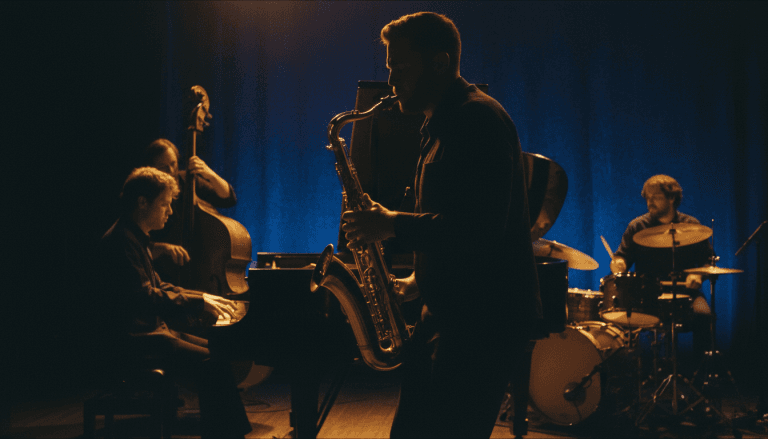
Cool jazz ensembles typically range from three to eight players, larger than the standard bebop quartet, smaller than the big band. The rhythm section remains piano, bass, and drums, but each instrument is played with restraint. The bassist walks with a lighter touch; the drummer brushes rather than pounds; the pianist comps sparsely, leaving room for the soloist to breathe. Trumpet and saxophone remain central, but their tone and approach differ fundamentally from bebop’s bright, punching attack.
The Unusual Additions
The Birth of the Cool nonet introduced instruments that had no precedent in small-group jazz. French horn, played by Gunther Schuller and Julius Watkins, brought a warm, rounded brass color that no trumpet or trombone could replicate. Tuba, played by Bill Barber, replaced the conventional bass register brass with something rounder and more orchestral. Vibraphone became central to the Modern Jazz Quartet’s sound, with Milt Jackson’s mallet-percussion adding a shimmering, sustain-rich texture. Flute gained prominence through Herbie Mann and West Coast players. Rarer still were oboe and cello, appearing in Third Stream crossover recordings. Miles Davis later adopted the flugelhorn for its warmer, rounder tone compared to the trumpet.

| Feature | Bebop | Cool Jazz | Hard Bop |
|---|---|---|---|
| Ensemble size | Small combo (4-5) | 3-8, chamber-influenced | Small combo (4-5) |
| Typical tempo | Fast to very fast | Moderate | Moderate to fast |
| Drum approach | High energy, assertive | Brushes, restrained | Powerful, gospel-influenced |
| Harmonic density | Very high | Moderate, open | High |
| Unusual instruments | Rare | French horn, tuba, vibraphone, flute | Rare |
| Tonal color | Bright, punching | Soft, round | Warm, bluesy |
Subgenres and Variants of Cool Jazz
Cool jazz is not monolithic. It splintered across geography and philosophy into identifiable sub-strands, each with its own character, its own key players, and its own relationship to the broader cool aesthetic. Understanding these variants also answers a question that comes up constantly: is cool jazz the same as smooth jazz? It isn’t, and the distinction matters.
West Coast Jazz
The Los Angeles-based scene that developed in the early 1950s produced what historians often call West Coast jazz, a strand of cool that was lighter in texture, more compositional, and more explicitly influenced by European classical music than its East Coast counterpart. Key figures include Shorty Rogers, Jimmy Giuffre, Shelly Manne, Chet Baker, and Gerry Mulligan (post-New York). Mulligan’s pianoless quartet was a defining structural choice: removing the piano stripped away the harmonic anchor and forced the remaining instruments into a more contrapuntal, interdependent relationship. The result was airy, elegant, and unmistakably Californian in its relaxed lyricism.
East Coast Cool, The Tristano School
In New York, Lennie Tristano built a parallel cool tradition that was colder, more abstract, and more intellectually austere than anything happening in Los Angeles. Tristano, Lee Konitz, and Warne Marsh developed a style rooted in contrapuntal improvisation, multiple independent melodic lines moving simultaneously, with chromatic experimentation that pushed toward atonality without fully abandoning tonal centers. This branch of cool jazz is the least commercially known and the most academically studied. It’s also the most demanding listen.
Third Stream Jazz
Gunther Schuller coined the term “Third Stream” in a 1957 lecture at Brandeis University to describe a deliberate fusion of jazz improvisation with European classical composition. The Modern Jazz Quartet, led by pianist and composer John Lewis, were the primary practitioners. Their formal concert hall performances, tuxedo dress code, and compositionally rigorous arrangements made the classical-jazz synthesis explicit. As the Timeline of African American Music notes, Third Stream became associated more with white jazz musicians than Black ones, a tension that reflects the genre’s broader racial complexities.
Bossa Nova as Cool Jazz’s Offspring
Stan Getz’s importation of Brazilian bossa nova in the early 1960s extended cool jazz’s reach into new cultural territory. Bossa nova shares cool’s restraint, soft dynamics, and harmonic sophistication, it’s essentially Brazilian cool, built on samba rhythms filtered through jazz harmony. Getz/Gilberto, recorded with João Gilberto and released in 1964, became one of the best-selling jazz records of its era and won Grammy Awards for Album of the Year and Record of the Year at the 7th Annual Grammy Awards, the first time a jazz album had won Album of the Year.
Cool Jazz vs. Smooth Jazz, Are They the Same?
They are not the same. This distinction is worth stating plainly because the two genres are frequently conflated. Cool jazz (late 1940s to mid-1960s) is a compositionally serious, bebop-descended style that prioritizes musical complexity within restraint. Smooth jazz is a commercial radio format that emerged in the 1980s and 1990s, typically featuring electronic production, simplified harmonic content, and pop crossover appeal. Cool jazz values musical depth; smooth jazz often trades depth for accessibility. The two share a soft tonal quality and a preference for moderate tempos, but their musical ambitions are fundamentally different. Critics have long considered smooth jazz a commercial dilution of the jazz tradition rather than a continuation of it.
The Defining Bands and Musicians of Cool Jazz
Seven artists and ensembles whose recordings define the cool jazz canon, each appearing once, each essential to understanding what the genre actually sounds like in practice.

Miles Davis, The Catalyst
No single musician did more to launch cool jazz than Miles Davis, though he didn’t stay in the genre long. Davis assembled the nine-piece nonet that recorded the Birth of the Cool sessions in 1949 and 1950, bringing together arranger Gil Evans, baritone saxophonist Gerry Mulligan, alto saxophonist Lee Konitz, and pianist John Lewis, among others. The unusual instrumentation, French horn, tuba, and the deliberately restrained approach to every instrument, signaled a clean break from bebop orthodoxy. According to the Birth of the Cool Wikipedia entry, the album compiles eleven tracks recorded across those three sessions. Davis moved on quickly to other innovations, but the sessions he initiated remain the genre’s founding document.
Gerry Mulligan, The Architect of the West Coast Sound
Gerry Mulligan served as both arranger and baritone saxophonist on the Birth of the Cool sessions, then relocated to Los Angeles and built the West Coast jazz scene almost single-handedly. His 1952 pianoless quartet with Chet Baker, documented on recordings released through Pacific Jazz, was a radical structural choice that proved cool jazz could swing without a harmonic anchor. His official biography traces a career that extended from these foundational sessions through decades of big band and small group work. His arrangements prioritized ensemble counterpoint over solo showcase, a philosophy that defined West Coast jazz.
Chet Baker, The Lyrical Trumpet Voice
Chet Baker’s trumpet tone is one of the most immediately recognizable sounds in jazz: soft, conversational, near-vocal in quality, with minimal vibrato and an intimacy that felt almost private. His work with the Mulligan-Baker Quartet established him as a West Coast jazz star, and his subsequent solo recordings extended that reputation. Chet Baker Sings, released in 1954 by Pacific Jazz Records, brought cool jazz’s emotional restraint to vocal performance, Baker’s near-whispered delivery of standards like “My Funny Valentine” made the album a crossover success. The album was later inducted into the Grammy Hall of Fame.
Dave Brubeck, The Rhythmic Experimenter
Dave Brubeck’s Quartet, with Paul Desmond on alto saxophone as his melodic foil, pushed cool jazz’s experimental reach into territory no one else had explored. Desmond’s tone, light, airy, almost flute-like, was the perfect cool jazz instrument, and his melodic invention on “Take Five” remains one of the most recognizable saxophone lines in jazz history. Time Out, released on Columbia in 1959, became the first jazz album to sell over one million copies, according to widely documented sources including the Library of Congress National Recording Preservation Board documentation. Brubeck received a Grammy Lifetime Achievement Award in 1996.
Stan Getz, The Sound
Stan Getz earned the nickname “The Sound” for his warm, breathy tenor saxophone tone, a deliberate contrast to the harder, more aggressive approach of bebop tenors. His cool credentials were established early, with “Early Autumn,” recorded with Woody Herman’s band, showing the lyrical restraint that would define his career. Getz recorded over 150 albums during his lifetime, according to AllMusic, and several are considered jazz classics. Getz/Gilberto co-created the bossa nova crossover that extended cool jazz’s cultural reach into the mid-1960s and won five Grammy Awards across his career.
The Modern Jazz Quartet, The Chamber Ensemble
The Modern Jazz Quartet, John Lewis on piano, Milt Jackson on vibraphone, Percy Heath on bass, and Connie Kay on drums, was the most explicitly classical-influenced of the cool jazz groups. According to the Modern Jazz Quartet’s Wikipedia entry, the ensemble blended classical music, cool jazz, blues, and bebop across a career that lasted, counting a seven-year hiatus, 43 years. Their formal concert hall performances and tuxedo dress code were deliberate artistic statements. The album Django (1956, Prestige) is cited in academic sources as an exemplary cool jazz document, with John Lewis’s compositional rigor balanced against Milt Jackson’s blues feeling on the vibraphone.
Lennie Tristano, The Intellectual Outlier
Lennie Tristano built the most cerebral and austere branch of cool jazz from his New York base. His 1956 Atlantic album Lennie Tristano included freely improvised tracks that predated free jazz by several years, a remarkable fact that positions Tristano as a bridge between cool’s formal structures and the freedom that would follow. According to his Wikipedia entry, Tristano recorded his first album for Atlantic Records in 1955 with full control over the recording process. His students Lee Konitz and Warne Marsh carried his contrapuntal approach forward into their own careers.
For a deeper look at the artists who shaped this era, the artist profiles section covers many of the key figures in jazz history.
Essential Cool Jazz Albums
These nine recordings, listed chronologically, form the essential listening canon for cool jazz. Each appears once. Together they trace the genre from its founding document through its commercial peak and into its most lasting cultural legacy.
1. Miles Davis Nonet | Birth of the Cool | Recorded 1949-50, Released 1957 | Capitol
Key tracks: “Boplicity,” “Jeru,” “Move”
The genre’s founding document. Gil Evans’s orchestration set the template for ensemble restraint, with French horn and tuba replacing conventional brass register instruments and every player instructed to pull back from bebop’s assertive attack. Pitchfork describes it as “a modern-jazz touchstone that opened the door to the sleek introspection and sophisticated aplomb of 1950s cool jazz.” Nothing before it sounded quite like this.
2. Gerry Mulligan and Chet Baker | The Original Gerry Mulligan-Chet Baker Quartet Recordings | 1952-53 | Pacific Jazz
Key tracks: “Line for Lyons,” “Bark for Barksdale”
The pianoless quartet was a radical structural proof that cool jazz could swing without a harmonic anchor. Mulligan’s baritone and Baker’s trumpet trade melodic lines in a counterpoint that feels simultaneously composed and spontaneous. The absence of piano creates a transparency that no other cool jazz recording quite matches.
3. Lennie Tristano | Lennie Tristano | 1956 | Atlantic
Key tracks: “Requiem,” “Turkish Mambo”
East Coast cool at its most experimental. The freely improvised tracks on this album predate free jazz by years, making it one of the most historically significant recordings in jazz, and one of the least celebrated outside academic circles. Jazzfuel’s overview of Tristano’s albums places this record at the center of his legacy.
4. Modern Jazz Quartet | Django | 1956 | Prestige
Key tracks: “Django,” “Autumn in New York”
Chamber jazz formalism at its most refined. John Lewis’s compositional rigor gives the album a structural clarity that most jazz recordings don’t attempt, while Milt Jackson’s vibraphone brings a blues feeling that keeps the music grounded. The title track, a tribute to Django Reinhardt, is one of the most beautiful pieces in the cool jazz repertoire.
5. Dave Brubeck Quartet | Time Out | 1959 | Columbia
Key tracks: “Take Five,” “Blue Rondo à la Turk”
The first jazz album to sell over one million copies, and still the most commercially successful experiment in odd-meter jazz ever recorded. “Take Five” in 5/4 and “Blue Rondo à la Turk” in 9/8 expanded what cool jazz could do rhythmically. WRTI notes that it was also a jazz album consisting entirely of original compositions, no standards, a bold choice in 1959.
6. Miles Davis | Kind of Blue | 1959 | Columbia
Key tracks: “So What,” “Freddie Freeloader,” “All Blues”
Technically the modal turn rather than pure cool jazz, but rooted entirely in cool jazz’s emotional and harmonic philosophy. The album’s spaciousness, its moderate tempos, and its preference for modal scales over chord changes all descend directly from the cool tradition Davis had helped establish a decade earlier. It remains the best-selling jazz album in history.
7. Bill Evans Trio | Waltz for Debby | 1962 | Riverside
Key tracks: “Waltz for Debby,” “My Foolish Heart”
The piano trio that most directly inherited cool jazz’s introspective philosophy. Evans’s impressionist voicings, open, harmonically rich, with a left hand that suggests rather than states, descend directly from cool’s harmonic approach. Recorded live at the Village Vanguard in New York, the album captures a trio at the peak of its collective intelligence.
8. Stan Getz and João Gilberto | Getz/Gilberto | 1964 | Verve
Key tracks: “The Girl from Ipanema,” “Corcovado”
Bossa nova crossover at its most refined. uDiscover Music describes it as the moment jazz defined the rhythms of Brazil for an international audience. The album won Grammy Awards for Album of the Year and Record of the Year, the first jazz album to win Album of the Year, and became one of the best-selling jazz records of its era.
9. Chet Baker | Chet Baker Sings | 1954 | Pacific Jazz
Key tracks: “My Funny Valentine,” “The Thrill Is Gone”
Vocal cool jazz, Baker’s near-whispered delivery extended the genre’s emotional restraint into song form. The album brought cool jazz to listeners who might never have sought out an instrumental record, and its influence on subsequent generations of jazz vocalists is difficult to overstate. Later inducted into the Grammy Hall of Fame.
For broader listening guidance, the best jazz albums for beginners guide covers several of these records alongside other essential starting points.
Cool Jazz Theory Primer, Scales, Chords, and Harmony
Cool jazz has a specific harmonic language that intermediate musicians can learn and apply. Here’s a practical overview of the theory behind the sound, accessible whether you’re approaching it from the piano, guitar, or as a serious listener trying to understand what you’re hearing.
Harmonic Language, Open Voicings and Color Tones
Cool jazz favors maj7, min7, and maj9 chords over bebop’s dense chromatic alterations. Shell voicings, built from the root, third, and seventh of a chord, create the open, spacious sound that defines the genre. Tritone substitutions, used liberally in bebop to create harmonic tension, appear far less frequently in cool jazz; the movement tends to be more diatonic, more predictable in the best sense. A foundational “cool” cadence might move Imaj7 – VIm7 – IIm7 – V7, a progression that feels resolved and lyrical rather than restless and searching.
Modal Tendencies
Cool jazz was already moving toward modal thinking before Miles Davis made it explicit on Kind of Blue. The Dorian mode, the scale built on the second degree of a major scale, producing a minor sound with a raised sixth, appears constantly. “So What” is the textbook example: D Dorian for eight bars, then E-flat Dorian for four bars, then back to D Dorian. The Lydian mode, with its raised fourth degree, gives maj7 chords a floating, unresolved quality that Gil Evans used extensively in his orchestrations. George Russell’s Lydian Chromatic Concept of Tonal Organization, published in 1953, provided the theoretical framework that cool jazz arrangers were already applying intuitively.
Rhythm and Comping Approach, Guitar and Piano
Cool jazz guitar comping sits behind the beat, sparse, with low-register chord stabs rather than full strummed voicings. Drop-2 and drop-3 chord forms, where the second or third voice from the top is dropped an octave, produce the open, spread voicings that give cool jazz guitar its characteristic sound. Avoid dense open-position chords; they’re too bright and too full. Piano comping in cool jazz follows the same “less is more” philosophy: leave space for the soloist, suggest harmony rather than stating it, and trust the bass to carry the harmonic foundation. Transcribing Bill Evans’s piano comping on “So What” is one of the most instructive exercises available for any jazz musician studying this style.
Listening as Theory Study, Recommended Ear Training
The fastest way to internalize cool jazz’s harmonic language is comparative listening. Put Chet Baker’s version of a standard next to Charlie Parker’s version of the same tune and listen specifically to phrasing rhythm, where Baker breathes, where Parker pushes. Then isolate the bass and drums on any Birth of the Cool track and listen to how much space exists in the rhythm section. That space is the theory made audible.
For more on the harmonic foundations that underpin cool jazz, the guide to jazz chord progressions covers the essential harmonic sequences in depth, and the modal jazz guide traces how cool’s harmonic tendencies evolved into the modal revolution of the late 1950s.
“Cool” Beyond the Music, Cultural Identity and Racial Context
The word “cool” carried social weight that went far beyond musical description. Understanding this context is essential to understanding why the genre’s history remains contested, and why its commercial story unfolded the way it did.
The composed, unruffled demeanor that the word described was a survival strategy as much as an aesthetic choice, a way of maintaining dignity and authority in a society that denied both. This cultural meaning predates the music genre and gives the term a depth that purely musical definitions miss.
The paradox at the heart of cool jazz’s commercial history is this: the genre was founded by Black musicians, Miles Davis, Gil Evans (who was white but worked in a Black musical tradition), John Lewis, Lennie Tristano, but became commercially associated primarily with white West Coast players. Brubeck, Baker, and Mulligan were the faces that record labels marketed most aggressively to mainstream audiences. As the Timeline of African American Music notes, Gunther Schuller’s Third Stream concept became “associated more with white jazz than Black musicians”, a pattern that reflects the broader racial dynamics of the American music industry in the 1950s.
Record labels played an active role in this process. The “cool” aesthetic, restrained, cerebral, European-influenced, was easier to market to white middle-class audiences than the more explicitly African American sounds of hard bop and soul jazz. This doesn’t diminish the music that Brubeck, Baker, and Mulligan made. It does mean that the genre’s commercial narrative obscured its African American origins in ways that historians have been working to correct ever since.
The Decline of Cool Jazz and Its Continuing Influence
Cool jazz didn’t end so much as it got absorbed, superseded, and transformed. Understanding what replaced it, and what it left behind, reveals just how far its influence actually reached.
What Ended the Cool Jazz Era?
Hard bop emerged in the mid-1950s as a direct and deliberate reaction against cool jazz’s cerebral restraint. Art Blakey, Clifford Brown, and Horace Silver reasserted blues and gospel roots, bringing back the rhythmic intensity and emotional directness that cool jazz had deliberately set aside. For more on this counter-movement, the hard bop guide traces how Art Blakey and the Jazz Messengers brought soul back to bebop. Free jazz, launched by Ornette Coleman’s Atlantic recordings beginning in 1959, made cool’s formal structures seem conservative by comparison. Bossa nova extended cool’s commercial reach through the early 1960s but also diluted its jazz identity. By the mid-1960s, with John Coltrane’s modal period fully underway and A Love Supreme released in 1965, cool jazz as a distinct movement had largely been absorbed or superseded.
Cool Jazz’s Lasting Influence
Here’s the thing: cool jazz never really disappeared. It just changed address. Bill Evans’s piano language, the most direct descendant of cool’s harmonic philosophy, remains the dominant “jazz piano sound” in popular perception, influencing Brad Mehldau, Diana Krall, and countless others. ECM Records, founded in Munich in 1969, carried cool jazz’s chamber aesthetic into European jazz and has released more than 1,800 albums in that tradition. Vince Guaraldi’s Peanuts scores brought cool jazz’s tonal palette into American living rooms every holiday season, and Henry Mancini’s film scores extended the same aesthetic into Hollywood. The “jazz for studying” and lo-fi chill genre that dominates streaming playlists today draws its sonic DNA directly from cool jazz’s textural philosophy, the soft tones, the moderate tempos, the spacious harmonies. Cool jazz didn’t just influence what came after it. It became the background music of contemporary life.
Frequently Asked Questions About Cool Jazz
Where did cool jazz originate?
Cool jazz has a dual origin. Miles Davis’s nonet recording sessions at WOR Studios in New York City, across three dates in January 1949, April 1949, and March 1950, produced the recordings most frequently cited as the genre’s founding document. Simultaneously, a separate West Coast scene was developing in Los Angeles, centered on arrangers and players including Shorty Rogers and Jimmy Giuffre. Both strands emerged independently but are grouped under the cool jazz umbrella by historians.
Who were the pioneers of cool jazz?
Miles Davis is most frequently cited as the catalyst, with arranger Gil Evans and baritone saxophonist Gerry Mulligan as co-architects of the Birth of the Cool sessions. On the West Coast, Mulligan (post-New York), Chet Baker, and Shorty Rogers were central figures. The Tristano school in New York, Lennie Tristano, Lee Konitz, and Warne Marsh, represents a parallel founding stream that developed independently of both the Davis nonet and the West Coast scene.
What is the difference between cool jazz and smooth jazz?
Cool jazz (late 1940s to mid-1960s) is a compositionally serious, bebop-descended style that prioritizes musical complexity within restraint. Smooth jazz is a commercial radio format that emerged in the 1980s and 1990s, typically featuring electronic production, simplified harmonic content, and pop crossover appeal. The two share a soft tonal quality but differ fundamentally in musical ambition and historical context. Cool jazz values depth; smooth jazz typically trades depth for accessibility. Critics have consistently treated them as distinct genres.
What makes cool jazz “cool”?
The term refers to the music’s emotional temperature, a deliberate contrast to bebop’s feverish energy. Musically, “cool” describes the reduced vibrato, moderate tempos, lighter tonal colors, and spacious harmonies. Culturally, it referenced a composed, unruffled demeanor that carried social meaning in postwar African American artistic communities before being broadly adopted by jazz culture as a whole. The word was applied by journalists and record companies; many musicians rejected the label even as the music it described became one of jazz’s most influential movements.
Is cool jazz the same as West Coast jazz?
West Coast jazz is a subset of cool jazz, not a synonym. Cool jazz encompasses the New York Birth of the Cool sessions, the Tristano school’s East Coast approach, Third Stream experiments, and West Coast jazz. West Coast jazz specifically refers to the Los Angeles-centered scene of the early to mid-1950s, featuring players like Chet Baker, Gerry Mulligan, Shelly Manne, and Shorty Rogers. It’s the most commercially recognizable branch of cool jazz, but it represents only one strand of a broader and more varied movement.
The Legacy of Cool
Cool jazz redirected jazz history once, away from bebop’s density, and seeded multiple futures simultaneously: modal jazz, bossa nova, Third Stream, ECM’s European chamber aesthetic, and the contemporary piano jazz tradition that Bill Evans launched and Brad Mehldau, Diana Krall, and Norah Jones have carried forward. The key dates are 1949 to the mid-1960s; the key names are Davis, Evans, Mulligan, Baker, Brubeck, Getz, Lewis, and Tristano; the key principle is that restraint is not absence, it’s a different kind of presence. If you’re starting your cool jazz journey, put on Birth of the Cool, then Time Out, then Waltz for Debby. By the third album, you’ll understand what the temperature drop felt like. For the full sweep of jazz history that cool jazz fits into, the types of jazz guide covers every major genre and subgenre, and the best jazz albums of all time places the essential cool jazz records in their broader historical context.