Jazz Guitar: A Complete Guide to the Music, the Players, and the Instruments
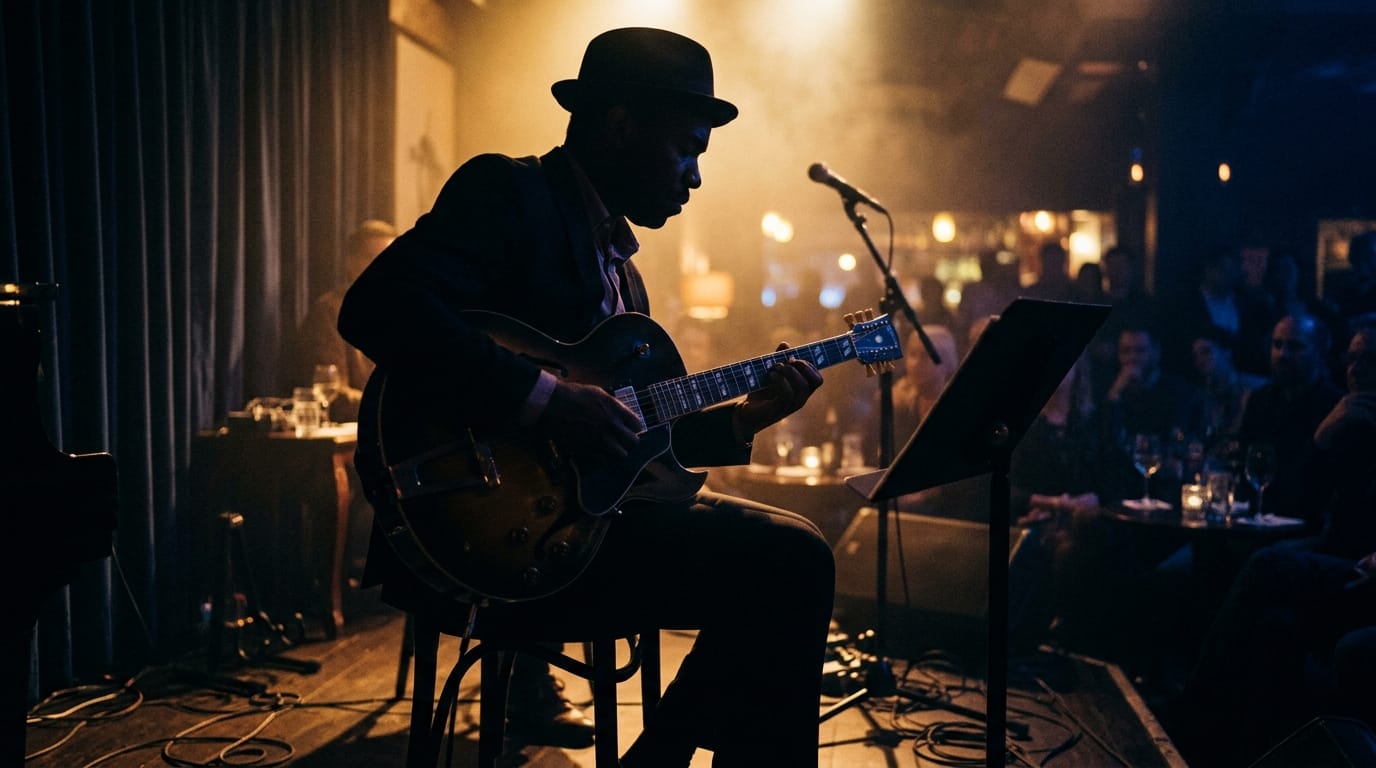
Jazz guitar is a style of guitar playing, and a family of instruments, central to jazz music from the 1920s to the present day, encompassing everything from the warm-toned archtop rhythm work of the swing era to the harmonically sophisticated single-note lines of bebop and beyond. Jazz guitarists play hollow-body archtop electrics, semi-hollow thinlines, and nylon-string classical guitars, depending on the subgenre. The instrument serves a dual role: anchoring the rhythm section through comping (chord accompaniment) while also functioning as a front-line soloist.
Table of Contents
- The Origin Story: Jazz Guitar from the 1920s to Today
- Why the Guitar Arrived Late to Jazz
- The Electric Revolution and Charlie Christian
- From Bebop to the Modern Era
- Defining Characteristics of Jazz Guitar
- Harmony, The Chord Vocabulary
- Rhythmic Feel, Swing, Comping, and the Time Feel
- Improvisation Philosophy
- Tone and Performance Context
- Key Instruments, What Makes a Jazz Guitar
- The Archtop Hollow-Body Electric
- Semi-Hollow and Thinline Guitars
- The Gypsy Jazz Guitar (Selmer-Style)
- A Note on Nylon-String and Solid-Body Guitars in Jazz
- Subgenres and Variants of Jazz Guitar
- Swing Era Rhythm Guitar
- Bebop and Hard Bop Guitar
- Gypsy Jazz Guitar
- Jazz Fusion Guitar
- Solo Guitar and Chord-Melody
- Contemporary and Post-Bop Guitar
- The Defining Players, Jazz Guitar Greats
- Eddie Lang (1902-1933)
- Django Reinhardt (1910-1953)
- Charlie Christian (1916-1942)
- Wes Montgomery (1923-1968)
- Joe Pass (1929-1994)
- Jim Hall (1930-2013)
- Pat Metheny (b. 1954)
- Essential Albums, Jazz Guitar Quick List
- Jazz Guitar Theory Primer, What You Need to Know to Play Standards
- The ii-V-I Progression, The Engine of Jazz
- Essential Scales for Jazz Guitar
- Chord Voicings for Standards
- The Decline, Revival, and Continuing Influence of Jazz Guitar
- The Fusion Crossroads and Commercial Pull
- The Neoclassical Revival
- Where Jazz Guitar Stands Today
- Frequently Asked Questions About Jazz Guitar
- What is jazz guitar?
- Who are the most famous jazz guitar players?
- What jazz guitar songs should beginners learn first?
- What is the best jazz guitar for beginners?
- How is gypsy jazz guitar different from other jazz guitar styles?
- How does jazz guitar improvisation work?
The Origin Story: Jazz Guitar from the 1920s to Today
Jazz guitar didn’t arrive fully formed. It fought its way into the music through a combination of technological change, individual genius, and sheer persistence against louder instruments. Understanding that struggle explains almost everything about how the style developed.
Why the Guitar Arrived Late to Jazz
Before amplification, the guitar simply couldn’t compete in a jazz ensemble. The banjo dominated early jazz rhythm sections because its bright, percussive attack cut through the noise of a dance hall. The guitar’s warmer, rounder tone got swallowed whole. The shift from banjo to guitar happened gradually between roughly 1925 and 1932, as recording technology improved and smaller ensemble formats became more common.
The player who changed everything was Eddie Lang (1902-1933), born Salvatore Massaro in Philadelphia. Lang was the first widely recognized jazz guitar soloist, and critics have consistently called him the instrument’s first true virtuoso. His recorded duets with violinist Joe Venuti for Okeh Records in the late 1920s demonstrated that the guitar could carry a melodic line with sophistication and swing. Lang also appeared on hundreds of commercial recordings as a session guitarist, working alongside Bing Crosby and Paul Whiteman, which spread his influence far beyond the jazz world.
The Electric Revolution and Charlie Christian
Charlie Christian (1916-1942) is the pivot point in jazz guitar history. When he joined Benny Goodman’s sextet in 1939, he brought the Gibson ES-150 electric guitar with him, an instrument whose pickup became known colloquially as the “Charlie Christian pickup.” Christian won DownBeat’s best guitarist poll for three consecutive years after joining Goodman, a documented measure of his immediate impact on the jazz world.
Christian’s single-note lines were something genuinely new. He phrased like a horn player, building long melodic statements over chord changes rather than strumming rhythm. His recording Solo Flight (Columbia, 1941) remains the single most cited recording in jazz guitar historiography. He also participated in the after-hours jam sessions at Minton’s Playhouse in Harlem in 1941, sessions documented as a seedbed for bebop. Christian died of tuberculosis at 25 in 1942, leaving fewer than five years of recordings, but those recordings rewired the instrument’s entire future.
From Bebop to the Modern Era
The generation that followed Christian, Barney Kessel, Tal Farlow, Jimmy Raney, Johnny Smith, absorbed his vocabulary and applied it to the faster tempos and denser harmonies of bebop. Wes Montgomery, working in Indianapolis through the 1950s, developed his thumb-pick technique and octave-unison lines largely in isolation before his Riverside Records debut in 1960 introduced him to a national audience.
The 1960s brought a chamber-jazz sensibility through Jim Hall, whose duo recording Undercurrent (United Artists, 1962) with pianist Bill Evans remains a landmark in the use of space and harmonic restraint. The fusion era of the late 1960s and 1970s brought Larry Coryell, John McLaughlin, and Pat Metheny into the picture, bridging jazz guitar to rock amplification and world music influences. Today, players like Kurt Rosenwinkel, Julian Lage, and Mary Halvorson continue expanding the instrument’s harmonic and textural range, absorbing everything from indie rock to contemporary classical music into a tradition that’s now over a century old. For a broader view of how jazz evolved across all its instruments, the Jazz Education section on types of jazz provides useful context.
Defining Characteristics of Jazz Guitar
Jazz guitar isn’t just a genre label, it’s a specific set of musical choices that distinguish it from blues, rock, or classical playing. Those choices operate across four dimensions: harmony, rhythm, improvisation, and tone.
Harmony, The Chord Vocabulary
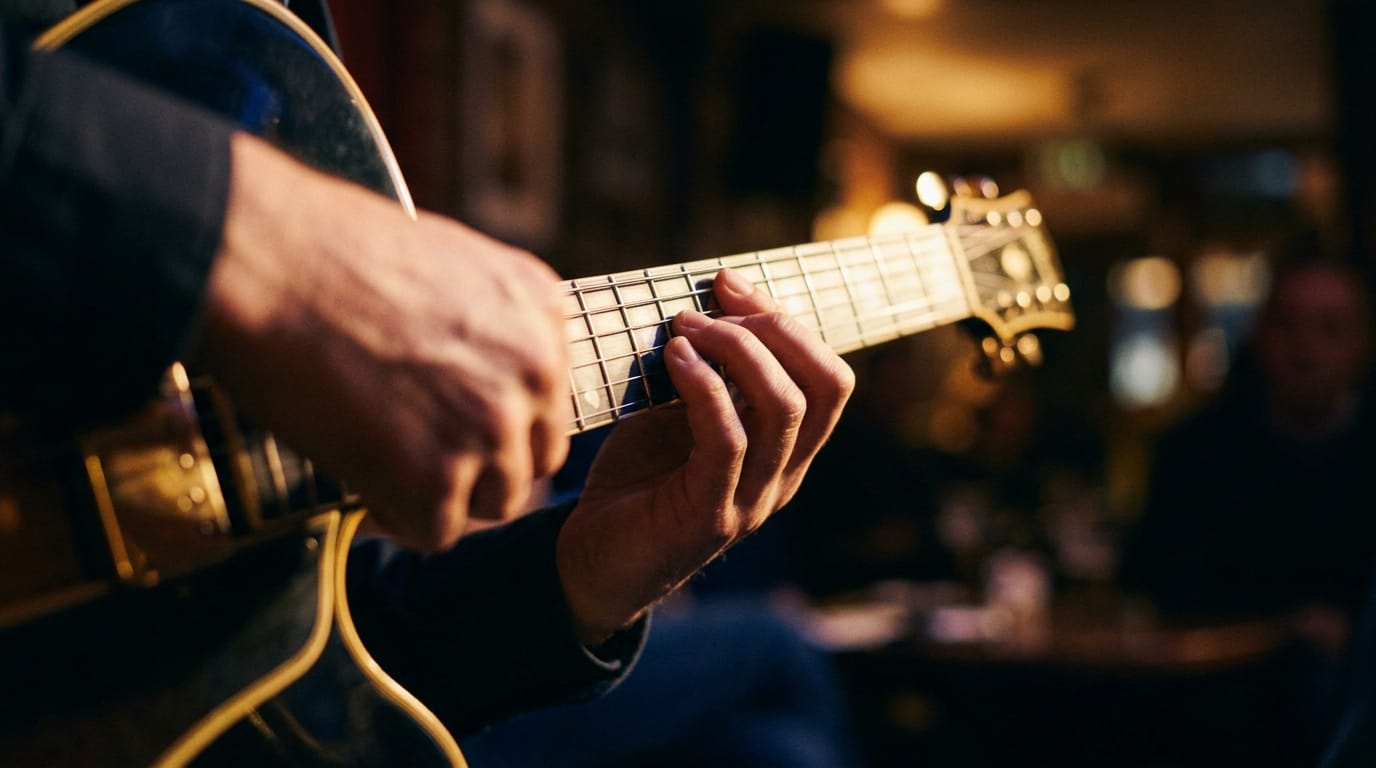
Here’s the thing that separates jazz guitar from almost every other guitar style: the chords. Jazz harmony is built on extended chords, 7ths, 9ths, 11ths, and 13ths, and altered dominants (chords where the 5th or 9th is raised or lowered by a half step). A pop guitarist plays a G major chord with three notes. A jazz guitarist plays a Gmaj13 with six, or a G7#11 that creates deliberate harmonic tension before resolving.
The foundational chord types every jazz guitarist needs are: major 7th (maj7), minor 7th (min7), dominant 7th (dom7), minor 7th flat 5 (min7b5, also called half-diminished), and diminished 7th. These chords drive the ii-V-I progression, the engine of jazz harmony, discussed in the theory section below. Jazz guitarists typically voice chords across four strings maximum, often omitting the 5th of the chord entirely. This isn’t laziness; it’s function. When a bass player anchors the root, the guitarist’s job is to define the color of the chord through its 3rd and 7th, the two notes that determine whether a chord is major, minor, or dominant.
The gold standard for jazz guitar comping (accompanying) discipline is Freddie Green, who played four-to-the-bar rhythm guitar with the Count Basie Orchestra for 50 years, from 1937 until his death in 1987. Green played an acoustic archtop without amplification in the Basie band context, and his chord voicings were so stripped-down and rhythmically precise that they functioned more like a percussion instrument than a harmonic one. His approach on Basie’s Decca recordings from the late 1930s remains the definitive example of how much a guitarist can contribute while playing almost nothing.
Rhythmic Feel, Swing, Comping, and the Time Feel
Comping is the jazz guitarist’s primary rhythmic role, and it’s more demanding than it sounds. The word comes from “accompanying,” but that undersells it. Good comping is reactive, conversational, and never static. A jazz guitarist listens to the soloist and responds with chord voicings that support, challenge, or color what’s being played, sometimes a full chord, sometimes a single note, sometimes silence.
The swing eighth-note feel is the rhythmic foundation. In rock, eighth notes are evenly spaced. In jazz, they’re derived from a triplet subdivision, giving the music its characteristic lilt, the first eighth note of each pair is slightly longer than the second. This is what people mean when they say music “swings.” Bebop comping takes a different approach from swing-era rhythm guitar: fewer chords, more space, and short chord “shots” placed on beats 2 and 4 rather than all four beats. The contrast between Freddie Green’s relentless four-to-the-bar pulse and a bebop guitarist’s sparse, reactive comping illustrates how dramatically the rhythmic role shifted between the 1930s and 1950s.
Improvisation Philosophy
Jazz guitar improvisation is melodically and harmonically driven. Soloists “play the changes”, they navigate the underlying chord progression, targeting strong chord tones (particularly the 3rd and 7th of each chord) on strong beats while using passing tones and chromatic approach notes to connect them. This is fundamentally different from blues or rock improvisation, where a single scale or pentatonic pattern can work over an entire song.
Charlie Parker’s influence on all jazz improvisers after 1945, including guitarists, can’t be overstated. His approach to bebop melody, with its long chromatic lines and precise chord-tone targeting, became the shared language of jazz improvisation regardless of instrument. Jazz improvisation is also partly a language of learned phrases, or “licks,” recombined in real time. This doesn’t make it less creative; it makes it more like spoken language, where fluency comes from internalizing vocabulary deeply enough to use it spontaneously. Our guide to jazz improvisation covers this concept in depth across all instruments.
Tone and Performance Context
The “jazz tone” ideal is warm, round, and slightly dark, with minimal distortion. It’s the opposite of a rock guitar tone. That sound comes from a combination of factors: hollow-body archtop construction, flatwound strings (which have a smooth winding that reduces brightness and finger noise), playing through the neck pickup, rolling the guitar’s tone control back, and right-hand technique that favors picking near the neck rather than the bridge.
Jazz guitarists perform in several distinct contexts: small groups (trios, quartets), big band rhythm sections, and solo guitar, a particularly demanding format where the guitarist covers harmony, melody, and rhythm simultaneously. Joe Pass’s Virtuoso (Pablo Records, 1973) is the benchmark for solo jazz guitar performance. The fact that the guitar can imply a full band unaccompanied, walking bass lines in the lower strings, chord voicings in the middle, melody on top, makes it one of the most self-sufficient instruments in jazz.
Key Instruments, What Makes a Jazz Guitar
Not every guitar is a jazz guitar. The instrument choices jazz players make are deliberate, and the construction differences between an archtop hollow-body and a solid-body electric produce genuinely different sounds. Here’s what’s actually in use.
The Archtop Hollow-Body Electric
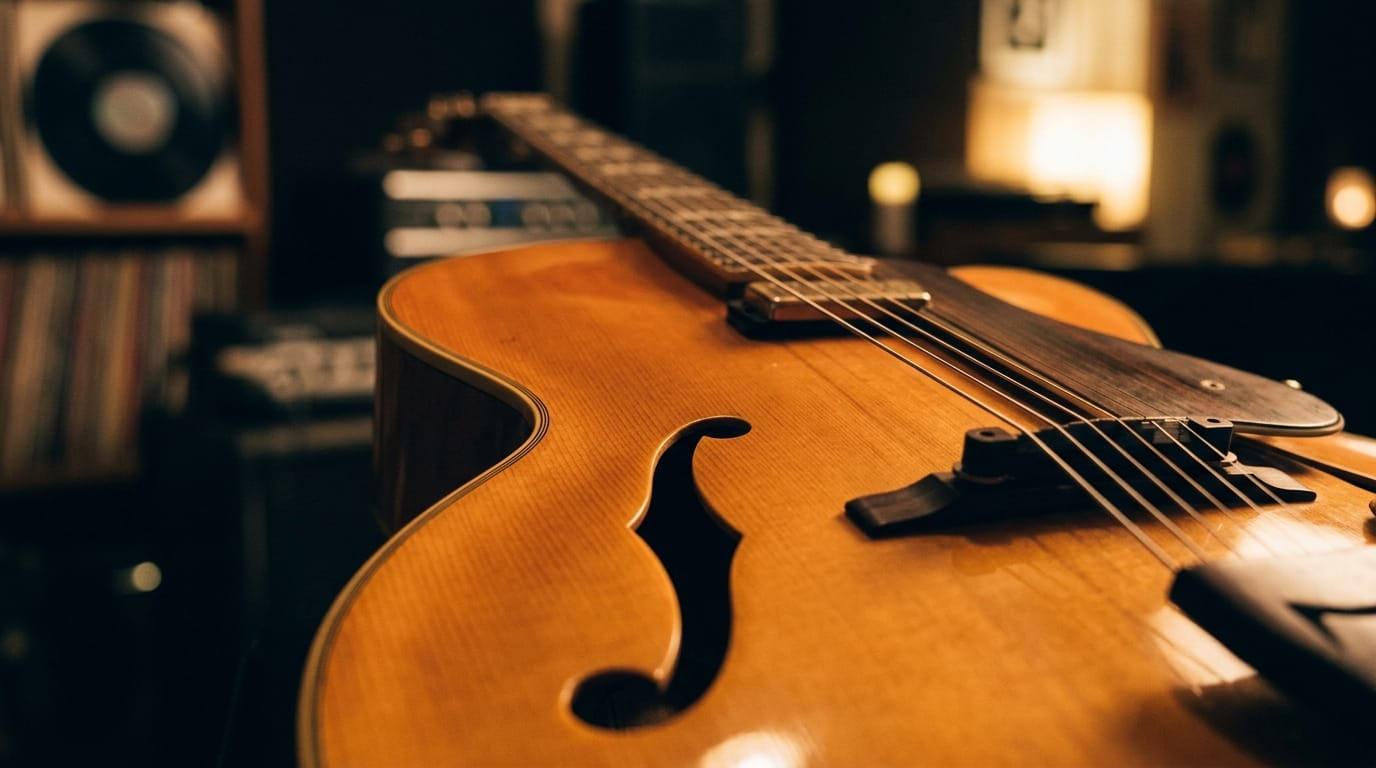
The archtop hollow-body is the definitive jazz guitar. Its construction, an arched spruce or carved maple top, f-holes, floating bridge, and tailpiece, produces the warm, resonant tone that defines the jazz guitar sound. The two most documented American archtops are the Gibson L-5 CES (introduced 1951, 17-inch body width, single-cutaway) and the Gibson ES-175 (introduced 1949, 16.5-inch body, pressed laminate top). The ES-175 appears on countless Blue Note and Prestige recordings from the 1950s and 1960s; it’s the sound of hard bop guitar. The D’Angelico New Yorker represents the handcrafted American benchmark, documented extensively in guitar lutherie literature.
One construction detail matters enormously for tone: carved versus pressed laminate tops. A carved solid-wood top vibrates more freely and produces a richer, more complex acoustic resonance. A pressed laminate top is more affordable and more resistant to feedback at high volumes, which is why working jazz guitarists often prefer it on loud gigs. This distinction is absent from most introductory jazz guitar writing, but it’s the reason two archtops at very different price points sound noticeably different.
Semi-Hollow and Thinline Guitars
The Gibson ES-335 (introduced 1958) splits the difference between hollow and solid. Its 1.75-inch body depth and center wooden block reduce feedback while retaining some acoustic resonance. The result is a warmer, more complex tone than a solid-body, without the feedback problems of a full hollow-body at high volumes. Jazz-rock and fusion players gravitated toward it for exactly this reason. Contemporary options at lower price points include the Ibanez AS series and the Eastman T386, both well-documented in guitar retail and review literature.
The Gypsy Jazz Guitar (Selmer-Style)
Django Reinhardt played a Selmer-Maccaferri guitar, designed by Mario Maccaferri and produced by Henri Selmer in Paris. Production ran from 1932 to 1952, with approximately 900 instruments built in total according to documented lutherie records. The instrument’s distinguishing features, a small oval or D-shaped soundhole, a long 670mm scale length, and a floating Wicker bridge, produce a bright, projecting acoustic tone that cuts through an ensemble without amplification. Modern builders including Dupont, Dell’Arte, and Cigano (at the entry level) serve the active gypsy jazz guitar revival community. Our full guide to the greatest jazz guitarists of all time covers Django’s place in the broader tradition.
A Note on Nylon-String and Solid-Body Guitars in Jazz
Charlie Byrd and Laurindo Almeida brought the classical nylon-string guitar into jazz. Byrd’s collaboration with Stan Getz on Jazz Samba (Verve, 1962) is the documented proof of concept, a Grammy-winning album that helped introduce bossa nova to American audiences. Solid-body guitars appear in jazz primarily in fusion contexts. Pat Metheny has used various solid-body and semi-hollow instruments across his career, including his signature Ibanez PM series, while John Scofield’s use of the Ibanez AS200 is documented in published interviews in Guitar Player magazine.
| Guitar Type | Key Players | Tone Character | Typical Price Range |
|---|---|---|---|
| Archtop Hollow-Body | Wes Montgomery, Joe Pass | Warm, dark, full | $500-$9,000+ |
| Semi-Hollow | Larry Carlton, John Scofield | Balanced, versatile | $400-$3,500 |
| Gypsy Jazz (Selmer-style) | Django Reinhardt | Bright, projecting | $300 (Cigano)-$5,000+ |
| Nylon-String Classical | Charlie Byrd, Laurindo Almeida | Soft, mellow | $200-$4,000 |
| Solid-Body | Pat Metheny (later work) | Bright, sustain-rich | $300-$2,500 |
Subgenres and Variants of Jazz Guitar
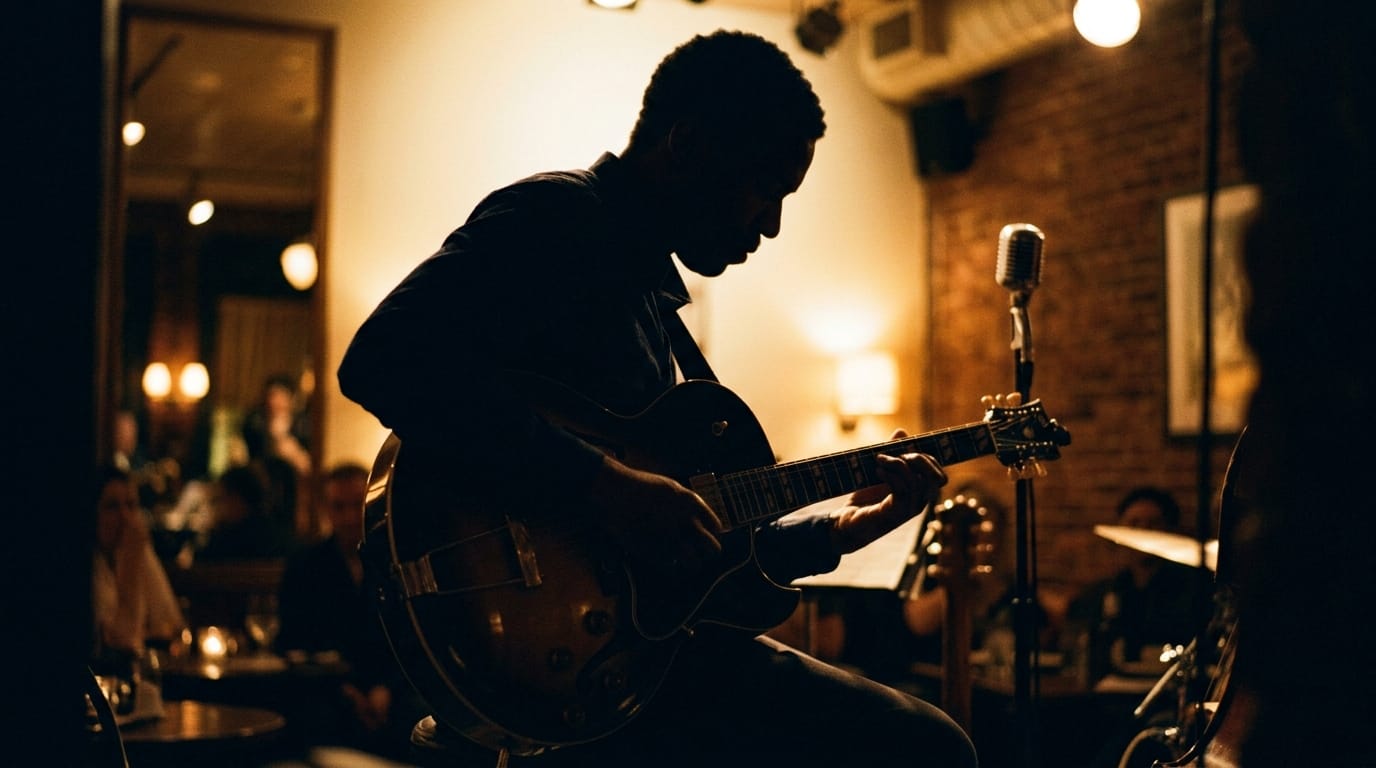
Jazz guitar isn’t one thing. It’s a family of related styles that share a harmonic language but differ dramatically in instrumentation, rhythm, and intent. Knowing the subgenres helps you find the music that actually connects with you.
Swing Era Rhythm Guitar
Swing era rhythm guitar is defined by four-to-the-bar chord strumming on an acoustic or lightly amplified archtop, functioning as part of the rhythm section rather than a solo voice. The goal is to be felt rather than heard as a separate voice, a documented aesthetic philosophy verifiable through period recordings and musician interviews. Freddie Green, who held the rhythm guitar chair in the Count Basie Orchestra from 1937 until his death in 1987, is the defining practitioner. His playing is so integrated into the Basie rhythm section that isolating it on recordings is genuinely difficult, which is exactly the point.
Bebop and Hard Bop Guitar
Bebop guitar takes Charlie Christian’s single-note approach and applies it to faster tempos and more harmonically complex chord progressions. Players like Barney Kessel, Tal Farlow, Jimmy Raney, and Kenny Burrell all built careers on this vocabulary, documented through their recordings for Prestige, Verve, and Blue Note. Hard bop guitar adds blues and gospel inflections to the bebop foundation. Kenny Burrell’s Midnight Blue (Blue Note, 1963) is the touchstone: blues-soaked, rhythmically direct, and immediately accessible without sacrificing harmonic sophistication. It’s one of the best entry points to the jazz standards guitar repertoire for new listeners.
Gypsy Jazz Guitar
Gypsy jazz guitar is rooted in Django Reinhardt’s Hot Club de France recordings made in Paris between 1934 and 1939, documented on Ultraphone and HMV labels. The style is built on the Selmer-style guitar, a driving two-beat rhythm technique called la pompe (a percussive chord chop on beats 2 and 4), fast single-note runs with a distinctive attack, and minor-key melodies influenced by Romani music and French musette. The modern revival is active and well-documented: Biréli Lagrène, Stochelo Rosenberg, and the international Django festival circuit have kept the tradition alive and growing since the 1980s. This is the most acoustically oriented of all jazz guitar subgenres, and it remains largely separate from the American jazz guitar mainstream.
Jazz Fusion Guitar
Fusion emerged in the late 1960s when jazz musicians began incorporating rock amplification, distortion, and rhythmic intensity into jazz harmony. John McLaughlin’s work with Miles Davis on Bitches Brew (Columbia, 1970) is the documented launch point for electric jazz guitar in a fusion context, the guitar screams and sustains in ways that would have been unthinkable in a bebop setting. Pat Metheny’s Bright Size Life (ECM, 1976) represents the more lyrical, acoustic-influenced alternative within the fusion spectrum. Larry Coryell, Al Di Meola, and John Abercrombie each developed parallel and distinct voices within the fusion tradition.
Solo Guitar and Chord-Melody
Solo jazz guitar is a demanding format where the guitarist simultaneously covers melody, harmony, and rhythm, no bass player, no drummer, no pianist. Joe Pass codified the modern approach on Virtuoso (Pablo Records, 1973), recorded entirely unaccompanied in a single session. The technique involves chord-melody arrangements (where the melody is harmonized with chords directly beneath it), walking bass-note patterns in the lower strings, and arpeggio fills between phrases. Lenny Breau developed a parallel approach to solo guitar, particularly notable for his use of artificial harmonics to create bell-like tones that implied additional voices. Both players expanded what one guitarist could do alone.
Contemporary and Post-Bop Guitar
The contemporary scene absorbs the full jazz tradition while incorporating indie rock, contemporary classical, and electronic influences. Kurt Rosenwinkel, whose album Star of Jupiter (Heartcore, 2012) is widely cited in the jazz press, brought a singing, vocal-influenced tone and dense harmonic language to post-bop guitar. Julian Lage works across acoustic and electric contexts with a melodic directness that connects bebop vocabulary to American roots music. Mary Halvorson, who won DownBeat’s International Critics Poll for Best Guitar in 2017, 2018, and 2019 and received a MacArthur “Genius” Grant in 2019, represents the avant-garde wing, her use of a pitch-bending pedal and angular melodic lines push jazz guitar into genuinely new territory.
The Defining Players, Jazz Guitar Greats
Seven players define the arc of jazz guitar from its origins to the present. Each one changed what the instrument could do, and each one’s recorded output is essential listening.
Eddie Lang (1902-1933)
Eddie Lang was the first widely recognized jazz guitar soloist, establishing the guitar as a legitimate solo voice in American popular music. He recorded with Joe Venuti, Bing Crosby, and Paul Whiteman, a verifiable discography that placed him at the center of 1920s commercial music. His recording Eddie’s Twister (Okeh, 1927) demonstrates a melodic single-note sophistication unprecedented for the instrument at that time. Lang’s death at 30 cut short what historians broadly agree was an immensely influential career. Without Lang, the guitar might have remained a rhythm-only instrument for another decade.
Django Reinhardt (1910-1953)
Django Reinhardt was a Belgian-born Romani guitarist who performed and recorded despite losing the use of two fingers on his left hand in a 1928 caravan fire. He co-founded the Quintette du Hot Club de France with violinist Stéphane Grappelli in 1934, and their recordings on HMV and Swing Records constitute the foundational gypsy jazz guitar canon. Minor Swing (1937) remains one of the most recognized jazz recordings globally. Django recorded more than 900 tracks across his lifetime, according to documented discography research. He was the first major European jazz musician, and his influence on acoustic guitar playing worldwide is impossible to overstate.
Charlie Christian (1916-1942)
Christian transformed the guitar from a rhythm instrument into a bebop-capable solo voice. His joining of Benny Goodman’s sextet in 1939 is the documented turning point. He introduced single-note lines over chord changes that directly influenced every post-1940 jazz guitarist, regardless of style. Solo Flight (Columbia, 1941) is the single most cited recording in jazz guitar historiography, a three-minute demonstration of everything the electric guitar could become. Christian died of tuberculosis at 25, leaving fewer than five years of recordings. The brevity of his output makes its influence even more remarkable.
Wes Montgomery (1923-1968)
Wes Montgomery was an Indianapolis-born guitarist who developed his thumb-pick technique, playing with the fleshy part of the thumb rather than a plectrum, producing a signature warm, dark tone unlike any other guitarist’s. He pioneered the octave-unison technique, playing melodic lines in parallel octaves simultaneously. Smokin’ at the Half Note (Verve, 1965), recorded live with the Wynton Kelly Trio, is broadly considered his definitive recorded statement. Montgomery received a Grammy Award for Goin’ Out of My Head and was inducted into the DownBeat Jazz Hall of Fame. He died of a heart attack at 45, at the height of his commercial success.
Joe Pass (1929-1994)
Joe Pass was born Joseph Anthony Passalaqua in New Brunswick, New Jersey. After recovering from drug addiction in the 1960s, he built his mature career through Norman Granz’s Pablo Records label, recording extensively with Ella Fitzgerald and Oscar Peterson. Virtuoso (Pablo Records, 1973) stands as the defining solo jazz guitar album, entirely unaccompanied, recorded in a single session, and widely considered one of the best jazz guitar albums ever made. Pass recorded 14 solo guitar albums for Pablo in addition to Virtuoso, according to documented discography records. His chord-melody command and walking bass technique remain the benchmark for solo guitar performance.
Jim Hall (1930-2013)
Jim Hall brought a chamber-music sensibility to jazz guitar that no one before him had articulated so clearly. He was integral to the Chico Hamilton Quintet and the Jimmy Giuffre Trio in the 1950s, and his duo recording Undercurrent (United Artists, 1962) with pianist Bill Evans is documented as a landmark in jazz guitar intimacy and harmonic sophistication. Concierto (CTI, 1975), featuring orchestral arrangements by Don Sebesky, demonstrates Hall’s lyrical single-note phrasing in a large-ensemble context. Pat Metheny has cited Hall as a primary influence in multiple published interviews.
Pat Metheny (b. 1954)
Pat Metheny is a Kansas City-born guitarist whose debut album Bright Size Life (ECM, 1976), recorded with bassist Jaco Pastorius and drummer Bob Moses, launched his international profile. He has won 20 Grammy Awards across 10 different categories, documented via the Recording Academy, making him the only person to have won Grammys in 10 categories. His signature sounds include the Roland GR guitar synthesizer, chorus-drenched Ibanez PM guitars, and the 42-string Pikasso guitar built by luthier Linda Manzer in 1984. His duo collaboration with John Scofield, I Can See Your House from Here (Blue Note, 1994), is among his most acclaimed recordings as a collaborator.
Essential Albums, Jazz Guitar Quick List
These eight albums represent the jazz guitar canon across its major eras and styles. Each one is essential listening, not just for guitarists but for anyone who wants to understand what the instrument can do in a jazz context.
Smokin’ at the Half Note | Wes Montgomery with the Wynton Kelly Trio | Verve, 1965 | Four on Six, No Blues, Unit 7
Live recording capturing Montgomery’s octave technique, blues feeling, and swing-era roots in a small-group setting. Pat Metheny has stated publicly that this album altered his musical life upon first hearing it.
Virtuoso | Joe Pass | Pablo Records, 1973 | Night and Day, How High the Moon, Cherokee
Entirely unaccompanied; the benchmark for solo jazz guitar performance. Recorded in a single session and widely considered Pass’s best work, as well as one of the best jazz guitar albums ever made.
Bright Size Life | Pat Metheny | ECM, 1976 | Bright Size Life, Sirabhorn, Unity Village
Metheny’s debut, recorded in December 1975 in Ludwigsburg and produced by ECM founder Manfred Eicher. It established ECM’s acoustic jazz guitar aesthetic and remains a gateway recording for modern listeners.
Concierto | Jim Hall | CTI, 1975 | Concierto de Aranjuez, You’d Be So Nice to Come Home To
Hall’s orchestral setting demonstrates jazz guitar’s capacity for large-ensemble integration. Don Sebesky’s arrangements are documented as landmark CTI productions, and Hall’s 19-minute treatment of Rodrigo’s concerto is unlike anything else in the jazz guitar catalog.
The Incredible Jazz Guitar of Wes Montgomery | Wes Montgomery | Riverside, 1960 | West Coast Blues, Airegin, D-Natural Blues
Montgomery’s studio debut as a leader, recorded in January 1960. It introduced his vocabulary to the jazz world and was selected for the National Recording Registry, a documented honor confirming its cultural significance.
Midnight Blue | Kenny Burrell | Blue Note, 1963 | Chitlins Con Carne, Mule, Midnight Blue
Blues-soaked and rhythmically direct, recorded at Rudy Van Gelder’s studio in Englewood Cliffs, New Jersey. One of the most accessible entry points to hard bop jazz guitar, and a record that sounds as immediate today as it did in 1963.
A Go Go | John Scofield | Verve, 1998 | A Go Go, Hottentot, Green Tea
Fusion-inflected and groove-heavy, recorded with Medeski Martin & Wood. Scofield’s blues-drenched tone and rhythmic flexibility make this one of the most approachable jazz guitar records of the 1990s, and a strong introduction to contemporary jazz guitar music.
Undercurrent | Jim Hall & Bill Evans | United Artists, 1962 | My Funny Valentine, I Hear a Rhapsody, Romain
Intimate duo format recorded in April and May 1962. Its documented influence on chamber jazz and the use of space in guitar phrasing makes it essential listening for anyone interested in how two instruments can create a complete musical world between them.
For a deeper dive into the broader recorded canon, the 50 best jazz albums of all time includes several jazz guitar records in its ranking.
Jazz Guitar Theory Primer, What You Need to Know to Play Standards
You don’t need a music degree to start playing jazz guitar. You need three things: the ii-V-I progression, a handful of scales, and some practical chord voicings. Start here.
The ii-V-I Progression, The Engine of Jazz
The ii-V-I (pronounced “two-five-one”) is the foundational harmonic movement in jazz. In the key of C major, it looks like this: Dm7 (ii) – G7 (V) – Cmaj7 (I). The ii chord creates harmonic tension, the V chord intensifies it, and the I chord resolves it. This three-chord sequence, in various keys and with various extensions, drives the vast majority of jazz standards. It’s the harmonic backbone of the jazz standards guitar repertoire.
For beginners, the most accessible standards built on clear ii-V-I structures are Autumn Leaves (which moves through the progression in both G minor and Bb major), All of Me (C major, simple form), and Summertime (modal, with minimal chord movement, a good bridge between blues and jazz). These three appear in virtually every published jazz guitar instructional book, from Hal Leonard to Sher Music publications. Understanding the ii-V-I also unlocks the theory behind jazz chord progressions across all instruments.
Essential Scales for Jazz Guitar
Scales in jazz are tools for working through chord changes, not blueprints for soloing. The ear comes first. That said, three modes cover most situations: the Dorian mode (a minor scale with a raised 6th) works over minor 7th chords (the ii chord); the Mixolydian mode (a major scale with a lowered 7th) works over dominant 7th chords (the V chord); and the Ionian mode (the standard major scale) works over major 7th chords (the I chord). The bebop dominant scale adds a chromatic passing tone between the 7th and the root of the Mixolydian mode, creating an eight-note scale that produces even eighth-note lines landing chord tones on strong beats. For a complete breakdown of all seven essential jazz scales, the jazz scales guide covers each one with practical application.
Chord Voicings for Standards
Start with shell voicings: three-note chords built from the root, 3rd, and 7th of each chord. They’re lean, functional, and leave room for the bass player. Once shell voicings feel natural, move to drop-2 voicings, a four-note technique derived from orchestral writing where the second-highest note of a close-position chord is dropped an octave. Drop-2 voicings are the workhorse of jazz guitar comping and appear throughout the recorded canon. The chord-melody concept, where the melody is harmonized with chords directly beneath it, connects voicing knowledge to solo guitar performance, tying back to the Joe Pass tradition discussed earlier. For a complete reference on jazz piano chords that translates directly to guitar harmony, the jazz piano chords guide covers voicings and progressions in depth.
The Decline, Revival, and Continuing Influence of Jazz Guitar
Jazz guitar has never really declined, but it has fractured, commercialized, and reinvented itself several times since the 1970s. Understanding those shifts explains the current scene.
The Fusion Crossroads and Commercial Pull
By the mid-1970s, jazz guitar split into two streams. The acoustic post-bop tradition, Hall, Pass, Montgomery’s legacy, continued in small clubs and on independent labels. Meanwhile, the electric fusion and crossover market pulled other players toward larger audiences and bigger production budgets. George Benson’s pivot to pop-jazz on Breezin’ (Warner Bros., 1976), documented as the first jazz album to achieve platinum certification, exemplifies the commercial pull. Benson won multiple Grammys for that album, including Record of the Year for “This Masquerade.” The jazz press debated this shift extensively through the late 1970s and 1980s, with critics questioning whether commercial success and artistic integrity could coexist in jazz guitar.
The Neoclassical Revival
The 1980s neo-bop revival brought guitarists back to small-group acoustic contexts. John Scofield, a three-time Grammy winner, developed a blues-inflected post-bop style that bridged the gap between fusion energy and bebop vocabulary. Bill Frisell, whose album Unspeakable won a Grammy Award for Best Contemporary Jazz Album, brought Americana and country influences into jazz guitar in ways that expanded the genre’s emotional range. Pat Metheny straddled ECM acoustic aesthetics and pop-friendly production simultaneously, winning Grammys across multiple decades. The rise of dedicated jazz guitar programs at institutions like Berklee College of Music helped codify and transmit the tradition to new generations of players.
Where Jazz Guitar Stands Today
Today’s jazz guitar scene is genuinely diverse. Julian Lage, documented through recent festival appearances and Blue Note recordings, works across acoustic and electric contexts with a melodic directness that connects bebop to American roots music. Mary Halvorson’s MacArthur “Genius” Grant in 2019 confirmed her standing as one of the most important voices in contemporary improvised music. Gilad Hekselman, born in Israel and based in New York, tours globally as a bandleader and has appeared on Grammy ballots in recent years. Lionel Loueke, from Benin and based in New York, brings West African rhythmic and vocal influences into jazz guitar in ways that have no real precedent. The gypsy jazz revival remains active across Europe and North America through Django festivals and dedicated communities. Let’s be honest: jazz guitar isn’t a museum artifact. It’s a living tradition that keeps finding new voices, and the best of those voices are working right now.
Frequently Asked Questions About Jazz Guitar
What is jazz guitar?
Jazz guitar refers to both a family of instruments and a style of playing. As an instrument category, it includes hollow-body archtop electrics, semi-hollow thinlines, Selmer-style gypsy jazz guitars, and nylon-string classical guitars used in jazz contexts. As a playing style, it encompasses the harmonic language (extended chords, ii-V-I progressions), rhythmic approach (swing feel, comping), and improvisational philosophy (playing the changes, chord-tone targeting) that define jazz music. The style emerged in the 1920s with Eddie Lang and has evolved continuously through bebop, fusion, and contemporary post-bop to the present day.
Who are the most famous jazz guitar players?
Critical consensus from DownBeat Hall of Fame inductions and published jazz reference works consistently identifies the same core group: Charlie Christian, who transformed the guitar into a bebop-capable solo instrument; Django Reinhardt, the foundational gypsy jazz guitarist; Wes Montgomery, whose octave technique and warm thumb-pick tone remain instantly recognizable; Joe Pass, the master of solo guitar; Jim Hall, the chamber-jazz innovator; and Pat Metheny, the most decorated jazz guitarist in Grammy history. Kenny Burrell, Barney Kessel, Tal Farlow, and John Scofield are equally essential to the full picture of jazz guitar greats.
What jazz guitar songs should beginners learn first?
The most frequently recommended jazz standards for guitar beginners are Autumn Leaves (clear ii-V-I structure in G minor, manageable tempo), All of Me (C major, simple 32-bar form), and Summertime (modal, minimal chord movement, familiar melody). These three appear in virtually every published jazz guitar instructional book. Once those feel comfortable, There Will Never Be Another You and All the Things You Are introduce more complex harmonic movement while remaining within the documented jazz educational canon. The goal is to learn the melody first, then the chords, then improvise over the changes.
What is the best jazz guitar for beginners?
The best jazz guitar for a beginner depends on budget. At the entry level ($300-$600), the Ibanez AF75 and Epiphone ES-175 reissue are well-documented, widely available options that deliver genuine archtop tone without a professional price tag. Mid-range players ($600-$1,500) should look at the Eastman T386 and D’Angelico Excel, both of which appear regularly in jazz guitar gear reviews. At the professional level ($1,500 and up), the Gibson ES-175 and Gibson L-5 CES are the documented benchmarks. Regardless of budget, switching to flatwound strings is the single most effective tonal upgrade, they immediately produce a warmer, darker sound closer to the classic jazz guitar tone.
How is gypsy jazz guitar different from other jazz guitar styles?
Gypsy jazz guitar is distinct in almost every dimension. It uses a Selmer-style acoustic guitar rather than an electric archtop. Its rhythm technique, la pompe, a percussive two-beat chop, is unique to the style. Its melodic language draws on Romani music and French musette alongside jazz harmony. And it’s primarily an acoustic performance tradition, developed without amplification. The style is rooted in Django Reinhardt’s 1930s and 1940s recordings and remains largely separate from the American jazz guitar tradition built on Charlie Christian’s electric bebop vocabulary. The two traditions share harmonic language but almost nothing else.
How does jazz guitar improvisation work?
Jazz guitar improvisation is built on “playing the changes”, working through the underlying chord progression by targeting strong chord tones (the 3rd and 7th of each chord) on strong beats, while using passing tones and chromatic approach notes to connect them. It’s not about playing a single scale over the whole song. A jazz guitarist thinks chord by chord, adjusting their note choices as the harmony moves. The bebop dominant scale, Dorian mode, and Mixolydian mode are the primary tools, but the ear drives the decisions. Learning jazz improvisation means internalizing a vocabulary of phrases through listening and transcription, then recombining them in real time, exactly as a fluent speaker uses language.