Modal Jazz: How Miles Davis Replaced Chord Changes With Scales
Modal jazz is a style of jazz improvisation, originating between 1958 and the mid-1960s, in which musicians improvise over static or slowly-changing scales (modes) rather than working through the rapid chord changes that defined bebop. Where bebop demanded that soloists outline a new chord every two to four beats, modal jazz plants a single scale as the harmonic foundation for eight, sixteen, or even thirty-two bars at a stretch. That shift sounds simple on paper. In practice, it changed everything: the role of the rhythm section, the shape of a melody, and the very definition of what jazz improvisation could be.
Table of Contents
- What You’ll Learn in This Guide
- The Origin Story: Why Miles Davis Broke With Bebop (1958-Mid-1960s)
- The Problem With Bebop Harmony
- The Watershed Moment, “Milestones” (1958)
- Kind of Blue and the Full Arrival (1959)
- Defining Characteristics of Modal Jazz
- Harmonic Approach, Slow Harmonic Rhythm
- Improvisational Philosophy, Melody Over Changes
- Rhythmic Feel
- Tonal Centers and the Use of Modes
- Key Instruments, What Makes the Modal Jazz Lineup Distinct
- Piano
- Saxophone
- Guitar
- Bass and Drums
- Subgenres and Variants, How Modal Jazz Evolved and Branched
- Hard Bop with Modal Elements (Late 1950s)
- Free Modal Jazz (Early 1960s)
- Post-Bop Modal Jazz (Mid-1960s Onward)
- Spiritual/Modal Jazz (1960s)
- Neo-Modal Jazz (1980s-Present)
- The Defining Bands and Players
- Miles Davis
- John Coltrane
- Bill Evans
- McCoy Tyner
- Herbie Hancock
- Wayne Shorter
- Wes Montgomery
- Joe Henderson
- Essential Modal Jazz Albums, A Listener’s Guide
- A Plain-Language Theory Primer, Scales, Modes, and How to Hear Them
- What Is a Mode?
- How Modal Harmony Replaces Chord Changes
- Quartal Harmony, The Modal Jazz Chord Sound
- The Decline, the Legacy, and the Modern Revival
- Why Modal Jazz Lost Momentum (Late 1960s-1970s)
- What Modal Jazz Left Behind, Lasting Influence
- Modal Jazz Today, The Neo-Modal Revival
- Frequently Asked Questions About Modal Jazz
- What is modal jazz?
- How is modal jazz characterized?
- Did Miles Davis invent modal jazz?
- What is the difference between modal jazz and bebop?
- What are the best modal jazz songs for a first-time listener?
- How do you improvise in modal jazz?
- Modal Jazz’s Enduring Framework
What You’ll Learn in This Guide
- Why Miles Davis abandoned bebop’s chord changes and what he replaced them with
- The harmonic, rhythmic, and improvisational characteristics that define modal jazz
- Which instruments and players shaped the modal jazz sound
- The essential albums, from Kind of Blue to Maiden Voyage, every listener should know
- A plain-language theory primer explaining modes, Dorian scales, and quartal harmony
- How modal jazz influenced fusion, post-bop, soul, rock, and modern jazz
The Origin Story: Why Miles Davis Broke With Bebop (1958-Mid-1960s)
Modal jazz didn’t appear from nowhere. It grew out of a specific frustration with bebop’s harmonic density, a frustration shared by some of the most gifted musicians in New York City during the late 1950s. Understanding why it emerged means understanding what bebop demanded of its players, and why those demands started to feel like a cage.
The Problem With Bebop Harmony
Bebop, the style that dominated jazz from the mid-1940s onward, is built on ii-V-I cycles (a sequence of three chords that function as the harmonic engine of most jazz standards) moving at high speed. A typical bebop tune might change chords every two beats, forcing the soloist to “chase” each change with arpeggios and passing tones. The technical ceiling was extraordinary: players like Charlie Parker and Dizzy Gillespie thrived on it. But by the mid-1950s, a younger generation of musicians felt that the relentless chord movement left little room to develop a melodic idea before the next change arrived.
Arranger and composer Gil Evans was a key conversation partner for Miles Davis during this period. Evans’s orchestral writing favored sustained harmonic colors over rapid movement, and his influence pushed Davis toward thinking about music in terms of tonal space rather than chord-by-chord navigation. The theoretical groundwork had already been laid: in 1953, pianist and composer George Russell published The Lydian Chromatic Concept of Tonal Organization, the first systematic framework for modal improvisation in jazz. Russell argued that scales, not chords, were the true organizing principle of tonal music. Davis read it. So did Coltrane.
The Watershed Moment, “Milestones” (1958)
The first recorded evidence of Davis applying modal thinking to a jazz performance arrived with the album Milestones, released by Columbia Records in September 1958. The title track is the key document. Its A sections rest on G Dorian (a minor scale with a raised sixth degree), while the B sections shift to A Aeolian (the natural minor scale). The form is AABBA: two A sections, two B sections, then a return to A. That’s it. No ii-V-I cycles, no rapid chord movement, just two scales alternating across a 32-bar structure.
Milestones is best understood as a transition record rather than a full commitment. Davis was still working within a hard bop context on other tracks from the same sessions. But the title track proved the concept worked in a recording studio with a working band, and it pointed directly toward what came next.
Kind of Blue and the Full Arrival (1959)
According to the Miles Davis Official Site, Kind of Blue was released on August 17, 1959, and recorded across two sessions: March 2 and April 22, 1959, at Columbia’s 30th Street Studio in New York City. The studio, a converted church in Manhattan, gave the recordings their characteristic acoustic depth. Davis’s approach in the studio was radical: he handed musicians brief scales and sketches rather than chord charts before the tape rolled. Bill Evans, the album’s pianist, documented this in his original liner note essay, describing how Davis “avoided the usual method of painstakingly constructing a piece” and instead presented “skeletal musical directives” that left the performers free to respond in the moment.
The result was five tracks that collectively defined modal jazz for every musician who followed. Kind of Blue has since been certified 5x Platinum by the RIAA and reached number two on the Billboard Jazz Albums chart, making it the best-selling jazz album in history. Did Miles Davis invent modal jazz? The honest answer is no, George Russell theorized it first, and Davis himself credited those conversations with Evans and Russell as foundational. But Davis made it a recorded reality that musicians could study, copy, and build on. That’s a different kind of invention, and arguably a more important one.
Defining Characteristics of Modal Jazz
You can identify modal jazz on first listen by its openness. There’s space between the notes. The harmony doesn’t push forward with the urgency of bebop; it settles, breathes, and invites the soloist to explore rather than react. These qualities aren’t accidental, they follow directly from a set of structural choices that distinguish modal jazz from every style that preceded it.
Harmonic Approach, Slow Harmonic Rhythm
Harmonic rhythm refers to the rate at which chords change in a piece of music. In bebop, harmonic rhythm is fast, sometimes a new chord on every beat. In modal jazz, harmonic rhythm slows to a near-stop. A single mode might govern an entire section of a tune, giving the soloist a vast open field instead of a series of hurdles to clear. “So What,” the opening track of Kind of Blue, illustrates this perfectly: 16 bars of D Dorian, 8 bars of Eb Dorian (up a half step), then 8 bars back to D Dorian. That’s a 32-bar form built on exactly two scales. The shift from D Dorian to Eb Dorian is the only harmonic event in the entire piece.
| Feature | Bebop | Modal Jazz |
|---|---|---|
| Harmonic rhythm | Fast (every 1-4 beats) | Slow (every 8-32+ bars) |
| Improvisation basis | Chord arpeggios + passing tones | Scales/modes as tonal centers |
| Melody construction | Vertical (chord-driven) | Horizontal (scale-driven) |
| Tempo | Typically fast | Often medium or slow |
| Harmonic complexity | Dense (ii-V-I cycles) | Sparse (one or two modes) |
| Key example | Charlie Parker’s “Ko-Ko” | Miles Davis’s “So What” |
Improvisational Philosophy, Melody Over Changes
Modal jazz improvisation is a fundamentally different skill set from bebop improvisation. Without rapid chord changes to navigate, the soloist can’t rely on the standard bebop toolkit of arpeggios and chromatic passing tones. Instead, the improviser must create interest through melodic development, rhythmic variation, dynamics, timbre, and emotional arc. As JazzStandards.com describes it, modal jazz organizes improvisation in a scalar, “horizontal” way rather than a chordal, “vertical” manner. The melody moves across the scale rather than up and down the chord. Many bebop-trained musicians found this harder, not easier. Removing the changes removed the guardrails.
The practical challenge is real: how do you sustain listener interest for 16 bars over a single scale? The answer lies in phrasing. Modal jazz soloists learned to build melodic sentences that breathe, repeat, vary, and resolve on their own terms rather than tracking the harmony. Coltrane’s soprano saxophone lines on “My Favorite Things” demonstrate this perfectly, long, arching phrases that develop internal logic across the static Dorian vamp.
Rhythmic Feel
The rhythm section’s role changes dramatically in modal jazz. A walking bass line (the standard bebop approach, where the bassist plays one note per beat, outlining each chord as it passes) becomes less necessary when the harmony isn’t moving. Bassists gain the freedom to pedal a single note, play ostinatos (short repeated figures), or engage in melodic conversation with the soloists. Paul Chambers’s bass introduction on “So What”, a two-note call-and-response motif answered by Bill Evans’s piano, is one of the most recognizable moments in jazz precisely because it announces a new kind of rhythmic relationship between instruments.
Drummers, similarly, are freed from the obligation to demarcate chord changes. Jimmy Cobb’s brushwork on Kind of Blue is textural rather than structural, it creates atmosphere rather than marking harmonic events. This liberation of the rhythm section is one of modal jazz’s most lasting contributions to the music.
Tonal Centers and the Use of Modes
A mode is simply a scale, a specific sequence of whole steps and half steps that creates a characteristic sound. Modal jazz draws primarily from the Dorian mode (a minor-flavored scale with a raised sixth degree that gives it an open, neither-sad-nor-bright quality), the Mixolydian mode (a major scale with a flatted seventh, common in blues-influenced modal tunes), and the Aeolian mode (the natural minor scale). “So What” uses Dorian. The B section of “Milestones” uses Aeolian. “Flamenco Sketches,” the final track on Kind of Blue, cycles through five different scales, each held for as long as the soloist chooses, the most open-ended structure on the album.
The result is tonal ambiguity: the music has a clear center of gravity but doesn’t resolve in the way a traditional ii-V-I progression does. To a listener, this sounds like floating, purposeful, directed floating, but floating nonetheless. That quality is modal jazz’s most immediately recognizable characteristic.
Key Instruments, What Makes the Modal Jazz Lineup Distinct
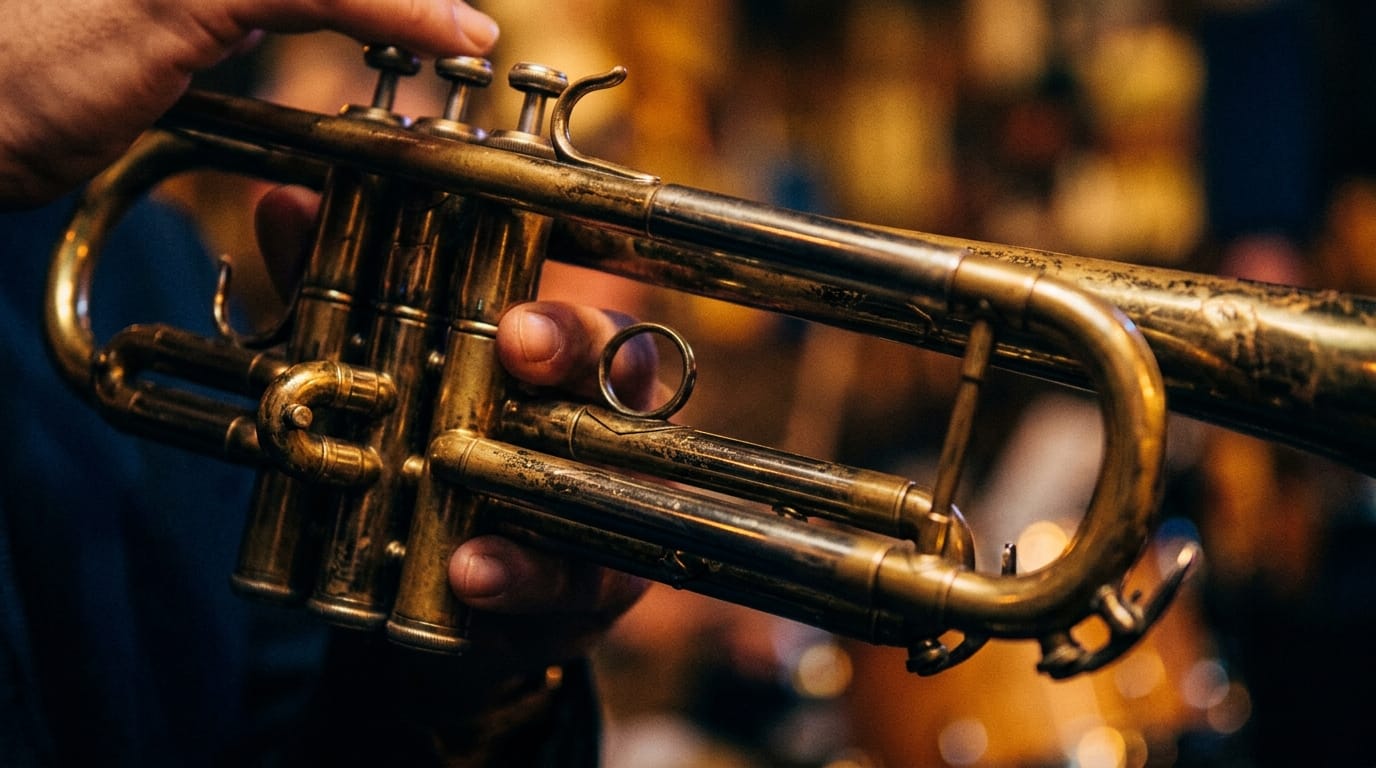
Modal jazz uses the same instruments as other jazz forms, piano, saxophone, trumpet, bass, drums, guitar. What changes is how each instrument functions within the ensemble. The modal framework redistributes responsibility across the band, and each instrument finds a new role in the process.
Piano
The piano’s role shifts from harmonic traffic cop to textural colorist. In bebop, the pianist’s left hand typically “comps” (plays chords) in a way that reinforces each chord change as it arrives. In modal jazz, that function becomes redundant. Bill Evans responded by developing sparse, impressionistic voicings built in fourths rather than thirds, what musicians call quartal harmony. These voicings sound ambiguous and floating because they don’t point toward a resolution the way traditional triads do. McCoy Tyner took a different approach with Coltrane: thick, percussive block chords in the left hand, driving the music forward with rhythmic force rather than harmonic clarity. Both approaches became templates that pianists still use today. According to Blue Note Records, Tyner’s chord voicings have been adopted by virtually every younger pianist in jazz.
Saxophone
The saxophone became the primary melodic vehicle for modal exploration, partly because its range maps naturally onto long scalar runs and partly because its expressive palette, from whisper to roar, suits the emotional arc that modal improvisation demands. Coltrane’s decision to play soprano saxophone on “My Favorite Things” (released on Atlantic Records in 1961, the first album to feature him on that instrument) was a pivotal moment. The soprano’s bright, penetrating tone cut through the static Dorian vamp with a clarity that the tenor couldn’t quite match, and it opened up a new sonic dimension for modal jazz.
Guitar
The guitar’s natural sustain makes it well-suited to slow harmonic rhythm. Wes Montgomery brought modal scalar vocabulary to the guitar without sacrificing his characteristic swinging feel, recording modal-influenced sessions for Riverside and Verve in the early 1960s. Grant Green’s Blue Note recordings took a more blues-rooted approach, applying modal thinking to a sound that never lost its earthy directness. Both players demonstrated that the guitar could hold a tonal center as effectively as any horn.
Bass and Drums
The bass’s liberation from walking through chord changes opened up new possibilities: pedal points (sustaining a single note beneath shifting melodic activity above), ostinatos, and melodic counterpoint with the soloists. The drums followed suit. Tony Williams, working with Miles Davis’s Second Great Quintet from 1964 onward, pushed this further than anyone, his playing was so rhythmically independent that it sometimes seemed to exist in a separate time stream from the rest of the band, creating a productive tension that defined post-bop modal jazz. The rhythm section’s freedom was as important as the soloists’ freedom. Modal jazz democratized the ensemble.
Subgenres and Variants, How Modal Jazz Evolved and Branched
Modal jazz was never a fixed style. It was a framework, a set of harmonic and improvisational principles that different musicians applied in different ways, producing distinct variants that sometimes barely resembled each other. Here are the main branches.
Hard Bop with Modal Elements (Late 1950s)
The transition zone between hard bop and modal jazz produced some of the most interesting music of the era. Art Blakey’s Jazz Messengers and Horace Silver’s groups retained the hard-swinging rhythmic feel and blues influence of hard bop while beginning to incorporate modal thinking into their harmonic language. The result was less pure than Davis’s approach, chord changes still moved, but more slowly, and soloists began to think in scalar terms rather than purely chordal ones. This hybrid zone produced much of the Blue Note catalog’s most accessible and enduring music.
Free Modal Jazz (Early 1960s)
Coltrane’s Ascension, recorded in June 1965 and released on Impulse! Records, pushed modal jazz to its outer limit. Modes became launching pads rather than structures, the ensemble would establish a tonal center and then collectively push against it, testing how far the music could stretch before the center disappeared entirely. Eric Dolphy’s Blue Note recordings explored similar territory, using modal frameworks as starting points for increasingly abstract improvisation. The key distinction between free modal jazz and pure free jazz is that free modal jazz retains tonal centers; pure free jazz abandons them altogether.
Post-Bop Modal Jazz (Mid-1960s Onward)
Miles Davis’s Second Great Quintet, with Wayne Shorter, Herbie Hancock, Ron Carter, and Tony Williams, combined modal harmony with rhythmic complexity and compositional sophistication that went well beyond the relatively simple structures of Kind of Blue. Albums like E.S.P. (Columbia, 1965) and Miles Smiles (Columbia, 1967) used modal harmony as one tool among many, layering it with rhythmic displacement, metric ambiguity, and Shorter’s compositionally distinctive tunes. This is the most intellectually demanding branch of modal jazz, and arguably its most rewarding.
Spiritual/Modal Jazz (1960s)
For Coltrane, modal scales became a spiritual language. A Love Supreme, recorded in December 1964 and released on Impulse! Records the following year, uses modal improvisation as the vehicle for what Coltrane described as a devotional offering. Alice Coltrane and Pharoah Sanders extended this approach into the late 1960s and beyond, connecting the openness of Dorian and Mixolydian harmony to meditative, devotional expression rooted in both African American church music and Eastern spiritual traditions. The connection between modal jazz’s harmonic spaciousness and spiritual music is not coincidental, both require the listener to dwell rather than follow.
Neo-Modal Jazz (1980s-Present)
By the 1980s, modal harmony had been absorbed so thoroughly into jazz vocabulary that it ceased to be a distinct style and became standard practice. Keith Jarrett’s solo concerts, Branford Marsalis’s quartet recordings, and the entire curriculum at institutions like Berklee College of Music and the Juilliard School treat Dorian and Mixolydian improvisation as foundational skills. Kamasi Washington’s The Epic (Brainfeeder, May 5, 2015) brought modal jazz’s scale-based improvisation, slow harmonic rhythm, and spiritual suite structure to a new generation of listeners, drawing a direct line from Coltrane’s 1960s work to contemporary jazz and R&B.
The Defining Bands and Players
Modal jazz’s originating era produced a remarkably concentrated cast of innovators. Most of them knew each other, played on each other’s records, and pushed each other forward. What follows is the core group, the musicians whose work defined what modal jazz was and what it could become. For a broader survey of the genre’s instrumental voices, the complete guide to jazz improvisation covers the improvisational techniques these players pioneered.
Miles Davis
Davis was the primary popularizer and recorded architect of modal jazz. His key recordings, the title track of Milestones (1958) and the entirety of Kind of Blue (1959), established the style’s parameters for every musician who followed. His studio method was as important as the music itself: by handing players scale sketches rather than chord charts, he forced spontaneous, unguarded responses that gave Kind of Blue its characteristic freshness. According to the Miles Davis Official Site, Kind of Blue holds a 5x Platinum RIAA certification, making it the best-selling jazz album in history. Davis won multiple Grammy Awards across his career, including the Grammy Lifetime Achievement Award in 1990.
John Coltrane
Coltrane played tenor saxophone on Kind of Blue and simultaneously developed his own modal language through independent exploration. His transformation of the Rodgers and Hammerstein show tune “My Favorite Things” into a modal vehicle, using the Dorian mode on soprano saxophone across an extended vamp, demonstrated that modal jazz could work on any source material. A Love Supreme (Impulse!, 1965) remains the style’s most emotionally complete statement: a four-part suite in which modal improvisation serves as spiritual expression. The term “sheets of sound,” coined in the liner notes for Coltrane’s album Soultrane in 1958 to describe his dense, rapid scalar runs, captures the intensity he brought to modal improvisation. You can explore his full recorded output at the official John Coltrane biography.
Bill Evans
Evans was the pianist on Kind of Blue and wrote the album’s original liner notes, which remain the clearest primary-source account of how Davis structured the sessions. His contribution to modal jazz piano was the quartal voicing, chords built in fourths rather than thirds, which sound open and unresolved in a way that perfectly suits the modal framework. His later trio work with bassist Scott LaFaro and drummer Paul Motian extended modal concepts into an interactive format where all three instruments improvised simultaneously rather than following a soloist-plus-rhythm-section hierarchy. Bill Evans received multiple Grammy Awards across his career and was inducted into the DownBeat Jazz Hall of Fame.
McCoy Tyner
Tyner served as Coltrane’s pianist from 1960 to 1965 and developed the most influential modal piano style after Evans. Where Evans favored impressionistic delicacy, Tyner brought percussive force: his left-hand quartal voicings drove the music forward with rhythmic urgency, creating a churning, propulsive energy beneath Coltrane’s soprano and tenor lines. That approach became the standard template for modal jazz comping, and it’s still the first thing jazz piano students learn when they encounter modal harmony. His solo album The Real McCoy (Blue Note, 1967) is the fullest statement of his mature style. According to The HistoryMakers, Tyner recorded over eighty albums and won multiple Grammy Awards.
Herbie Hancock
Maiden Voyage (Blue Note, 1965) is Hancock’s defining modal statement and one of the most fully realized modal albums ever recorded. All five tracks use suspended, ambiguous chord voicings rooted in modal harmony, the music evokes the ocean’s surface without ever quite resolving to solid ground. Hancock later bridged modal jazz and jazz fusion as a member of Davis’s Second Great Quintet and as a solo artist. His career has earned him 14 Grammy Awards, including Album of the Year for River: The Joni Letters, according to his official biography.
Wayne Shorter
Shorter’s Blue Note recordings as a leader, particularly Speak No Evil (1966) and Adam’s Apple (1967), are defining post-bop modal works. His compositions used mode-based harmony to create narrative, cinematic moods: each tune feels like a short story with a beginning, middle, and unresolved ending. “Footprints,” composed for Adam’s Apple in 1966, became one of the most widely played modal jazz standards, later recorded by Miles Davis’s Second Great Quintet. Wayne Shorter received 12 Grammy Awards across his career and the Polar Music Prize.
Wes Montgomery
Montgomery brought modal scalar vocabulary to the guitar without sacrificing the swinging feel that defined his playing. His Riverside and Verve recordings from the early 1960s demonstrated that the guitar could hold a tonal center as effectively as any horn, and his characteristic technique, plucking strings with his thumb rather than a pick, gave his modal lines a warm, rounded tone that suited the style’s meditative quality. He won Grammy Awards for recordings in the late 1960s before his death in 1968.
Joe Henderson
Henderson’s Blue Note recordings bridged hard bop and modal jazz with compositional sophistication that set him apart from his contemporaries. Mode for Joe (Blue Note, 1966) is a canonical modal jazz album: the title track is a textbook example of Mixolydian-based composition, and the ensemble, featuring Lee Morgan, Bobby Hutcherson, and Cedar Walton, plays with a collective intelligence that rewards repeated listening. Henderson won multiple Grammy Awards during his career, including recognition for best instrumental jazz solo and best jazz instrumental performance.
Essential Modal Jazz Albums, A Listener’s Guide
The eight albums below form a sequenced listening path from foundational to exploratory. Start with Kind of Blue and work outward. Each record demonstrates a distinct aspect of modal jazz’s range, and together they map the style’s full territory. For a broader survey of the genre’s recorded history, the best jazz albums for beginners guide includes several of these titles with additional context for new listeners.
#1, Kind of Blue, Miles Davis (Columbia, 1959). The definitive starting point. “So What” demonstrates the two-mode structure in its purest form; “Flamenco Sketches” shows what happens when the structure opens up entirely, with each soloist free to stay on each scale for as long as they choose. No other album explains modal jazz as clearly or as beautifully.
#2, Milestones, Miles Davis (Columbia, 1958). The transitional record. The title track is the earliest modal statement on a major jazz release, and hearing it alongside the album’s more conventional tracks makes the contrast vivid. This is where the idea became a recording.
#3, My Favorite Things, John Coltrane (Atlantic, 1961). Coltrane’s transformation of a Rodgers and Hammerstein standard into a modal vehicle is one of jazz’s great acts of reinvention. The E Dorian vamp stretches across an extended soprano saxophone improvisation that builds in intensity without ever losing its melodic thread. It was also the first album to feature Coltrane on soprano saxophone.
#4, A Love Supreme, John Coltrane (Impulse!, 1965). Modal jazz as devotional suite. Recorded in a single session in December 1964, the album’s four-part structure, “Acknowledgement,” “Resolution,” “Pursuance,” “Psalm”, uses modal improvisation as the vehicle for spiritual expression. According to NPR’s account of the album’s creation, Coltrane presented it explicitly as a spiritual declaration.
#5, Maiden Voyage, Herbie Hancock (Blue Note, 1965). The most harmonically sophisticated entry on this list. Hancock’s suspended, non-resolving chord voicings create a sense of perpetual motion without destination, the musical equivalent of open water. Every track uses modal harmony, and the ensemble (featuring Freddie Hubbard, George Coleman, Ron Carter, and Tony Williams) plays with extraordinary collective sensitivity.
#6, Speak No Evil, Wayne Shorter (Blue Note, 1966). Five original Shorter compositions, all mode-centered, all built on the cinematic, narrative approach that made him the most distinctive composer in modal jazz. Recorded on Christmas Eve 1964 and released in 1966, the album features Davis’s mid-1960s rhythm section and represents post-bop modal jazz at its most compositionally refined.
#7, The Real McCoy, McCoy Tyner (Blue Note, 1967). Tyner’s quartal voicings fully developed, his left-hand drive at its most powerful. The album features Joe Henderson on tenor saxophone, Ron Carter on bass, and Elvin Jones on drums, a lineup that generates extraordinary collective energy. This is the album that codified the modal piano trio sound.
#8, Mode for Joe, Joe Henderson (Blue Note, 1966). The title track is a textbook modal jazz composition built on Mixolydian harmony, and the album as a whole demonstrates how modal thinking could be applied to a larger ensemble without losing the style’s characteristic openness. Recorded on January 27, 1966, with Lee Morgan, Bobby Hutcherson, Cedar Walton, Ron Carter, and Joe Chambers.
| Album | Artist | Year | Label | Key Mode/Scale |
|---|---|---|---|---|
| Kind of Blue | Miles Davis | 1959 | Columbia | D Dorian, Eb Dorian |
| Milestones | Miles Davis | 1958 | Columbia | G Dorian, A Aeolian |
| My Favorite Things | John Coltrane | 1961 | Atlantic | E Dorian |
| A Love Supreme | John Coltrane | 1965 | Impulse! | F minor modal |
| Maiden Voyage | Herbie Hancock | 1965 | Blue Note | Suspended quartal |
| Speak No Evil | Wayne Shorter | 1966 | Blue Note | Mixed modal |
| The Real McCoy | McCoy Tyner | 1967 | Blue Note | Dorian/Mixolydian |
| Mode for Joe | Joe Henderson | 1966 | Blue Note | Mixolydian |
A Plain-Language Theory Primer, Scales, Modes, and How to Hear Them
This section is for listeners without music theory background. No assumed knowledge required. If you can hear the difference between a major and minor scale, you already have everything you need to follow along.

What Is a Mode?
A mode is a scale, a specific sequence of notes with a characteristic sound. Western music uses seven modes, all derived from the major scale by starting on a different note. The two modes that appear most frequently in modal jazz are Dorian and Mixolydian. Dorian is a minor-flavored scale with one important difference from the natural minor: its sixth degree is raised by a half step. That single change gives Dorian its characteristic quality, it sounds minor but not sad, open rather than dark. Here’s the simplest way to hear it: sit at a piano and play only the white keys from D to D. That’s D Dorian. Now play from A to A on the white keys. That’s A Aeolian, the natural minor. The difference is subtle but audible, Dorian has a brightness that Aeolian lacks.
Mixolydian is a major scale with a flatted seventh degree. Play white keys from G to G on a piano and you have G Mixolydian. It sounds major but with a slightly unresolved quality at the top, that flatted seventh pulls the ear without quite landing. Blues musicians have used this sound for decades, which is why modal jazz and blues share a certain earthy directness.
How Modal Harmony Replaces Chord Changes
In bebop, chord changes happen every two to four beats, and the improviser’s job is to outline each chord as it arrives. The melody moves vertically, up and down the chord. In modal jazz, one mode may last sixteen to thirty-two bars, and the improviser builds melodic narrative instead of tracking harmony. The melody moves horizontally, across the scale, developing ideas over time. “So What” is the clearest example: two modes, a 32-bar form, and a single harmonic shift that even a first-time listener can follow. When the piano and bass shift from D Dorian to Eb Dorian at bar 17, you hear it as a brightening, a slight lift, and then the return to D Dorian at bar 25 feels like coming home.
Quartal Harmony, The Modal Jazz Chord Sound
Here’s the angle that most explanations of modal jazz skip entirely: the chord sound. Traditional jazz chords are built in thirds, stack a third on top of a third on top of a third and you get a seventh chord. Quartal chords are built in fourths instead. Stack a fourth on top of a fourth and you get a voicing that sounds ambiguous, floating, unresolved. It doesn’t point toward a tonic the way a traditional chord does. Bill Evans and McCoy Tyner were the two architects of this sound on piano, and their approaches differed: Evans used quartal voicings to create impressionistic space, while Tyner used them as rhythmic hammers. Try this listening test: play “So What” and focus on the piano introduction. Those stacked fourths in Evans’s left hand are the sound of modal jazz harmony. Then find a standard bebop recording and listen to the piano comping, the difference in harmonic texture is immediate and unmistakable.
Understanding quartal harmony also explains why modal jazz sounds the way it does to a listener who can’t name a single chord. The music doesn’t resolve. It doesn’t push toward a destination. It creates a sustained tonal environment and invites you to inhabit it. That’s the modal jazz experience, and it starts with those stacked fourths. For a deeper look at how these harmonic concepts connect to the broader jazz vocabulary, the guide to jazz chord progressions covers the full harmonic language of the genre.
The Decline, the Legacy, and the Modern Revival
Modal jazz’s peak era was concentrated and intense. By the late 1960s, the musicians who had defined it were already moving on, and the style’s center of gravity shifted, outward into fusion, inward into free jazz, and eventually into the general vocabulary of jazz education.
Why Modal Jazz Lost Momentum (Late 1960s-1970s)
By 1968, the leading players had moved on. Davis released In a Silent Way in 1969 and Bitches Brew in 1970, both of which absorbed modal harmony into an electric, rock-influenced context where it became one element among many rather than the organizing principle. Coltrane’s death in 1967 removed the style’s most radical proponent at the moment when his work was pushing hardest against its own boundaries. Rock’s commercial dominance redirected jazz audiences and record label priorities throughout the early 1970s, and modal jazz, which had never been commercially driven, found fewer institutional champions.
What Modal Jazz Left Behind, Lasting Influence
Let’s be honest about the scale of modal jazz’s influence: it’s everywhere. Modal jazz scales became foundational jazz pedagogy. Mark Levine’s The Jazz Theory Book (Sher Music), the most widely used jazz theory text in university programs, devotes substantial attention to Dorian and Mixolydian improvisation as core skills. Berklee College of Music and the Juilliard School both treat modal harmony as a prerequisite for advanced jazz study. Every jazz musician trained after 1960 learns these scales before they learn anything else.
The influence extends well beyond jazz. Stevie Wonder’s use of Dorian harmony in his 1970s recordings gave soul music a harmonic sophistication it hadn’t previously possessed. Carlos Santana built an entire guitar vocabulary on Dorian-based improvisation, bringing modal jazz’s scalar approach to rock audiences who had never heard Kind of Blue. The Doors’ keyboard-driven sound drew on modal vamps in ways that their rock contemporaries rarely acknowledged. Ambient and electronic music, from Brian Eno’s early work onward, borrowed modal jazz’s concept of sustained tonal centers as the basis for texture-based composition.
Modal Jazz Today, The Neo-Modal Revival
Kamasi Washington’s The Epic (Brainfeeder, May 5, 2015) announced that modal jazz’s core principles were not only alive but capable of generating genuinely new music. The album’s scale-based improvisation, slow harmonic rhythm, and spiritual suite structure drew a direct line from Coltrane’s 1960s work to contemporary jazz and R&B. Robert Glasper’s modal-influenced approach bridges jazz and R&B in a way that reaches audiences far beyond the traditional jazz listenership. In the UK, saxophonists Nubya Garcia and Shabaka Hutchings have built substantial careers on a modal jazz foundation updated with Afrobeat, Caribbean, and electronic influences. Modal jazz isn’t a historical artifact. It’s the grammar that contemporary jazz still speaks. For a broader look at how these contemporary voices are extending the tradition, the modern jazz artists defining the genre today article covers the vocal side of this ongoing conversation.
Frequently Asked Questions About Modal Jazz
What is modal jazz?
Modal jazz is a style of jazz improvisation in which musicians improvise over static or slowly-changing scales (modes) rather than working through rapid chord changes. Originating between 1958 and the mid-1960s, it is defined by slow harmonic rhythm, scale-based melodic construction, and an improvisational freedom that bebop’s dense chord vocabulary didn’t allow. Miles Davis’s “So What” (from Kind of Blue, 1959) is the canonical example: a 32-bar form built on just two modes, D Dorian and Eb Dorian.
How is modal jazz characterized?
Modal jazz is characterized by the following features:
- Slow harmonic rhythm: a single mode or chord may last 8, 16, or 32 bars
- Scale-based improvisation: soloists build melodic ideas across a mode rather than outlining chord changes
- Quartal harmony: piano and guitar voicings built in fourths rather than thirds, creating an ambiguous, floating sound
- Rhythmic freedom: the bass and drums are freed from the obligation to demarcate chord changes
- Melodic (horizontal) construction: melodies move across the scale rather than up and down chords
- Tonal ambiguity: the music has a clear center of gravity but doesn’t resolve in the traditional sense
Did Miles Davis invent modal jazz?
No, not entirely. George Russell published the first theoretical framework for modal improvisation in jazz in 1953 with The Lydian Chromatic Concept of Tonal Organization, and Davis credited those ideas as foundational. Coltrane and other musicians were exploring similar territory simultaneously and independently. What Davis did was make modal jazz a recorded reality: his 1958 recording of “Milestones” and the 1959 album Kind of Blue gave musicians a concrete model to study, copy, and build on. He was the popularizer, not the sole inventor, and in jazz, popularization is its own form of creation.
What is the difference between modal jazz and bebop?
The core difference is harmonic rhythm. Bebop moves through chord changes every one to four beats, forcing soloists to outline each chord with arpeggios and passing tones. Modal jazz slows harmonic rhythm to a near-stop, resting on a single scale for eight to thirty-two bars at a stretch. This changes everything downstream: the improviser’s approach shifts from vertical (chord-driven) to horizontal (scale-driven), the rhythm section’s role shifts from harmonic traffic management to textural support, and the overall feel shifts from urgent and dense to open and spacious. Table 1 above summarizes the key differences across six dimensions.
What are the best modal jazz songs for a first-time listener?
Start with these five tracks, in this order:
- “So What”, Miles Davis (Kind of Blue, 1959): the clearest structural example, two modes, 32 bars
- “Impressions”, John Coltrane (recorded 1962-1963): Coltrane’s own modal standard, built on the same D Dorian/Eb Dorian structure as “So What”
- “Maiden Voyage”, Herbie Hancock (Maiden Voyage, 1965): suspended quartal harmony at its most evocative
- “My Favorite Things”, John Coltrane (My Favorite Things, 1961): modal transformation of a familiar melody
- “Footprints”, Wayne Shorter (Adam’s Apple, 1966): modal jazz as compositional narrative, one of the most widely played modal standards
How do you improvise in modal jazz?
Pick one mode and stay in it. That’s the starting point. Choose D Dorian (white keys from D to D on a piano), set up a simple vamp on a D minor chord, and start building melodic ideas using only those notes. The challenge isn’t the scale, it’s what you do with it. Use space: silence is as important as sound. Vary your rhythm: play the same melodic idea in different rhythmic shapes. Build phrases that have a beginning, middle, and end. Use dynamics: start quiet and build, or start loud and pull back. The goal is to create a complete musical statement using a single tonal environment. That’s modal jazz improvisation in its purest form. The guide to jazz scales covers the full range of modes and their applications in detail.
Modal Jazz’s Enduring Framework
Modal jazz didn’t just change how jazz musicians played, it changed what jazz could mean as an art form. From Miles Davis’s scale sketches in 1958 to Kamasi Washington’s three-disc suite in 2015, the modal framework has proven the most adaptable and enduring structural innovation in post-war jazz. It gave musicians permission to slow down, to breathe, to develop an idea rather than chase a chord. That permission turned out to be worth more than anyone anticipated. If you’re ready to go deeper, the complete guide to bebop jazz provides the essential context for understanding what modal jazz was reacting against, and why that reaction produced some of the most beautiful music of the twentieth century.