Jazz Piano: A Complete Guide to the Music, the Players, and the Albums
Jazz piano is a style of keyboard performance rooted in African American musical tradition, emerging from the ragtime and blues idioms of the early 1900s and evolving into one of the most technically demanding and harmonically rich performance practices in Western music. From Scott Joplin’s syncopated rags around 1899 to the fully improvised solo concerts of Keith Jarrett in the 1970s and the neo-soul crossovers of Robert Glasper today, jazz piano has continuously reinvented itself while keeping improvisation at its core. No other instrument in jazz carries the same dual responsibility: the pianist must simultaneously provide melody, harmony, and rhythmic momentum, functioning as a one-person orchestra within any ensemble. That structural advantage explains why jazz piano players have driven so many of the genre’s most important stylistic revolutions, and why jazz piano music remains one of the most searched and studied areas of the entire jazz tradition.
Table of Contents
- The Origin Story: From Ragtime Parlors to Concert Stages
- Why the Piano? The Instrument’s Structural Advantage
- Ragtime and the First Jazz Pianists (1897-1917)
- Stride and the Harlem Renaissance (1920s-1930s)
- Defining Characteristics of Jazz Piano
- Harmony, The Extended Chord Vocabulary
- Rhythm, Swing, Comping, and the Rhythmic Contract
- Improvisation, The Real-Time Compositional Act
- Performance Context, Solo, Trio, and Ensemble
- Instrumentation, What Piano Is Used for Jazz?
- Key Instruments and the Jazz Piano Ensemble
- The Piano’s Role Across Jazz Formats
- Acoustic vs. Electric, A Functional Comparison
- Subgenres and Variants of Jazz Piano
- Stride Piano
- Bebop Piano
- Cool and West Coast Jazz Piano
- Modal Jazz Piano
- Jazz Fusion and Electric Piano
- Contemporary and Post-Bop Piano
- The Defining Players, Eight Essential Jazz Pianists
- Art Tatum (1909-1956)
- Mary Lou Williams (1910-1981)
- Bud Powell (1924-1966)
- Thelonious Monk (1917-1982)
- Oscar Peterson (1925-2007)
- Bill Evans (1929-1980)
- Herbie Hancock (b. 1940)
- Keith Jarrett (b. 1945)
- Essential Jazz Piano Albums
- #1, Piano Starts Here
- #2, Zodiac Suite
- #3, The Amazing Bud Powell, Vol. 1
- #4, Genius of Modern Music, Vol. 1
- #5, Night Train
- #6, Sunday at the Village Vanguard
- #7, Now He Sings, Now He Sobs
- #8, The Köln Concert
- #9, Maiden Voyage
- #10, A Note on McCoy Tyner
- Jazz Piano Theory Primer, Scales, Chords, and the Language of Standards
- The Core Scales Every Jazz Pianist Uses
- The ii-V-I Progression and Jazz Standards
- Where to Find Jazz Piano Sheet Music
- The Decline, Resilience, and Modern Reinvention of Jazz Piano
- The Commercial Pressure of the 1970s-1980s
- The Neo-Classic and Contemporary Renaissance
- Jazz Piano in the Streaming Era
- Frequently Asked Questions About Jazz Piano
- What Is Jazz Piano?
- Who Is the Most Famous Jazz Pianist?
- Is Jazz Piano the Hardest Style of Piano to Learn?
- What Are the Most Famous Jazz Piano Songs?
- Where Can I Learn Jazz Piano Online?
- Unique Angles: Geography, Classical Crossover, and Women in Jazz Piano
- The Physical Geography of Jazz Piano, A City-by-City Map
- Jazz Piano and Classical Music, The Cross-Pollination
- Women in Jazz Piano, A Corrective History
- How jazz piano evolved from ragtime and stride through bebop to contemporary styles
- The defining harmonic, rhythmic, and improvisational characteristics of jazz piano
- The subgenres, from stride and bebop to modal, fusion, and post-bop
- Profiles of eight essential jazz piano players, from Art Tatum to Keith Jarrett
- Ten essential jazz piano albums and what makes each one indispensable
- A beginner-accessible theory primer on scales, chords, and jazz standards
The Origin Story: From Ragtime Parlors to Concert Stages
Jazz piano didn’t emerge from a single moment or a single city. It grew out of a collision between African rhythmic sensibility, European harmonic structure, and the social geography of late 19th-century America, where the piano happened to be the most widely available instrument capable of holding all three at once. The story runs from Missouri saloons to Harlem rent parties to the concert stages of Carnegie Hall, and it covers roughly three decades of rapid stylistic evolution before bebop arrived to change everything again.
Why the Piano? The Instrument’s Structural Advantage
The piano’s 88 keys, 52 white, 36 black, place the full chromatic spectrum under a single player’s hands. No wind or string instrument can do that. A saxophonist plays one note at a time; a pianist can voice a seven-note chord in the left hand while running a bebop line in the right. This polyphonic capacity made the piano the natural harmonic anchor of any jazz ensemble, and it made solo piano performance viable in a way that solo trumpet or solo saxophone simply isn’t. The piano is, structurally, a one-instrument orchestra.
Ragtime and the First Jazz Pianists (1897-1917)
Scott Joplin, dubbed the “King of Ragtime,” composed more than 40 ragtime pieces and his Maple Leaf Rag (1899) became one of the best-selling instrumental sheet-music hits of its era, a commercial milestone that established piano jazz music as a mass-market phenomenon before the recording industry existed in any meaningful form. Joplin worked primarily out of Sedalia, Missouri, though his influence spread quickly to St. Louis and New Orleans. Ferdinand “Jelly Roll” Morton, a Louisiana Creole pianist and bandleader, claimed to have invented jazz itself, a boast historians treat skeptically but which reflects how central piano was to the genre’s self-mythology. Morton’s King Porter Stomp (composed around 1906) became one of the most-covered jazz compositions of the swing era. The social venues for these early jazz piano songs were unambiguously working-class: saloons, brothels, and rent parties where the piano was the only instrument that didn’t need to be carried in.
Stride and the Harlem Renaissance (1920s-1930s)
Stride piano is defined by a specific left-hand pattern: the hand “strides” between a low bass note on beats one and three and a mid-register chord on beats two and four, creating a self-contained rhythmic engine beneath the right hand’s melodic improvisation. James P. Johnson, born in 1894, is widely credited as the architect of the style. His Carolina Shout (1921), added to the Grammy Hall of Fame in 2020, became the test piece at Harlem rent parties, where pianists competed in “cutting contests” to establish dominance. Fats Waller, born and raised in Harlem, became the most commercially successful stride pianist, while Willie “The Lion” Smith completed what historians call the “big three” of stride piano. These Harlem rent parties, informal gatherings where guests paid admission to help cover the rent, functioned as performance laboratories, pushing pianists toward ever-greater technical demands.
| Era | Recording | Artist | Year |
|---|---|---|---|
| Ragtime | Maple Leaf Rag | Scott Joplin | 1899 |
| Stride | Carolina Shout | James P. Johnson | 1921 |
| Swing | Tiger Rag | Art Tatum | 1933 |
| Bebop | Ornithology | Bud Powell | 1949 |
| Modal | Kind of Blue (piano parts) | Bill Evans | 1959 |
For a broader look at how these early decades shaped American culture, see our history of jazz in the 1920s.
Defining Characteristics of Jazz Piano
Jazz piano isn’t just a genre label, it’s a set of interlocking technical and philosophical commitments that distinguish it from every other keyboard tradition. Understanding those commitments is the fastest route to understanding why jazz piano sounds the way it does, and why learning it demands a different kind of practice than classical or pop piano.
Harmony, The Extended Chord Vocabulary
Where classical harmony centers on triads (three-note chords), jazz piano harmony builds upward from seventh chords, four-note structures that add a seventh interval above the root, and then extends further to ninths, elevenths, and thirteenths. A C major seventh chord (Cmaj7) already sounds distinctly “jazzy” compared to a plain C major triad; add a ninth (D) and an eleventh (F#) and you’re in the territory of the lush, ambiguous voicings that define the genre. The tritone substitution, replacing a dominant seventh chord with another dominant chord whose root sits a tritone (three whole steps) away, is one of jazz piano’s most documented harmonic devices, explained in detail in Mark Levine’s The Jazz Piano Book (Sher Music, 1989), the most widely cited written resource in jazz piano education. Shell voicings strip a chord down to just its third and seventh, leaving space for the bassist to define the root; this technique keeps the piano from cluttering the low register. Rootless voicings, pioneered by Bill Evans and Red Garland in the late 1950s, take that concept further, floating the harmony in the middle register while the bass player handles the foundation. The ii-V-I progression (a minor seventh chord moving to a dominant seventh chord moving to a major seventh chord) is the foundational cadential unit of jazz harmony, appearing in some form in the vast majority of jazz standards.
Rhythm, Swing, Comping, and the Rhythmic Contract
The defining rhythmic feature of jazz piano is swing feel: a triplet-based subdivision of the beat that makes written eighth notes sound uneven, with the first eighth note slightly longer than the second. It’s the difference between a march and a groove, and it’s almost impossible to notate precisely, you absorb it by listening. Comping (short for “accompanying”) is the jazz pianist’s art of providing rhythmic and harmonic support behind a soloist, using short, punchy chord stabs placed unpredictably across the bar rather than on every beat. The left hand’s role has evolved dramatically across jazz piano’s history: stride piano demanded a mechanical alternating bass-chord pattern, while modern jazz piano allows the left hand to “float,” dropping in chords only when they add something to the conversation. Syncopation, placing rhythmic accents on the “weak” beats or between beats, isn’t an ornament in jazz piano; it’s a structural principle. The rhythmic relationship between pianist, bassist, and drummer is often described as a conversation, with each player responding to and anticipating the others in real time.
Improvisation, The Real-Time Compositional Act
Jazz improvisation means inventing melody in real time, constrained by the chord changes and formal structure of the piece being played. The pianist isn’t reading a solo from a page, they’re composing it on the spot, drawing on a vocabulary of scales, patterns, and harmonic ideas built up through years of practice and listening. The most common formal containers are the 12-bar blues (a repeating 12-measure harmonic cycle) and the 32-bar AABA form (four 8-bar sections, the third of which is a contrasting “bridge”). “Playing inside” means staying within the expected harmonic framework; “playing outside” means deliberately introducing notes or phrases that clash with the underlying chords, creating tension before resolving back. Charlie Parker’s saxophone vocabulary, fast, chromatic, rhythmically displaced, became the template for bebop piano improvisation, with Bud Powell translating those lines directly to the keyboard. Thelonious Monk took the opposite approach: deliberate space, dissonant “wrong” notes held long enough to become structural, and angular melodic leaps that made his solos instantly recognizable. Our complete guide to jazz improvisation covers these concepts in greater depth.
Performance Context, Solo, Trio, and Ensemble
Jazz piano operates across three primary performance contexts, each demanding a different approach. Solo piano requires the pianist to cover all harmonic, melodic, and rhythmic functions simultaneously, the most demanding format, and the one that produced Art Tatum’s most astonishing recordings. The piano trio (piano, bass, drums) is the most common jazz piano format; Nat King Cole popularized it in the 1940s, and Bill Evans’s Village Vanguard recordings in 1961 elevated it to an art form built on collective improvisation rather than piano-plus-rhythm-section. In larger ensembles, quartets, quintets, big bands, the pianist shifts between featured soloist and section member, comping behind horn soloists and contributing to the ensemble’s harmonic texture. The recording studio and the live stage also demand different approaches: studio recordings allow for multiple takes and careful editing, while live performance rewards spontaneity and risk-taking.
Instrumentation, What Piano Is Used for Jazz?
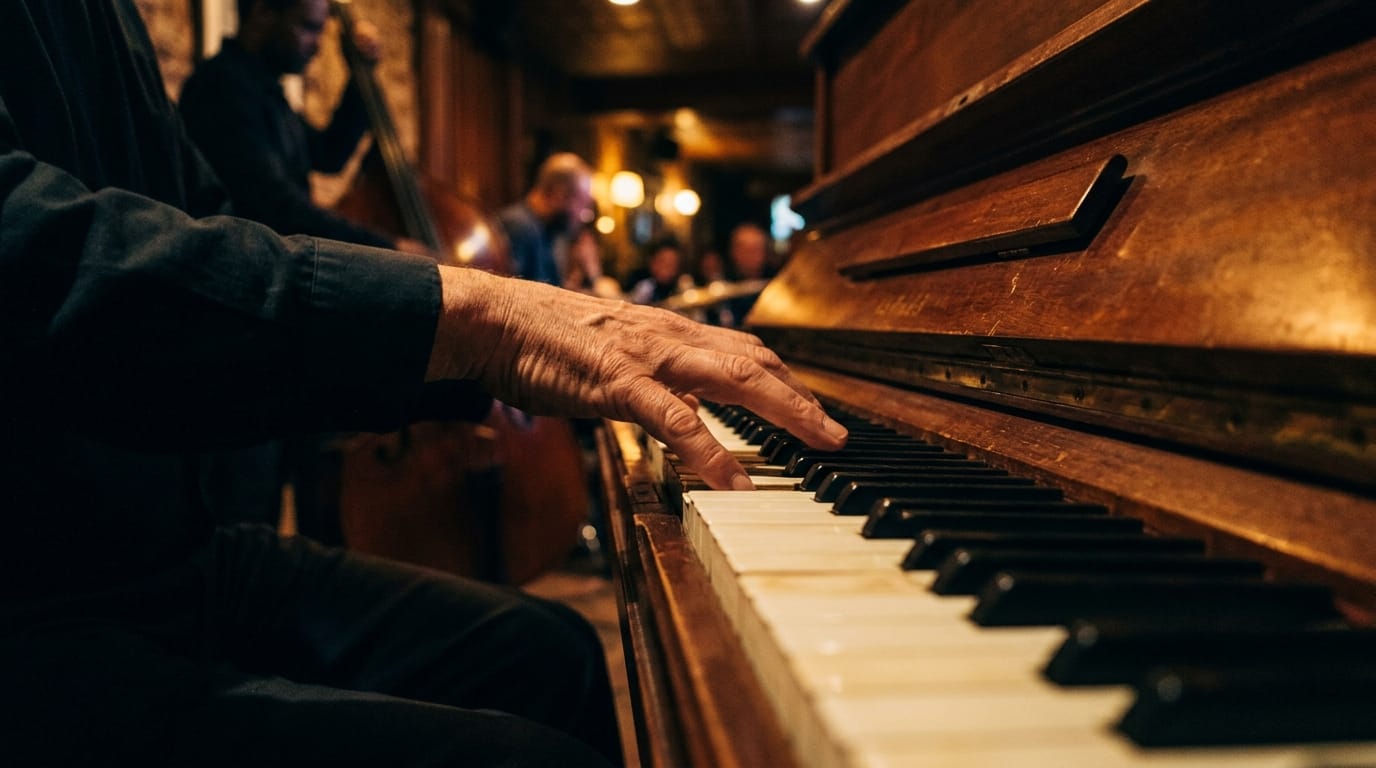
The Steinway Model D concert grand (nine feet long) is the professional standard for concert jazz piano performance, prized for its dynamic range and the responsiveness of its action. In smaller club settings through the 1920s to 1950s, upright pianos were the norm, cheaper, more portable, and often badly out of tune, which paradoxically contributed to the raw character of early jazz piano recordings. The Fender Rhodes and Wurlitzer electric pianos became essential instruments in 1970s jazz fusion, with Herbie Hancock’s Head Hunters (Columbia, 1973) demonstrating the Rhodes’s warm, bell-like sustain at its most effective. The Yamaha C7 grand has become the touring standard for contemporary jazz pianists, offering consistency across different venues worldwide. The choice of instrument isn’t just practical, it’s a stylistic statement about which tradition a pianist is working within.
Key Instruments and the Jazz Piano Ensemble
The piano’s role within a jazz ensemble is unlike any other instrument’s. It sits at the intersection of the rhythm section and the front line, capable of functioning as either, or both simultaneously. Understanding that dual role explains why the piano is so central to jazz, and why its absence is always a deliberate aesthetic choice.
The Piano’s Role Across Jazz Formats
In the standard jazz rhythm section (piano, bass, drums), the piano serves as the harmonic anchor, defining the chord changes that give the soloists their framework. The guitar can substitute for piano in this role, and does, in many small-group settings, but the piano’s left-hand bass function gives it a depth that guitar can’t fully replicate. The “piano-less” quartet, as explored by Gerry Mulligan in the early 1950s and Ornette Coleman later in the decade, was a deliberate rejection of that harmonic anchoring, creating a more open, ambiguous sound. The fact that removing the piano was considered a radical statement tells you everything about how central it normally is. Modern avant-garde jazz has also incorporated prepared piano techniques, inserting objects between the strings to alter the instrument’s timbre, drawing on the innovations of composer John Cage and applying them to improvised contexts.
Acoustic vs. Electric, A Functional Comparison
| Feature | Acoustic Grand | Fender Rhodes | Wurlitzer |
|---|---|---|---|
| Tone character | Full, resonant, percussive | Warm, bell-like | Reedy, slightly brassy |
| Key jazz use | Bebop, standards, post-bop | Fusion, soul jazz | R&B-influenced jazz |
| Famous users | Bill Evans, Oscar Peterson | Herbie Hancock, Chick Corea | Joe Zawinul, Ray Charles |
| Peak era | 1920s-present | 1968-1982 | 1960s-1975 |
For a deeper look at how jazz harmony translates across these instruments, our guide to jazz piano chords, voicings, and progressions covers the theory in practical detail.
Subgenres and Variants of Jazz Piano
Jazz piano hasn’t stayed still for a decade since it emerged. Each generation of pianists has pushed the style into new territory, sometimes in direct reaction to what came before. Here are the six most distinct stylistic variants, each with its own harmonic logic, rhythmic feel, and cast of defining players.
Stride Piano
Stride piano is the direct descendant of ragtime, amplified and made more physically demanding. The left hand leaps across intervals of a tenth or more, a span that requires a large hand and considerable practice, while the right hand delivers melodic improvisation at tempos that regularly reached 180 to 240 BPM in competitive cutting contests. James P. Johnson built the template; Fats Waller made it commercially irresistible, adding humor and showmanship to Johnson’s architectural precision. The style remains alive today through practitioners like Dick Hyman and Grammy-nominated pianist Judy Carmichael, who has dedicated her career to keeping stride’s technical demands in front of contemporary audiences.
Bebop Piano
Bebop arrived after World War II as a deliberate rejection of swing’s accessibility. Tempos accelerated dramatically, often exceeding 250 BPM, chord changes became more complex and chromatic, and the rhythm section’s role shifted from steady timekeeping to interactive conversation. Bud Powell translated Charlie Parker’s saxophone vocabulary directly to the keyboard: single-note right-hand lines running at speed, with the left hand dropping sparse chord stabs rather than maintaining stride’s mechanical alternation. The key venues were Minton’s Playhouse and Monroe’s Uptown House in Harlem, where musicians gathered after their regular gigs to experiment. Our full guide to bebop jazz covers this revolution in detail.
Cool and West Coast Jazz Piano
Cool jazz emerged in the late 1940s as a reaction to bebop’s intensity, favoring lyrical melodies, softer dynamics, and a more deliberate incorporation of European classical influences. Dave Brubeck’s use of unusual time signatures, most famously 5/4 on “Take Five” from Time Out (1959), brought jazz piano to a mainstream audience that found bebop too abrasive. Lennie Tristano, working in New York rather than the West Coast, developed a contrapuntal approach drawing directly on Bach, layering independent melodic lines in a way that had no precedent in jazz piano. The West Coast scene, centered on Los Angeles, produced a cooler, more relaxed sound that contrasted sharply with New York’s bebop intensity. For a full account of this style, see our guide to cool jazz.
Modal Jazz Piano
Modal jazz replaced the rapid chord changes of bebop with longer stretches of a single scale or mode, giving improvisers more harmonic space and encouraging a more meditative, lyrical approach. Miles Davis‘s Kind of Blue (Columbia, 1959) is the foundational document, and Bill Evans’s role in shaping its concept, he wrote the album’s liner notes, articulating the modal philosophy in plain language, makes it as much a jazz piano landmark as a trumpet one. The modal approach allows a pianist to explore a single harmonic color for eight or sixteen bars rather than working through a new chord every two beats. John Coltrane’s “sheets of sound” approach, developed partly in response to modal concepts, also influenced a generation of pianists toward denser, more layered improvisation. Our complete guide to modal jazz explains the theory behind this shift.
Jazz Fusion and Electric Piano
Miles Davis’s Bitches Brew (Columbia, 1970) fused jazz improvisation with rock rhythms and electric instruments, and the piano’s acoustic form largely stepped aside for a decade. Herbie Hancock’s Head Hunters (Columbia, 1973), the first jazz album certified Platinum by the RIAA, built its grooves around the Fender Rhodes’s warm, sustaining tone rather than an acoustic grand. Chick Corea’s Return to Forever and Joe Zawinul’s Weather Report pushed the electric piano further into funk and rock territory. Corea’s earlier Now He Sings, Now He Sobs (Solid State, 1968) bridges the acoustic post-bop world and the electric era, making it an essential transitional document. The fusion era also introduced synthesizers as a jazz keyboard instrument, expanding the palette well beyond anything the acoustic piano could offer.
Contemporary and Post-Bop Piano
Brad Mehldau’s The Art of the Trio series (Warner Bros./Nonesuch, 1996-2002) reestablished the acoustic piano trio as a vehicle for contemporary expression, incorporating rock harmonies and song structures without abandoning jazz’s improvisational core. Vijay Iyer brings rhythmic complexity drawn from South Asian classical music to his jazz piano work, documented across more than thirty albums. Robert Glasper’s Black Radio (Blue Note, 2012) won a Grammy Award for Best R&B Album and brought jazz piano vocabulary to hip-hop and neo-soul audiences who might never have sought it out otherwise. The “neo-classic” school, Jason Moran, Sullivan Fortner, Hiromi Uehara, demonstrates that jazz piano’s technical and harmonic tradition remains a living, developing practice rather than a museum piece. For a broader look at where jazz piano sits today, our feature on popular jazz artists today covers the contemporary space.
The Defining Players, Eight Essential Jazz Pianists
Any list of essential jazz piano players involves painful omissions, Duke Ellington, McCoy Tyner, Chick Corea, and Marian McPartland could each anchor their own article. The eight profiles below represent the players whose work most directly shaped the instrument’s history, chosen for documented influence on subsequent generations rather than personal preference.
Art Tatum (1909-1956)
Born in Toledo, Ohio, and nearly blind from birth, Art Tatum was largely self-taught and developed a technique so advanced that it baffled his contemporaries. His stride foundation incorporated harmonic substitutions that anticipated bebop by a full decade, he was reharmonizing standards in the early 1930s using chord movements that bebop pianists wouldn’t systematize until the late 1940s. Fats Waller reportedly announced “God is in the house” when Tatum entered a room. Oscar Peterson, himself widely regarded as the most technically complete pianist in jazz history, cited Tatum as his primary influence. Tatum received a Grammy Lifetime Achievement Award in 1989. Essential Listening: Piano Starts Here (Columbia, 1968).
Mary Lou Williams (1910-1981)
Born in Atlanta and raised in Pittsburgh, Mary Lou Williams is the most important female figure in jazz piano history and one of the most important figures in the music regardless of gender. She arranged for Duke Ellington and Benny Goodman, mentored Thelonious Monk and Bud Powell, and composed jazz’s first significant large-scale suite, the Zodiac Suite (1945), twelve movements each dedicated to a jazz musician born under a different zodiac sign, including Ben Webster, Dizzy Gillespie, and Billie Holiday. Williams moved fluidly through swing, bebop, and later spiritual and avant-garde phases across a fifty-year career, a stylistic range that no other jazz pianist matched. Essential Listening: Zodiac Suite (Asch, 1945).
Bud Powell (1924-1966)
Born in Harlem into a musical family, Bud Powell established the bebop piano template that every subsequent pianist in the tradition has had to reckon with. He suffered severe head trauma after a police beating in 1945 and played through chronic mental illness for the rest of his life, a biographical fact that makes his recorded output even more remarkable. His right-hand single-note lines ran at speeds that remain technically demanding today, while his left hand abandoned stride’s mechanical alternation for sparse, rhythmically displaced chord stabs. Powell’s fastest recordings frequently exceeded 300 BPM, though pieces like the Afro-Cuban-tinged “Un Poco Loco” (1951) showcased his rhythmic range at a far more measured pulse. Essential Listening: The Amazing Bud Powell, Vol. 1 (Blue Note, 1952).
Thelonious Monk (1917-1982)
Born in Rocky Mount, North Carolina, and raised in Harlem, Thelonious Monk developed a pianistic language so distinctive that critics initially dismissed it as incompetence. His dissonant voicings, deliberate use of space, and angular melodic lines were not mistakes, they were a fully realized compositional philosophy that took the jazz world years to understand. He composed roughly 70 compositions in total, several of which, including “Round Midnight,” “Straight, No Chaser,” and “Blue Monk,” rank among the most-recorded originals in jazz history. Monk received a Grammy Lifetime Achievement Award in 1993. Essential Listening: Genius of Modern Music, Vol. 1 (Blue Note, 1951).
Oscar Peterson (1925-2007)
Born in Montreal, Oscar Peterson recorded more than 200 albums and won seven competitive Grammy Awards and a Grammy Lifetime Achievement Award across a career spanning six decades. His technique is frequently described as the most complete in jazz piano history, speed, harmonic fluency, and rhythmic drive combined at a level that left other pianists shaking their heads. The trio he led with bassist Ray Brown and guitarist Herb Ellis from 1953 to 1958 set the standard for ensemble interplay in the piano trio format. Night Train (Verve, 1962), recorded with Brown and drummer Ed Thigpen, became his most commercially successful record, demonstrating that harmonic depth and popular accessibility aren’t mutually exclusive. Essential Listening: Night Train (Verve, 1962).
Bill Evans (1929-1980)
Born in Plainfield, New Jersey, Bill Evans studied classical piano formally before turning to jazz, and that background shaped everything about his approach, the pedal-heavy sustain, the voicings borrowed from Debussy and Ravel, the unmetered phrases that seem to float above the bar line. He pioneered rootless voicings and an “impressionistic” harmonic language that influenced virtually every jazz pianist who came after him. His liner notes for Miles Davis’s Kind of Blue (1959) articulate the modal jazz philosophy more clearly than any subsequent academic analysis. Sunday at the Village Vanguard (Riverside, 1961), recorded eleven days before bassist Scott LaFaro’s death in a car accident, captures an unrepeatable musical conversation. Evans won multiple Grammy Awards during his career. Essential Listening: Sunday at the Village Vanguard (Riverside, 1961).
Herbie Hancock (b. 1940)
Born in Chicago, Herbie Hancock performed a Mozart piano concerto with the Chicago Symphony Orchestra at age eleven, a detail that explains the classical fluency underlying his jazz work. He bridged acoustic post-bop as a member of Miles Davis’s second great quintet (1963-68) and electric fusion with Head Hunters (Columbia, 1973), the first jazz album certified Platinum by the RIAA. According to Blue Note Records, Hancock’s work with Davis produced some of the most significant recordings in the label’s history. He has won 14 Grammy Awards, including Album of the Year for the 2007 album River: The Joni Letters at the 2008 Grammy Awards, the first jazz musician to receive that honor in 43 years. Essential Listening: Maiden Voyage (Blue Note, 1965) for acoustic; Head Hunters (Columbia, 1973) for electric.
Keith Jarrett (b. 1945)
Born in Allentown, Pennsylvania, and trained at Berklee College of Music, Keith Jarrett built his reputation on fully improvised solo piano concerts, no prewritten material, no set list, just Jarrett and a piano for ninety minutes or more. The Köln Concert (ECM, 1975) is the best-selling solo piano album in jazz history, with over 4 million copies sold worldwide, according to a 2025 Oper Köln retrospective marking the recording’s 50th anniversary. The recording was made on a defective, undersized piano that Jarrett nearly refused to play; the constraints arguably pushed him toward one of his most inspired performances. Jarrett suffered two strokes in 2018, in February and May, and has not performed publicly since. Essential Listening: The Köln Concert (ECM, 1975).
For profiles of 20 essential jazz piano players across all eras, see our complete guide to the greatest jazz pianistsEssential Jazz Piano Albums
The ten albums below were selected for historical significance, stylistic representation across subgenres, and documented influence on subsequent recordings. The list spans 1945 to 1975 to represent jazz piano’s most thoroughly documented periods; contemporary additions are noted separately. Each album appears exactly once across this article.
#1, Piano Starts Here
- Artist: Art Tatum
- Label / Year: Columbia, 1968
- Personnel: Art Tatum (solo piano)
- Key Tracks: “Tiger Rag,” “Willow Weep for Me,” “I Know That You Know”
- Why It’s Essential: Documents Tatum’s 1933 radio broadcast recordings alongside 1949 studio work. The most concentrated demonstration of jazz piano’s technical ceiling available on record, the album title is not an exaggeration.
#2, Zodiac Suite
- Artist: Mary Lou Williams
- Label / Year: Asch, 1945
- Personnel: Mary Lou Williams (piano), Al Lucas (bass), Jack Parker (drums)
- Key Tracks: “Aries,” “Leo,” “Scorpio”
- Why It’s Essential: Jazz’s first significant large-scale compositional suite by a pianist. Each of the twelve movements is dedicated to a jazz musician born under that zodiac sign, Ben Webster, Dizzy Gillespie, and Billie Holiday among them. A landmark of jazz composition that remained underappreciated for decades.
#3, The Amazing Bud Powell, Vol. 1
- Artist: Bud Powell
- Label / Year: Blue Note, 1952
- Personnel: Bud Powell (piano), Fats Navarro (trumpet), Sonny Rollins (tenor saxophone), Tommy Potter and Curly Russell (bass), Roy Haynes and Max Roach (drums)
- Key Tracks: “Ornithology,” “A Night in Tunisia,” “Bouncin’ with Bud”
- Why It’s Essential: The definitive bebop piano record. Two sessions combined without feeling repetitive; Powell’s right-hand velocity on “Ornithology” remains the bebop benchmark more than seventy years later.
#4, Genius of Modern Music, Vol. 1
- Artist: Thelonious Monk
- Label / Year: Blue Note, 1951
- Personnel: Thelonious Monk (piano), various sidemen including Art Blakey (drums)
- Key Tracks: “Round Midnight,” “Straight, No Chaser,” “Blue Monk”
- Why It’s Essential: The first document of Monk’s compositional and pianistic language. These tracks entered the standard repertoire within a decade and have never left it.
#5, Night Train
- Artist: Oscar Peterson
- Label / Year: Verve, 1962
- Personnel: Oscar Peterson (piano), Ray Brown (bass), Ed Thigpen (drums)
- Key Tracks: “Night Train,” “Bags’ Groove,” “Hymn to Freedom”
- Why It’s Essential: Peterson’s most commercially successful record demonstrates the peak of the jazz piano trio format, accessible enough for a broad audience, harmonically deep enough to reward close listening.
#6, Sunday at the Village Vanguard
- Artist: Bill Evans
- Label / Year: Riverside, 1961
- Personnel: Bill Evans (piano), Scott LaFaro (bass), Paul Motian (drums)
- Key Tracks: “Solar,” “Alice in Wonderland,” “Gloria’s Step”
- Why It’s Essential: Recorded eleven days before LaFaro’s death in a car accident, this album captures an unrepeatable musical conversation. LaFaro’s bass independence, playing melodic counterlines rather than walking bass, permanently redefined the trio concept.
#7, Now He Sings, Now He Sobs
- Artist: Chick Corea
- Label / Year: Solid State, 1968
- Personnel: Chick Corea (piano), Miroslav Vitouš (bass), Roy Haynes (drums)
- Key Tracks: “Steps,” “Matrix,” “Now He Sings, Now He Sobs”
- Why It’s Essential: The bridge between post-bop and fusion. Corea’s use of space and rhythmic displacement points directly toward the electric work he’d pursue with Return to Forever, while remaining rooted in acoustic jazz piano tradition.
#8, The Köln Concert
- Artist: Keith Jarrett
- Label / Year: ECM, 1975
- Personnel: Keith Jarrett (solo piano)
- Key Tracks: Part I, Part IIa, Part IIb
- Why It’s Essential: Over 4 million copies sold worldwide (per a 2025 Oper Köln retrospective) makes this the best-selling solo jazz piano album ever recorded. Entirely improvised on a defective, undersized piano, the recording’s backstory is documented in Ian Carr’s 1991 biography Keith Jarrett: The Man and His Music.
#9, Maiden Voyage
- Artist: Herbie Hancock
- Label / Year: Blue Note, 1965
- Personnel: Herbie Hancock (piano), Freddie Hubbard (trumpet), George Coleman (tenor saxophone), Ron Carter (bass), Tony Williams (drums)
- Key Tracks: “Maiden Voyage,” “The Eye of the Hurricane,” “Dolphin Dance”
- Why It’s Essential: Modal jazz at its most accessible. “Dolphin Dance” is among the most-studied jazz piano compositions in academic curricula, cited in Berklee course materials as a model of modal harmony and voice leading.
#10, A Note on McCoy Tyner
McCoy Tyner’s piano work on John Coltrane’s A Love Supreme (Impulse!, 1965) represents modal and spiritual jazz piano’s outer edge, quartal voicings (chords built from fourths rather than thirds), thunderous left-hand comping, and a rhythmic intensity that influenced virtually every jazz pianist of the following generation. Tyner won multiple Grammy Awards and is widely regarded as the most influential jazz pianist of the past fifty years. A full profile of this album appears in our guide to the best jazz albums of all time.
Jazz Piano Theory Primer, Scales, Chords, and the Language of Standards
You don’t need a music degree to understand jazz piano theory. You need a handful of scales, one essential chord progression, and a sense of how those elements connect to the songs you already know. Here’s the shortest path from zero to functional understanding.
The Core Scales Every Jazz Pianist Uses
Start with the major scale, the familiar do-re-mi sequence. From there, jazz piano draws on several modes (scales derived from the major scale by starting on a different degree). The Mixolydian mode is the major scale with a lowered seventh, and it’s the natural scale for dominant seventh chords, the chords that create tension before resolving. The Dorian mode is a minor scale with a natural (raised) sixth: D Dorian, for example, runs D-E-F-G-A-B-C, and it’s the scale that fits over a minor seventh chord in a ii-V-I progression. The bebop dominant scale adds a chromatic passing tone between the flatted seventh and the root of the Mixolydian mode, creating an eight-note scale that keeps chord tones landing on strong beats when played in eighth notes. The blues scale, root, flat third, fourth, flat fifth, fifth, flat seventh, is a six-note scale essential for blues-inflected jazz standards and for adding grit to otherwise smooth harmonic passages. Mark Levine’s The Jazz Piano Book (Sher Music, 1989) remains the most widely cited written resource for all of these scales in a jazz context. For a complete breakdown of all seven essential scales, see our dedicated guide to jazz scales.
The ii-V-I Progression and Jazz Standards
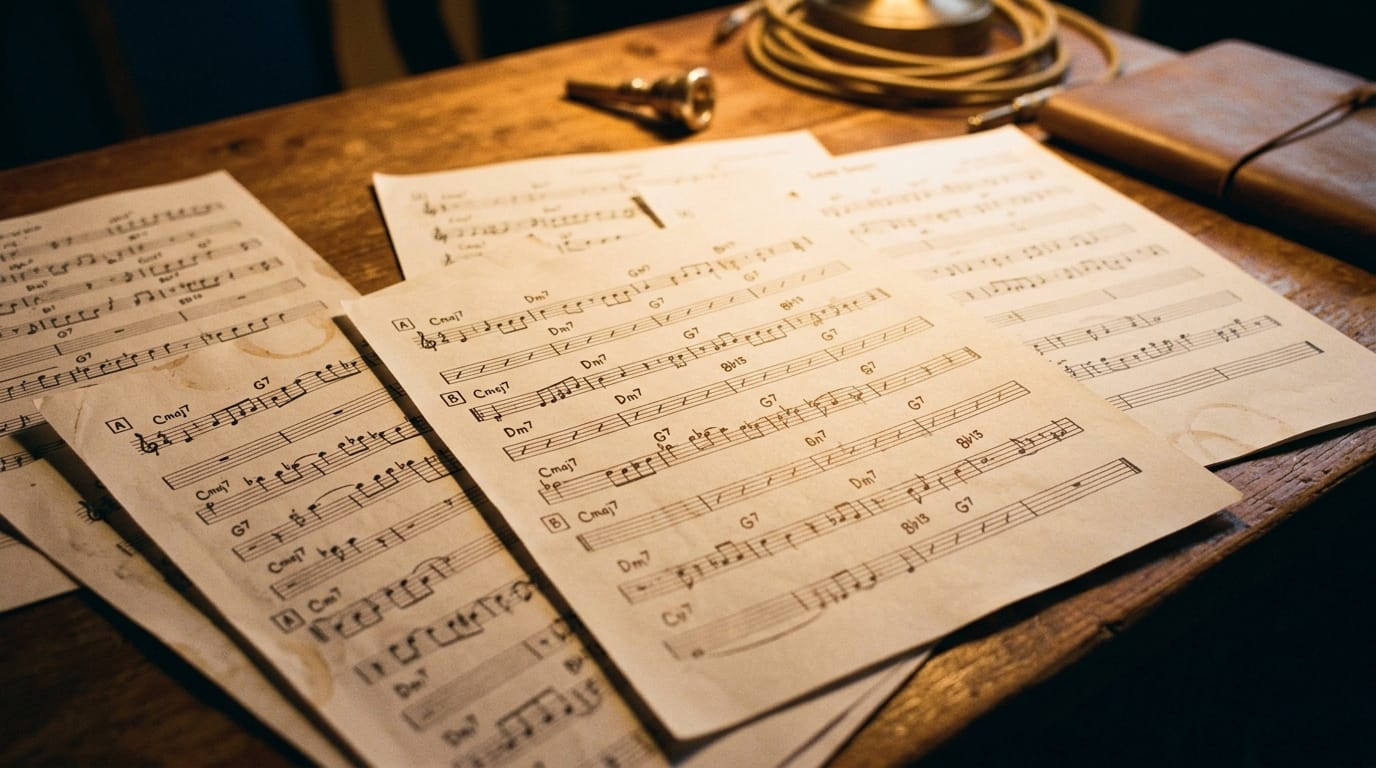
The ii-V-I progression is the engine of jazz harmony. In C major, it runs Dm7 (the ii chord) to G7 (the V chord) to Cmaj7 (the I chord). The ii chord creates mild tension; the V chord intensifies it; the I chord resolves it. This three-chord sequence appears in some form in the vast majority of jazz standards, “Autumn Leaves,” “All the Things You Are,” and “There Will Never Be Another You” are built almost entirely from ii-V-I chains in various keys. Voice leading is the art of moving from one chord to the next with minimal motion: the third of G7 (B) becomes the seventh of Cmaj7 (also B), while the seventh of G7 (F) moves down a half step to the third of Cmaj7 (E). That smooth, half-step motion is what gives jazz piano its characteristic sense of harmonic inevitability. The turnaround, a ii-V-I at the end of a section that loops back to the top, is the device that keeps jazz standards in perpetual harmonic motion. Our complete guide to jazz chord progressions covers these patterns with practical examples.
Where to Find Jazz Piano Sheet Music
The Real Book (Hal Leonard, sixth edition) is the standard lead sheet collection for jazz musicians, containing over 400 jazz standards in a single volume. A lead sheet shows the melody, chord symbols, and form of a song without specifying exactly how to play it, the pianist fills in the voicings, comping patterns, and improvisational content. The iReal Pro app provides digital chord charts used by professional jazz musicians for practice and performance, allowing you to set any tempo and loop any section. For individual arrangement PDFs, Sheet Music Plus and Musicnotes.com carry a wide range of jazz piano sheet music at various difficulty levels. For public-domain ragtime and early jazz compositions, IMSLP offers free downloads of scores that are no longer under copyright, an excellent resource for exploring the stride and ragtime foundations of jazz piano pieces.
The Decline, Resilience, and Modern Reinvention of Jazz Piano
Jazz piano’s history isn’t a straight line upward. The 1970s brought commercial pressure that fractured the audience, the 1980s brought a neo-classical backlash, and the streaming era has created a new “jazz piano” category that has almost nothing to do with improvisation. Here’s how the tradition navigated each of those challenges.
The Commercial Pressure of the 1970s-1980s
Fusion’s electric turn fractured the jazz piano audience. Acoustic jazz piano record sales declined measurably through the mid-1970s as the Fender Rhodes and synthesizers dominated the market. The “smooth jazz” radio format, emerging in the late 1970s, commercialized jazz piano into a background-music genre, critics documented this shift in DownBeat’s editorial coverage throughout the 1980s, with considerable alarm. Bob James and Dave Grusin achieved commercial success during this period but were critically distanced from jazz’s improvisational core; their work prioritized accessibility over the harmonic and rhythmic complexity that defined the tradition. The shift wasn’t total, acoustic jazz piano never disappeared, but its cultural prestige took a significant hit. Wynton Marsalis’s neo-classical advocacy in the 1980s, insisting on acoustic instruments and bebop-rooted technique, helped restore acoustic jazz piano’s prestige and created a new generation of pianists committed to the tradition.
The Neo-Classic and Contemporary Renaissance
Brad Mehldau’s The Art of the Trio series (1996-2002) reestablished the acoustic piano trio as a vehicle for contemporary expression, incorporating rock harmonies and song structures, Radiohead, Nick Drake, without abandoning jazz’s improvisational core. Robert Glasper’s Black Radio (Blue Note, 2012), which won a Grammy Award for Best R&B Album, brought jazz piano vocabulary to R&B and hip-hop audiences who might never have sought it out otherwise. Hiromi Uehara, a graduate of Berklee College of Music, has released more than ten studio albums since her 2003 debut Another Mind, demonstrating a technical command that critics have compared to Oscar Peterson. Jazz piano education has also expanded significantly: Berklee Online, Juilliard, and the New School all grew their jazz piano curricula substantially after 2000, creating a pipeline of technically trained young pianists entering the tradition.
Jazz Piano in the Streaming Era
Here’s the thing about “jazz piano” on streaming platforms: the term now covers two almost entirely separate phenomena. The first is the improvisational tradition documented throughout this article. The second is an ambient, lo-fi adjacent category, slow tempos, minimal improvisation, soft dynamics, that generates enormous streaming numbers but has little connection to the bebop or post-bop tradition. Search intent for “jazz piano” splits sharply between listeners seeking the performance tradition and listeners seeking background music. Both are valid uses of the piano, but conflating them obscures what makes jazz piano historically significant: the real-time compositional act, the harmonic sophistication, and the conversation between musicians that no playlist algorithm can replicate. The streaming category addresses keywords like best piano jazz and piano jazz music in their ambient sense, but the tradition this article documents is something considerably more demanding and rewarding.
Frequently Asked Questions About Jazz Piano
What Is Jazz Piano?
Jazz piano is a performance practice in which a pianist applies jazz’s harmonic language (extended chords, altered voicings, tritone substitutions), rhythmic feel (swing, syncopation, comping), and improvisational philosophy (real-time melodic invention over chord changes) to the keyboard. It differs from classical piano in that the performer invents rather than interprets, the score, if one exists at all, is a starting point rather than a blueprint. It differs from pop piano in its use of extended harmony, formal structures like the 12-bar blues and 32-bar AABA form, and the expectation of improvisation. Jazz piano emerged from ragtime and blues around the turn of the 20th century and has evolved continuously through stride, bebop, modal, fusion, and contemporary styles.
Who Is the Most Famous Jazz Pianist?
There’s no single defensible answer, and let’s be honest, the question depends on what you mean by “famous.” Art Tatum set the technical ceiling and influenced every pianist who followed. Duke Ellington had the broadest cultural impact of any jazz pianist, though he’s better known as a composer and bandleader. Bill Evans had the deepest influence on modern jazz piano’s harmonic language. Oscar Peterson had the largest recorded output, with more than 200 albums and seven competitive Grammy Awards plus a Grammy Lifetime Achievement Award. DownBeat’s historical polls have consistently placed Tatum, Evans, and Peterson at the top of critical rankings. Any of the four is a defensible answer to the question of who the most famous jazz piano player is.
Is Jazz Piano the Hardest Style of Piano to Learn?
It depends on which dimension of difficulty you’re measuring. The technical demands of bebop piano, Art Tatum’s stride runs, Bud Powell’s right-hand lines at 300 BPM, are comparable to the most demanding classical repertoire. But the conceptual challenge is arguably steeper: jazz piano requires real-time harmonic improvisation, a skill that classical training doesn’t develop. Classical piano demands interpretive precision within a fixed text; jazz piano demands the ability to compose fluently in the moment. Most jazz educators, including those at Berklee and Juilliard, identify jazz improvisation as the steeper learning curve for pianists trained in the classical tradition. The good news is that the foundational theory, scales, ii-V-I progressions, basic voicings, is accessible to any pianist with a few months of focused study.
What Are the Most Famous Jazz Piano Songs?
“Round Midnight” by Thelonious Monk is documented in multiple jazz encyclopedias as the most-recorded jazz composition by a pianist. “Autumn Leaves” is the most-recorded jazz standard with piano as the lead instrument in trio settings. “So What” from Miles Davis’s Kind of Blue opens with a piano introduction by Bill Evans that is one of the most recognizable passages in jazz history, a slow, hymn-like statement that sets the modal concept before the horns enter. “Misty” by Erroll Garner and “Lush Life” by Billy Strayhorn round out the most-performed jazz piano standards in live settings. For a broader list, our feature on the greatest jazz songs of all time covers the full repertoire.
Where Can I Learn Jazz Piano Online?
For structured courses, Berklee Online and the Juilliard Extension program both offer jazz piano curricula taught by working professionals. The NYC Jazz Workshop provides intensive online instruction for intermediate and advanced players. For free resources, Adam Neely’s YouTube channel covers jazz theory and piano concepts in accessible, well-produced videos. PianoTV offers free beginner-level jazz piano lessons. For practice tools, iReal Pro provides professional-grade chord charts and backing tracks, while Transcribe! software slows down recordings without changing pitch, the standard tool for learning solos by ear. Mark Levine’s The Jazz Piano Book (Sher Music, 1989) remains the universal academic standard for self-study, covering scales, voicings, and jazz standards piano in systematic detail.
Unique Angles: Geography, Classical Crossover, and Women in Jazz Piano
Three dimensions of jazz piano history are consistently underrepresented in general overviews. Each one adds context that changes how you hear the music.
The Physical Geography of Jazz Piano, A City-by-City Map
Jazz piano didn’t develop in one place. New Orleans gave it its earliest social context, the brothels and saloons of Storyville, where pianists like Jelly Roll Morton developed the blues-inflected style that would feed into jazz. Sedalia, Missouri, and then St. Louis were Scott Joplin’s bases, making the Midwest the center of ragtime’s commercial development. New York’s Harlem became the crucible of stride piano in the 1920s and bebop in the 1940s, with Minton’s Playhouse as the key laboratory. Chicago developed its own boogie-woogie piano tradition through Albert Ammons and Pete Johnson, a blues-heavy, rhythmically driving style distinct from Harlem’s stride. Los Angeles anchored the West Coast cool scene around Dave Brubeck and his quartet. And Cologne, Germany, gave Keith Jarrett the venue for The Köln Concert, while ECM Records in Munich became the home of European jazz piano’s most significant recordings, a reminder that jazz piano’s geography eventually became global.
Jazz Piano and Classical Music, The Cross-Pollination
The relationship between jazz piano and European classical music runs deeper than most listeners realize. Bill Evans studied Ravel’s chord voicings directly, and the floating, pedal-heavy quality of his playing reflects Ravel’s impressionist harmonic language more than any jazz predecessor. Thelonious Monk’s angular melodic leaps and rhythmic displacement echo Stravinsky’s rhythmic complexity, not as a direct influence but as a parallel development of similar ideas. Keith Jarrett performed both Bach’s Goldberg Variations and fully improvised solo concerts, documented across his ECM discography, treating the two practices as complementary rather than contradictory. The majority of post-1970 jazz pianists trained classically before transitioning to jazz, a structural feature of the genre’s development that explains both its technical sophistication and its ongoing dialogue with the Western concert tradition.
Women in Jazz Piano, A Corrective History
Let’s be honest: most jazz piano histories treat women as footnotes. That’s a distortion. Mary Lou Williams, profiled above, was not a peripheral figure, she was a central architect of bebop who happened to be female in a male-dominated industry. Marian McPartland hosted Piano Jazz on NPR from 1978 to 2011, producing more than 700 episodes and making it the longest-running jazz program in NPR history, a verifiable landmark that introduced jazz piano to millions of listeners who would never have sought it out otherwise. Geri Allen, who died in 2017, brought a rigorous post-bop sensibility to her work that earned her recognition as one of the most important pianists of her generation. Hiromi Uehara, a Grammy Award winner as part of the Stanley Clarke Band, has built one of the most technically demanding and commercially successful careers in contemporary jazz piano. The history of women in jazz extends well beyond vocalists, the piano has always had its own parallel tradition of female innovators.
Jazz piano’s story isn’t finished. Sullivan Fortner, a multiple Grammy Award winner, is extending the post-bop tradition with a harmonic sophistication that draws on everything from Monk to Evans. Vijay Iyer continues to push the rhythmic boundaries of what jazz piano can absorb. And the next generation of players, many of them trained in the expanded jazz curricula that Berklee, Juilliard, and the New School built after 2000, will inevitably find new ways to make the instrument’s 88 keys say something that hasn’t been said before. Start with Art Tatum’s “Tiger Rag,” work your way through Bill Evans’s Sunday at the Village Vanguard, and let Keith Jarrett’s Köln Concert show you what total improvisational commitment sounds like. The rest will follow.